
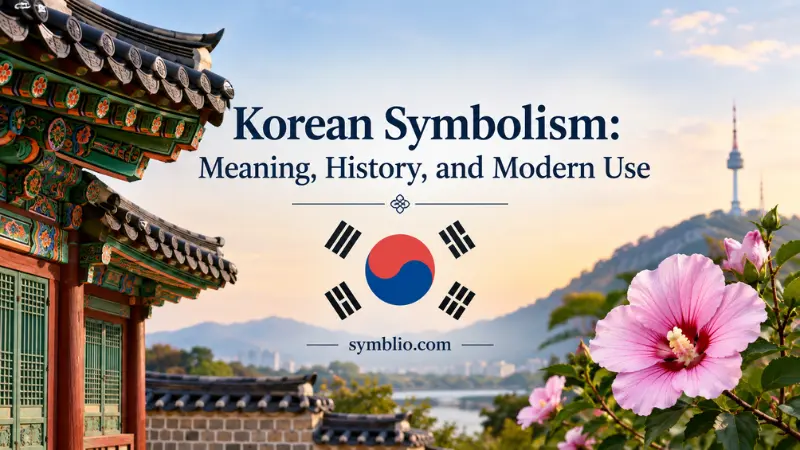
Korean symbolism encompasses a wide range of images, colors, patterns, animals, plants, clothing, and objects that carry cultural meanings in Korea. Korean symbolism is especially associated with harmony, balance, nature, longevity, prosperity, family, identity, and the relationship between opposing forces.
For many Americans, Korean symbols first appear through Korean food, hanbok, K-pop, Korean dramas, traditional architecture, tattoos, art, or the Korean flag. Some meanings are immediately recognizable, while others come from older philosophical and religious traditions that are less familiar outside Korea.
Understanding these symbols requires some historical context. Korean visual culture developed through a mixture of indigenous traditions and influences from Buddhism, Confucianism, Daoism, and broader East Asian philosophies. Meanings also changed according to the period, social setting, and purpose of a particular design.
Quick Answer
Korean symbolism commonly represents harmony, balance, nature, longevity, prosperity, and cultural identity in modern American culture, especially through the Korean flag, hanbok, traditional colors, flowers, animals, and decorative patterns. Historically, these symbols were also connected with yin-yang philosophy, the Five Elements, Buddhism, Confucian values, royal traditions, and wishes for health and good fortune.
TL;DR
- Korean symbols often emphasize balance between complementary forces.
- The Taegeuk represents harmony between yin and yang.
- Five traditional colors connect nature, directions, and elements.
- Cranes, turtles, flowers, and mountains often express longevity or prosperity.
- Hanbok patterns can communicate wishes, status, and occasion.
- Modern Americans often encounter Korean symbols through K-culture and design.
What Korean Symbols Look Like in Traditional Culture
There is no single image that represents all of Korean symbolism. Instead, Korean culture has developed a visual vocabulary made up of colors, animals, plants, geometric patterns, landscapes, clothing, architecture, and objects.
Some of the most recognizable examples include the red-and-blue Taegeuk found on the South Korean flag, the four black trigrams surrounding it, the five traditional colors known as obangsaek, and decorative motifs used on hanbok and traditional buildings.
Natural imagery is particularly important. Mountains, clouds, water, pine trees, cranes, turtles, deer, flowers, and birds appear repeatedly in traditional artwork. These images were not chosen simply because they were attractive. Many were associated with particular hopes, virtues, social positions, or ideas about the natural world.
The same motif can also carry different meanings depending on its placement and context. A crane embroidered on traditional clothing, for example, does not necessarily communicate exactly the same message as a crane appearing in a painting or contemporary tattoo.
The Taegeuk and the Idea of Balance
The Taegeuk is one of the most recognizable Korean symbols. It appears prominently in the center of the South Korean flag, known as the Taegeukgi.
Its red and blue halves represent the interaction of complementary forces traditionally understood through yin and yang. Rather than treating opposing forces as simply good and bad, the concept emphasizes their relationship and mutual influence.
This makes balance one of the central ideas associated with Korean visual culture.
The Taegeuk is not merely a decorative spiral. In the context of the national flag, it connects Korean national identity with an older philosophical understanding of the universe. The four trigrams surrounding it further connect the design with heaven, earth, water, and fire.
For Americans encountering the symbol today, the Taegeuk can therefore communicate several ideas at once: Korea itself, cultural heritage, balance, harmony, and national identity.
The Five Traditional Colors and Their Meanings
Color has an unusually important place in traditional Korean symbolism. The five directional colors, commonly called obangsaek, are blue or green, red, yellow, white, and black.
They are associated with the Five Elements and the four directions plus the center. Traditional interpretations connect them with wood, fire, earth, metal, and water.
| Color | Traditional Association | Common Symbolic Ideas |
|---|---|---|
| Blue/Green | East, wood | Spring, growth, renewal |
| Red | South, fire | Energy, protection, vitality |
| Yellow | Center, earth | Authority, prosperity, stability |
| White | West, metal | Purity, simplicity, integrity |
| Black | North, water | Wisdom, depth, winter |
These associations appear in clothing, architecture, food presentation, crafts, painting, and ceremonial objects.
The colors should not be treated as a universal five-part code that gives every Korean object the same meaning. Their interpretation depends on historical period and context. Still, the system demonstrates an important feature of Korean traditional aesthetics: color can connect an everyday object with broader ideas about nature and balance.
Why White Became Important in Korean Culture
White has a particularly interesting place in Korean history.
Ordinary Koreans historically wore white clothing extensively, contributing to the expression sometimes translated as “white-clad people.” White clothing could communicate simplicity, modesty, and purity, although its meaning was also connected with practical clothing traditions and historical circumstances.
The preference for white became culturally significant enough that authorities at different points attempted to regulate or discourage its use. Ordinary people nevertheless continued wearing white garments.
In modern American discussions of Korean culture, white is sometimes reduced to a simple symbol of purity. The historical picture is more complicated. Its importance developed through everyday life, clothing customs, aesthetics, identity, and changing political circumstances.
Hanbok and Symbolism Through Clothing
Hanbok is more than a traditional Korean costume. Historically, its colors, materials, decorative patterns, and construction could communicate information about the wearer and the occasion.
Certain colors and motifs were associated with age, marital status, social position, celebrations, or court life. Traditional children’s clothing could feature brightly colored striped sleeves known as saekdong, while wedding clothing often incorporated auspicious colors and designs.
Decorative motifs also carried messages. Cranes were associated with longevity and nobility, peonies with prosperity, lotus flowers with purity, and clouds with heavenly or divine associations.
This makes traditional Korean clothing an example of symbolism working through several layers simultaneously. The garment could be beautiful, socially informative, ceremonial, and symbolic at the same time.
Today, hanbok appears in Korean festivals, weddings, historical dramas, tourism, fashion photography, cultural events, and international Korean cultural showcases.
Animals as Symbols of Longevity, Status, and Protection
Animals frequently appear in Korean traditional art.
The crane is one of the best-known examples. It has long been associated with longevity and high status. During the Joseon period, cranes appeared on official rank badges for civil officials, making the bird a visual marker of both longevity and bureaucratic status.
The tiger has a different character. It appears in Korean folklore and visual art as a formidable animal associated with strength and protection. Korean folk paintings sometimes portray the tiger in humorous or unusual ways rather than presenting it solely as a fearsome creature.
The turtle is another traditional longevity symbol. Because turtles live for a long time and were associated with endurance, they became part of artistic traditions expressing wishes for a long life.
The deer can also appear in auspicious imagery, particularly in designs associated with longevity and good fortune.
These animals show why context matters. A tiger in a traditional folk painting may communicate something different from a tiger in a modern tattoo inspired by Korean imagery.
Flowers and Plants in Korean Symbolism
Plants often carry symbolic meanings related to character, beauty, prosperity, or long life.
The mugunghwa, or Rose of Sharon, is the national flower of South Korea. Its Korean name is associated with the idea of flourishing or enduring repeatedly, which contributes to its association with persistence and national identity.
The lotus has strong Buddhist associations across East Asia and appears in Korean religious art. Because the flower rises from muddy water while producing a clean blossom, it became associated with purity and spiritual development.
The peony has traditionally represented wealth, prosperity, beauty, and abundance. It appears frequently in decorative art and traditional clothing.
The plum blossom has been associated with resilience and integrity because it can bloom during cold conditions. In literary and artistic traditions, it became connected with qualities such as endurance and refined character.
Pine trees also appear in Korean art and symbolism, particularly in contexts involving longevity and steadfastness.
Nature and the Korean Landscape
Korean symbolism often treats nature as something to live with rather than merely something to dominate.
Mountains are particularly prominent because of Korea’s mountainous landscape and their importance in traditional landscape painting, spirituality, geography, and geomantic thought.
Traditional Korean landscape art does not always attempt to reproduce nature as a literal photograph. Mountains, water, clouds, trees, and empty space can be arranged to express relationships between humans and the natural world.
This helps explain why landscapes in Korean art can feel symbolic even when they contain no obvious religious figure or mythological creature.
The relationship between mountains, water, buildings, and human activity has also influenced traditional approaches to architecture and the placement of homes and important structures.
Religious and Philosophical Influences
Korean symbolism developed from several intellectual and religious traditions rather than one single belief system.
Buddhism contributed symbols such as the lotus, Buddhist architecture, temple decoration, and imagery connected with spiritual liberation.
Confucianism strongly influenced Korean society, especially during the Joseon period. Values involving family relationships, education, social responsibility, respect for elders, and proper conduct became important parts of Korean cultural life.
Daoist and broader East Asian philosophical traditions contributed concepts involving yin and yang, natural forces, balance, and the Five Elements.
Korean folk traditions also contributed local beliefs involving protective animals, household customs, spirits, seasonal practices, and auspicious objects.
These traditions sometimes overlap. A single object or pattern can therefore have multiple layers of meaning rather than belonging neatly to one religious category.
Korean Symbolism in the United States
Americans commonly encounter Korean symbolism through Korean American communities and the global popularity of Korean culture.
The Korean flag is perhaps the clearest example. Korean American organizations, cultural festivals, restaurants, museums, schools, community events, and diplomatic occasions may use the Taegeukgi as a straightforward marker of Korean heritage.
Hanbok has also become more visible outside Korea through weddings, cultural festivals, museum programs, photography, and Korean entertainment.
K-pop and Korean television have introduced international audiences to traditional clothing, architecture, food, colors, and historical imagery. Contemporary artists may combine these elements with Western fashion, graphic design, illustration, or tattoo styles.
For Korean Americans, however, these symbols can carry meanings beyond what an outside observer sees. They can represent family heritage, language, migration, childhood memories, ancestry, or a connection to Korean history.
That personal dimension is important. A symbol does not have to carry exactly the same meaning for every person who uses it.
How Korean Symbols Appear in Modern Design
Traditional Korean visual elements have become increasingly visible in contemporary design.
Graphic designers may use the Taegeuk, traditional color combinations, cloud patterns, geometric motifs, or simplified hanok-inspired forms. Fashion designers sometimes reinterpret hanbok silhouettes rather than reproducing historical clothing exactly.
Dancheong, the colorful decorative painting traditionally found on wooden architecture, is another major source of visual inspiration. Its repeated patterns and vivid colors can now appear in artwork, fashion, illustration, accessories, and tattoos.
Modern reinterpretation does not necessarily erase traditional meaning. Sometimes artists deliberately preserve a connection to Korean heritage. In other cases, a traditional motif is used primarily for its visual qualities.
The difference matters when interpreting contemporary work.
Tattoos, Jewelry, and Personal Identity
Korean-inspired symbolism can also appear in tattoos and personal accessories.
Someone might choose a Taegeuk design to represent Korean heritage, family background, balance, or a personal connection to Korea. A crane may be selected for longevity, while a tiger can represent strength or cultural folklore.
Traditional flowers can provide another route into personal symbolism. A lotus may reflect Buddhist imagery or ideas about purity and growth, while a mugunghwa can communicate a direct connection with Korean national identity.
Modern tattoos often combine several motifs. A person might place a traditional flower alongside Korean lettering, a landscape, or a geometric pattern.
Because tattoo symbolism is personal, it is best not to assume that every Korean-inspired tattoo has one fixed interpretation.
Korean Symbolism in Food and Everyday Life
Traditional symbolism is not limited to art and clothing.
The five-color system has influenced Korean food presentation, with different natural ingredients providing contrasting colors. The visual balance of a meal can therefore have aesthetic and cultural significance beyond simple decoration.
Traditional foods and ceremonies can also involve ideas about harmony, health, seasonal change, family, and good fortune.
This demonstrates a broader principle of Korean symbolism: meaning often enters ordinary life through arrangement, color, timing, ingredients, clothing, and ritual rather than appearing only in explicitly religious objects.
Longevity, Prosperity, and Wishes for Good Fortune
Many Korean decorative motifs are auspicious symbols. Their purpose is often to express a wish rather than to make a literal statement.
A crane can communicate a wish for long life. A peony can express hopes for prosperity. Certain combinations of animals, plants, clouds, stones, and other natural forms can create larger compositions centered on health, longevity, wealth, or happiness.
The traditional “Ten Symbols of Longevity” are a well-known example. They include natural and animal motifs such as the sun, mountains, water, clouds, pine trees, cranes, turtles, deer, and other elements associated with long life.
Such designs could appear on screens, paintings, clothing, furniture, and household objects.
Common Misunderstandings About Korean Symbols
One common mistake is treating every Korean symbol as if it had one universal definition.
Korean culture has changed dramatically across different historical periods. A motif used by a Joseon court official may have a very different context from the same animal appearing in a contemporary Korean illustration.
Another mistake is assuming that every Korean symbol is specifically religious. Many traditional motifs developed through a mixture of philosophy, folklore, social customs, court culture, aesthetics, and religious traditions.
It is also easy for Western audiences to assign familiar Western meanings to Korean imagery. A white garment, flower, animal, or color may have overlapping associations but does not necessarily carry the same cultural history.
Understanding the original context produces a more accurate interpretation.
How Korean Symbolism Has Changed Over Time
Korean symbolism has never been completely static.
Ancient kingdoms developed their own visual traditions. Buddhism became particularly influential during earlier periods, while Confucian values became highly influential during the Joseon dynasty. Court clothing, official badges, architecture, and decorative arts developed according to changing institutions and social structures.
The twentieth century brought colonization, war, division, rapid modernization, and major social changes. These events affected how national and cultural symbols were understood.
In the twenty-first century, Korean traditional imagery exists alongside contemporary fashion, digital art, film, K-pop, gaming, advertising, and global design.
As a result, an old symbol may now function in several ways: as historical heritage, national identity, personal expression, commercial design, or simply an attractive visual motif.
Why Korean Symbols Still Matter Today
Korean symbolism remains relevant because it provides a visual connection between past and present.
The continuing use of these symbols also shows that tradition and modernity are not necessarily opposites. A Taegeuk can appear on a national flag, a sports jersey, a graphic design, or a contemporary artwork while retaining recognizable connections to Korean history.
The meaning changes with the setting, but the historical associations remain part of the symbol’s cultural background.
FAQs
The Taegeuk is among the most recognizable symbols associated with South Korea. It appears at the center of the national flag and represents the interaction and harmony of yin and yang.
The Taegeukgi combines a red-and-blue Taegeuk, four black trigrams, and a white background. Together, these elements connect Korean national identity with ideas about balance, complementary forces, nature, and harmony.
Traditional Korean colors are connected with the Five Elements and the four directions plus the center. Blue or green, red, yellow, white, and black can represent different natural forces, directions, seasons, and philosophical concepts.
The crane is traditionally associated with longevity and nobility. During the Joseon period, crane motifs were used on rank badges for civil officials, giving the bird an additional connection with official status.
The tiger is strongly associated with strength and protection in Korean folklore and traditional art. Korean representations can also be humorous or playful, so its meaning depends on the specific artwork and historical context.
Yes, some Korean symbols have strong Buddhist connections, particularly the lotus and many temple-related images. However, Korean symbolism also includes Confucian, folk, philosophical, royal, and national traditions.
White has a long history in Korean clothing and cultural identity. It has been associated with simplicity, purity, and modesty, while its widespread historical use also reflects everyday clothing practices and broader ideas about Korean identity.
Conclusion
Korean symbolism brings together ideas about balance, nature, longevity, prosperity, identity, and human relationships with the natural world. Its visual language includes the Taegeuk, traditional colors, animals, flowers, landscapes, hanbok patterns, and architectural decoration, with each motif gaining meaning from its particular cultural setting.
Today, Korean symbolism can be encountered far beyond Korea through Korean American communities, fashion, entertainment, art, tattoos, food culture, and contemporary design. Some traditional meanings remain recognizable, while others have become more personal or have been reinterpreted for modern audiences.
The most useful way to understand these symbols is to look at both their historical context and their present-day use. A symbol can preserve an old cultural idea while taking on a new meaning in the hands of the person using it.


