
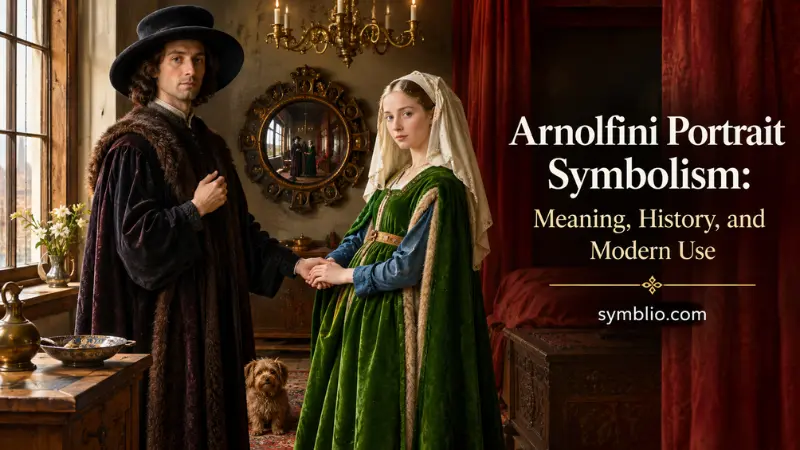
The Arnolfini Portrait symbolism comes from a remarkable combination of marriage, identity, wealth, religious imagery, domestic life, and artistic illusion. Painted by Jan van Eyck in 1434, the work shows a richly dressed couple standing inside what appears to be a prosperous household, surrounded by carefully rendered objects.
The painting has attracted attention because almost every visible detail invites interpretation. A small dog, a single burning candle, oranges, a convex mirror, clothing, gestures, and even the arrangement of the room have all been given possible meanings. Some interpretations are well supported by historical context, while others remain debated.
For modern American viewers, the painting can be especially interesting because it resembles a visual record of private life while also functioning as a portrait of status and identity. It raises familiar questions about marriage, home, wealth, memory, and how people choose to present themselves.
Quick Answer
Arnolfini Portrait symbolism commonly represents marriage, domestic identity, prosperity, fidelity, and religious awareness in modern American interpretations. Historically, its objects and gestures have also been connected with wealth, Christian devotion, mortality, social status, and the couple’s public presentation of themselves.
TL;DR
- The painting dates to 1434 and was created by Jan van Eyck.
- It probably depicts Giovanni Arnolfini and a woman associated with him.
- The dog is commonly connected with fidelity and domestic companionship.
- Oranges and luxurious furnishings emphasize prosperity and social position.
- The mirror combines observation, religion, illusion, and artistic presence.
- Modern viewers often read the work through marriage and personal identity.
What the Arnolfini Portrait Actually Shows
The painting presents a man and woman standing inside an elegantly furnished room. The man wears dark clothing with a fur-trimmed garment, while the woman wears a large green dress with elaborate folds and a fur-lined outer garment.
A small dog stands between them. A chandelier hangs overhead with one candle burning. An ornate convex mirror occupies the wall behind the figures, surrounded by tiny scenes depicting episodes from the Passion of Christ.
Fruit sits near the window, while expensive-looking household objects fill the room. The scene includes a bed, furniture, textiles, clothing, wooden flooring, and carefully painted architectural details.
The work is relatively small, measuring about 82 by 60 centimeters, but van Eyck gives its interior an extraordinary sense of material detail.
The people are generally identified as Giovanni di Nicolao Arnolfini, an Italian merchant active in Bruges, and a woman who is probably his wife. Her exact identity remains uncertain.
That uncertainty matters. The painting does not provide a simple written explanation of what event is taking place.
Why the Painting Is So Symbolically Dense
Van Eyck lived in a culture where religious ideas, social reputation, family connections, material wealth, and personal remembrance were closely connected.
Portraits were not simply private photographs in the modern sense. Commissioning an image could communicate social position and preserve someone’s appearance for future generations.
At the same time, the objects in the painting were real things that could communicate information without necessarily functioning as coded symbols.
This distinction is important.
An orange can demonstrate wealth because oranges were expensive in northern Europe. A luxurious bed can demonstrate status because such furnishings were costly. A carefully rendered garment can show the resources required to own fine clothing.
Not every object therefore needs to have a hidden symbolic meaning.
The painting’s fascination comes partly from this mixture of ordinary material evidence and possible symbolic references.
Marriage and Partnership in the Painting
Marriage is one of the most common ways people interpret the scene.
The couple stand together in an intimate domestic setting, and their positioning naturally encourages viewers to think about partnership and household life. The man’s raised hand has sometimes been interpreted as a ceremonial gesture, while their joined or approaching hands have encouraged theories about marriage or commitment.
For centuries, viewers and scholars have debated whether the painting records an actual marriage ceremony, a betrothal, or simply a portrait of a married couple.
A famous twentieth-century interpretation proposed that the painting represented a wedding ceremony and that the artist acted as a witness. That theory influenced generations of discussion, but later scholarship has challenged several of its assumptions.
The safest interpretation is that marriage and partnership are relevant themes without claiming that the painting definitively documents a wedding ceremony.
The Dog and the Idea of Fidelity
The little dog is one of the easiest details to connect with symbolism.
Dogs had long associations with loyalty and fidelity in European visual culture. In this setting, the animal can reasonably encourage an interpretation involving faithfulness between partners.
It also has a simpler explanation: the dog is a household pet.
These interpretations do not necessarily conflict. A pet can contribute to the atmosphere of domestic life while also carrying associations familiar to contemporary viewers.
This is a useful lesson for interpreting symbolic art. An object can have an ordinary function and still contribute to the larger meaning of a scene.
In modern American culture, a dog appearing in a portrait of a couple would often suggest companionship, home life, and attachment even without a formal symbolic tradition behind it.
What the Oranges Say About Wealth
The oranges near the window and on the furniture are small but important details.
In fifteenth-century northern Europe, oranges were costly imported fruits. Their presence therefore helps establish the couple’s prosperity.
For contemporary Americans, this detail can be easy to miss because oranges are ordinary grocery-store items. Their symbolic effect changes when we understand their historical economic value.
Rather than simply representing happiness or abundance, the fruit can be read more concretely as evidence of access to expensive goods.
The painting repeatedly makes this point through material objects. Fine clothing, furnishings, metalwork, fruit, and other possessions create an image of a household with considerable resources.
Symbolic Meanings at a Glance
| Detail | Common Interpretation | Historical Context | Modern Reading |
|---|---|---|---|
| Dog | Fidelity and companionship | Household pet with established associations | Loyalty and partnership |
| Oranges | Prosperity and luxury | Expensive imported fruit | Abundance and status |
| Mirror | Reflection, observation, religious thought | Unusual convex mirror with Passion scenes | Self-awareness and identity |
| Single candle | Possible religious or commemorative associations | Candle appears in a Christian household | Faith, remembrance, or intimacy |
| Fine clothing | Wealth and social position | Costly textiles and fur | Status and personal presentation |
The Mirror as a Symbol of Reflection and Presence
The convex mirror is arguably the most important visual feature in the painting.
It reflects the backs of the couple and shows two additional figures in the doorway. Tiny scenes from the Passion of Christ surround its frame.
The mirror therefore expands the physical space of the painting. We see something that the couple themselves cannot see from their position.
This creates several possible meanings.
It can suggest observation, memory, and the relationship between appearance and reality. It also reminds viewers that the painting is itself an artificial construction. Van Eyck is showing us a room while simultaneously reminding us that we are looking at an image created by an artist.
The inscription above the mirror reads, in Latin, that Jan van Eyck “was here” in 1434. The unusual placement makes the artist’s presence part of the composition.
Rather than simply disappearing behind the portrait, van Eyck makes viewers aware of the person who created the image.
For modern viewers, the mirror can therefore represent more than physical reflection. It raises questions about who is watching, who is being represented, and how identity is constructed through images.
The Christian Imagery Around the Mirror
The mirror is surrounded by small circular scenes depicting episodes from the Passion of Christ.
These images place the domestic scene within a Christian visual environment. They introduce themes of suffering, death, sacrifice, salvation, and religious devotion.
The contrast is striking.
The central figures appear prosperous and secure, surrounded by valuable possessions. Yet the religious scenes around the mirror remind viewers of mortality and spiritual concerns.
This does not mean that every object in the room has a single religious code attached to it. Instead, the painting combines worldly life with Christian imagery in a way that would have been familiar to its original audience.
For modern Americans, the religious dimension may be less immediately obvious because many viewers encounter the painting primarily as an art-history masterpiece rather than as a product of fifteenth-century Christian culture.
The Candle and Questions of Life and Death
Only one candle appears to be burning in the chandelier.
The single flame has encouraged several interpretations, including ideas about divine presence, remembrance, marriage, or mortality. Some traditional readings have connected the extinguished candle on the other side with death.
These interpretations should be treated cautiously.
The National Gallery’s detailed research has questioned the assumption that every apparently symbolic object was deliberately planned as a fixed code. Some features may have developed during the painting process rather than being part of a predetermined symbolic program.
The candle remains visually striking, but its precise intended meaning cannot be established with certainty.
That uncertainty is part of what makes the painting interesting rather than a flaw that needs to be solved.
Clothing, Fashion, and Social Status
The couple’s clothing provides some of the clearest evidence of social position.
Their garments use expensive-looking materials, elaborate construction, and substantial amounts of fabric. The woman’s green dress is particularly visually prominent.
Modern viewers sometimes assume that the woman is pregnant because of the shape of her clothing. That interpretation became popular, but the appearance does not establish pregnancy.
Large, gathered clothing was fashionable at the time, and the pose and folds of the garment contribute to the impression.
The clothing is therefore more securely understood as evidence of wealth and fashion than as proof of pregnancy.
This distinction matters because modern expectations can easily change how historical clothing is interpreted.
The Room as a Picture of Prosperity
The interior itself contributes to the painting’s meaning.
The bed, chandelier, textiles, furniture, fruit, clothing, and other objects create an environment that communicates financial success.
The room is not simply a neutral background. It functions almost like a carefully arranged statement about the couple.
For an American audience today, this has a familiar parallel. People often communicate identity through homes, clothing, furniture, cars, travel photographs, and other possessions.
The difference is that the Arnolfini couple’s portrait predates modern advertising and social media by centuries. Their portrait nevertheless demonstrates a similar human tendency: material surroundings can become part of how people present themselves to others.
How Americans Commonly Understand the Painting Today
In the United States, people generally encounter the Arnolfini Portrait through museums, art-history courses, textbooks, documentaries, and online educational content.
Its symbolism is often discussed through several overlapping themes:
- marriage and partnership
- wealth and social status
- domestic identity
- religious belief
- fidelity
- mortality
- artistic realism
- reflection and observation
American audiences may also approach the work through contemporary ideas about personal branding and visual identity.
A modern portrait can communicate someone’s lifestyle through clothing, location, possessions, and body language. The Arnolfini Portrait does something comparable within the social conventions of fifteenth-century Europe.
The painting can therefore feel surprisingly contemporary even though its cultural context is very different.
Emotional and Psychological Meaning
The emotional effect of the painting comes partly from its restraint.
The couple do not display exaggerated affection. Instead, they stand quietly in an ordered interior while the viewer examines their surroundings.
That restraint can create impressions of seriousness, privacy, formality, and permanence.
The mirror adds another psychological dimension. It makes the viewer aware that someone else may be observing the scene, while the artist’s inscription makes his own presence impossible to ignore.
The result is a portrait about more than two people. It becomes a meditation on how people are seen by others.
In psychological terms, the painting can be read through ideas of self-presentation, social identity, privacy, and remembrance. These are not exclusive to medieval or Renaissance society. They remain recognizable aspects of modern life.
What the Painting Says About Identity
One of the most interesting aspects of the work is its attention to individual identity.
Van Eyck does not present anonymous symbolic figures. He gives the people recognizable faces, clothing, possessions, and surroundings.
The inscription also identifies the artist’s presence.
The mirror introduces additional people into the scene, making the painting feel like a moment involving several individuals rather than a simple isolated portrait.
This creates a layered idea of identity:
the couple are represented, the artist is represented through his presence, and the viewer becomes part of the act of looking.
That structure helps explain why the painting remains relevant in discussions about portraiture and visual culture.
Common Misunderstandings About the Arnolfini Portrait
Several popular interpretations have become so familiar that they are sometimes treated as established facts.
The idea that the woman is definitely pregnant is one example. Her clothing reflects contemporary fashion and does not prove pregnancy.
Another common claim is that the painting unquestionably records a wedding ceremony. Scholars have debated this interpretation, and the available evidence does not make that conclusion certain.
The belief that every object is a carefully encoded symbol is also too simple. Research into the painting’s underdrawing and changes made during its creation suggests that some details traditionally given symbolic interpretations may not have been planned as such.
The best approach is to distinguish between reasonable interpretation and historical certainty.
How the Meaning Has Changed Over Time
The painting’s interpretation has never been completely fixed.
Earlier viewers encountered it in very different circumstances from today’s museum visitors. Its original setting, ownership, and social purpose shaped how it was understood.
By the nineteenth and twentieth centuries, scholars developed increasingly elaborate explanations for the objects and gestures.
Some interpretations became extremely influential even though later research questioned parts of them.
Today, the painting is often appreciated on several levels at once. It can be viewed as a portrait, a record of merchant prosperity, a demonstration of oil-painting technique, a Christian-inflected domestic image, and an exploration of artistic illusion.
That evolution is itself significant. The meaning of an artwork can change because later audiences bring new questions to an old image.
Why the Arnolfini Portrait Still Matters
The painting remains relevant because its central concerns are not limited to fifteenth-century Bruges.
People still use clothing to communicate status. Homes still communicate lifestyle. Couples still create portraits to preserve memories. Religious beliefs still influence visual culture. Mirrors still raise questions about self-image and observation.
At the same time, the painting reminds modern viewers not to assume that historical images work exactly like contemporary photographs.
Its symbols belong to a particular culture, economy, religion, and artistic tradition.
That combination makes the Arnolfini Portrait especially useful for understanding how visual symbolism works: meaning comes from both the object itself and the cultural context in which people see it.
FAQs
The painting is commonly associated with marriage, partnership, prosperity, fidelity, Christian belief, and social identity. Some individual details have additional proposed meanings, but several traditional interpretations remain debated.
It may relate to marriage or a marital relationship, but there is no definitive evidence that it records a wedding ceremony. Earlier scholars proposed a wedding interpretation, while later research has challenged some of the evidence used to support it.
The dog is often interpreted as a symbol of fidelity because dogs had associations with loyalty in European art. It is also clearly a domestic pet, so its role does not have to be exclusively symbolic.
Oranges help communicate the couple’s prosperity because imported oranges were expensive in fifteenth-century northern Europe. Their presence can therefore be understood as evidence of access to luxury goods.
The convex mirror expands the scene by reflecting the couple and figures standing outside their immediate space. It can also encourage ideas about observation, identity, religious reflection, and the relationship between reality and artistic representation.
Her clothing creates that impression to modern viewers, but the painting does not establish that she was pregnant. The large, gathered garment reflects the fashions of the period.
The inscription identifies the artist’s presence in the scene and dates the painting to 1434. Its unusual placement also draws attention to the fact that the seemingly realistic world is an artwork constructed by van Eyck.
Conclusion
The Arnolfini Portrait symbolism is best understood as a combination of domestic life, social status, partnership, Christian imagery, personal identity, and artistic illusion rather than as a single hidden code. Some details have recognizable historical associations, while others remain open to interpretation.
For modern American viewers, the painting offers an especially useful reminder that people have long communicated identity through their homes, clothing, possessions, relationships, and portraits. Van Eyck transformed those ordinary elements into a carefully constructed image that still invites viewers to ask what is being shown, what is being implied, and what remains unknowable.


