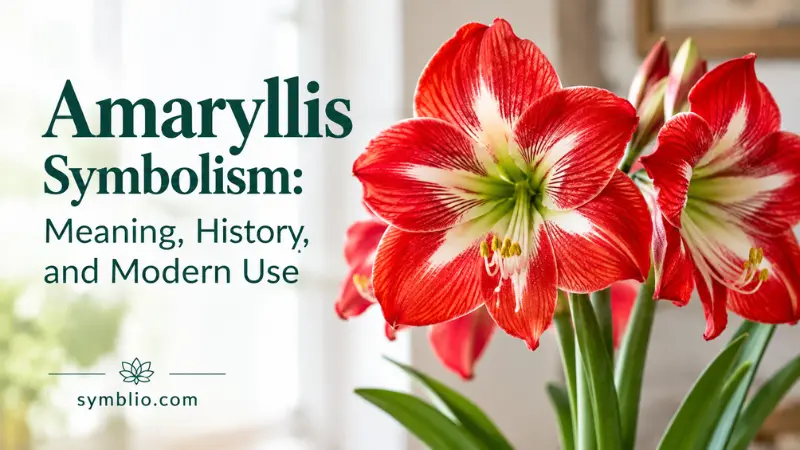
Amaryllis symbolism often centers on pride, confidence, beauty, determination, and a striking presence. The flower’s tall stems and large trumpet-shaped blooms make it especially noticeable, while its association with winter gift-giving has given it a familiar place in American homes.
The name also has a long literary history. Amaryllis appears as a female character in ancient Greek and Roman pastoral poetry, while the plant now commonly sold as “amaryllis” in the United States is usually a Hippeastrum, a South American bulb rather than the true Amaryllis genus. That botanical distinction matters because the flower’s modern symbolism developed from several overlapping traditions rather than from one single ancient meaning.
Quick Answer
In modern American culture, amaryllis symbolism commonly represents pride, confidence, beauty, determination, and a bold personal presence, especially when the flower is given as a gift or displayed during the winter holidays. Historically, its name connects it with a literary shepherdess and ideas of beauty and radiance, while Victorian flower language associated amaryllis with qualities such as self-reflection and pride.
TL;DR
- Amaryllis commonly represents pride, confidence, beauty, and determination.
- Its name comes from a woman in ancient pastoral poetry.
- Victorian flower language gave amaryllis a more specific symbolic vocabulary.
- Americans often associate it with Christmas and winter gift-giving.
- Red, white, and pink flowers can create different emotional impressions.
- Modern symbolism emphasizes resilience, celebration, and visible personal expression.
What the Amaryllis Flower Looks Like
The flower commonly called amaryllis in the United States has an unmistakable appearance. A tall, sturdy stalk rises from a large bulb and produces several large, trumpet-shaped flowers near the top. Depending on the cultivar, the blooms may be red, white, pink, orange, salmon, green, striped, or combinations of several colors.
The familiar holiday plant is generally Hippeastrum, although garden centers and gift sellers commonly label it “amaryllis.” True Amaryllis is a separate genus, best represented by Amaryllis belladonna. The two belong to the same broader plant family but differ botanically and in their natural origins.
That distinction does not invalidate the symbolism people attach to the familiar houseplant. Symbolic meanings usually follow common names, cultural traditions, and visual associations rather than botanical classification alone.
The flower’s upright growth also contributes naturally to its visual symbolism. Unlike a small flower that sits close to the ground, an amaryllis rises prominently above its foliage, making it easy to read as a representation of confidence, visibility, or standing tall.
What Amaryllis Commonly Symbolizes
The most widely repeated symbolic associations are pride, beauty, confidence, determination, and striking presence.
Pride is particularly important in traditional flower symbolism. Here, pride does not necessarily mean arrogance. It can describe dignity, self-respect, confidence, or the willingness to acknowledge one’s accomplishments.
Determination fits the plant’s growing pattern particularly well. A dormant bulb can eventually produce a tall flowering stalk, often indoors during a season when many outdoor plants are inactive. For modern observers, that transformation can suggest persistence and the ability to produce something visible after a period of waiting.
Beauty is another straightforward association. The flowers are large, symmetrical, and visually dramatic, so they naturally communicate elegance and attention.
These meanings are not fixed rules. Giving an amaryllis to someone does not automatically communicate one precise message. The occasion, flower color, relationship between the people involved, and personal circumstances all influence what the gift means.
Ancient Roots of the Name Amaryllis
The history of the name reaches back to ancient pastoral literature.
Amaryllis was used as a woman’s name in Greek literary tradition and later appeared in Roman poetry. The name is associated with a Greek word connected with shining, sparkling, or gleaming. The Roman poet Virgil used Amaryllis as the name of a shepherdess in his Eclogues.
This literary history helped give the flower a name associated with feminine beauty and radiance. It is important, however, to separate the ancient literary character from later flower legends. The plant was not simply carrying an established Greek religious meaning from antiquity into modern times.
The connection developed gradually through naming, literature, horticulture, and later traditions of flower symbolism.
That makes the amaryllis an interesting example of how symbolism can form through several cultural layers rather than originating from a single myth.
The Amaryllis and Victorian Flower Language
During the nineteenth century, flowers were frequently assigned symbolic meanings in books and social customs often described as the language of flowers.
These meanings were not universal codes. Different authors sometimes gave the same flower different interpretations. Even so, flower dictionaries helped popularize the idea that sending a particular flower could communicate an emotion or message.
Amaryllis appeared in this tradition with meanings connected to pride and self-reflection. One nineteenth-century example gives amaryllis the message “Study your own heart.”
That wording adds an interesting dimension to the modern interpretation. Instead of seeing the flower only as a symbol of outward confidence, the older tradition also encouraged introspection.
This is one reason it is misleading to claim that every flower has had one fixed symbolic meaning for thousands of years. Victorian flower language itself changed from author to author, and modern interpretations have continued to evolve.
Why Amaryllis Became Associated With Christmas in America
The Christmas association is primarily a modern horticultural and cultural tradition, not an ancient religious meaning.
The plant commonly sold as amaryllis is well suited to indoor cultivation. Its bulbs can be sold dormant and encouraged to flower indoors during late fall and winter. That timing makes the plant especially useful as a seasonal gift.
In the United States, stores commonly sell amaryllis bulbs and potted plants during the holiday season. Red and white varieties fit naturally into Christmas decorating, while the tall flowers make an attractive centerpiece or mantel display.
The association has therefore become stronger through repetition. People see amaryllis in homes, stores, holiday arrangements, and gift boxes during December, so the flower gradually becomes part of the visual language of the season.
Unlike symbols directly connected with Christian scripture, however, amaryllis does not have a specific biblical meaning tied to Christmas.
Amaryllis Symbolism in the United States
American interpretations tend to emphasize celebration, confidence, beauty, and seasonal warmth rather than a single traditional message.
An amaryllis can make an appropriate gift when someone wants to give a living plant instead of a short-lived bouquet. Because the bulb can produce flowers and may be cared for after blooming, the gift can also represent an ongoing experience rather than a one-day gesture.
In American homes, the plant can symbolize:
- Confidence: Its tall, noticeable flowers have a strong visual presence.
- Celebration: Bright blooms work naturally with festive decorations.
- Pride: Traditional flower language connected it with this quality.
- Determination: The bulb’s emergence and flowering can suggest persistence.
- Beauty: Large trumpet-shaped flowers create an obvious association with elegance.
- Renewal: A dormant bulb producing new growth can suggest a fresh beginning.
The meaning becomes especially personal when the recipient grows the plant themselves. Watching a bulb develop into a flowering plant turns the symbol into an experience rather than simply an object.
What Different Amaryllis Colors Can Suggest
Color can influence how people interpret an amaryllis, although these associations are modern and flexible rather than universal rules.
| Color or Form | Common U.S. Association | Emotional Impression | Typical Setting |
|---|---|---|---|
| Red | Celebration, confidence, passion | Warm and energetic | Christmas, gifts, festive decor |
| White | Elegance, simplicity, peace | Calm and refined | Winter decor, formal gifts |
| Pink | Affection, grace, appreciation | Soft and cheerful | Personal gifts, spring displays |
| Orange | Enthusiasm, warmth, creativity | Lively and optimistic | Casual gifts and home decor |
| Striped or Bicolor | Individuality, visual flair | Playful and distinctive | Contemporary arrangements |
These interpretations should not be treated as a universal floral dictionary. Color symbolism varies considerably across cultures and individuals.
A red amaryllis might feel strongly connected with Christmas to one person and simply represent confidence or beauty to another. The surrounding occasion often matters as much as the color itself.
Amaryllis as a Symbol of Determination
Determination is one of the most intuitive modern interpretations of the flower.
The plant begins as a bulb that may appear inactive. After receiving appropriate conditions, it produces a substantial flowering stalk and eventually opens large blooms. That visual progression makes it easy to associate the plant with persistence and delayed results.
For this reason, an amaryllis can work as a symbolic gift for someone beginning a new chapter, completing a difficult project, or celebrating an accomplishment.
The symbolism does not require a supernatural explanation. It comes directly from observing the plant’s growth cycle and turning that visible process into a human metaphor.
In this sense, the amaryllis represents the idea that progress is not always immediately visible.
Pride, Confidence, and Personal Identity
The connection between amaryllis and pride can be interpreted in either a positive or negative way.
Positive pride means taking satisfaction in one’s work, identity, achievements, or growth. In that context, an amaryllis can symbolize confidence without suggesting superiority.
Negative pride implies arrogance or excessive self-importance. That interpretation is possible because the word “pride” itself has both positive and negative uses, but it is not the only or even necessary interpretation of the flower.
This distinction becomes useful when choosing an amaryllis as a gift. Someone celebrating graduation, artistic work, professional success, or another accomplishment may use the flower to communicate “you have every reason to be proud.”
The flower’s conspicuous appearance reinforces that message: it does not disappear into a background arrangement.
Beauty, Love, and the Amaryllis Legend
Amaryllis is sometimes connected online with a romantic story involving a shepherdess named Amaryllis and a man named Alteo. In popular retellings, the story explains the origin of the red flower and is used to associate amaryllis with love, sacrifice, and devotion.
This story should be treated carefully.
The literary Amaryllis is genuinely associated with ancient pastoral poetry, but the dramatic bulb-and-blood story commonly repeated today is a later mythological retelling rather than a straightforward account from ancient Greek religion.
That distinction matters because modern flower symbolism frequently blends classical literature, Victorian flower language, horticultural tradition, and later storytelling.
The result can still be culturally interesting. It simply should not be presented as though the modern legend were an unchanged ancient Greek myth.
Amaryllis in Weddings, Celebrations, and Gifts
Amaryllis is not as conventional a wedding flower as roses, lilies, or peonies, but its large blooms can work well when a couple wants something more architectural and noticeable.
Its symbolism can suit celebrations involving:
- accomplishment
- confidence
- new beginnings
- appreciation
- admiration
- personal growth
The flower can also serve as a meaningful gift for birthdays, graduations, housewarmings, and winter celebrations.
A potted amaryllis has a particular advantage as a symbolic gift because the recipient can watch it develop. The gift therefore has a beginning, a period of anticipation, and a visible flowering stage.
That sequence can make the plant feel more personal than a decorative object with no continuing life cycle.
Amaryllis in Home Decor and Modern Culture
Today, amaryllis is especially visible in seasonal interior design.
Its tall stems and large blooms create strong vertical lines, making it useful for dining tables, entryways, mantels, shelves, and holiday arrangements. White varieties can produce a restrained winter appearance, while red flowers create a more traditional festive effect.
Photography has also made the flower useful in modern visual culture. Its symmetrical blooms photograph well and can appear in floral styling, botanical artwork, greeting cards, seasonal advertisements, and social media posts.
Unlike some symbols that require specialized cultural knowledge, amaryllis communicates visually. A viewer does not need to know its literary history to recognize it as an ornamental flower associated with celebration and beauty.
Amaryllis in Tattoos and Personal Symbolism
Amaryllis tattoos are less standardized than rose, lotus, sunflower, or lily tattoos. That can actually make the flower more personal.
Someone might choose an amaryllis tattoo to represent:
- confidence after personal growth
- determination through a difficult period
- pride in an achievement
- beauty combined with strength
- a meaningful winter memory
- admiration for the flower itself
The tattoo’s color can add another layer. Red may emphasize confidence or passion, while white may create a quieter association with elegance and simplicity.
Because tattoo symbolism is highly individual, there is no single official meaning for an amaryllis tattoo. The owner’s story matters more than a generic symbolism list.
Religious and Cross-Cultural Interpretations
Amaryllis does not have one universally recognized religious meaning.
Its name has classical literary roots, while its modern holiday presence has developed largely through horticulture and Western seasonal customs. Some people may include it in Christmas decorations, but that does not make it a formal Christian symbol.
The flower’s cultural history is also complicated by the difference between Amaryllis and Hippeastrum. The plant commonly sold as a Christmas amaryllis is generally Hippeastrum, which originates in the Americas, while true Amaryllis species are associated with southern Africa.
This botanical history is useful because it shows why cultural symbolism cannot always be reduced to geography. A plant can originate in one region, receive a classical name, become popular through European horticulture, and eventually acquire a strong American holiday association.
Emotional and Psychological Meaning
Amaryllis can communicate an emotional combination of confidence and anticipation.
Its flowers are visually bold, so the plant can suggest someone who is comfortable being noticed. At the same time, the period between planting or purchasing the bulb and seeing it bloom introduces anticipation.
That combination gives the flower a broader emotional vocabulary than simple beauty.
An amaryllis can represent:
Confidence — standing visibly and comfortably in one’s identity.
Anticipation — waiting for something worthwhile to develop.
Determination — continuing toward an eventual result.
Celebration — marking an occasion with something conspicuous and joyful.
Self-respect — taking legitimate pride in personal growth or achievement.
These are interpretations rather than psychological laws. A person’s response to a flower depends on memories, relationships, culture, and personal taste.
Common Misunderstandings About Amaryllis Symbolism
Several claims about amaryllis symbolism deserve clarification.
First, “amaryllis” is often used botanically as a common name for Hippeastrum, even though true Amaryllis is a different genus.
Second, the flower does not have one universally accepted symbolic meaning. Pride, determination, beauty, and confidence are common associations, but historical flower dictionaries often differed.
Third, the Christmas connection is largely a modern seasonal tradition, not an ancient Christmas symbol.
Finally, the popular romantic story about Amaryllis should not be confused with the literary Amaryllis of ancient pastoral poetry. Modern retellings have combined elements from classical literature and later flower lore.
Understanding these distinctions makes the symbolism more interesting rather than less meaningful.
How Amaryllis Symbolism Has Changed Over Time
The flower’s symbolic identity has developed through several stages.
Its name first carried literary associations through Greek and Roman pastoral poetry. Later, European horticulture adopted the name for a group of bulbous plants. During the Victorian era, flower-language books added more explicit symbolic messages.
Modern American culture then added another layer through indoor gardening and holiday commerce. Because Hippeastrum can be encouraged to bloom during winter, it became a familiar Christmas-season plant.
The result is a symbol with several overlapping identities: literary beauty, Victorian self-reflection, personal confidence, seasonal celebration, and modern appreciation of plant growth.
That evolution is a useful reminder that symbolism is rarely static. People repeatedly reinterpret familiar objects according to the occasions and cultural settings in which they encounter them.
FAQs
Amaryllis commonly symbolizes pride, confidence, beauty, determination, and admiration. In modern American settings, the meaning can also include celebration and renewal, particularly when the flower is given as a gift.
At Christmas, amaryllis commonly represents festivity, beauty, warmth, and seasonal celebration. Its winter flowering and red or white blooms have made it a popular holiday plant in American homes, although Christmas is not the source of its original symbolism.
Amaryllis can represent love or admiration, particularly in romantic or personal gift settings. However, love is not its only established association; traditional flower symbolism also connects it with pride and self-reflection.
An amaryllis tattoo can represent confidence, determination, personal growth, beauty, or pride in an achievement. Because amaryllis tattoos are not governed by one universal code, the meaning usually depends on the person’s story and chosen design.
A red amaryllis can suggest confidence, passion, celebration, and strong personal presence. During the holiday season in the United States, red amaryllis also naturally takes on a festive Christmas association.
The amaryllis flower does not have a specific biblical symbolism. Its name and literary history are connected more closely with classical Greek and Roman pastoral traditions, while its modern Christmas use developed through horticultural and cultural practice.
Pride became associated with amaryllis through the historical language of flowers, in which the plant was given meanings related to pride and self-reflection. The flower’s tall stems and conspicuous blooms also make confidence and visible presence intuitive modern interpretations.
Conclusion
Amaryllis symbolism brings together pride, confidence, beauty, determination, and celebration. Its story is more complicated than a simple list of flower meanings: the name comes from classical literature, Victorian flower language added symbolic messages, and modern American gardening turned the familiar Hippeastrum into a popular winter and Christmas plant.
Today, an amaryllis can mean different things depending on the setting. As a gift, it may celebrate an achievement or express admiration; as home decor, it can mark the holiday season; and as a personal symbol, it can represent the patience and confidence involved in growth.
What makes the amaryllis distinctive is the way its symbolism matches its appearance: it begins quietly as a bulb and eventually produces a conspicuous display. That simple transformation gives the flower a grounded metaphor for confidence, anticipation, and becoming visible at the right moment.