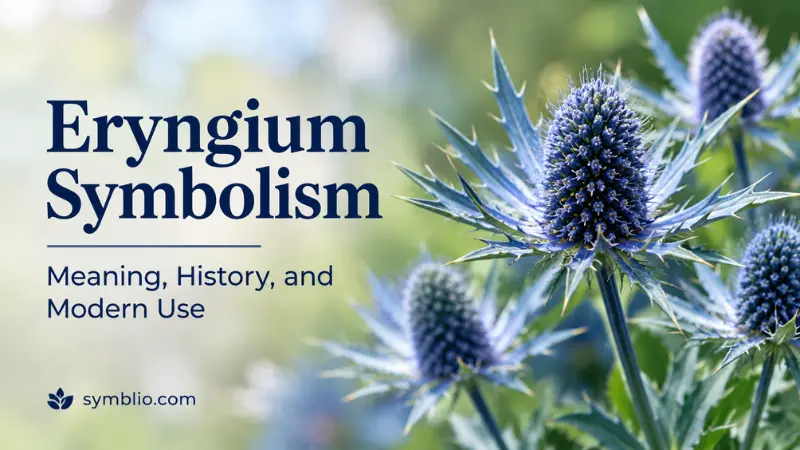
Eryngium is a distinctive flowering plant known for its spiky leaves, blue-gray flower heads, and architectural shape. Eryngium symbolism often centers on independence, resilience, admiration, protection, and individuality, making the plant an interesting choice for bouquets, gardens, and decorative arrangements.
Unlike roses or lilies, eryngium does not have one universally recognized symbolic message in American culture. Its meaning comes from a combination of its physical appearance, historical European folklore, traditional flower language, and the context in which people use it today.
In the United States, people most often encounter eryngium in floral design, wedding arrangements, dried bouquets, ornamental gardens, and botanical decoration. Its unusual appearance allows it to communicate strength and individuality while adding texture and contrast to softer flowers.
Quick Answer
Eryngium commonly symbolizes independence, resilience, admiration, and protection in modern American floral culture, especially in weddings, bouquets, gardens, and decorative arrangements. Historically, European traditions also associated eryngium with attraction, romance, fertility, and vitality.
TL;DR
- Eryngium represents independence, resilience, admiration, and protection.
- Its spiky shape contributes associations with strength and boundaries.
- European folklore connected eryngium with attraction and romantic vitality.
- American florists use it for contrast, texture, and individuality.
- Blue-gray varieties suit contemporary wedding and home decor.
- Modern interpretations vary according to context and personal meaning.
What Is Eryngium?
Eryngium belongs to the Apiaceae family, which also includes familiar plants such as carrots, celery, and parsley. People often call several eryngium species sea holly, although eryngium is not a true holly.
The plants have stiff stems, pointed leaves, and compact flower heads surrounded by sharp-looking bracts. Depending on the species and cultivar, the plant may display blue, blue-gray, silver, green, white, or purple tones.
Eryngium maritimum, commonly known as sea holly, grows naturally in sandy coastal environments. Other species thrive in grasslands, dry habitats, and gardens.
Its unusual structure plays an important role in its symbolism. Instead of appearing delicate and soft, eryngium looks sturdy, defensive, and self-contained. Those qualities naturally lend themselves to interpretations involving resilience and independence.
What Does Eryngium Symbolize?
Modern interpretations commonly connect eryngium with several ideas:
- Independence: Its distinctive form suggests individuality and self-reliance.
- Resilience: Its ability to grow in challenging environments supports associations with endurance.
- Admiration: Traditional flower-language interpretations sometimes connect it with appreciation and admiration.
- Protection: Its pointed bracts can suggest defense and personal boundaries.
- Attraction: Historical European folklore gave some eryngium species romantic associations.
- Individuality: Its unusual appearance makes it a fitting symbol for people who prefer unconventional beauty.
These meanings do not carry equal historical weight. Some come from documented folklore, while others reflect modern floral interpretation.
Independence and Individuality
Eryngium looks noticeably different from traditional rounded flowers. Its rigid stems and angular bracts give it a strong visual identity even when florists place it among larger blooms.
That appearance makes individuality one of its most natural modern associations.
Someone might choose eryngium for a bouquet celebrating a new chapter in life, personal independence, or a decision to follow an unconventional path. The flower does not need to dominate the arrangement to communicate that idea. Its unusual structure creates contrast simply by being present.
In modern floral design, that contrast can represent a person who remains distinctive while still being part of a larger community.
Resilience and Strength
Eryngium’s association with resilience partly comes from its growing habits.
Coastal sea holly, for example, can live in sandy environments that expose plants to wind, salt, and limited nutrients. Its ability to survive in such conditions provides a straightforward natural metaphor for endurance.
That does not mean every eryngium species faces identical conditions. Instead, the plant’s reputation for toughness contributes to a broader symbolic idea: remaining capable and distinctive when circumstances are difficult.
For this reason, eryngium can suit arrangements celebrating perseverance, recovery, a new beginning, or an important personal milestone.
Why Its Spiky Shape Suggests Protection
The pointed bracts around eryngium’s flower heads give the plant a defensive appearance.
People often interpret sharp botanical forms as signs of protection, boundaries, or guarded strength. Eryngium fits that pattern particularly well because its structure creates a clear visual contrast with rounded flowers.
This symbolism does not necessarily imply hostility. A more useful interpretation is strength with boundaries.
A bouquet containing eryngium and soft flowers can therefore create an interesting visual message: gentleness can coexist with firmness, and openness does not require abandoning personal boundaries.
Ancient Roots and Early European Associations
Eryngium has a documented place in European botanical and herbal traditions.
European writers knew sea holly and other eryngiums as distinctive plants, particularly in coastal regions. Historical traditions also gave certain eryngium roots a place in food preparation and herbal practice.
In early modern England, candied eryngo roots became associated with romance and sexual vitality. Literary references from the period reflect this reputation.
Those historical beliefs belong to the cultural history of the plant rather than modern medical science. People in earlier centuries frequently connected plants with fertility, attraction, health, and other qualities through folklore and traditional herbal knowledge.
This history helps explain why modern interpretations sometimes connect eryngium with attraction, desire, vitality, and romance.
Eryngium and Attraction in Historical Folklore
Among eryngium’s most unusual historical associations is its connection with romantic attraction.
The belief developed partly around eryngo roots, which people prepared as a sweet and associated with romantic and reproductive vitality. Writers of the English Renaissance sometimes referenced eryngo in this context.
Modern readers should treat those associations as folklore rather than evidence that eryngium produces romantic or reproductive effects.
The symbolic value lies in the history itself. A plant that once appeared in romantic folklore later became a decorative flower associated with admiration and individuality. Its meaning therefore combines older cultural associations with modern visual interpretation.
Eryngium Symbolism in the United States
Eryngium does not have one dominant national role in American holidays, religion, or public ceremonies.
Instead, Americans generally encounter it through floral design, gardening, weddings, home decoration, and dried arrangements.
That gives context a major role in determining its meaning.
A florist may use eryngium to add structure to a romantic bouquet. A couple may choose it because its blue-gray color fits their wedding palette. A gardener may appreciate its unusual form without assigning any symbolic meaning to it.
The plant’s modern American symbolism therefore tends to remain flexible rather than fixed.
Eryngium in American Weddings
Eryngium works particularly well in contemporary wedding arrangements because it provides visual structure without overwhelming softer flowers.
Florists can combine it with roses, peonies, dahlias, grasses, eucalyptus, baby’s breath, and other materials. Its blue-gray tones can also introduce a subtle cool color into arrangements dominated by white, cream, green, or blush tones.
Symbolically, couples may interpret eryngium as representing:
- strength within a partnership
- individuality within marriage
- mutual admiration
- resilience
- commitment through difficult periods
- a relationship that does not follow traditional expectations
These interpretations are personal rather than official wedding symbolism.
| Context | Common U.S. Interpretation | Visual Association | Typical Use |
|---|---|---|---|
| Wedding flowers | Strength and individuality | Blue-gray structure | Bouquets and centerpieces |
| Gift arrangements | Admiration | Distinctive form | Appreciation and friendship |
| Dried flowers | Endurance | Long-lasting structure | Home decoration |
| Gardens | Resilience | Tough ornamental growth | Naturalistic landscapes |
| Tattoos | Independence | Spiky botanical outline | Personal identity designs |
Blue and Silver Eryngium Meaning
Color can influence how people interpret eryngium.
Blue varieties often create associations with calmness, stability, trust, and composure because Western visual culture frequently connects those qualities with blue.
When people combine blue with eryngium’s pointed form, the result can suggest calm strength rather than aggression.
Silver-gray varieties create a different impression. Their muted appearance can suggest maturity, restraint, sophistication, or a connection with natural landscapes.
There is no universal rule that assigns one meaning to every eryngium color. Arrangement, personal experience, and cultural context all influence interpretation.
Emotional and Psychological Symbolism
Eryngium can serve as a useful metaphor for emotional independence.
Its appearance combines attraction with defense. The flower head looks interesting and ornamental, while its pointed surrounding structures suggest caution and boundaries.
That combination can represent someone who values relationships without giving up their individuality.
For example, people might associate eryngium with:
- starting an independent chapter
- recovering from a difficult experience
- developing stronger boundaries
- honoring individuality
- appreciating a resilient friend
- celebrating personal growth
- respecting someone with a strong character
These are symbolic interpretations, not psychological diagnoses or established scientific meanings.
Eryngium in Gardens and Nature-Based Design
Gardeners often value eryngium for its unusual appearance as much as for its symbolic potential.
Its architectural form works well in naturalistic planting schemes, cottage-style gardens, dry landscapes, and arrangements designed to attract pollinating insects.
From a symbolic perspective, garden use reinforces associations with resilience and individuality. The plant does not resemble a conventional ornamental flower, yet it can become one of the most noticeable features of a planting.
That makes eryngium especially appropriate for gardeners who prefer unusual textures and forms rather than relying only on traditional blooms.
Eryngium in Tattoos, Fashion, and Decor
Eryngium is less common in tattoo designs than roses, lilies, or lotuses, but its distinctive outline gives botanical artists plenty of visual material.
An eryngium tattoo may represent independence, resilience, protection, individuality, or appreciation for unconventional natural beauty.
In home decor, dried eryngium can provide a blue-gray accent within neutral arrangements. Designers may combine it with grasses, seed heads, eucalyptus, or other dried botanicals.
Here, the symbolic message often depends more on the owner’s intention than on a fixed dictionary definition.
Spiritual and Religious Interpretations
Eryngium does not have one universally accepted religious meaning in American Christianity, Judaism, Islam, or other major religious traditions.
Some European folklore associated plants such as sea holly with protective qualities, but folklore should not be confused with formal religious doctrine.
Someone may still use eryngium in a spiritual arrangement or personal ritual because they associate it with resilience, protection, or personal growth. That interpretation can be meaningful to the individual without representing an established religious tradition.
Common Misunderstandings About Eryngium Symbolism
The biggest misunderstanding involves treating flower symbolism as a universal dictionary.
Eryngium does not have one meaning that every culture, florist, historian, or individual recognizes in exactly the same way.
Another mistake involves presenting historical folklore as scientific fact. Traditional beliefs about eryngium’s romantic or medicinal properties tell us what earlier communities believed; they do not prove that those beliefs have a scientific basis.
People also sometimes confuse sea holly with true holly. Despite its common name, eryngium belongs to the Apiaceae family rather than the holly family.
How Eryngium Symbolism Has Evolved
Eryngium’s symbolic history has changed considerably.
Older European traditions gave certain eryngiums associations with attraction, romance, vitality, and traditional plant lore. Later flower-language traditions emphasized emotional messages associated with individual flowers.
Modern American floristry tends to interpret the plant more visually. Its spiky structure suggests protection and strength, while its unusual appearance supports ideas of individuality and independence.
This evolution shows why plant symbolism should not be treated as a fixed formula. Meanings develop as people encounter plants in different cultural, artistic, and social settings.
Is Eryngium a Positive or Negative Symbol?
Eryngium generally carries positive associations in modern floral culture.
Strength, independence, resilience, admiration, and protection are usually favorable qualities. Its pointed appearance can sometimes suggest emotional guardedness, but that interpretation does not make the plant inherently negative.
The same feature can support different readings. A person might see the spikes as defensive, while a florist might see them as architectural and beautiful.
Context determines which quality becomes most noticeable.
What Eryngium Represents in Modern American Culture
Modern Americans generally encounter eryngium as an ornamental plant rather than a formal cultural symbol.
Its strongest contemporary associations come from floral design, weddings, gardening, dried arrangements, and personal aesthetics.
The plant fits current design preferences that favor natural textures, muted colors, unusual botanical forms, and arrangements that mix traditional flowers with less conventional materials.
Its symbolism works because its physical appearance provides an understandable foundation. The plant looks resilient, structured, and distinctive, so people can naturally connect it with those qualities.
FAQs
Eryngium commonly symbolizes independence, resilience, admiration, protection, and individuality. Historical European traditions also connected some eryngium species with attraction, romance, and vitality.
Eryngium can represent strength, individuality, admiration, and resilience within a relationship. Its blue-gray appearance also works well with modern and understated wedding color palettes.
Yes, historical European folklore connected eryngo with attraction and romantic vitality. Modern floral interpretations more commonly emphasize admiration and individuality alongside that older association.
Blue eryngium can suggest calmness and stability because blue carries those associations in Western visual culture. Combined with the plant’s pointed structure, it can create an impression of composed strength.
Eryngium does not have one universally recognized religious meaning. Some folklore gives it protective associations, but those traditions should remain separate from formal religious teachings.
An eryngium tattoo can represent independence, resilience, protection, individuality, or unconventional beauty. The person’s reason for choosing the plant ultimately determines the most meaningful interpretation.
Generally, yes. Modern interpretations usually emphasize resilience, independence, admiration, individuality, and protection rather than negative qualities.
Conclusion
Eryngium stands apart from traditional flowers because its beauty comes from structure as much as softness. Its spiky form, blue-gray colors, and ability to grow in demanding environments naturally support modern associations with independence, resilience, protection, and individuality.
Historical European traditions add another layer through connections with attraction, romance, and vitality. In the United States, however, people most often encounter eryngium through weddings, bouquets, gardens, dried arrangements, and contemporary floral design.
Ultimately, eryngium symbolism combines historical folklore with the visual qualities people recognize today. Its most fitting message is not a single fixed definition but a set of related ideas: remaining distinctive, maintaining boundaries, and showing strength while still being part of a larger arrangement.