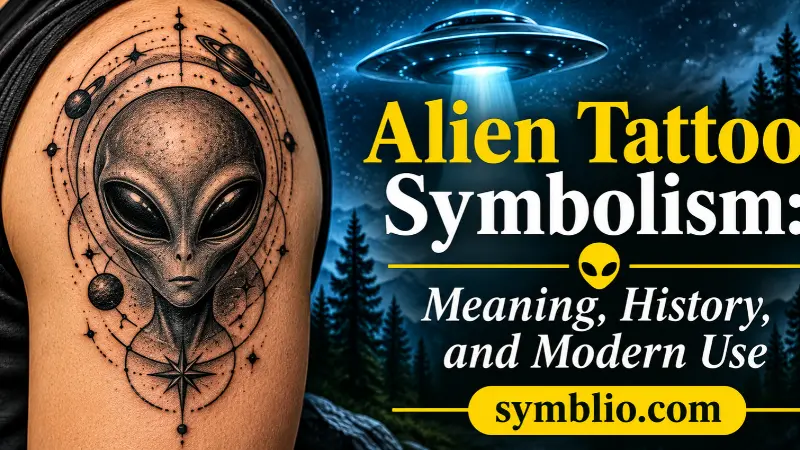
Alien tattoo symbolism reflects humanity’s curiosity about life beyond Earth, the unknown, and the possibility that we are not alone in the universe. In modern American culture, alien tattoos often represent individuality, imagination, unconventional thinking, and an interest in extraterrestrial life. Their meanings can range from playful science-fiction references to personal statements about identity and belonging.
An alien tattoo can take many forms. Some designs feature the familiar green creature with a large head and oversized black eyes, while others depict gray extraterrestrials, flying saucers, cosmic landscapes, or detailed figures inspired by science fiction. Each design communicates something slightly different, depending on its appearance and the person’s reason for choosing it.
In the United States, extraterrestrial imagery has become a recognizable part of popular culture. Movies, television shows, comic books, UFO stories, and space exploration have helped turn aliens into symbols of curiosity, imagination, and the possibility of discovering something beyond familiar human experience.
Understanding these tattoos requires looking beyond their unusual appearance. Their symbolism connects to American history, entertainment, personal identity, and longstanding questions about humanity’s place in the universe.
Quick Answer: What Does Alien Tattoo Symbolism Mean?
Alien tattoo symbolism commonly represents individuality, curiosity, imagination, and fascination with extraterrestrial life in modern American culture. It can also symbolize feeling different from others, questioning conventional ideas, exploring the unknown, and expressing an interest in science fiction and the mysteries of the universe.
TL;DR: Key Meanings of Alien Tattoos
- Individuality: Expresses independence and comfort with being different.
- Curiosity: Represents questions about extraterrestrial life and the universe.
- Imagination: Reflects creativity and an interest in science fiction.
- Nonconformity: Communicates a willingness to challenge conventional expectations.
- Belonging: Can represent feeling like an outsider or finding a unique identity.
- Exploration: Connects to discovery, space, and possibilities beyond Earth.
What an Alien Tattoo Looks Like
An alien tattoo typically depicts an imaginary extraterrestrial being, although the design can vary considerably. The most recognizable version features a disproportionately large head, enormous dark eyes, a narrow chin, and a slender body. This appearance is commonly associated with the gray alien popularized by UFO stories and science-fiction entertainment.
Another familiar design features a small green creature with a rounded head, pointed ears, and expressive facial features. These characters often have a humorous appearance and are associated with cartoons, novelty merchandise, and lighthearted interpretations of extraterrestrial life.
Some people choose more elaborate artwork, including:
- Alien faces surrounded by stars and planets.
- Flying saucers above mountains or desert landscapes.
- Extraterrestrial figures wearing futuristic clothing.
- Alien silhouettes against colorful galaxies.
- Astronauts encountering imaginary extraterrestrial beings.
- Geometric alien faces combined with cosmic patterns.
The visual style influences how viewers interpret the tattoo. A smiling green alien might suggest humor and creativity, while a realistic gray extraterrestrial surrounded by darkness may communicate fascination with unexplained phenomena.
Individuality and Being Different
One of the most recognizable meanings associated with alien tattoos is individuality.
Aliens are imagined as beings from somewhere beyond human society. Because they do not belong to familiar human communities, they can represent people who feel different from those around them.
Someone who chooses an alien tattoo may appreciate having an unusual personality, independent interests, or a perspective that does not always match mainstream expectations.
This interpretation can be particularly meaningful for people who grew up feeling misunderstood or out of place. Rather than treating difference as something negative, the alien becomes a reminder that individuality deserves acceptance.
The message is not necessarily that someone wants to separate themselves from society. Instead, it can communicate that personal identity does not need to follow a standard pattern.
For some, the tattoo simply celebrates being unconventional. For others, it represents the experience of finding confidence in characteristics that once made them feel different.
Curiosity About the Unknown
Aliens are closely associated with questions that humans cannot easily answer.
Is Earth the only planet supporting life? Could intelligent civilizations exist somewhere else? What might extraterrestrial organisms look like?
These questions have influenced science, astronomy, philosophy, and popular entertainment for generations.
An alien tattoo can symbolize a willingness to explore questions without immediately accepting familiar explanations. It represents curiosity about possibilities that extend beyond everyday experience.
For people interested in astronomy and space exploration, the design may reflect genuine scientific curiosity rather than belief in UFO encounters.
The tattoo can also communicate a broader attitude toward life: remaining interested in unfamiliar subjects, learning new things, and being open to unexpected discoveries.
This meaning makes extraterrestrial imagery suitable for people who enjoy exploring ideas, questioning assumptions, and thinking beyond established boundaries.
Historical Origins of Alien Imagery
The modern alien image did not emerge from one ancient tradition. It developed through literature, scientific speculation, popular entertainment, and twentieth-century UFO culture.
Writers had imagined inhabitants of other worlds long before the familiar gray alien became popular. During the nineteenth century, advances in astronomy encouraged public interest in the possibility of life beyond Earth.
H. G. Wells’s 1898 novel The War of the Worlds introduced an influential fictional invasion from Mars. The story helped establish extraterrestrial visitors as subjects of popular fiction.
In 1938, Orson Welles’s radio adaptation brought the invasion story to American audiences in a particularly memorable way. It demonstrated how strongly extraterrestrial narratives could capture public attention.
A major turning point arrived in 1947, when pilot Kenneth Arnold reported seeing unusual objects near Mount Rainier in Washington. Newspaper coverage helped popularize the expression flying saucers.
The Roswell incident in New Mexico later that year added another important chapter to American UFO culture.
Over subsequent decades, fictional extraterrestrials developed recognizable visual characteristics. Large-headed, large-eyed gray beings became especially familiar through entertainment and reported encounter stories.
These developments helped create the visual vocabulary that many modern alien tattoos use today.
Alien Symbolism in American Culture
The United States has played a particularly important role in shaping the modern image of extraterrestrial visitors.
During the twentieth century, American audiences encountered aliens through science-fiction novels, radio programs, television, movies, advertisements, and comic books.
The subject became especially prominent during the Cold War. Public anxiety about nuclear technology, military secrecy, and rapid scientific developments influenced stories about visitors from other planets.
Extraterrestrials sometimes appeared as dangerous invaders. In other stories, they represented peaceful visitors who could help humanity understand the universe.
Later entertainment introduced more humorous and friendly versions of alien characters.
Today, alien imagery appears in several areas of American culture:
- Entertainment: Science-fiction films, television, animation, and video games.
- Fashion: Graphic shirts, accessories, and alternative clothing.
- Decor: Posters, collectible figures, and space-themed decorations.
- Tourism: UFO museums and extraterrestrial-themed attractions.
- Personal expression: Tattoos representing imagination and unconventional identity.
The alien has become more than a fictional creature. It is a recognizable cultural image that Americans use to express curiosity, humor, creativity, and interest in the unexplained.
Science Fiction and the Evolution of Alien Meaning
Science fiction has significantly influenced how people understand extraterrestrial imagery.
Early stories often presented aliens as threats to humanity. Their unfamiliar appearance and advanced technology made them convenient characters for exploring fears about invasion, scientific progress, and social change.
Later productions offered more complicated portrayals.
In The Day the Earth Stood Still (1951), an extraterrestrial visitor becomes a way to explore human conflict and responsibility. Close Encounters of the Third Kind (1977) presented contact with extraterrestrial visitors through wonder and curiosity.
Other productions, including E.T. the Extra-Terrestrial (1982), helped establish the friendly alien as a familiar figure in American entertainment.
These different portrayals created several possible interpretations for alien tattoos.
| Science-fiction influence | Common tattoo association | General interpretation |
|---|---|---|
| Alien invasion stories | Warning and uncertainty | Fear of the unknown |
| Friendly extraterrestrials | Friendship and acceptance | Connection across differences |
| Space exploration stories | Discovery | Curiosity and adventure |
| Humorous alien characters | Playfulness | Humor and creativity |
| Alien conspiracy stories | Secrecy and questions | Interest in unexplained events |
The character represented in a tattoo can therefore communicate a very different message depending on its cultural background.
Feeling Like an Outsider
Another personal interpretation of alien tattoos involves the experience of not fitting in.
The word alien is commonly associated with something unfamiliar or foreign. In everyday language, people sometimes use extraterrestrial imagery metaphorically to describe feeling disconnected from their surroundings.
A person might choose an alien tattoo because they have experienced differences in personality, interests, social expectations, or lifestyle.
For them, the design can represent acceptance rather than isolation.
It may communicate:
- I appreciate what makes me different.
- I do not need everyone’s approval.
- My interests do not have to match mainstream culture.
- I can create my own identity.
- Being unusual is not necessarily a disadvantage.
This interpretation is especially visible in alternative art and tattoo culture, where unusual imagery often provides a way to communicate personal identity.
However, not every alien tattoo represents loneliness. Many people simply enjoy the artwork or have a longstanding interest in extraterrestrial stories.
Psychological and Emotional Meaning
Alien tattoos can communicate several emotional ideas, depending on the wearer’s experiences and the design itself.
Wonder and curiosity: Extraterrestrial imagery encourages people to think about possibilities beyond their immediate surroundings. It can represent an interest in discovery and learning.
Freedom of expression: Choosing an unusual design can reflect confidence in personal preferences and a willingness to express interests openly.
Acceptance: An alien can represent the idea that differences do not make someone less valuable or deserving of connection.
Humor: Cartoon-style extraterrestrials often communicate a playful personality and enjoyment of unusual characters.
Imagination: Space creatures and fictional worlds allow people to express creative interests that might not fit conventional tattoo themes.
There is no single psychological explanation for choosing this artwork. A person’s interpretation depends on their memories, experiences, and reasons for selecting the design.
The same image can represent humor to one person and personal identity to another.
Different Types of Alien Tattoos and Their Meanings
The design is an important part of understanding an alien tattoo.
Different extraterrestrial figures have developed distinct associations through movies, illustrations, and popular culture.
Gray Alien Tattoos
Gray aliens are usually illustrated with large heads, narrow bodies, and oversized dark eyes.
Their imagery is associated with UFO reports, extraterrestrial encounter stories, and questions about intelligent life beyond Earth.
A gray alien tattoo can represent fascination with unexplained phenomena, scientific curiosity, or an interest in UFO history.
Green Alien Tattoos
Green aliens usually have a more playful appearance.
Their meaning often connects to humor, childhood imagination, cartoons, and science-fiction nostalgia.
People who choose these designs may want something unusual without communicating a serious or intimidating message.
Alien and UFO Tattoos
These designs combine extraterrestrial beings with spacecraft, flying saucers, or unusual lights in the sky.
They often represent interest in UFO history, space exploration, and the possibility of extraterrestrial encounters.
They can also reflect appreciation for classic science-fiction artwork.
Alien Head Tattoos
An isolated alien face is a simple and recognizable design.
Its meaning usually depends on the facial expression and artistic style. A smiling face may communicate friendliness, while a serious expression can suggest fascination with the unknown.
Alien and Galaxy Tattoos
Combining extraterrestrial imagery with planets, stars, and galaxies creates a broader connection to the universe.
These designs can represent exploration, imagination, astronomy, and the desire to understand humanity’s place in space.
Spiritual and Philosophical Interpretations
Alien tattoos sometimes carry philosophical meanings that extend beyond science fiction.
For example, the idea of life beyond Earth raises questions about human existence, consciousness, and our understanding of the universe.
Some people interpret extraterrestrial imagery as a reminder that humanity may not occupy a central position in the larger cosmos.
Others connect the design with the idea of remaining open to experiences and possibilities that challenge established beliefs.
These interpretations are personal rather than part of a recognized religious tradition.
There is no universal spiritual meaning attached to alien tattoos, and they should not automatically be understood as expressions of a particular belief system.
For some wearers, the design represents a philosophical question. For others, it is simply an enjoyable piece of science-fiction artwork.
Alien Tattoos and Modern American Tattoo Culture
Alien imagery fits naturally into several areas of contemporary American tattoo culture.
Traditional tattoo subjects often include animals, flowers, nautical symbols, and recognizable objects. Extraterrestrial designs offer another option for people interested in unusual characters and imaginative artwork.
They can also combine several artistic approaches.
Traditional tattoo style: Bold outlines and simplified alien figures create a playful, recognizable appearance.
Blackwork: Solid black shapes and contrasting details produce a striking extraterrestrial image.
Realism: Detailed shading creates a more lifelike interpretation of fictional alien anatomy.
Minimalist artwork: Simple lines and small alien faces communicate the subject without elaborate backgrounds.
Neo-traditional style: Strong outlines, decorative details, and imaginative colors give alien characters a distinctive appearance.
Alien tattoos also appear in alternative fashion communities and among people interested in science fiction, astronomy, gaming, and UFO-related entertainment.
Their popularity reflects the flexibility of the subject. It can be humorous, artistic, nostalgic, or philosophical without depending on one fixed interpretation.
What Alien Tattoo Colors Represent
Color can influence the overall impression of an alien tattoo.
Although there are no universal color rules for extraterrestrial imagery, common artistic associations can help explain why certain shades are chosen.
| Color | Common association | Possible interpretation |
|---|---|---|
| Green | Classic alien imagery | Playfulness and imagination |
| Gray | Traditional gray extraterrestrials | Uncertainty and the unknown |
| Black | Mystery and contrast | Individuality and unconventional style |
| Blue | Space and technology | Exploration and curiosity |
| Purple | Fantasy and cosmic imagery | Creativity and imagination |
| Red | Intensity and dramatic artwork | Boldness and strong expression |
These associations are artistic choices rather than established symbolic definitions.
A green alien, for instance, does not automatically represent a particular personality trait. The surrounding artwork and the wearer’s intentions provide the more meaningful context.
Misunderstandings and Controversial Associations
Alien imagery is generally associated with entertainment, science fiction, and extraterrestrial curiosity. However, some interpretations can become controversial when fictional ideas are presented as established facts.
One common misunderstanding involves UFO sightings.
An unidentified flying object simply refers to an aerial observation that has not been identified. It does not automatically establish that an extraterrestrial spacecraft was involved.
Similarly, the popularity of stories about Roswell and Area 51 does not establish that extraterrestrial beings or spacecraft have been recovered by the government.
Another issue involves the word alien itself.
In immigration and legal contexts, the term has historically been used to describe people who are not citizens of a particular country. This meaning is entirely different from the fictional extraterrestrial creature commonly depicted in tattoos.
People should also avoid assuming that everyone with an alien tattoo believes in extraterrestrial visitors, supports conspiracy theories, or identifies with a particular subculture.
A tattoo is an individual expression. Its meaning should not be assigned to someone without understanding their intentions.
How Alien Tattoo Symbolism Has Changed Over Time
The meaning of extraterrestrial imagery has changed considerably since the early twentieth century.
Before the modern UFO era, imaginary beings from other worlds were primarily associated with literature and scientific speculation.
During the late 1940s and 1950s, flying saucer reports and Cold War anxieties helped establish aliens as recognizable figures in American popular culture.
By the 1970s and 1980s, science-fiction entertainment introduced more varied portrayals. Extraterrestrials could be frightening, friendly, intelligent, humorous, or emotionally relatable.
The growth of video games, comic books, animation, and internet culture expanded these interpretations further.
Today, alien tattoos can represent several different things at once:
- A connection to childhood science-fiction memories.
- An interest in astronomy and space exploration.
- A celebration of individuality.
- An appreciation for unusual artwork.
- A humorous reference to popular culture.
- A personal reminder to remain curious.
This evolution explains why the same alien image can have different meanings across generations.
For an older science-fiction fan, it might recall classic movies. For someone younger, it might represent digital art, gaming culture, or an appreciation for alternative design.
FAQs
An alien tattoo commonly symbolizes individuality, curiosity, creativity, and fascination with extraterrestrial life. Some people also use it to express their appreciation for being different or their interest in exploring unfamiliar ideas.
Yes, alien tattoos generally have positive or neutral interpretations. They can represent imagination, independence, humor, and openness to new possibilities, although some darker designs may communicate uncertainty or fear of the unknown.
A gray alien tattoo often represents interest in UFO stories, extraterrestrial encounter narratives, and unexplained phenomena. Its large-headed, large-eyed appearance is closely connected to modern popular depictions of supposed extraterrestrial visitors.
No. Someone can enjoy alien imagery without believing that extraterrestrial visitors have come to Earth. The design may simply reflect an interest in science fiction, astronomy, art, or humor.
A green alien tattoo often represents playfulness, imagination, and nostalgia for cartoons and science-fiction entertainment. Its meaning is usually lighter and more humorous than realistic extraterrestrial designs.
Some people connect alien imagery with questions about existence, consciousness, and humanity’s place in the universe. However, extraterrestrial tattoos do not have one universally recognized spiritual meaning or established religious interpretation.
People choose alien tattoos for different reasons, including personal expression, science-fiction interests, childhood memories, and appreciation for unusual artwork. For some, the design also represents confidence in being different from mainstream expectations.
Conclusion
Alien tattoo symbolism brings together individuality, curiosity, imagination, and fascination with the unknown. In modern American culture, extraterrestrial imagery has developed from early science-fiction stories and UFO reports into a recognizable form of personal expression. Its meaning can be humorous, philosophical, nostalgic, or connected to someone’s sense of identity.
The design itself often provides clues to its interpretation. A friendly green alien may celebrate creativity and humor, while a realistic gray figure might reflect an interest in UFO history or extraterrestrial possibilities. Spacecraft and galaxy backgrounds can add themes of discovery and exploration.
Ultimately, an alien tattoo does not have one fixed meaning. It gives people a creative way to express their interests, embrace their individuality, and celebrate the questions that make the universe so fascinating.