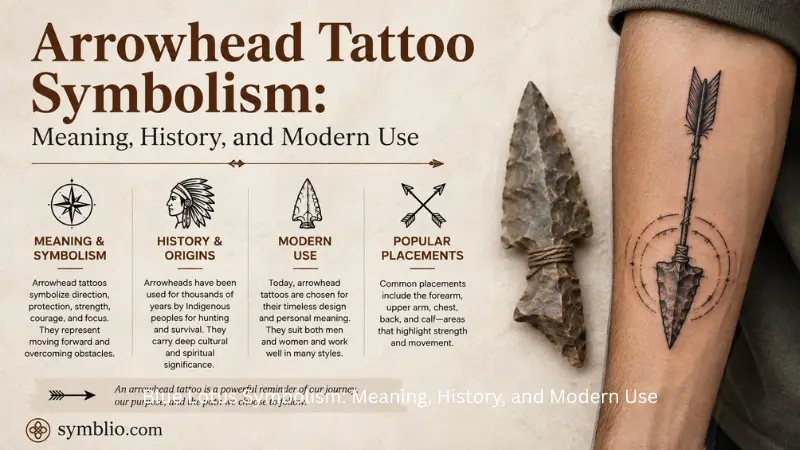
Arrowhead tattoo symbolism commonly represents protection, survival, determination, courage, and focused strength. In modern American tattoo culture, people often choose the design to mark personal growth, resilience, independence, or the ability to keep moving through difficult circumstances.
The arrowhead is a simple but recognizable shape. It usually appears as a pointed stone or geometric form with sharp edges and sometimes small notches near its base. Historically, similar projectile points were practical tools used for hunting and other purposes by Indigenous peoples across North America and by cultures elsewhere in the world.
Because the object once had a clear practical purpose, many of its modern meanings come from what it physically did: it helped people hunt, prepare, adapt, and survive. Today, those qualities have become personal symbols worn on the skin.
Quick Answer
Arrowhead tattoo symbolism most commonly represents protection, survival, strength, determination, and readiness in modern American culture. Its broader meaning comes from the historical use of stone projectile points as practical tools for hunting and survival, although there was never one universal cultural meaning shared by every Indigenous community.
TL;DR
- Arrowheads commonly symbolize protection, survival, courage, and determination.
- Their meaning partly comes from their historical practical function.
- Not every ancient projectile point was technically an arrowhead.
- Indigenous cultures did not share one universal arrowhead meaning.
- Modern tattoos often represent resilience, identity, focus, or independence.
- Cultural context matters when using specifically Indigenous-inspired designs.
What Arrowhead Tattoos Commonly Mean in the United States
In modern American tattoo culture, an arrowhead usually communicates strength under pressure.
The image feels deliberate. An arrowhead was created for a purpose, shaped carefully, and designed to perform a specific task. That practical quality makes it easy to connect with determination and focus.
Many people choose the tattoo after experiencing a major personal change. It may mark recovery from hardship, the end of a difficult relationship, a new stage of independence, or a renewed commitment to a goal.
Others simply appreciate the design because it connects them with outdoor life, hunting traditions, craftsmanship, archaeology, or family heritage.
| Context | Common U.S. Meaning | Main Association | Notes |
|---|---|---|---|
| Personal growth | Determination | Moving through hardship | Usually personal symbolism |
| Protection | Defense and readiness | Guarding what matters | Modern interpretation |
| Survival | Resilience | Enduring difficult conditions | Inspired by practical use |
| Heritage | Ancestry | Family or cultural connection | Meaning depends on identity |
| Direction | Focus | Choosing a path | Stronger with full arrow designs |
| Nature | Connection with land | Hunting and wilderness | Common in outdoor tattoos |
No tattoo has one fixed definition. Placement, style, surrounding imagery, and the wearer’s personal story can all change how the design is understood.
What an Arrowhead Actually Is
People often use the word arrowhead for almost any pointed stone artifact, but the historical picture is more complicated.
Archaeologists commonly use the broader term projectile point because pointed stone tools could be attached to different kinds of weapons. Some were used with arrows, while others may have been attached to darts or spears.
This distinction matters because bows and arrows did not exist in every place and period where pointed stone tools have been found.
Some prehistoric points that are casually called arrowheads are much older than the widespread use of bow-and-arrow technology in that region.
For tattoo symbolism, this wider history expands the image beyond archery. The shape can represent craftsmanship, adaptation, patience, skill, survival, and practical intelligence.
Why Arrowheads Represent Protection
Protection is one of the most common meanings attached to arrowhead tattoos today.
The connection is easy to understand. Projectile points were part of tools and weapons that helped people hunt and defend themselves. In modern symbolism, that practical role becomes a metaphor for protecting yourself, your family, your values, or your personal boundaries.
Someone might choose an arrowhead tattoo after learning to stand up for themselves or after becoming responsible for other people.
In that context, the design can mean:
“I am prepared.”
It can also express vigilance without necessarily suggesting aggression.
However, protection should be understood primarily as a modern tattoo interpretation. It would be inaccurate to claim that every Indigenous nation historically treated the arrowhead as the same universal protection symbol.
Survival, Resilience, and Self-Reliance
The arrowhead is especially well suited to symbolism involving survival.
Making a useful stone point required knowledge, patience, and technical ability. People needed to understand available materials, toolmaking methods, animals, landscapes, and hunting practices.
A failed point could break. A well-made one became part of a practical survival system.
That history helps explain why modern wearers often connect the image with resilience.
An arrowhead tattoo may represent:
- surviving a difficult period
- recovering after loss
- rebuilding life after failure
- developing independence
- overcoming fear
- becoming more disciplined
- learning to rely on personal strength
The meaning does not need to be dramatic. Someone may simply use the tattoo as a reminder that difficult conditions can be handled with preparation and persistence.
Focus, Purpose, and Moving Forward
Arrowheads also carry a natural association with direction.
A pointed object visually leads the eye toward a destination. That makes it easy to connect the image with goals, concentration, and forward movement.
A complete arrow expresses this idea even more clearly because the shaft creates a visible line of travel. Still, the arrowhead alone retains the most important feature: the point.
For that reason, some people interpret an arrowhead tattoo as a reminder to stop drifting and commit to a direction.
It may represent:
- choosing a career
- pursuing a long-term goal
- leaving the past behind
- maintaining discipline
- refusing distraction
- beginning a new chapter
In this interpretation, the arrowhead represents precision more than speed.
Historical Roots of the Arrowhead Image
Pointed stone tools have existed for thousands of years and appeared in many parts of the world.
In North America, Indigenous peoples created a wide range of projectile points using materials such as flint, chert, obsidian, and other workable stone. Shapes and manufacturing methods differed across regions and historical periods.
Some points were broad and heavy. Others were small and narrow. Different forms could reflect different weapons, materials, local traditions, and technological developments.
This long history is one reason the arrowhead feels ancient even when it appears in a modern minimalist tattoo.
Yet its earliest importance was usually practical rather than decorative.
These objects helped people interact with their environment. They reflect craftsmanship, planning, technological knowledge, hunting practices, and adaptation.
Modern symbolism developed later by turning those practical qualities into emotional ideas such as strength and resilience.
Not Every Projectile Point Was an Arrowhead
One of the biggest misconceptions surrounding arrowheads is the assumption that every pointed stone artifact was used on an arrow.
That is not accurate.
Some points were connected with spears or dart systems rather than bows. Others may have served multiple purposes depending on their shape and context.
This matters when discussing tattoos because many designs labeled “arrowheads” are actually generic versions of prehistoric projectile points.
A person interested in archaeology might therefore see the tattoo differently from someone interested in archery.
For one wearer, it represents direction.
For another, it may represent ancient craftsmanship, traditional technology, hunting skill, or humanity’s ability to adapt to difficult environments.
Both interpretations can make sense without requiring a single universal definition.
Arrowhead Symbolism and Indigenous North America
Arrowheads are closely associated with Indigenous history in the United States, but this connection should be described carefully.
Native American nations are culturally diverse. They developed different languages, artistic traditions, technologies, ceremonies, social structures, and relationships with their environments.
Because of that diversity, there is no historically accurate single sentence such as:
“The arrowhead meant this to Native Americans.”
Such statements flatten hundreds of distinct communities into one imaginary culture.
Some Indigenous communities may have specific traditions connected with hunting, warfare, stoneworking, arrows, particular animals, or specific forms of material culture.
Those meanings belong to those communities.
For a general modern tattoo, it is more accurate to say that the arrowhead can be inspired by Indigenous North American history while recognizing that its personal symbolism is often modern.
Arrowhead Tattoos and Personal Heritage
For some people, an arrowhead tattoo has a heritage-based meaning.
Someone with Indigenous ancestry may connect the image with family identity, homeland, cultural continuity, community history, or personal reconnection with heritage.
In those situations, the tattoo may carry meanings that outsiders cannot determine simply by looking at the design.
A person without that background might choose the same basic shape because it represents survival, wilderness, hunting, archaeology, or personal strength.
The two tattoos can look nearly identical while communicating very different things.
That is why personal context matters more than generalized symbolism lists.
The strongest interpretation usually comes from understanding why that particular person chose the design.
Cultural Respect and Appropriation Concerns
A simple arrowhead shape is not automatically disrespectful.
Problems become more likely when the design is falsely described as a sacred tribal symbol or when it combines unrelated Indigenous imagery into a stereotype.
For example, an arrowhead surrounded by generic feathers, war bonnets, dreamcatchers, or invented “tribal” patterns may unintentionally reduce many separate traditions into a single visual theme.
A better approach is to separate personal symbolism from cultural claims.
A non-Indigenous wearer can reasonably say:
“I chose an arrowhead because it represents resilience and focus for me.”
That is very different from claiming that a specific image carries an ancient Native spiritual meaning without knowing its actual cultural background.
If a tattoo copies imagery associated with a particular community, ceremony, family tradition, or sacred practice, additional research and respect are appropriate.
Why Arrowhead Tattoos Appeal to Modern Wearers
The design works especially well as a tattoo because it can communicate meaning without requiring much space.
Its sharp outline remains recognizable in minimalist styles, while larger versions allow artists to add texture, landscapes, geometric patterns, animals, dates, or other imagery.
It can also look masculine, feminine, neutral, historical, contemporary, rugged, or refined depending on the artistic approach.
That flexibility helps explain why arrowhead tattoos appear across several tattoo styles.
People interested in outdoor culture may connect them with hunting and wilderness.
Minimalist tattoo fans may choose them for their clean geometry.
Others appreciate their archaeological appearance or use the image as a personal symbol of surviving something difficult.
Popular Arrowhead Tattoo Designs and Their Meanings
Different artistic choices can change the way an arrowhead tattoo is read.
Single Arrowhead
A single isolated point usually emphasizes strength, readiness, independence, or survival.
Because there are few surrounding elements, attention stays on the basic shape and what it means personally to the wearer.
Broken Arrowhead
A cracked or broken point can represent a difficult period that has ended.
Some people use it to symbolize recovery, peace after conflict, leaving an old identity behind, or recognizing that hardship no longer controls them.
Its meaning is primarily personal rather than standardized.
Arrowhead With Mountains
Mountains add ideas of endurance, wilderness, travel, challenge, and achievement.
This version can work especially well for hikers, hunters, climbers, travelers, or people who feel emotionally connected with outdoor environments.
Arrowhead With Trees
Trees can add themes of stability, growth, roots, family, and connection with nature.
Combined with an arrowhead, they can create a design centered on survival and belonging to the land.
Arrowhead With Feathers
Feathers may represent freedom, flight, memory, spirituality, or nature depending on context.
However, combining feathers and arrowheads can also create an intentionally or unintentionally Indigenous-inspired appearance, so culturally specific imagery deserves careful consideration.
Geometric Arrowhead
A clean geometric point usually emphasizes order, balance, precision, and focus.
This version often feels more contemporary and less explicitly historical.
Stone-Textured Arrowhead
A realistic chipped-stone design brings the historical object itself into focus.
It may appeal to people interested in archaeology, ancient technology, hunting traditions, craftsmanship, or natural materials.
Does the Direction of an Arrowhead Tattoo Matter?
Direction can influence how people interpret the design, although there are no universal rules.
An upward-pointing arrowhead may suggest ambition, growth, achievement, or rising above difficulty.
A forward-facing point can emphasize determination, motion, readiness, or commitment to a goal.
A downward-facing arrowhead may be interpreted as grounding, stability, reflection, or completion.
Some people choose orientation for purely visual reasons.
A vertical arrowhead might fit naturally on the forearm, calf, sternum, or spine, while a horizontal design may work well across the upper arm, chest, or shoulder.
Personal meaning should not be inferred solely from direction.
Emotional and Psychological Meaning
The arrowhead has a distinctive psychological quality because its shape appears controlled and purposeful.
Rounded symbols often feel soft or harmonious. A pointed form feels more decisive.
That visual sharpness can communicate concentration, confidence, preparedness, and self-control.
Different people may recognize themselves in different aspects of the image.
A survivor may see resilience.
A protector may see defense.
A goal-oriented person may see discipline.
An outdoors enthusiast may see hunting and wilderness.
Someone interested in history may see human ingenuity.
A person marking a life transition may simply see a reminder to keep going.
The design works because it allows these meanings without requiring a complicated scene.
Positive and Negative Meanings
Most arrowhead tattoos carry positive or neutral symbolism.
Common positive meanings include:
- courage
- determination
- resilience
- protection
- focus
- self-reliance
- preparedness
- independence
However, the arrowhead is still associated with a weapon.
In certain designs, it may therefore suggest aggression, conflict, danger, combat, or hunting.
Surrounding imagery usually determines which interpretation feels strongest.
An arrowhead placed beside mountains and trees will probably feel adventurous or outdoors-oriented.
One combined with memorial dates may represent loss and endurance.
A darker composition involving blood, skulls, or weapons can create a much more confrontational message.
The arrowhead itself does not force one emotional reading.
Arrowheads, Archaeology, and Respect for the Past
Modern interest in arrowheads extends beyond tattoos.
People collect, study, photograph, and display projectile points because they offer evidence about earlier human communities.
Real archaeological artifacts can contain information about toolmaking, trade, migration, hunting practices, technology, and settlement patterns.
Their value therefore goes beyond appearance.
Removing an artifact from its original archaeological setting can destroy important information about where it was found and what other objects surrounded it.
For someone who appreciates arrowhead imagery because of its history, respecting archaeological sites is a natural extension of that interest.
A tattoo can celebrate the design without treating actual artifacts as casual souvenirs.
How Arrowhead Symbolism Changed Over Time
The arrowhead did not begin as the generalized tattoo symbol people recognize today.
Its earliest importance was practical.
Projectile points were tools created to solve real problems. They helped people hunt and formed part of broader technologies developed for survival.
Over time, the meaning shifted as modern societies encountered these objects through archaeology, museums, private collections, historical storytelling, outdoor culture, jewelry, graphic design, and popular media.
Tattoo culture transformed the object again.
The sharp point became a symbol of focus and determination.
Because arrowheads were also used as weapons, they developed associations with protection and defense.
Their importance in hunting connected them with survival, skill, and self-reliance.
Over time, ancient arrowheads also came to represent ancestry, history, and a connection to the past.
That evolution explains why a modern arrowhead tattoo can communicate several meanings without any one interpretation being universally correct.
FAQs
What does an arrowhead tattoo symbolize?
An arrowhead tattoo commonly symbolizes protection, strength, courage, survival, and determination. It can also represent moving forward with purpose or staying focused on an important goal.
What does an arrowhead tattoo mean spiritually?
Spiritually, an arrowhead tattoo may represent guidance, personal protection, inner strength, and a clear life direction. Meanings vary according to the wearer’s beliefs and cultural context.
Does an arrowhead tattoo symbolize protection?
Yes. Protection is one of the most common meanings associated with arrowhead imagery because arrowheads were historically connected with hunting, defense, and survival.
What does a broken arrowhead tattoo mean?
A broken arrowhead can symbolize peace after conflict, overcoming hardship, ending a difficult chapter, or choosing a new direction. Its meaning often depends on the tattoo’s overall design.
What does an arrowhead tattoo pointing up mean?
An upward-pointing arrowhead may suggest ambition, progress, strength, or striving toward a higher goal. Tattoo meanings are personal, so the direction can also have an individual significance.
Is an arrowhead tattoo a Native American symbol?
Arrowheads have important historical associations with many Indigenous peoples of North America, but their meanings differ among nations and communities. If a tattoo uses specific Native American designs, patterns, or sacred imagery, it is best to research their cultural context carefully and respectfully.
Is an arrowhead tattoo good for men and women?
Yes. Arrowhead tattoos are not gender-specific. People choose them for meanings such as courage, independence, protection, resilience, adventure, and personal growth.
Conclusion
Arrowhead tattoo symbolism most commonly centers on protection, resilience, survival, determination, and purposeful focus. Its modern meaning grows naturally from the object’s practical history: a carefully made point designed to perform a specific task in demanding conditions.
Its cultural background also deserves accuracy. Projectile points have deep connections with Indigenous histories across North America, but those histories belong to many distinct peoples rather than one universal tradition.
For modern wearers, the arrowhead works best when its meaning is personal and clearly understood. It can mark the ability to survive hardship, protect what matters, remain prepared, and direct energy toward a chosen path.