
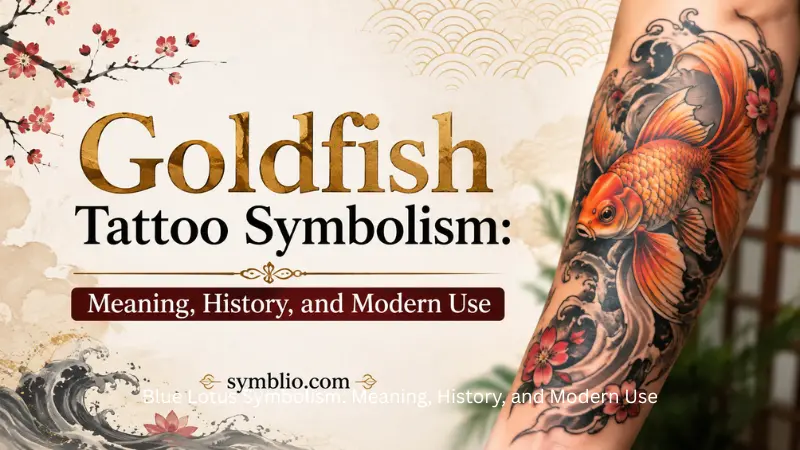
Goldfish may look delicate and decorative, but they can carry surprisingly varied meanings when used as body art. Goldfish tattoo symbolism most commonly centers on good fortune, prosperity, beauty, contentment, adaptability, and appreciation for life’s quieter pleasures.
These meanings come from several places. Goldfish were domesticated in China, where fish imagery became closely associated with abundance and favorable wishes. In Japan, goldfish developed strong connections with ornamental beauty, summer traditions, festivals, and popular art. Modern American tattoo culture draws from these traditions while also giving the image highly personal meanings.
A goldfish tattoo can therefore represent inherited cultural symbolism, a personal memory, or simply an attraction to the fish’s flowing shape and vivid colors.
Quick Answer
Goldfish tattoo symbolism commonly represents good luck, prosperity, beauty, calm, and contentment in modern American culture. Historically, its associations developed largely from Chinese ideas of fish as symbols of abundance and from Japanese traditions linking goldfish with elegance, summer, and everyday enjoyment.
TL;DR
- Goldfish often represent luck, prosperity, beauty, and contentment.
- Chinese fish symbolism connects strongly with abundance and good fortune.
- Japanese goldfish imagery often evokes summer, elegance, and nostalgia.
- Goldfish tattoos differ symbolically from traditional koi tattoos.
- Two goldfish can represent partnership, harmony, or companionship.
- Modern designs often combine cultural meaning with personal memories.
What a Goldfish Tattoo Commonly Represents
In the United States, goldfish tattoos are usually interpreted as positive symbols. Their bright colors, graceful fins, and peaceful movement naturally suggest beauty, calm, good fortune, and emotional balance.
Prosperity is another common meaning. Part of that association comes from older Chinese fish symbolism, while the gold or orange coloring can reinforce modern ideas of wealth, success, and value.
However, not every goldfish tattoo is meant to communicate financial prosperity. For some people, abundance means having enough love, time, family, security, or happiness.
Others choose the fish for personal reasons. A tattoo might commemorate a childhood pet, celebrate an interest in aquariums, or represent a person who prefers quiet confidence over dramatic displays of strength.
| Context | Common Meaning in the USA | Associations | Notes |
|---|---|---|---|
| Traditional-inspired design | Good fortune | Prosperity, abundance | Often draws from East Asian imagery |
| Flowing goldfish | Calm and grace | Movement, water, balance | Common modern interpretation |
| Two goldfish | Partnership | Love, friendship, harmony | Meaning depends on composition |
| Memorial tattoo | Remembrance | Childhood, home, affection | Usually highly personal |
| Decorative tattoo | Beauty | Creativity, elegance, individuality | May have no fixed cultural meaning |
Why the Goldfish Works So Well as a Tattoo Symbol
Goldfish have a naturally decorative appearance.
Many varieties have flowing tails, rounded bodies, dramatic fins, unusual eyes, or combinations of orange, red, white, black, and gold. Tattoo artists can use those shapes to create movement across the arm, shoulder, back, thigh, or ribs.
The fish’s physical appearance also affects its emotional meaning.
A shark may communicate danger. An eagle can imply authority or freedom. A goldfish usually creates a softer impression involving elegance, playfulness, tranquility, and cultivated beauty.
Its movement through water adds another layer. Curving fins and flowing lines can visually suggest adaptability, emotional fluidity, or moving through life without unnecessary resistance.
Chinese Origins of the Goldfish
The history of the domesticated goldfish begins in China.
Goldfish developed from freshwater carp relatives that sometimes displayed unusual yellow, orange, or reddish coloration. Over generations, people selectively bred these fish for appearance, producing increasingly distinctive colors, fins, eyes, and body shapes.
Eventually, goldfish became prized ornamental animals.
This history matters because the goldfish was not primarily celebrated as a fierce wild creature. It became admired for beauty, rarity, careful breeding, and visual distinction.
That background allows modern tattoo wearers to connect the fish with refinement, transformation, individuality, and appreciation for qualities that make something different rather than dominant.
These modern interpretations should not be confused with fixed ancient definitions, but they fit naturally with the animal’s historical development.
Why Fish Symbolize Abundance in Chinese Culture
One of the strongest traditional associations behind goldfish tattoos comes from Chinese symbolism surrounding fish more generally.
In Chinese language and decorative traditions, fish became associated with surplus, plenty, and having more than enough. The connection was strengthened by wordplay involving similar-sounding terms.
As a result, fish appeared in artwork, household decoration, ceramics, festival imagery, and other visual settings connected with prosperity and favorable wishes.
Goldfish naturally inherited some of these associations.
In modern tattoo design, prosperity does not have to mean becoming wealthy. Someone might interpret abundance as a stable home, strong relationships, emotional security, creative fulfillment, or simply having enough.
That makes the goldfish a useful symbol for people who want to express prosperity without focusing only on money.
Goldfish in Japanese Culture
Goldfish later became important in Japanese visual and popular culture as well.
When they first appeared in Japan, they were expensive ornamental animals associated mainly with wealthy households. As breeding expanded and goldfish became easier to obtain, they entered the lives of a much broader part of society.
Over time, they appeared in art, household environments, recreational activities, and seasonal traditions.
This Japanese cultural development added meanings that differ slightly from the Chinese emphasis on abundance.
Goldfish could suggest elegance, beauty, leisure, enjoyment, seasonal atmosphere, and everyday pleasure.
For tattoo wearers inspired by Japanese art, the fish can therefore carry a lighter and more nostalgic tone than symbols centered on struggle, battle, or conquest.
Why Goldfish Are Connected With Summer in Japan
Goldfish have a particularly strong association with Japanese summer culture.
They became familiar sights at warm-season festivals and were connected with the traditional game of scooping goldfish from shallow pools. Goldfish sellers and decorative images also contributed to their seasonal identity.
Because of this history, the fish can evoke warm evenings, festivals, childhood memories, bright colors, and temporary pleasures.
That gives Japanese-inspired goldfish imagery a sense of nostalgia.
A tattoo using this association might represent appreciation for small joys, memories of childhood, or the awareness that enjoyable moments do not last forever.
This differs from prosperity symbolism. The same fish can represent abundance in one context and seasonal beauty in another.
Goldfish and Buddhist Symbolism
Some online explanations connect ordinary goldfish tattoos directly with Buddhist symbolism, but the distinction is important.
A pair of golden fish is one of the traditional auspicious symbols used in Buddhist art. Within that religious context, the paired fish belong to a specific symbolic system.
However, this does not mean that every tattoo of an orange aquarium goldfish is automatically Buddhist.
A single fancy goldfish with bubbles, flowers, or decorative water is usually better understood through Chinese ornamental history, Japanese popular culture, modern tattoo symbolism, or the wearer’s personal interpretation.
A religious meaning becomes more relevant when the design intentionally uses a symmetrical pair of golden fish together with clearly Buddhist imagery.
Knowing that distinction helps prevent cultural symbols from being reduced to vague or inaccurate explanations.
Goldfish Tattoos vs. Koi Tattoos
Goldfish and koi tattoos are sometimes confused because both fish can appear in orange, red, black, white, or gold.
Their symbolism, however, usually emphasizes different qualities.
Koi imagery is strongly associated in modern tattoo culture with perseverance, endurance, ambition, strength, and overcoming obstacles. Dramatic koi designs often feature currents, waterfalls, or forceful swimming.
Goldfish usually communicate something gentler.
They are more commonly associated with good fortune, beauty, pleasure, prosperity, contentment, and graceful movement.
That difference is not absolute. Someone can choose a goldfish to symbolize surviving hardship or personal transformation. Tattoo symbolism is ultimately personal.
Still, perseverance is not the most natural starting point when explaining traditional goldfish meaning.
Emotional and Psychological Meaning
Goldfish tattoos can also communicate personality and emotional values.
The fish moves through water without the aggressive visual energy associated with many predator animals. That makes it suitable for someone who identifies with calmness, flexibility, sensitivity, or emotional awareness.
Contentment is another meaningful interpretation.
A goldfish can represent the idea that a satisfying life does not always require constant competition. Beauty, peace, friendship, creativity, and ordinary routines may be enough to create a meaningful existence.
For some wearers, that message feels more personal than symbols centered on victory or dominance.
Goldfish can also communicate playfulness. Fancy varieties often look colorful, unusual, and almost whimsical, making them suitable for people who want a tattoo that feels cheerful rather than intimidating.
What Two Goldfish Symbolize
A pair of goldfish often creates a relationship-centered meaning.
Two fish swimming together may represent romantic partners, close friends, siblings, family members, or two people whose lives remain connected.
When the fish circle one another, the composition can suggest balance, cooperation, or mutual influence.
Matching fish may emphasize equality. Different colors can represent two personalities that complement one another.
Fish swimming in opposite directions might symbolize independence within a relationship or two people following different paths while remaining emotionally connected.
However, two circling fish should not automatically be described as yin and yang.
Yin-yang has a specific philosophical history. A tattoo may intentionally reference it, but simply arranging two fish in a circle does not automatically create that meaning.
What Different Goldfish Colors Can Mean
Color can change the mood of a goldfish tattoo, although color meanings should not be treated as universal rules.
Orange and Gold
Orange and gold are the most recognizable colors. They naturally reinforce associations with prosperity, warmth, optimism, value, and good fortune.
Red
Red can suggest vitality, celebration, passion, or luck, especially when the design draws from Chinese visual traditions.
Black
Black creates a more dramatic appearance. Modern wearers may use it to represent individuality, survival, change, mystery, or personal strength.
There is no universal tradition stating that a black goldfish tattoo means bad luck.
White
White or pale goldfish can look delicate and minimalist. Depending on the wearer, they might suggest simplicity, peace, remembrance, or visual elegance.
Color works best when interpreted alongside the rest of the design rather than through rigid symbolic rules.
Symbols Commonly Combined With Goldfish
Companion imagery can change the message of a goldfish tattoo considerably.
Lotus Flowers
A lotus can introduce associations with spiritual growth, purity, or Buddhist-inspired imagery. Because the flower has genuine religious and cultural significance, it should be used with awareness rather than treated as generic decoration.
Water and Waves
Water reinforces movement, flexibility, emotional flow, and adaptation. Stylized waves may also create a stronger Japanese artistic influence.
Cherry Blossoms
Cherry blossoms are strongly associated with seasonal beauty and impermanence in Japanese culture. When combined with goldfish, they can create a design centered on beauty, passing time, or appreciation for temporary experiences.
Peonies
Peonies can give the tattoo a lush, ornamental appearance and may complement themes of prosperity, beauty, and abundance.
Fish Bowls and Aquariums
A bowl, tank, bubbles, or aquatic plants can make the tattoo feel more personal and nostalgic. These details may reference childhood, pets, home life, or an interest in aquarium keeping.
Goldfish Tattoos in Modern American Culture
American tattoo culture allows traditional symbolism and personal interpretation to exist together.
Some people choose Japanese-inspired goldfish with strong outlines, waves, and floral elements. Others prefer realistic portraits of particular varieties such as fantails, orandas, ranchus, or black moors.
Neo-traditional designs often emphasize saturated color and elaborate fins.
Minimalist tattoos may reduce the fish to a few curved lines, creating a small symbol of calm, memory, or good fortune.
Placement also changes the visual effect.
The arm, thigh, shoulder, and back provide room for flowing fins and surrounding water. Smaller tattoos on the wrist, ankle, or forearm can feel more private and personal.
For modern American wearers, the goldfish can therefore function as both a cultural symbol and an individual identity marker.
Goldfish as Symbols of Memory and Childhood
Not every goldfish tattoo needs a traditional cultural explanation.
For many Americans, goldfish are associated with childhood pets, family aquariums, classroom fish tanks, garden ponds, or early experiences of caring for an animal.
That makes the fish suitable for memorial tattoos.
Someone may use a goldfish to remember a specific pet, a family member who kept fish, or a period of life connected with home.
Small personal details can strengthen that meaning. A date, particular plant, aquarium decoration, or recognizable fish variety can turn a general symbol into a specific memory.
This personal use demonstrates how symbolism changes over time. A creature with centuries of cultural associations can acquire an entirely new meaning through one person’s lived experience.
Common Misunderstandings About Goldfish Tattoos
One of the most common mistakes is assuming that goldfish, koi, carp, and Buddhist golden fish are interchangeable.
They overlap visually and culturally, but their histories are not identical.
Another problem is assigning strict meanings to every color, number, or swimming direction.
Claims such as “a fish swimming left always means the past” or “a goldfish swimming upward always means success” are usually modern interpretations rather than universal historical rules.
They can still work as personal symbolism, but they should not be presented as fixed traditions.
Cultural respect means understanding what a design references before permanently using it.
Chinese characters, Buddhist symbols, Japanese religious imagery, and culturally specific patterns deserve particular care because inaccurate combinations can change or distort their intended meaning.
How Goldfish Symbolism Has Changed Over Time
Goldfish meaning developed gradually rather than appearing all at once.
In China, selective breeding transformed the ancestors of modern goldfish into prized ornamental animals. Existing fish symbolism connected them with favorable ideas such as abundance and prosperity.
In Japan, goldfish moved from expensive ornamental possessions into everyday popular culture. Art, household keeping, breeding, festival traditions, and summer recreation gave them additional associations with beauty, enjoyment, nostalgia, and seasonal life.
In the United States, those inherited meanings now exist alongside modern tattoo culture.
A single design might represent prosperity through Chinese-inspired symbolism, seasonal beauty through Japanese influence, and personal remembrance through the wearer’s own experience.
That layered history explains why two visually similar goldfish tattoos can mean very different things.
FAQs
Is a goldfish tattoo considered lucky?
What does a goldfish tattoo mean for a woman?
Is a goldfish tattoo the same as a koi tattoo?
What does a pair of goldfish mean?
Does a black goldfish tattoo mean bad luck?
Are goldfish tattoos Chinese or Japanese?
Can a goldfish tattoo symbolize freedom?
Conclusion
The goldfish works as a tattoo symbol because it combines cultural history with an image that feels approachable and personal. Chinese traditions contribute associations with abundance and good fortune, while Japanese culture adds elegance, summer memories, popular art, and appreciation for temporary pleasures.
Modern goldfish tattoo symbolism can also represent calm, individuality, companionship, childhood memories, or satisfaction with life’s smaller joys. The most meaningful design is usually one that understands the fish’s cultural background while leaving room for the wearer’s own story.
A goldfish does not need to symbolize struggle or dominance to carry meaning; sometimes prosperity, beauty, connection, and contentment are enough.


