
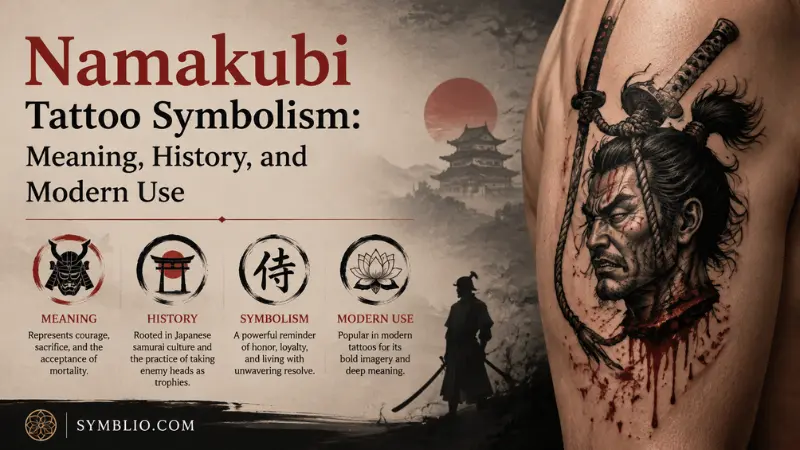
A namakubi tattoo symbolism can look startling at first: the image traditionally depicts a severed human head, often presented within the visual language of Japanese tattooing. Yet the design is not limited to violence or horror; its meanings can include courage, mortality, victory, warning, respect for an adversary, and acceptance of life’s impermanence.
For Americans encountering the motif through contemporary tattoo culture, understanding the historical background makes an enormous difference. Namakubi belongs to a much older visual world of Japanese warfare, folklore, woodblock prints, theater, and tattoo art, where images of death could communicate moral lessons, dramatic storytelling, or the temporary nature of worldly status.
Quick Answer
Namakubi tattoo symbolism commonly represents courage, confrontation with mortality, and acceptance of life’s impermanence in modern American tattoo culture. Historically, the severed-head motif was connected with warfare, warrior narratives, public warnings, folklore, and artistic depictions of heroes and defeated enemies.
TL;DR
- Namakubi literally refers to a freshly severed head.
- The motif can symbolize courage, mortality, victory, or warning.
- Japanese warrior art frequently depicted severed heads in historical narratives.
- Edo-period prints helped popularize dramatic warrior imagery.
- American tattoo culture often emphasizes personal strength and mortality.
- Context matters because the same image can carry different meanings.
What Does Namakubi Actually Mean?
The Japanese word namakubi (生首) refers literally to a freshly severed head. In tattoo culture, the term generally describes a stylized image of a severed head used as part of Japanese-inspired tattoo art.
The important point is that the word describes the image rather than prescribing one universal symbolic interpretation.
A namakubi might represent a defeated warrior, a historical figure, a character from folklore, or a dramatic fictional subject. The expression, surrounding imagery, and overall composition can change the message considerably.
A calm or dignified face can make the design feel contemplative. A fierce expression may emphasize defiance. A warrior surrounded by traditional Japanese motifs can suggest courage and martial resolve, while a supernatural character can shift the meaning toward folklore, fear, or transformation.
That flexibility is one reason the motif has survived as an artistic subject.
Why a Severed Head Became a Symbol
To a modern American viewer, a severed head naturally tends to communicate horror, violence, or danger. Japanese historical and artistic traditions provide a more complicated context.
During periods of warfare, enemy heads could be presented as evidence of battlefield accomplishments. The practice was part of a larger military culture in which identity, status, victory, and recognition were attached to the outcome of battles. The British Museum’s historical material on samurai warfare documents this practice and its representation in Japanese art.
That does not mean every namakubi image should be interpreted as a celebration of violence.
In art, the severed head could become a reminder that warriors, heroes, enemies, and rulers were all vulnerable to death. It could therefore carry an uncomfortable dual meaning: triumph and mortality at the same time.
That tension is central to understanding the symbol.
Namakubi in Japanese Warrior Art
Japanese artists repeatedly returned to battles and legendary warriors as subjects.
Woodblock prints from the Edo period portrayed famous warriors in dramatic scenes, including characters carrying or confronting severed heads. The British Museum’s collections contain numerous examples from the 18th and 19th centuries, demonstrating that this imagery was not invented by modern tattoo artists.
These artworks were often part of popular storytelling. Viewers already knew the historical or literary characters being depicted, so a head in the scene could communicate an entire story without words.
This is important because Japanese visual culture did not necessarily treat violent imagery as an isolated symbol. It could function as a narrative device.
A namakubi design therefore works best when viewed as part of a larger visual vocabulary rather than as a single dictionary definition.
The Connection With Samurai Is More Complicated Than It Looks
Modern tattoo descriptions often connect namakubi directly with samurai honor or bushido, but that explanation can become overly simplistic.
Warrior culture certainly matters. Historical Japanese art contains extensive imagery of battles, warriors, executions, defeated enemies, and heroic figures. However, elaborate decorative tattooing did not simply originate as a samurai tradition.
In fact, the development of Japanese tattooing during the Edo period involved urban workers, couriers, firefighters, entertainers, gamblers, and other groups. Ukiyo-e artists and popular literature played an important role in turning tattoo imagery into an elaborate visual art form.
The British Museum likewise preserves Edo-period warrior prints in which severed heads appear as elements of historical and literary storytelling.
So while a modern namakubi tattoo may intentionally evoke the warrior ideal, it should not be presented as though samurai were simply the original tattoo-wearing audience for the motif.
How Edo-Period Art Shaped the Modern Image
The Edo period was crucial to the visual development of Japanese tattooing.
Ukiyo-e woodblock printing made elaborate scenes of warriors, actors, legends, ghosts, monsters, and historical figures widely available. The Library of Congress describes ukiyo-e as a major artistic development of Edo-period Japan, centered on the culture of Edo, now Tokyo.
Artists such as Utagawa Kuniyoshi became particularly important to the visual language surrounding tattoo culture. His warrior prints featured dramatic compositions, expressive figures, weapons, mythical creatures, and other motifs that later influenced tattoo aesthetics.
This connection helps explain why Japanese tattooing often looks theatrical. It inherited a visual tradition built around storytelling, movement, recognizable characters, and carefully arranged backgrounds.
Namakubi fits naturally into that world.
What Namakubi Symbolizes in the United States
In contemporary American tattoo culture, the motif is usually interpreted through a personal rather than strictly historical lens.
Someone may choose a namakubi to represent:
- courage in the face of adversity
- acceptance of mortality
- overcoming fear
- survival after a difficult period
- respect for an opponent or past struggle
- personal transformation
- defiance
- remembrance
- the temporary nature of status and power
There is no single meaning that applies to everyone.
An American tattoo wearer may know Japanese history intimately, may be drawn primarily to traditional tattoo aesthetics, or may simply connect with the image as a reminder that life is temporary.
Those are different motivations, and none should automatically be assumed from the design alone.
Common Namakubi Meanings at a Glance
| Context | Meaning in the USA | Common Associations | Notes |
|---|---|---|---|
| Warrior imagery | Courage and resolve | Samurai stories, battle, honor | Often emphasizes historical storytelling |
| Mortality theme | Acceptance of life’s limits | Memento mori, impermanence | More reflective than violent |
| Victory theme | Overcoming adversity | Triumph, resilience, confrontation | Often highly personal |
| Warning imagery | Consequences and danger | Folklore, punishment, caution | Can feel darker or more theatrical |
| Folklore design | Transformation or supernatural danger | Ghosts, demons, legends | Meaning depends heavily on the character |
| Memorial design | Remembrance and loss | Memory, grief, history | Usually shaped by the wearer’s personal story |
Namakubi and the Idea of Mortality
One of the most useful ways to understand the motif is as a visual reminder of mortality.
Japanese art contains many traditions concerned with impermanence. Cherry blossoms, autumn leaves, fading beauty, aging, ghosts, and scenes of death can all function as reminders that circumstances change.
Namakubi expresses that idea in a much more confrontational form.
Instead of showing a flower that will eventually fall or a leaf that will eventually fade, it places human mortality directly into the composition.
For some tattoo wearers, that makes the image meaningful after a major life transition. The design can serve as a reminder to live with awareness of life’s limits rather than as a celebration of death itself.
Namakubi in Folklore and Ghost Stories
The severed head also appears outside battlefield imagery.
Japanese folklore includes stories of restless spirits, supernatural heads, monsters, and legendary figures whose deaths become part of the story. Some traditions portray the boundary between life and death as unstable, allowing a dead character to remain active within a narrative.
Japanese visual artists explored these subjects extensively. The British Museum, for example, holds Edo-period works depicting supernatural and frightening scenes involving severed heads and other forms of death imagery.
This gives namakubi another possible interpretation: the persistence of memory, unfinished conflict, supernatural consequence, or the unsettling relationship between death and identity.
A tattoo based on a folkloric character can therefore mean something very different from one based on a historical warrior.
Why Namakubi Works So Well in Tattoo Composition
Traditional Japanese tattoo design is rarely just about placing one isolated picture on the skin.
Japanese tattoo compositions commonly use waves, clouds, wind, flowers, animals, mythical creatures, and other background elements to connect separate subjects into a unified design. Contemporary discussions of Japanese tattoo composition continue to emphasize this relationship between central figures and their surrounding visual structure.
Namakubi can function especially well in this format because the human face naturally becomes a focal point.
Flowers may soften the subject. Waves can create movement. Leaves can establish a season. Snakes, demons, warriors, or other figures can provide narrative context.
The surrounding elements therefore matter almost as much as the head itself.
Flowers and Other Motifs Can Change the Meaning
A namakubi tattoo does not exist symbolically in isolation.
For example, flowers associated with impermanence can reinforce a mortality theme. Autumn foliage may suggest change and passing time. A warrior figure can shift the focus toward courage and conflict. A supernatural figure can make the tattoo feel more connected to folklore.
This is why reading a Japanese tattoo motif from one object alone can be misleading.
The same namakubi can communicate remembrance in one composition and defiance in another.
Tattoo symbolism is often closer to visual grammar than a fixed vocabulary: the meaning emerges from how the parts are arranged.
Emotional and Psychological Meaning
The emotional appeal of namakubi is partly based on contrast.
It combines vulnerability with defiance.
A human face is recognizable and emotionally expressive, yet the subject has been placed in a situation representing ultimate loss of control. That tension can make the design an effective metaphor for confronting difficult realities.
For some people, it represents the decision not to avoid uncomfortable subjects such as mortality, failure, loss, or fear.
For others, the meaning is simpler: the tattoo marks a difficult chapter that they survived.
The important distinction is that these interpretations describe the wearer’s relationship with the image. They are not universal psychological meanings built into every namakubi tattoo.
Namakubi and Modern American Tattoo Culture
Japanese tattooing has had a major influence on tattoo culture outside Japan, including in the United States.
American tattoo artists and collectors have adopted Japanese compositions, motifs, and visual conventions while often combining them with local tattoo traditions. Namakubi fits particularly well into this environment because its bold silhouette and expressive face are immediately recognizable.
At the same time, Japanese tattooing carries a complicated social history.
Tattooing in Japan was sometimes used as punishment, while decorative tattooing developed into an important artistic tradition during the Edo period. Later government restrictions contributed to tattooing’s stigma, and tattoos became strongly associated in modern Japanese society with criminality and organized crime.
That history is relevant when Americans adopt Japanese tattoo imagery. The design can be aesthetically admired while still carrying cultural associations that are less obvious to someone outside Japan.
Common Misunderstandings About Namakubi
The biggest misunderstanding is that a namakubi tattoo automatically means violence.
It does not.
The image has historical associations with warfare, but it also exists within storytelling, folklore, theater, visual art, mortality symbolism, and contemporary tattoo interpretation.
Another misconception is that every namakubi represents samurai honor. Samurai imagery is certainly one important context, but Japanese tattoo history is broader than samurai culture.
A third mistake is assuming that a tattoo has one permanent meaning. Tattoo symbolism depends on the wearer, the artist’s composition, the accompanying imagery, and the cultural knowledge surrounding the design.
The visual can remain historically recognizable while acquiring a new personal meaning.
Controversial and Distorted Interpretations
Because namakubi depicts death, some viewers may interpret it simply as an attempt to shock.
That reaction is understandable, especially in the United States, where severed-head imagery is strongly associated with horror films, fantasy, heavy metal aesthetics, and violent entertainment.
But reducing the design to shock value overlooks its historical artistic context.
There is also a risk in presenting Japanese imagery as a collection of interchangeable “warrior symbols.” Japanese tattoo traditions developed within particular historical, social, and artistic circumstances. Treating every motif as a generic symbol of toughness removes much of that context.
A respectful interpretation does not require a tattoo wearer to be Japanese. It does require recognizing that the design has a cultural history beyond its appearance.
How the Meaning Has Changed Over Time
Namakubi has moved through several different symbolic environments.
In historical warfare, severed heads could function as evidence of victory and status. In literature and visual art, they became elements of heroic narratives, tragedies, legends, and supernatural stories. Edo-period artists helped make dramatic warrior imagery part of popular visual culture.
In modern tattooing, the motif can become a personal statement about mortality, resilience, fear, or identity.
That evolution does not erase the earlier meanings. Instead, it adds new layers.
This is common with symbols. A modern viewer does not necessarily inherit an old symbol’s meaning unchanged. They reinterpret it through their own cultural surroundings.
What a Namakubi Tattoo May Say About Its Wearer
A tattoo cannot reliably tell you who someone is, but the choice of namakubi can communicate certain themes.
It may suggest that the wearer appreciates Japanese tattoo aesthetics, enjoys historical or folkloric imagery, identifies with warrior narratives, or wants a visible reminder of mortality and resilience.
It can also simply be an artistic preference.
That last possibility deserves attention. Not every tattoo needs a profound personal explanation. Some people choose a motif because they admire the composition, craftsmanship, facial expression, or traditional visual language.
Symbolism becomes more useful when it explains possibilities rather than assigning a personality to the person wearing the tattoo.
FAQs
A namakubi tattoo can symbolize courage, mortality, victory, warning, resilience, or acceptance of life’s impermanence. Its precise meaning depends on the surrounding imagery and the reason the wearer chose it.
It can be associated with samurai and historical warrior imagery, particularly because Japanese art frequently depicted battlefield scenes involving severed heads. However, namakubi should not be treated as an exclusively samurai symbol; it also appears in folklore, literature, theater, and broader Japanese visual culture.
No. The image has historical connections to warfare, but modern tattoo interpretations can focus on mortality, courage, remembrance, personal struggle, or impermanence. The surrounding design often determines which interpretation is most appropriate.
Namakubi is part of the broader visual vocabulary associated with Japanese tattooing, although the image itself has roots in Japanese art and storytelling that extend beyond tattooing. Historical Japanese woodblock prints provide numerous examples of severed-head imagery involving warriors and legendary characters.
Someone might choose the design because of its connection to Japanese art, warrior stories, mortality, resilience, or personal transformation. Others may simply appreciate its dramatic composition and traditional tattoo aesthetics.
Yes. In contemporary tattoo culture, it can represent courage, overcoming adversity, acceptance, and the willingness to face difficult realities. The image is unsettling, but its message does not necessarily have to be negative.
Not necessarily. Horror aesthetics may influence some modern designs, but the historical motif has a much broader background involving warfare, folklore, storytelling, and Japanese art. Calling every namakubi tattoo a horror design overlooks that history.
Conclusion
Namakubi is visually confronting, but its symbolism is more complicated than the image suggests. Its historical associations include warfare and warrior narratives, while Japanese art and folklore expanded the motif into stories about heroes, tragedy, supernatural forces, and the temporary nature of human life.
In modern America, namakubi tattoo symbolism often becomes personal. One person may see courage, another mortality, another resilience, and another simply the distinctive visual language of Japanese tattoo art.
The most accurate interpretation is therefore not “a severed head means one thing.” It is that namakubi creates a deliberately stark image through which history, mortality, courage, storytelling, and personal identity can meet.


