
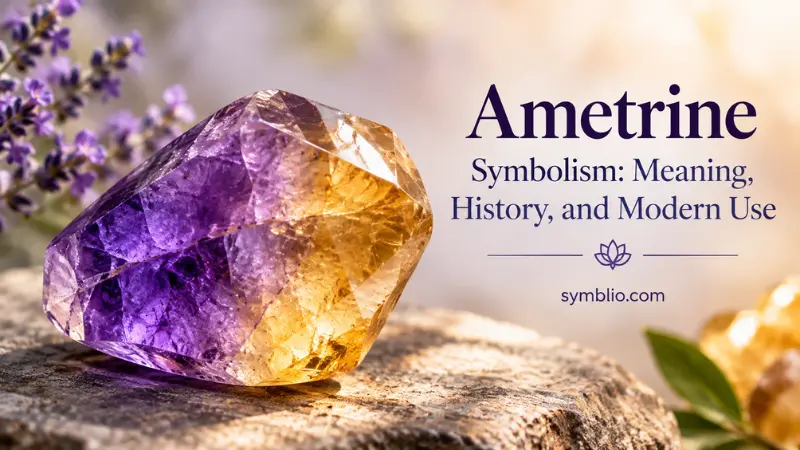
Ametrine is a naturally occurring variety of quartz recognized for its distinctive combination of purple amethyst and golden-yellow citrine in the same crystal. Its unusual two-color appearance has made it especially appealing in jewelry, mineral collecting, decorative objects, and modern discussions of gemstone symbolism. Ametrine symbolism is often connected with balance because the stone visibly brings two contrasting colors together.
The appeal goes beyond appearance. Purple and yellow have accumulated different associations in European and American traditions, so their combination can invite interpretations involving creativity and clarity, reflection and confidence, or spirituality and practical action.
For Americans today, ametrine is generally understood less as a fixed religious emblem and more as a gemstone whose contrasting colors offer a convenient metaphor for balance and individuality. Its symbolism comes from its geology, color associations, historical gemstone traditions, and the meanings people attach to it personally.
Quick Answer
Ametrine commonly symbolizes balance, harmony, and the integration of contrasting qualities in modern American culture, especially in jewelry and personal symbolism. Historically, its meaning developed from the established associations of amethyst and citrine rather than from one universal ancient tradition.
TL;DR
- Ametrine combines purple amethyst and golden citrine in one quartz crystal.
- Its central modern meaning is balance between contrasting qualities.
- Purple traditionally suggests spirituality, reflection, and dignity.
- Gold-yellow commonly suggests optimism, confidence, and warmth.
- Americans mainly encounter ametrine through jewelry, collecting, and personal style.
- Modern crystal meanings should be distinguished from documented historical traditions.
What Is Ametrine?
Ametrine is a bicolored form of quartz in which purple amethyst and yellow-to-orange citrine occur together. The color division can be sharp, creating a striking visual contrast, or more gradual, producing bands and transitions between the two shades.
The two colors develop because of differences in the conditions affecting iron within quartz during its formation. This geological origin matters symbolically because the gemstone does not simply combine two colors artificially. Its defining feature is a natural meeting of contrasting appearances within one crystal.
That visual quality explains why ametrine lends itself so easily to symbolic interpretation. A single stone can look divided and unified at the same time.
What It Commonly Means in the United States
In contemporary American gemstone culture, ametrine is most often associated with balance, duality, harmony, and personal integration.
The idea of balance comes directly from its appearance. Purple and yellow occupy opposite visual positions, yet they coexist in the same mineral. People may therefore use ametrine as a metaphor for bringing different parts of life together rather than choosing one side.
For example, someone might associate it with balancing:
- Intuition and practical thinking
- Rest and ambition
- Reflection and action
- Creativity and organization
- Individuality and social connection
These are modern symbolic interpretations rather than universally established meanings. Ametrine does not have one official symbolic definition in American culture.
The Meaning Behind Its Two Colors
Much of ametrine’s symbolism comes from the separate histories of purple and yellow.
Purple has long carried associations with dignity, religious devotion, contemplation, prestige, and artistic expression. In Western traditions, its connection with rarity and status was strengthened by the historical expense of producing certain purple dyes.
Yellow and gold have different associations. They can suggest sunlight, warmth, prosperity, vitality, celebration, and confidence. Gold has also been connected with wealth and social status.
When these colors appear together in ametrine, people naturally interpret their relationship. Instead of reading the purple and yellow independently, they may see the stone as representing the coexistence of inward reflection and outward confidence.
Ancient Roots and the History of Ametrine
Ametrine does not have the same extensive documented symbolic history as gemstones such as amethyst, jade, or lapis lazuli. It is therefore important not to invent ancient meanings for the specific stone.
The symbolic background of ametrine is better understood through the histories of its two color varieties. Amethyst has a long history in Greek and later European traditions, while yellow quartz varieties have been associated with gold, sunlight, ornament, and prosperity in different contexts.
The name itself reflects its composition: amethyst + citrine = ametrine.
The gemstone became particularly associated with South American deposits, especially material connected with Bolivia. Modern interest in ametrine grew alongside the gemstone trade and improved appreciation of unusual natural color zoning.
Its history illustrates an important point about symbolism: a gemstone can acquire modern cultural meaning without possessing a single ancient symbolic tradition.
Why Balance Became Its Central Symbol
Balance is perhaps the most intuitive interpretation of ametrine because the gemstone visually demonstrates coexistence.
Ametrine does not erase the difference between its colors. The purple remains purple, and the yellow remains yellow. Their relationship instead becomes the defining feature of the crystal.
That makes the stone useful as a modern symbol of difference without separation.
Someone choosing ametrine jewelry might interpret it as a reminder that seemingly opposite qualities can exist together. The symbolism can apply to personality, relationships, work, creativity, or periods of personal change.
This interpretation is especially compatible with modern American culture, where symbolic objects are often selected for personal significance rather than adherence to a formal tradition.
Ametrine and Emotional Symbolism
Ametrine can represent emotional steadiness, especially when people use its two colors as a metaphor for different emotional states.
Purple may suggest quiet reflection, while yellow can suggest openness and optimism. Together, they can represent moving between introspection and engagement with the outside world.
The symbolism should not be confused with a scientifically established psychological effect. There is no reliable evidence that wearing ametrine produces a particular emotional state.
Its emotional value is instead interpretive. A person may attach meaning to the stone because its appearance reminds them of a personal goal, transition, relationship, or philosophy.
Spiritual Associations and Modern Crystal Culture
Ametrine is sometimes given spiritual or metaphysical meanings in modern crystal culture. In these settings, it may be associated with balance, intention, meditation, clarity, or the integration of different aspects of the self.
Those interpretations belong to contemporary spiritual practice rather than established scientific findings or one universally recognized religious tradition.
This distinction is useful because gemstone symbolism often mixes several layers: documented history, folklore, artistic tradition, commercial language, and personal belief. They should not all be presented as equally historical.
For readers interested in symbolism, ametrine is most accurately described as a gemstone with strong modern metaphorical associations, rather than as an ancient universal spiritual symbol.
Ametrine in American Jewelry and Personal Style
Jewelry is where ametrine’s symbolism becomes particularly visible in the United States.
Its unusual color combination makes it attractive in rings, pendants, earrings, bracelets, and collector’s pieces. Unlike a uniformly colored gemstone, each ametrine can have a somewhat different division between purple and yellow.
That individuality contributes to its appeal. A person who wants jewelry that feels distinctive may prefer ametrine precisely because no two pieces present the color contrast in exactly the same way.
Symbolically, this can reinforce themes of individuality and complexity. The stone does not fit neatly into a single color category, which makes it suitable for people who see identity as multifaceted.
What Ametrine Can Symbolize in Different Contexts
| Context | Meaning in the USA | Common Associations | Notes |
|---|---|---|---|
| Jewelry | Balance and individuality | Contrast, harmony, self-expression | Often chosen for its unusual color |
| Meditation | Inner balance | Reflection, intention, calm | Primarily a modern spiritual interpretation |
| Gift giving | Personal growth | Change, integration, encouragement | Meaning depends strongly on the relationship |
| Mineral collecting | Natural rarity | Geology, beauty, uniqueness | Focuses more on the crystal itself |
| Interior decor | Harmony between colors | Warmth, contrast, visual balance | Usually an aesthetic rather than religious use |
Ametrine as a Symbol of Duality
Ametrine can also represent duality, but duality does not necessarily mean conflict.
Two contrasting colors may suggest two identities, two choices, two stages of life, or two perspectives. The stone offers a visual way to express the idea that these differences can coexist.
This makes ametrine particularly suitable for symbolic themes involving transition. Someone beginning a new chapter may see the stone as representing both where they came from and where they are going.
Its symbolism can therefore be more nuanced than simply “balance.” It can suggest accepting complexity rather than forcing everything into one category.
Ametrine in Gifts, Milestones, and Personal Meaning
Ametrine can make a meaningful symbolic gift when the giver wants to emphasize growth or balance.
For example, it may suit occasions involving:
- A new job or educational chapter
- A major life transition
- A creative achievement
- A personal milestone
- A friendship built around complementary personalities
Unlike traditional anniversary or birthstone symbolism, ametrine does not carry one universally recognized message for every recipient. Its value as a gift comes from the story attached to it.
A short personal explanation can make the symbolism more meaningful than relying on a generic gemstone definition.
Cross-Cultural Perspectives on Its Meaning
Ametrine itself does not have a single cross-cultural symbolic system comparable to certain religious or traditional symbols.
The colors within it, however, have broader cultural histories. Purple has appeared in religious clothing, royal imagery, ceremonial contexts, and artistic traditions. Yellow and gold have been connected in many societies with sunlight, preciousness, celebration, wealth, or sacred imagery.
These associations vary considerably by culture. A color that represents mourning or caution in one setting may have an entirely different meaning elsewhere.
Consequently, it is more accurate to discuss ametrine as a modern gemstone whose symbolism draws upon widely recognizable color associations, rather than claiming that every culture has historically interpreted ametrine in the same way.
Common Misunderstandings About Ametrine
One common mistake is treating modern crystal descriptions as if they were ancient historical facts.
Claims that ametrine had one specific meaning in ancient civilizations should be approached carefully unless supported by strong historical evidence. The gemstone’s modern popularity does not automatically prove an ancient symbolic tradition.
Another misunderstanding is assuming that ametrine has scientifically verified emotional or healing properties. Symbolic meaning and medical evidence are separate questions.
There is also no requirement that every person who wears ametrine interpret it as a symbol of balance. Someone may simply appreciate its natural color, geological formation, or appearance.
How Its Meaning Has Evolved
Ametrine’s modern symbolism reflects a broader change in the way Americans use gemstones.
Historically, gemstones could communicate wealth, status, religious affiliation, protection, or social position. Today, people still use jewelry to express identity, but the meaning is often more individualized.
Ametrine fits this environment particularly well because its physical appearance encourages personal interpretation. Its symbolism can be about balance, contrast, transition, creativity, or simply appreciation for natural variation.
The modern meaning is therefore less about a fixed cultural code and more about the relationship between the stone’s appearance and the story the wearer gives it.
Ametrine in Modern Culture and Design
Outside traditional jewelry, ametrine’s colors work naturally in contemporary design. Purple and warm yellow create a noticeable contrast that can appear in decorative objects, artwork, fashion accessories, photography, and digital imagery.
In social media culture, gemstones are also frequently presented as visual symbols of personality and lifestyle. Ametrine’s unusual appearance makes it easy to photograph and recognize, which supports its appeal among mineral enthusiasts and jewelry buyers.
Its modern cultural role is therefore partly symbolic and partly aesthetic. The two cannot always be separated.
Why People Connect With Ametrine
Ametrine offers something that many symbolic objects lack: its metaphor is visible immediately.
You do not need to know a complicated legend to understand why someone might see balance in a crystal containing both purple and yellow. The symbolism emerges from observation.
That makes it especially accessible. A person can interpret the stone through traditional color associations, personal experience, geology, design, or spiritual practice without needing to adopt one particular belief system.
For many Americans, that flexibility is precisely what makes a symbolic gemstone useful.
Ametrine Tattoo and Personal Symbolism
Ametrine is less common as a tattoo subject than familiar symbols such as flowers, animals, celestial objects, or traditional gemstones. When someone does choose it, the design can communicate a personal connection to balance, duality, individuality, or transformation.
A tattoo might emphasize the natural division between purple and yellow or incorporate the crystal into a larger design involving other personal symbols.
The meaning is highly individual. Unlike a standardized emblem, an ametrine tattoo does not have one universally recognized interpretation in American tattoo culture.
FAQs
Ametrine commonly symbolizes balance, harmony, duality, and the coexistence of contrasting qualities. These meanings are largely modern interpretations inspired by its natural combination of purple amethyst and yellow citrine.
It can be. Modern crystal traditions sometimes connect ametrine with meditation, intention, balance, and personal reflection, but these are spiritual interpretations rather than scientifically established effects.
An ametrine tattoo can represent balance, personal complexity, transformation, or the integration of contrasting qualities. Because ametrine lacks a single standardized tattoo meaning, the wearer’s personal story is especially important.
Ametrine is not generally recognized as a universal religious symbol. Its spiritual associations mainly come from modern gemstone and crystal practices, while some of its color symbolism draws on older traditions involving amethyst and purple.
In modern American symbolism, ametrine is generally interpreted positively. Balance, individuality, optimism, reflection, and harmony are among its common associations.
Its appearance provides the main reason: one naturally formed crystal contains distinctly purple and yellow areas. The coexistence of these contrasting colors makes balance and integration intuitive metaphors.
Ametrine itself has a more limited documented symbolic history than some famous gemstones. Many meanings currently associated with it are modern interpretations based on its appearance and the older symbolism of amethyst, citrine, and their colors.
Conclusion
Ametrine’s symbolism begins with its unusual physical character: purple amethyst and golden citrine occurring together in one natural quartz crystal. In modern American culture, that combination most commonly represents balance, duality, harmony, individuality, and the ability to hold contrasting qualities together.
Its meaning is not fixed by one ancient legend or religious tradition. Instead, ametrine has developed a modern symbolic language from geology, color associations, jewelry culture, contemporary spirituality, and personal interpretation.
That flexibility may be its most relevant quality today. Ametrine can symbolize two different sides without requiring one to disappear, making it a natural choice for people who see complexity as part of a complete identity.


