
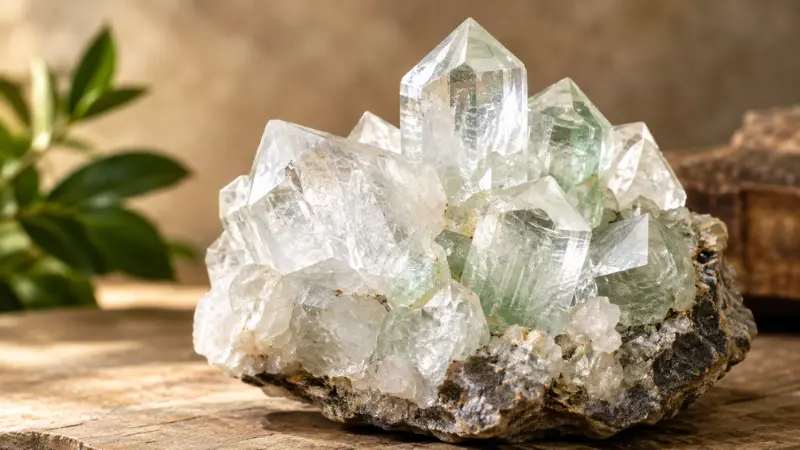
Apophyllite is a clear, white, pale green, or sometimes pink mineral known for its glassy luster, delicate crystal forms, and striking transparency. Mineralogically, “apophyllite” refers to a group of related minerals, with fluorapophyllite-(K) being the most common member when the name is used generally.
Its symbolic reputation is newer than its mineralogical history. In modern crystal culture, apophyllite symbolism is most often connected with mental clarity, honest reflection, meditation, spiritual awareness, and a sense of openness. These meanings come largely from contemporary metaphysical traditions rather than from an ancient, universally shared religious tradition.
That distinction matters. A beautiful crystal can acquire cultural meaning without having one fixed meaning across all societies. Apophyllite is a good example: its physical appearance, geological history, collecting culture, and modern spiritual use have all contributed to the way people interpret it today.
Quick Answer
Apophyllite symbolism commonly represents clarity, calm reflection, spiritual awareness, and openness in modern American crystal culture, especially in meditation, personal-growth, and decorative settings. Historically, however, apophyllite is better documented as a mineral than as an ancient symbol, so many of its spiritual meanings are modern interpretations rather than inherited religious traditions.
TL;DR
- Apophyllite commonly symbolizes clarity and reflective awareness.
- Its name comes from Greek words describing its tendency to exfoliate when heated.
- Modern crystal culture links it with meditation and spiritual reflection.
- Clear crystals often reinforce its associations with openness and mental focus.
- Indian specimens helped make apophyllite especially recognizable among collectors.
- Its spiritual claims should be treated as beliefs, not scientific facts.
What Apophyllite Looks Like and Why Appearance Matters
Apophyllite usually appears as transparent to translucent crystals with a glassy or pearly luster. Crystals may be colorless, white, greenish, or occasionally pink, and many specimens develop tabular or prismatic forms with distinctive terminations.
That appearance plays an important role in its modern symbolism.
A transparent crystal naturally invites associations with seeing, openness, and visibility. When light passes through the mineral, people may interpret the visual effect as a metaphor for removing confusion or seeing something more clearly.
This does not mean the mineral scientifically produces mental clarity. Instead, the symbolism develops from the way people experience and interpret the object.
Its delicate structure also contributes to its character. Apophyllite has excellent basal cleavage, meaning it can separate along particular crystal planes. The name itself refers to this behavior when heated.
What Apophyllite Commonly Symbolizes in the United States
In contemporary American crystal culture, apophyllite is most often associated with clarity, reflection, spiritual awareness, and calm.
These meanings tend to appear in several overlapping contexts:
- meditation and quiet reflection
- crystal collecting
- personal spiritual practices
- interior decoration
- jewelry and small decorative objects
- discussions about intuition and self-awareness
Clarity is probably the easiest meaning to understand. A clear or translucent crystal can become a visual reminder to slow down, examine a situation honestly, and separate useful information from mental clutter.
Spiritual awareness is another common interpretation. Crystal practitioners may use apophyllite as a symbolic object during meditation or contemplative practices. The stone’s light appearance makes it particularly suitable for themes involving illumination, insight, and openness.
Importantly, these are cultural and spiritual associations, not established scientific properties.
Ancient Roots and the Real History of Its Name
Apophyllite does not have the kind of ancient symbolic history associated with symbols such as the lotus, cross, or serpent.
The mineral itself was known to mineralogists before modern crystal spirituality, but its formal scientific naming dates to the early nineteenth century. René-Just Haüy named apophyllite in 1806, drawing from Greek words meaning approximately “away” and “leaf,” referring to the mineral’s tendency to exfoliate when heated.
This origin is revealing because the original name was descriptive rather than mystical.
Early mineralogists were interested in the mineral’s chemistry, crystal form, cleavage, and behavior under heat. Older mineralogical literature also recorded alternative names based on its appearance, including “fish-eye-stone” or ichthyophthalmite.
The modern symbolic interpretation therefore developed separately from the mineral’s original scientific identity.
How Indian Apophyllite Shaped Its Modern Image
India has played an important role in the history of apophyllite specimens, particularly the Deccan region of Maharashtra.
The Deccan volcanic rocks contain cavities where secondary minerals formed from circulating fluids. Apophyllite occurs in these cavities alongside minerals such as stilbite and heulandite. Scientific studies have documented apophyllite formation within the Deccan volcanic province over complex geological periods.
The Pune and Nashik areas became particularly famous for attractive specimens. Historical accounts describe clear, white, pink, and green crystals from the Deccan region, including specimens associated with railway construction and quarrying.
This geological story matters to symbolism because modern crystal culture often encounters apophyllite through spectacular mineral specimens. A transparent crystal cluster growing against dark basalt creates a striking contrast between darkness and light.
That visual contrast easily supports contemporary interpretations involving illumination, awareness, and clarity—even though those interpretations should not be confused with ancient Indian religious teachings about the mineral.
Why Clarity Became Apophyllite’s Central Symbol
Among its modern meanings, clarity is particularly closely tied to apophyllite’s appearance.
The crystal can look almost like frozen glass. Light enters, reflects, and passes through portions of the specimen. For people who use objects symbolically, that makes it a natural metaphor for clear thinking.
The idea can be applied to ordinary situations:
A person facing a difficult decision might keep an apophyllite specimen on a desk as a reminder to pause before reacting.
Someone beginning a meditation practice might associate its transparent appearance with quiet observation.
A collector might simply appreciate it as a physical example of how geological processes produce remarkable structures.
In each case, the symbolism comes from human interpretation. The crystal becomes a physical prompt for a mental habit rather than a scientifically demonstrated source of that mental state.
Apophyllite and Spiritual Awareness
Modern metaphysical writing frequently connects apophyllite with spiritual awareness, intuition, meditation, and a perceived connection with something beyond ordinary concerns.
Some practitioners also connect it with the crown or third-eye chakras. Those associations belong to contemporary spiritual and crystal-healing frameworks rather than to the mineral’s scientific classification.
For a person who accepts those traditions, apophyllite may function as a meditation object or personal reminder. For someone who does not share those beliefs, the same crystal can simply represent contemplation, quietness, or curiosity about nature.
That flexibility is part of its appeal in the United States, where mineral collecting, wellness culture, spirituality, interior design, and personal symbolism frequently overlap.
Emotional and Psychological Meaning
Symbolically, apophyllite tends to communicate a quiet rather than dramatic emotional message.
Its meanings often center on:
- clearing mental clutter
- making space for reflection
- approaching decisions calmly
- looking at personal experiences honestly
- remaining open to new perspectives
- creating a peaceful environment
The symbolism is therefore less about courage, aggression, or status and more about inward attention.
A person who chooses apophyllite for a personal collection may be expressing an interest in calm spaces and reflective practices. Someone who gives it as a gift may intend a message such as “take time to think,” “find clarity,” or “make room for a fresh perspective.”
Those interpretations are contemporary and personal rather than universal rules.
Apophyllite Symbolism in American Home Decor
Apophyllite has a particularly strong place in decorative mineral collecting.
Clusters can function as natural sculptures, especially when transparent crystals grow over contrasting matrix material. Their pale colors also fit easily into minimalist, contemporary, and nature-inspired interiors.
In an American home, an apophyllite specimen might appear on:
- a bookshelf
- a desk
- a display cabinet
- a coffee table
- a meditation area
- a collection of minerals and fossils
Its decorative meaning often overlaps with its symbolic meaning. A person may choose it because it looks beautiful while also appreciating the ideas of clarity and reflection associated with it.
This is different from claiming that the object has a measurable psychological effect. The value can be aesthetic, personal, cultural, or symbolic without needing a supernatural explanation.
Apophyllite in Meditation and Personal Ritual
Modern crystal practitioners sometimes place apophyllite near them during meditation, journaling, prayer, or other reflective activities. Contemporary crystal sources commonly describe it in terms of clarity, spiritual connection, and inner awareness.
The important distinction is between symbolic practice and medical or scientific treatment.
A crystal can serve as a visual anchor. Looking at the same object during a quiet practice may help someone create a consistent ritual or environment. That psychological function is different from claiming that the mineral itself changes health, brain function, or spiritual reality.
For many people, the symbolic purpose is enough: the crystal represents the kind of attention they want to cultivate.
Apophyllite Color Symbolism
Apophyllite is not limited to one color, and color can change how people interpret individual specimens.
| Context | Meaning in the USA | Common Associations | Notes |
|---|---|---|---|
| Clear or colorless | Clarity and openness | Reflection, insight, transparency | Most closely matches its modern “clarity” image |
| White | Simplicity and calm | Clean spaces, meditation | Often chosen for minimalist displays |
| Green | Renewal and balance | Nature, growth, emotional openness | Green color can add a heart-centered interpretation |
| Pink | Gentleness and affection | Compassion, warmth | Less common than clear or white specimens |
| Crystal cluster | Connection and complexity | Community, perspective | Individual crystals form a larger visual structure |
Color symbolism here is interpretive rather than fixed. A green apophyllite specimen does not possess one universally recognized “green meaning”; the interpretation depends on the surrounding cultural framework.
Apophyllite Compared With Other Symbolic Crystals
Apophyllite occupies a particular niche within modern crystal culture.
Clear quartz is often treated as a broad symbol of clarity, amplification, and versatility. Amethyst is frequently associated with spirituality, calm, and contemplation. Rose quartz is strongly associated with affection and emotional relationships.
Apophyllite tends to be more specifically connected with mental clarity and spiritual reflection.
That distinction helps explain why its symbolism can feel quieter than that of some more commercially familiar crystals. Its appeal is often based on transparency, delicacy, and introspection rather than romance, protection, or strength.
Cross-Cultural Meaning: What Can Actually Be Supported?
It is tempting to describe apophyllite as an ancient spiritual stone from a particular culture, but the evidence does not support treating it as a universally established sacred symbol.
The mineral has important geological occurrences in India, especially Maharashtra, and Indian apophyllite specimens are internationally recognized among mineral collectors.
That geological connection should not automatically be turned into a religious one.
Modern crystal sellers and practitioners may associate apophyllite with spiritual awakening, higher consciousness, intuition, or meditation. These are best described as modern metaphysical interpretations, not as ancient beliefs shared throughout Indian culture.
This distinction makes the symbolism more accurate and culturally respectful.
Apophyllite in Jewelry, Gifts, and Personal Style
Apophyllite is more fragile than many popular jewelry stones, which limits its everyday use in rings and heavily worn pieces. Its perfect cleavage and relatively modest hardness make specimens better suited to careful display than rough daily handling.
For that reason, its strongest modern presence is often as a mineral specimen rather than a mainstream fashion gemstone.
As a gift, however, apophyllite can communicate several messages:
- “I hope you find clarity.”
- “Take time for yourself.”
- “Trust thoughtful reflection.”
- “Keep an open mind.”
- “Create a peaceful space.”
The exact message depends on the relationship between giver and recipient.
Common Misunderstandings About Apophyllite
One common misunderstanding is that apophyllite has one ancient, universally agreed spiritual meaning. It does not.
Another is that every claim made about its metaphysical effects has scientific support. Claims that crystals can heal illness, alter energy fields, or produce specific physiological effects are not established simply because they appear frequently in crystal literature.
There is also confusion between the apophyllite group and a single mineral species. Modern mineralogical classification recognizes several related species within the group, while “apophyllite” remains widely used as a general term.
Finally, not every clear crystal sold under a similar visual description is necessarily apophyllite. Mineral identification is better based on crystal form, chemistry, locality, and testing than appearance alone.
How Apophyllite’s Meaning Has Evolved
Apophyllite’s story illustrates how symbolism can emerge from changing relationships with an object.
In the nineteenth century, the mineral was primarily an object of scientific and collecting interest. Its name described a physical behavior rather than a spiritual quality.
As mineral collecting expanded, spectacular specimens from locations such as Maharashtra became widely appreciated for their unusual beauty. The mineral increasingly appeared in collections where aesthetics mattered alongside scientific interest.
Modern crystal culture added another layer. Transparency became associated with clarity; reflective use became associated with meditation; and its pale, light-catching appearance encouraged ideas about openness and spiritual awareness.
The result is a modern symbolic identity built from several influences rather than a single ancient tradition.
Positive and Negative Symbolism of Apophyllite
Apophyllite is overwhelmingly associated with positive ideas in contemporary American symbolism.
Its common positive meanings include clarity, openness, reflection, peace, awareness, and personal growth.
Its potential “negative” symbolism is usually indirect. Because the mineral is delicate and can separate along cleavage planes, someone might use it metaphorically for fragility or the need for careful handling. But this is not a standard cultural meaning.
Likewise, its association with spirituality can become negative if people treat unverified metaphysical claims as established medical or scientific facts.
A balanced interpretation keeps the symbolic value while recognizing the difference between belief and evidence.
Why Apophyllite Still Matters in Modern Culture
Apophyllite fits neatly into a modern American interest in objects that combine natural beauty with personal meaning.
A mineral specimen can simultaneously be geology, decoration, collectible material, conversation piece, and personal symbol. None of those interpretations has to cancel the others.
For some people, the crystal’s transparency is simply beautiful. For others, it represents mental clarity. A collector may care most about locality and crystal formation, while someone interested in meditation may value the object as a visual reminder to slow down.
That range of meanings is what keeps apophyllite relevant without requiring it to have one fixed definition.
FAQs
Apophyllite commonly symbolizes clarity, reflection, openness, and spiritual awareness in contemporary American crystal culture. Its transparent appearance is a major reason these associations have developed.
Apophyllite is not a universally recognized religious symbol. Modern spiritual practitioners may incorporate it into meditation or personal rituals, but those practices should not be presented as an ancient or universal religious tradition.
Clear apophyllite is often interpreted as a symbol of mental clarity, transparency, insight, and openness. These meanings are primarily contemporary symbolic associations based partly on the crystal’s appearance.
In modern crystal practice, apophyllite may serve as a reminder of stillness, reflection, and spiritual awareness. Its role is symbolic and personal rather than a scientifically established method of producing a particular mental state.
Crystal-healing traditions sometimes attribute emotional or spiritual benefits to apophyllite. Those claims belong to complementary spiritual beliefs and should not be treated as proven medical effects or as substitutes for professional care.
Maharashtra’s Deccan volcanic province contains numerous cavities where apophyllite and other secondary minerals formed. The region has produced exceptionally attractive crystals and became an important source for mineral collectors.
The mineral group occurs at many localities worldwide, so apophyllite is not simply a universally rare mineral. However, large, transparent, well-formed specimens can be highly desirable to collectors because exceptional crystal quality is much less common.
Conclusion
Apophyllite symbolism today is centered mainly on clarity, reflection, openness, and spiritual awareness. Its transparent crystals make those ideas visually intuitive, while modern meditation and crystal practices have given them a more personal and spiritual dimension.
At the same time, apophyllite’s documented history begins with mineralogy rather than an ancient symbolic tradition. Understanding that distinction makes its modern meaning more interesting, not less: a mineral first named for its physical behavior has gradually become a contemporary symbol of seeing clearly and making space for thoughtful reflection.


