
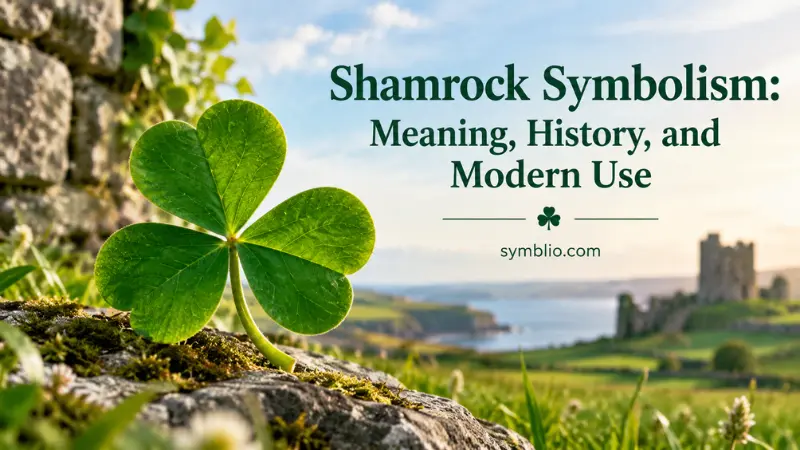
A shamrock is a small three-leaf plant, but its cultural meaning reaches far beyond its appearance. Shamrock symbolism is most closely associated with Irish identity, St. Patrick’s Day, Christian tradition, spring, and national pride, while its three leaves have also made it a recognizable symbol of belonging in the United States.
For many Americans, the shamrock immediately brings to mind green clothing, St. Patrick’s Day parades, Irish heritage, and festive decorations. Yet its story is more complicated than the familiar image suggests. The connection between the shamrock and St. Patrick’s explanation of the Christian Trinity became widely accepted over time, but historians note that this tradition is relatively late rather than something firmly documented from Patrick’s lifetime.
Understanding the shamrock therefore means looking at several layers at once: an ordinary plant, an Irish cultural emblem, a Christian teaching symbol, a marker of national identity, and eventually a major part of American holiday culture.
Quick Answer
Shamrock symbolism commonly represents Irish heritage, pride, good fortune, and St. Patrick’s Day in modern American culture. Historically, its three leaves became associated with the Holy Trinity and with Irish identity, while older traditions also connected the plant with spring and renewal.
TL;DR
- The shamrock commonly represents Irish heritage and cultural pride.
- Its three leaves became linked with the Holy Trinity.
- Earlier Irish traditions associated the plant with spring.
- Irish national identity strengthened the shamrock’s symbolic role.
- Americans strongly associate it with St. Patrick’s Day.
- Modern designs use shamrocks for heritage, luck, and celebration.
What a Shamrock Looks Like
A shamrock is generally represented as a small green plant with three rounded leaflets joined at a central point. The word is commonly used for several types of clover-like plants, so the familiar symbol does not necessarily identify one precise botanical species.
That distinction matters because the shamrock people see on greeting cards, clothing, jewelry, and decorations is often a stylized image rather than a botanical illustration. Designers usually exaggerate the three-leaf shape so that the symbol can be recognized immediately.
Its simplicity is part of its appeal. Three curved leaves can be drawn with only a few lines, making the shamrock easy to place on signs, badges, fabrics, jewelry, logos, food packaging, and holiday decorations.
The three-part structure also gives the plant its most important symbolic association. Instead of representing only vegetation, the three leaves allow the shamrock to carry ideas about unity, balance, and Irish identity.
What the Shamrock Commonly Means in the United States
In the United States, the shamrock is primarily a cultural symbol of Ireland and Irish heritage.
You can see this meaning during March, when shamrock imagery appears on parade banners, storefronts, clothing, greeting cards, school decorations, and social media posts. Americans with Irish ancestry may use it as a straightforward expression of family heritage, while others use it simply as a familiar symbol of St. Patrick’s Day.
The meaning can therefore vary by context. For someone researching family ancestry, a shamrock may communicate connection to Ireland. At a St. Patrick’s Day celebration, it can simply signal participation in a widely recognized American holiday.
The National Museum of Ireland describes symbols such as the shamrock as ways people communicate attachment to Ireland and a sense of belonging to a group or country.
That identity function helps explain why the shamrock remains recognizable even among Americans who have little personal connection to Ireland.
The Shamrock and the Holy Trinity
The best-known religious interpretation connects the three leaves with the Christian Holy Trinity: the Father, the Son, and the Holy Spirit.
According to the familiar tradition, St. Patrick used the three-leafed plant as a visual teaching aid when explaining Christian beliefs in Ireland. The idea is straightforward: one plant has three leaves, offering a simple comparison for the Christian concept of three persons in one God.
However, this story should be treated as tradition rather than firmly documented history.
The National Museum of Ireland specifically notes that the belief that Patrick used the shamrock to explain the Trinity is relatively late. The museum also points out that three-part groupings were already important in pre-Christian Irish traditions, making the story more complicated than a simple claim that Patrick invented the symbolism.
For Christians who use the shamrock symbolically, its three leaves can therefore suggest unity within the Trinity. Outside explicitly religious settings, however, the same shape usually carries cultural rather than theological meaning.
Ancient Roots and Early Irish Associations
The shamrock’s history reaches beyond St. Patrick’s Day.
Historical accounts describe three-leafed clover as a plant associated with earlier Irish traditions. Some modern sources connect it with ideas of spring and renewal, reflecting the plant’s green appearance and seasonal growth.
The important point is that the shamrock did not become meaningful only because of one Christian legend. Ireland already had cultural traditions in which three-part structures could carry significance.
The National Museum of Ireland notes that triads were central to pre-Christian Celtic religious tradition. This helps explain why the later Christian association with three leaves could fit naturally into existing cultural patterns.
Over time, different layers accumulated rather than replacing one another completely. Spring, threefold structure, Christianity, Irish identity, and national pride all became connected with the plant.
How the Shamrock Became a Symbol of Irish Identity
The shamrock gradually became more than a religious or seasonal emblem. By the 17th century, it had developed an association with Irish identity and, later, Irish nationalism.
This change was significant because symbols can become especially important when people use them to communicate identity publicly.
During periods of political conflict and restrictions on Irish culture, green imagery and shamrocks could signal attachment to Irish heritage. By the late 18th century, green had increasingly acquired nationalist associations, and wearing green could communicate solidarity with Irish causes.
The shamrock consequently became useful because it was small, recognizable, and easy to wear. A person did not need a long explanation to communicate an Irish connection.
That makes the shamrock an example of identity symbolism: an ordinary object becomes a visual shorthand for belonging.
Shamrocks and St. Patrick’s Day
St. Patrick’s Day is the setting in which most Americans encounter shamrock imagery.
March 17 commemorates St. Patrick, the patron saint of Ireland. Over centuries, the religious observance developed into a much broader cultural celebration, particularly in countries with large Irish immigrant populations.
In Ireland, older traditions included attending church and wearing shamrock. Historical folk customs also included the practice of eventually discarding the worn shamrock after celebrations.
In the United States, St. Patrick’s Day became increasingly associated with public celebrations, parades, green clothing, and displays of Irish identity. Irish immigrants used the holiday as an opportunity to strengthen community connections and publicly express cultural pride.
The shamrock fit naturally into this environment because it communicated Irishness in an instantly recognizable form.
Why Shamrocks Matter So Much in American Culture
The American meaning of the shamrock developed through immigration, community life, and popular celebration.
Irish immigrants brought St. Patrick’s Day traditions with them, but American communities transformed the holiday in distinctive ways. Historical records show St. Patrick’s Day celebrations in colonial America, including an early parade in Florida in 1601 and later celebrations among Irish communities in Boston and New York.
During the 18th and 19th centuries, St. Patrick’s Day became an important occasion for Irish Americans to express community identity, particularly as immigrants faced discrimination and worked to establish themselves socially and politically.
Today, the shamrock can therefore communicate two related ideas:
| Context | Meaning in the USA | Common Associations | Notes |
|---|---|---|---|
| St. Patrick’s Day | Celebration and Irish culture | Parades, green clothing | Most common modern use |
| Irish ancestry | Heritage and belonging | Family history, genealogy | Can be personally meaningful |
| Religious setting | Christian Trinity | St. Patrick, Christianity | Depends on the community |
| Jewelry or tattoos | Identity or good fortune | Personal style | Meaning varies by wearer |
| Decorations | Festivity and Irish culture | Parties, March celebrations | Often secular |
Shamrock Symbolism and Good Fortune
Many people associate a shamrock with luck, but this meaning requires an important distinction.
The three-leaf shamrock and the four-leaf clover are often treated as if they mean exactly the same thing in popular culture. They do not have identical histories.
The four-leaf clover has a particularly strong modern association with unusual good luck because finding four leaves is much less common than finding three. The shamrock, by contrast, is more strongly tied to Irish identity, St. Patrick’s Day, and the symbolism of three.
Still, luck can become part of shamrock imagery because Irish cultural traditions have connected shamrock with good fortune. Historical Irish customs included throwing worn shamrock over the shoulder after St. Patrick’s Day celebrations for luck.
As a result, a shamrock tattoo, charm, or decoration can carry a secondary message of good luck even when its primary meaning is Irish heritage.
Emotional and Psychological Associations
Symbols work partly because people attach personal memories to them.
For one person, a shamrock may recall a grandparent who emphasized Irish ancestry. For another, it may represent a childhood St. Patrick’s Day celebration at school. Someone else may simply associate it with March, green clothing, parades, and family gatherings.
This gives the shamrock a range of emotional associations:
- Belonging: connection to a cultural group or family heritage.
- Pride: appreciation for Irish history and identity.
- Celebration: participation in St. Patrick’s Day traditions.
- Faith: connection to Christian teaching about the Trinity.
- Hope: associations with spring and new growth.
- Luck: a popular association influenced by Irish folklore.
The symbol does not automatically create these emotions. Its meaning depends on the memories and cultural context surrounding it.
Shamrocks in Tattoos, Jewelry, and Personal Style
A shamrock is a popular design because its shape is simple enough to remain recognizable at different sizes.
In tattoos, it may represent Irish ancestry, family heritage, cultural pride, friendship, or a personal connection to someone of Irish background. Some people combine it with dates, names, Celtic-inspired patterns, or other family symbols.
Jewelry tends to use the shamrock in a similarly personal way. A pendant, bracelet, ring, or charm can function as a subtle heritage marker rather than a holiday decoration.
The design also works well in fashion because it is instantly associated with St. Patrick’s Day. In this context, the symbol often becomes playful and seasonal rather than religious.
The most accurate interpretation always comes from the person using it. A shamrock tattoo does not have one universal hidden message.
Shamrocks in Home Decor and Popular Culture
During March, shamrock designs appear widely in American homes, restaurants, schools, stores, and public spaces.
Decorators use the familiar three-leaf shape on table settings, banners, wreaths, clothing, greeting cards, and party supplies. Digital platforms have also made the symbol easy to reproduce as an emoji-like graphic or decorative icon.
Popular culture often combines shamrocks with other Irish-associated imagery, including green colors, Celtic-inspired patterns, leprechauns, rainbows, and Irish flags.
These combinations can make the symbol more commercial and playful than its historical meanings. That does not necessarily erase its cultural significance, but it can simplify a complicated history into a recognizable holiday aesthetic.
Common Misunderstandings About the Shamrock
One common misunderstanding is that St. Patrick’s connection with the shamrock is proven as a historical fact from his lifetime. The story is deeply established in popular tradition, but the National Museum of Ireland emphasizes that the specific Trinity explanation is relatively late.
Another mistake is treating every three-leaf clover as a uniquely sacred Christian object. Botanically, shamrock is a common plant category rather than a supernatural object, and its cultural meaning comes from human traditions.
It is also easy to assume that shamrock and four-leaf clover symbolism are identical. They overlap around ideas of luck, but the shamrock has a much stronger connection with Irish identity and St. Patrick’s Day.
Finally, the modern American celebration can sometimes reduce Irish culture to green clothing, leprechauns, and party imagery. The shamrock has a much longer history involving religion, migration, national identity, and cultural belonging.
How Shamrock Meaning Has Changed Over Time
The shamrock’s meaning did not develop in a single straight line.
Earlier Irish traditions gave the three-leafed plant associations with the natural world and seasonal renewal. Christian tradition later connected its three-part form with the Trinity. Irish national identity then strengthened its role as a marker of cultural pride. Eventually, Irish immigrants helped make it a familiar American holiday symbol.
Modern American culture has added another layer: commercial and social uses.
Today, someone can wear a shamrock for religious reasons, family heritage, national pride, holiday fun, personal luck, or simply because they like the design. None of these meanings has to completely replace the others.
That flexibility is one reason the symbol has remained recognizable across generations.
What Shamrocks Represent Today
For Americans today, the shamrock most often represents Irish heritage, St. Patrick’s Day, cultural pride, and celebration.
Its Christian meaning remains important in religious contexts, while its connection with spring and renewal provides an older cultural layer. Good fortune is another common association, although it is often stronger in popular culture than in historical descriptions of the shamrock itself.
The symbol is therefore best understood as a layered cultural emblem rather than a single-code message. Its meaning changes depending on whether it appears on a church program, family heirloom, parade float, tattoo, holiday decoration, or social media post.
FAQs
A shamrock most commonly symbolizes Irish heritage, cultural pride, and St. Patrick’s Day. It can also represent the Christian Trinity, spring, good fortune, and a sense of belonging.
According to a long-standing tradition, St. Patrick used the three leaves to explain the Christian Holy Trinity. However, historical evidence for Patrick personally using the plant this way is limited, and the written tradition became established much later.
It can, especially in modern popular culture and Irish folk tradition. However, the shamrock’s strongest historical associations are with Ireland, St. Patrick, Christianity, and cultural identity.
A shamrock tattoo can represent Irish ancestry, family heritage, cultural pride, faith, good fortune, or a personal connection to St. Patrick’s Day. The exact meaning depends on the wearer and any additional imagery in the tattoo.
It can be. Its three leaves have traditionally been connected with the Father, Son, and Holy Spirit, but the shamrock also has important cultural and national meanings that are not specifically Christian.
A shamrock is traditionally represented with three leaves and is strongly associated with Ireland and St. Patrick’s Day. A four-leaf clover is more specifically associated with unusual good luck because four-leaf varieties are less common.
Irish immigrants helped transform St. Patrick’s Day into a major public celebration in the United States. The shamrock became an easy visual marker of Irish identity, making it especially useful for parades, clothing, decorations, and community events.
Conclusion
The shamrock carries several meanings at once. It represents Irish heritage and pride, connects with St. Patrick’s Day, and has a longstanding traditional association with the Christian Trinity. Older associations with spring and later connections with good fortune add further layers to its cultural history.
In modern America, shamrock symbolism is often less about one fixed definition and more about identity and celebration. Whether worn as jewelry, displayed during March, incorporated into a tattoo, or used in a religious setting, the three-leaf form remains a recognizable way to express Irish connection, belonging, and cultural memory.


