
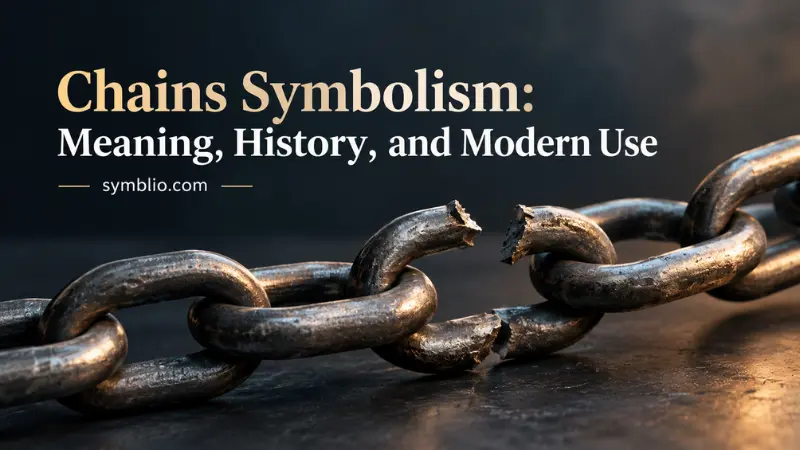
A chain is a simple object made from connected links, yet its meaning can change dramatically depending on how it appears and where it is used. Chains symbolism often points to connection, loyalty, restraint, responsibility, or freedom, making the image especially flexible in American culture.
People encounter chains in jewelry, religious imagery, tattoos, memorial art, fashion, architecture, literature, and political imagery. An unbroken chain can suggest something that holds people together, while a broken chain can communicate release from something that once restricted movement.
The symbol matters because the same physical object can represent opposite ideas. A necklace may suggest affection or status, while a chain around a prisoner suggests confinement. Understanding the surrounding context is therefore essential.
Quick Answer
Chains commonly symbolize connection, loyalty, commitment, or restraint in modern American culture, depending on whether the links are worn as decoration, used as a binding image, or shown breaking apart. Historically, chains have represented captivity and authority as well as honor, status, religious devotion, and social bonds.
TL;DR
- Chains can represent connection, loyalty, restraint, or freedom.
- Ancient and religious traditions used chains for both authority and captivity.
- American culture strongly connects chains with freedom and bondage.
- Jewelry often turns chains into symbols of connection and status.
- Broken chains commonly represent liberation or personal change.
- Tattoos use chain imagery to express bonds, endurance, or release.
What a Chain Represents Visually
A chain consists of individual links joined together so that each part depends on another. That physical structure naturally lends itself to symbolic interpretations involving relationships, continuity, dependence, and strength.
The condition of the chain also changes its meaning. A complete chain suggests something intact or connected. A locked chain can suggest restriction. A broken link may indicate separation, escape, independence, or the end of an obligation.
Context matters just as much as appearance. A gold chain worn around the neck may communicate fashion, wealth, or personal identity. A chain wrapped around an object can suggest protection or containment. A broken chain in a monument can represent liberation.
What Chains Commonly Mean in the United States
In the United States, chains have several recognizable meanings rather than one universal definition.
The first is connection. Because individual links become stronger and more useful when joined, chains can represent families, friendships, partnerships, communities, and lasting commitments.
The second is restriction. A chain can prevent movement, so it naturally became an image for imprisonment, control, dependency, and lack of freedom.
The third is freedom from restriction. This meaning becomes particularly clear when the chain is broken. The image does not simply represent freedom in the abstract; it can suggest freedom achieved after overcoming an obstacle.
Chains also have a strong place in American fashion. Necklaces, bracelets, watch chains, and other forms of metal jewelry can communicate style, wealth, cultural affiliation, or personal taste without carrying an explicitly symbolic message.
Ancient Roots and Early Symbolism
Chains are not a modern invention, and their symbolic range developed alongside their practical uses.
In ancient societies, metal chains could serve as restraints for captives and prisoners. That practical function made the chain an obvious metaphor for captivity. A person literally placed in chains had restricted movement, so chains became a visual shorthand for domination and imprisonment.
At the same time, chains could carry completely different associations. Decorative chains were used as ornaments and could indicate wealth, rank, or authority. In biblical traditions, for example, chains appear both as restraints and as forms of adornment or honor.
This dual meaning is important. Chains were never exclusively symbols of suffering. Their material, purpose, and setting determined what they communicated.
Chains in Biblical and Christian Symbolism
Chains appear repeatedly in biblical imagery, where they can represent physical imprisonment as well as spiritual or moral bondage.
The New Testament describes figures such as Paul being held in chains, making the object an image of imprisonment and hardship. Christian interpretation also developed a contrasting idea: spiritual freedom can be expressed through imagery of chains being removed.
This contrast became particularly influential in Christian language about liberation. A person may be described as being released from spiritual bondage, while the chain itself represents whatever prevents freedom.
Christian imagery therefore gives chains a two-sided meaning:
- Bondage: captivity, sin, oppression, or suffering
- Release: liberation, redemption, and freedom
- Commitment: attachment to faith or a religious community
- Authority: ceremonial or ornamental chains associated with status
The meaning depends heavily on whether the chain is shown as binding someone or being removed.
Chains and American Ideas of Freedom
Chains have a particularly sensitive meaning in United States history because of the country’s history of slavery and abolition.
The image of a person in chains became associated with enslavement and the denial of human freedom. Abolitionist movements also used chained figures in political art and jewelry to communicate opposition to slavery. Historical abolitionist objects demonstrate how jewelry and visual symbols could function as public statements about political beliefs.
This history means that chains should not always be treated as a generic symbol of “strength.” In certain contexts, they evoke the history of racial slavery, emancipation, and struggles over freedom.
The broken chain has consequently become a particularly recognizable American image of liberation. Its meaning comes from a simple visual transformation: something that once restricted movement no longer functions as a restraint.
Why Broken Chains Symbolize Freedom
A broken chain communicates a more specific idea than an ordinary chain.
An intact chain connects or restrains. A broken chain shows that the connection or restraint has been interrupted. That makes it useful for expressing escape, independence, recovery, political liberation, or the end of an unwanted relationship with a past situation.
The image can appear in monuments, artwork, tattoos, logos, posters, and personal designs.
For someone using the image personally, a broken chain might represent leaving behind an old identity or overcoming a difficult period. In public imagery, it can represent emancipation or resistance to oppression.
The symbolism is therefore less about the metal itself and more about what happened to the links.
Chains as Symbols of Connection and Loyalty
The same object associated with imprisonment can also symbolize closeness.
Connected links provide a natural metaphor for relationships. One link touches another, and the entire structure depends on those connections. This makes chains suitable for representing family ties, friendship, partnership, loyalty, and long-term commitment.
Jewelry often uses this interpretation. A chain given as a gift may represent a continuing relationship, especially when the design incorporates initials, charms, pendants, or other personalized elements.
The symbolism can also extend to communities. Many individuals acting together may be described metaphorically as links in a chain, emphasizing cooperation rather than individuality.
Chains as Symbols of Strength and Endurance
Chains can also suggest durability because their purpose depends on maintaining connected links.
A heavy industrial chain looks different from a delicate necklace, but both rely on the same basic structure. In symbolic artwork, a strong chain can therefore communicate resilience, persistence, and the ability to withstand pressure.
This interpretation appears frequently in personal designs. Someone may choose chain imagery to represent a relationship that has endured difficult circumstances or a personal commitment that they intend to maintain.
However, the symbolism should not be overstated. A chain does not automatically mean strength. Its meaning comes from the surrounding design and the person’s intended message.
Chains in Jewelry, Fashion, and Status
Chains have a long history as decorative objects as well as restraints.
Gold chains, silver necklaces, bracelets, watch chains, and ornamental links can signal wealth, craftsmanship, fashion, or social identity. In contemporary American culture, chain jewelry appears across many styles, from understated everyday accessories to highly visible fashion pieces.
The cultural meaning can also depend on the material. Gold may be associated with luxury and achievement, while silver can suggest a more understated or industrial aesthetic.
Fashion has also separated chains from their older associations with imprisonment. A person wearing a chain necklace is not necessarily making a statement about bondage or freedom. Often, the chain is simply part of an outfit.
That distinction prevents symbolic interpretation from becoming overly literal.
Chains in Tattoos and Personal Identity
Chain tattoos are especially flexible because people can manipulate the image to communicate different ideas.
A continuous chain may represent loyalty, family connection, commitment, or an enduring relationship. A broken chain can suggest independence, release, or leaving something behind.
Some tattoo designs combine chains with other imagery. A chain around a heart may emphasize attachment or emotional bonds. A broken chain alongside wings or another freedom-related image can reinforce the idea of liberation.
The context is essential because tattoo symbolism is personal. Two people can choose nearly identical chain designs while intending entirely different messages.
Certain prison and gang-related tattoo traditions have also used chains and locks to communicate confinement or incarceration. That does not mean every chain tattoo carries that association. Treating one design tradition as universal can lead to inaccurate assumptions about the person wearing it.
Chains in Mourning and Memorial Imagery
Chains can appear in mourning symbolism when an artist wants to represent separation, grief, or a bond that has been interrupted.
An intact chain may represent the continuing connection between loved ones. A broken link can represent death or the painful interruption of a relationship.
This interpretation is particularly dependent on surrounding imagery. A broken chain next to a name, date, memorial inscription, or religious symbol may communicate loss more clearly than the chain alone.
Because mourning traditions vary, there is no single standard interpretation. Personal and family context usually matters more than a general symbolic dictionary.
Chains in Literature and Popular Culture
Writers have long used chains as metaphors because their physical function is easy to understand.
Someone can be “chained” to an obligation, memory, expectation, or situation without any literal metal being present. The metaphor works because the reader already understands what a chain does: it limits movement while maintaining a connection.
Popular culture also uses chains to create visual contrast. A character surrounded by chains may appear trapped, while the same character breaking those chains may be presented as gaining independence.
Music, movies, comics, advertising, and fashion can therefore shift chain imagery between themes of rebellion, loyalty, wealth, confinement, and liberation.
How Color and Material Change Chain Symbolism
The material and color of a chain can influence how people read it.
| Chain Context | Common U.S. Meaning | Common Associations | Notes |
|---|---|---|---|
| Gold chain | Status or luxury | Wealth, fashion, achievement | Often decorative rather than symbolic |
| Silver chain | Style or personal identity | Simplicity, modern fashion | Meaning depends strongly on design |
| Heavy metal chain | Strength or restraint | Durability, control, industrial imagery | Can feel more imposing |
| Broken chain | Freedom or separation | Liberation, independence, change | Context determines whether meaning is positive or mournful |
| Chain with a pendant | Connection or identity | Relationships, faith, memories | Pendant often carries the main message |
The material does not determine meaning by itself. A gold chain can represent family, achievement, fashion, or religious commitment depending on how it is worn and presented.
Emotional and Psychological Meaning of Chains
At a psychological level, chain imagery often works because it makes an abstract experience visible.
People sometimes feel tied to responsibilities, expectations, relationships, habits, or memories. A chain provides a simple physical metaphor for that experience.
An intact chain can therefore communicate security as easily as restriction. A person may value a strong connection and describe it as an unbreakable bond. Someone else may view the same structure as confinement.
This is why chain symbolism frequently carries emotional tension. It can represent both belonging and limitation.
That duality makes the image useful for personal storytelling. It allows people to express complicated experiences without reducing them to a single emotion.
Common Misunderstandings About Chain Symbolism
One common mistake is assuming that chains always symbolize imprisonment. Their history includes captivity, but chains have also been used as jewelry, ornaments, symbols of rank, and representations of connection.
Another mistake is assuming that a broken chain always represents trauma or suffering. It can mean freedom, independence, political liberation, separation, or simply an artistic design choice.
It is also important not to assume that chain jewelry has a hidden symbolic message. In modern American fashion, many people wear chains primarily because they like the appearance.
Finally, historical associations should be handled carefully. Because chains can evoke slavery and imprisonment in American history, using them casually in political or cultural imagery can carry meanings that go beyond the creator’s original intention.
How Chains Have Changed Meaning Over Time
The history of chain symbolism is largely a history of competing meanings.
Early practical uses created associations with restraint and captivity. Decorative uses introduced ideas of status and ornament. Religious traditions expanded the image into spiritual bondage, devotion, and liberation.
In the United States, chains gained additional political significance through the history of slavery and abolition. Later, popular culture and fashion increasingly treated chains as signs of style, rebellion, toughness, or identity.
Modern symbolism therefore contains several layers at once. The same image can recall ancient ornament, religious metaphor, historical oppression, personal commitment, or contemporary fashion.
What Chains Mean in Modern American Culture
Today, chains are best understood as a context-dependent symbol rather than an object with one fixed definition.
In fashion, chains can represent style and status. Within relationships, they may suggest loyalty, connection, or commitment. Religious art can use them to represent bondage, devotion, or spiritual release, while broken chains in political imagery often communicate liberation. Tattoo designs frequently turn chains into personal statements about attachment, independence, endurance, or change.
To understand the intended meaning, look at how the chain appears in the design. A chain holding something together can suggest unity or commitment, whereas one restricting movement may represent control. A broken chain often points toward freedom or separation, while a chain worn as jewelry may simply express personal style. When another symbol appears alongside it, that element can further shape the chain’s meaning.
Those details usually reveal the intended meaning.
FAQs
Chains can symbolize spiritual bondage, obligation, temptation, or suffering, but they can also represent release from those conditions. In Christian traditions, imagery involving chains often contrasts captivity with spiritual freedom.
A chain tattoo can represent loyalty, connection, endurance, restraint, or freedom. A broken chain more commonly emphasizes independence or liberation, while an intact chain may emphasize an enduring bond.
A broken chain commonly represents freedom from restriction. Depending on its surrounding imagery, it can also symbolize separation, independence, emancipation, or the end of an unwanted connection.
Yes. Chains can represent loyalty, family bonds, commitment, unity, durability, and lasting relationships. Their positive or negative meaning depends on whether the chain is presented as a valued connection or an unwanted restraint.
Chains can evoke slavery, imprisonment, abolition, and the struggle for freedom in American history. They also appear in American jewelry and decorative traditions, so their meaning depends strongly on context.
A chain necklace may communicate fashion, wealth, identity, cultural affiliation, or personal connection. Many people wear chain jewelry simply as an accessory, without intending a particular symbolic message.
Chains appear in several religious traditions, especially as metaphors for bondage, suffering, devotion, or liberation. Their meaning varies by tradition and by the specific image or text in which they appear.
Conclusion
Chains can symbolize two seemingly opposite experiences: being connected and being constrained. That contrast explains why the image works so well across jewelry, religious art, tattoos, literature, fashion, memorials, and political imagery.
In the United States, chains symbolism carries additional historical weight because chains are associated not only with relationships and personal style but also with slavery, abolition, imprisonment, and freedom. A broken chain often turns that history into a visual statement about liberation, while an intact chain can represent loyalty or connection.
Ultimately, the meaning comes from the context. A chain can show what holds people together, what keeps them from moving forward, or what they have finally managed to leave behind.


