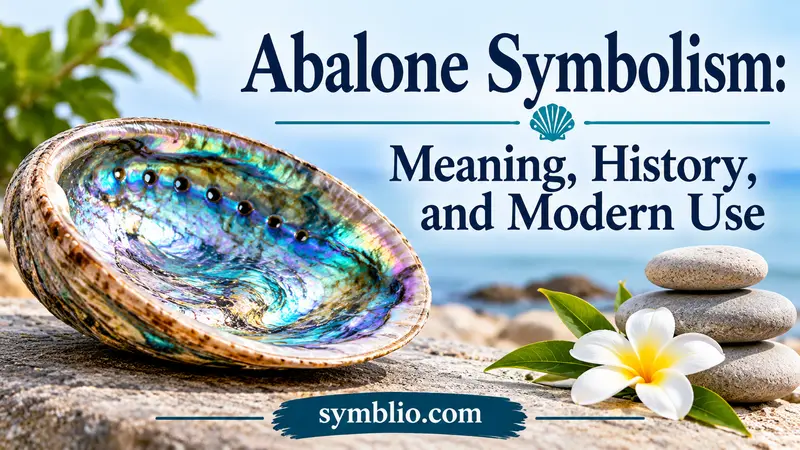
Abalone symbolism centers on emotional balance, resilience, oceanic beauty, and the connection between people and the natural world. Abalone is a marine mollusk known for its rounded shell, rough outer surface, and striking inner layer, which can shimmer with blue, green, pink, and purple colors. These shells have attracted attention for centuries, serving practical, decorative, and ceremonial purposes in different coastal communities.
In the United States, abalone often appears in jewelry, home decor, spiritual practices, and coastal-inspired design. Its iridescent interior makes it a natural symbol of beauty that emerges from an ordinary, sometimes rugged exterior. For some people, the shell also represents calm, emotional reflection, and a closer relationship with the sea.
Understanding this symbol requires more than assigning a single meaning to its colors. Abalone has a biological history, a place in Indigenous and other coastal traditions, and a modern identity shaped by jewelry trends, environmental awareness, and personal expression.
Quick Answer
Abalone symbolism commonly represents emotional balance, resilience, natural beauty, and a connection to the ocean in modern American culture. Its iridescent shell also suggests transformation and the value of inner beauty, while its historical uses in coastal communities reflect relationships with marine resources, craftsmanship, trade, and cultural tradition.
TL;DR
- Emotional balance: The shell’s oceanic associations suggest calm and reflection.
- Resilience: Its hard exterior represents protection and endurance.
- Natural beauty: Iridescent colors symbolize individuality and changing perspectives.
- Cultural heritage: Abalone shells reflect longstanding relationships between coastal peoples and the sea.
- Modern expression: Jewelry and decor use abalone to convey elegance and personal meaning.
- Conservation: Sustainable use connects the shell with respect for marine ecosystems.
What Abalone Looks Like and Why Its Appearance Matters
Abalone is a marine gastropod, a type of sea snail that lives on rocky coastal surfaces. Its shell typically has an oval shape, a series of small holes along one edge, and a hard exterior that can appear gray, brown, reddish, or dark green, depending on the species.
The inside tells a different visual story. A smooth, lustrous layer of mother-of-pearl reflects light in changing shades of turquoise, emerald, violet, silver, and rose. This contrast between the rugged exterior and colorful interior provides the basis for several modern symbolic interpretations.
People often connect the shell’s appearance with the idea that beauty can exist beneath an unremarkable surface. Its shifting colors also make it an appealing image for individuality, changing circumstances, and the complexity of human emotions.
These interpretations are modern symbolic readings rather than universal beliefs. The shell’s physical qualities inspire them, but personal experience and cultural background determine which meanings matter most.
The Main Symbolic Meanings of Abalone
Abalone can represent several related ideas, but its symbolism is most useful when each association has a clear explanation.
Emotional balance comes from the shell’s connection with the sea. The ocean can suggest quiet, reflection, and relief from everyday pressure, making abalone a fitting reminder to approach difficult feelings with patience.
Resilience reflects the shell’s protective function. The animal uses its hard shell and muscular foot to remain attached to rocky surfaces, even in a challenging marine environment. Symbolically, this can represent persistence and the ability to maintain stability when circumstances change.
Natural beauty comes from the shell’s iridescent interior. The colors are not painted onto its surface; they emerge from the structure of the shell itself. This can suggest authenticity, originality, and appreciation for qualities that become visible when someone looks more closely.
Transformation is associated with the way the shell appears different as light and viewing angles change. People may use this feature to represent personal growth, new perspectives, or the understanding that a person’s identity cannot be reduced to a single characteristic.
Connection is another important association. Abalone links the individual to the sea, coastal environments, family traditions, and the people who have worked with marine resources over generations.
These meanings overlap, but they are not interchangeable. Resilience concerns endurance, emotional balance concerns how someone responds to feelings, and transformation concerns how understanding or identity develops.
Ancient Roots and Early Uses of Abalone
Abalone’s historical significance developed through its practical value, visual appeal, and relationship to coastal life. Archaeological evidence from California includes abalone shell remains in ancient settlement deposits dating back thousands of years, demonstrating that people used these animals long before modern jewelry and decorative markets existed.
For Indigenous peoples along California’s coast, abalone provided food and a durable material for ornaments and other objects. Shells could be shaped into pendants, incorporated into ceremonial clothing, and exchanged through trading networks. Their usefulness gave them significance beyond their appearance.
The shell’s visual qualities also contributed to its value. Its changing colors made it suitable for personal adornment and carefully crafted objects, while the labor required to gather and work the material added to its importance.
Abalone later became part of commercial trade involving Spanish colonial settlements, Chinese immigrants, Japanese divers, and other coastal communities. These histories were not always peaceful or equitable. Colonial expansion, discrimination, and competition over marine resources shaped who could gather, trade, and benefit from abalone.
Its historical meaning therefore cannot be reduced to a universal symbol of beauty or tranquility. It also represents skilled work, food systems, exchange, cultural continuity, and the complicated history of access to coastal resources.
Abalone Symbolism in Indigenous California Cultures
Abalone holds particular cultural importance for many Indigenous communities along the Pacific coast. However, each nation has its own traditions, stories, protocols, and relationships with the species. No single explanation can represent every community.
Among California Native peoples, abalone has served as food, a material for adornment, an item of trade, and a component of ceremonial regalia. Some communities continue to incorporate the shell into cultural practices and contemporary artistic work.
For the Rumsen Ohlone community, the word aulun refers to abalone, and the shell remains a meaningful expression of cultural identity. Artists and cultural practitioners continue to use it in jewelry and regalia, connecting present-day creativity with inherited traditions.
Abalone also appears in the cultural lives of communities such as the Chumash and other California coastal peoples. Particular stories and ceremonial meanings belong to the communities that preserve them. Outsiders should not assume that all Indigenous people interpret the shell in the same way.
This distinction matters when discussing symbolism. A modern decorative interpretation, such as personal renewal, is not equivalent to a meaning preserved through a community’s own history and ceremonial knowledge.
For readers in the United States, respectful appreciation means recognizing both the shell’s beauty and the living cultures associated with it. Learning about Indigenous art from its makers and communities offers a more accurate understanding than assigning a generic spiritual meaning to every shell.
What Abalone Means in Modern American Culture
In contemporary American culture, abalone is especially associated with coastal living, handcrafted design, natural materials, and personal adornment. Its colors make it popular with people who prefer distinctive objects that feel connected to the ocean.
The shell often appears in beach-inspired homes, artisan jewelry, decorative bowls, small keepsakes, and inlay work. In these settings, it can suggest a relaxed coastal atmosphere without relying on literal images of waves or beaches.
Abalone also carries an association with California’s Pacific coast. The animal’s place in the state’s natural and cultural history gives it a local meaning that extends beyond decorative appeal. California designated black abalone its state seashell in 2024, recognizing a species associated with the state’s coastal ecosystems and Indigenous history.
At the same time, many Americans encounter abalone without knowing its history. A pendant may simply appeal to someone because of its colors, while a shell displayed in a home may remind another person of a family vacation.
Both responses are valid. Symbolic meaning does not always require deliberate knowledge of history, although understanding the context can make an object more meaningful.
Emotional and Psychological Associations
Abalone’s appearance lends itself to emotional interpretations, especially when people use natural objects as reminders of personal values.
Its ocean connection can evoke relaxation, spaciousness, and the desire to step back from daily demands. Someone who feels restored by the coast might associate an abalone pendant with time spent near the water or with a place where life feels less hurried.
Its protective shell can suggest boundaries. In this interpretation, protection does not mean withdrawing from everyone; it means recognizing the importance of personal space, privacy, and emotional security.
The iridescent interior offers another useful association. Different colors appear depending on the light, which can serve as a reminder that people experience different emotions and reveal different parts of themselves in different circumstances.
Abalone may also become a personal symbol of perseverance when it reminds someone of a difficult period they have worked through. The connection comes from the owner’s experience rather than from an established psychological rule.
There is no scientific basis for claiming that owning an abalone shell automatically reduces anxiety, heals emotional wounds, or changes a person’s mental state. Its value as a reminder can be meaningful without treating it as a medical or supernatural remedy.
Abalone in Spirituality and Meditation
Abalone is sometimes used in contemporary spiritual settings because of its oceanic associations and reflective surface. People may keep a shell on an altar, place it beside a meditation area, or use it as a visual reminder to pause and reflect.
In these contexts, the shell may represent gratitude for nature, emotional steadiness, connection with the living world, or a commitment to personal reflection.
Some modern spiritual traditions describe abalone as a calming or balancing object. Such descriptions reflect particular beliefs, not scientifically established effects. The shell itself does not guarantee peace, protection, or healing.
It is also important to distinguish contemporary wellness practices from Indigenous ceremonial traditions. Abalone has specific meanings within particular Native communities, and those meanings should not be detached from their cultural context or presented as interchangeable with generalized spiritual ideas.
For someone who simply appreciates the shell, a respectful practice can be straightforward: use it as a reminder to slow down, appreciate the natural world, or consider what deserves attention in everyday life. No special belief system is necessary.
The Symbolism of Abalone’s Colors
The colors inside an abalone shell contribute to its appeal, but they do not have one fixed symbolic meaning. Interpretations often draw on broader associations that Americans already attach to color.
Blue and turquoise
These shades commonly suggest water, openness, calm, and clear communication. In an abalone design, they reinforce the shell’s connection to the ocean.
Green
Green often brings to mind plants, renewal, and the natural environment. It can emphasize the shell’s relationship to marine ecosystems.
Pink and purple
These colors may communicate tenderness, creativity, individuality, or elegance in modern decorative design.
Silver and pearly white
These tones can suggest refinement, simplicity, and understated beauty, especially in jewelry and contemporary interiors.
These are general color associations, not a traditional abalone color code. A shell can display several shades simultaneously, and its meaning depends on how a person interprets the object as a whole.
Abalone Symbolism in Jewelry and Personal Style
Abalone is widely used in jewelry because its natural pattern makes every piece visually distinctive. Earrings, pendants, rings, bracelets, and inlaid accessories allow the shell to become a personal expression rather than merely a decorative object.
A person might choose abalone jewelry to express a love of the ocean, an interest in natural materials, or an appreciation for colorful craftsmanship. Someone else might associate it with a coastal hometown, a meaningful trip, or a gift from a relative.
Its symbolism can also depend on the form of the jewelry. A small pendant may serve as a private reminder of a personal value, while a larger statement piece may communicate an interest in unusual textures and artistic design.
In contemporary fashion, abalone works with both casual and formal styles. Its iridescence can complement neutral clothing, silver settings, and other natural materials without requiring a single symbolic interpretation.
Abalone jewelry should not automatically be described as a sign of spiritual enlightenment or emotional healing. Unless the wearer explains that intention, the safest interpretation is that the piece reflects personal taste, a meaningful association, or an appreciation for the shell’s natural beauty.
Abalone in Home Decor, Art, and Design
Abalone’s changing colors make it useful in interior design, particularly in spaces influenced by coastal landscapes. It appears in decorative trays, framed shell displays, furniture inlay, small boxes, and handmade artwork.
In a living room, a shell may suggest a connection to the sea or serve as a reminder of a particular place. In a bedroom or meditation space, its reflective surface may contribute to an atmosphere of quiet contemplation.
Designers also use abalone in small details rather than large displays. An inlaid surface or a single decorative object can introduce color without overwhelming a room.
The shell’s irregular patterns are part of its appeal. Unlike manufactured designs that repeat the same pattern, natural abalone has variations that make each piece distinct. That quality supports modern associations with individuality and handcrafted work.
For culturally informed design, it is worth considering where the shell came from and how the finished object was made. Authenticity includes more than appearance; it can involve ethical sourcing, respect for cultural traditions, and the environmental effects of collecting marine materials.
Abalone Tattoo Symbolism and Personal Identity
An abalone tattoo can represent a person’s connection to the ocean, appreciation for natural beauty, or desire to remember a place that matters to them. The shell’s changing colors also make it suitable for designs focused on individuality and the complexity of identity.
Some people interpret the protective exterior as a reminder to maintain healthy boundaries. Others focus on the luminous interior as a representation of personal growth or the idea that outward appearances do not reveal everything about a person.
Tattoo meaning often comes from the surrounding imagery. An abalone shell paired with waves may emphasize a connection to the sea, while a simple outline may focus on shape and natural elegance. A design incorporating personal dates or other meaningful elements can tell a more specific story.
However, abalone is not a universal symbol of strength, healing, or spiritual awakening. The wearer determines the personal meaning, and a design inspired by Indigenous art or ceremonial objects deserves particular care and cultural understanding.
A thoughtful tattoo does not need a long explanation. Its significance may be as simple as remembering a coastal home, honoring a loved one, or preserving a connection to a place that shaped one’s life.
Abalone Across Cultures and Coastal Traditions
Abalone belongs to a wider history of human relationships with marine shells. Coastal societies around the world have used shells for food, ornamentation, trade, artistic work, and ceremonial purposes, although the species and meanings differ by region.
Along the Pacific coast of North America, abalone has longstanding importance in Indigenous communities. Its role in food systems, exchange, adornment, and ceremonial life reflects a relationship with a specific coastal environment rather than a single shared belief across all Indigenous peoples.
In East Asia, abalone also has a substantial culinary history. In Chinese food traditions, it is valued as a prestigious ingredient, particularly in celebratory and formal meals. This association with hospitality and luxury comes from its place in cuisine and trade, not necessarily from the same symbolism found in modern American jewelry.
Japanese coastal communities have their own history of abalone harvesting and seafood traditions. These relationships reflect regional practices, specialized knowledge, and the economic importance of marine resources.
The broader lesson is that an object’s meaning depends on how people use it and the stories attached to it. Abalone may evoke personal reflection for one person, cultural continuity for another, and culinary heritage for someone else. Treating all these interpretations as one universal spiritual meaning would erase important distinctions.
Common Misunderstandings About Abalone Symbolism
Several misconceptions arise when a natural object becomes popular in spiritual and decorative markets.
One is the belief that every abalone shell carries a fixed spiritual message. There is no universally accepted symbolic code that assigns the same meaning to every shell or color combination.
Another misconception is that abalone has scientifically demonstrated healing properties. People may find a shell comforting or use it during meditation, but those personal experiences do not establish that the object can treat a health condition or reliably change someone’s emotions.
A third misunderstanding is that all Indigenous coastal communities share identical traditions involving abalone. Cultural practices vary, and some knowledge belongs to particular communities rather than to the public at large.
It is also inaccurate to assume that an abalone shell is simply a decorative souvenir without environmental implications. Several abalone species face serious conservation challenges. In California, black abalone is endangered, and white abalone is also endangered. Population declines have been linked to pressures including disease, overharvesting, habitat changes, and broader environmental conditions.
Finally, an attractive shell is not necessarily ethically sourced. Natural appearance alone cannot tell a buyer whether a product came from a sustainable fishery, a farm, an old collection, or illegal harvesting.
These distinctions do not diminish the shell’s symbolic appeal. They help keep personal interpretations separate from cultural facts, scientific evidence, and environmental realities.
Abalone and Conservation: A Modern Meaning of Responsibility
Abalone’s ecological story adds another dimension to its symbolism. These marine snails live in coastal habitats and feed primarily on algae, including kelp. Their survival depends on suitable conditions and healthy marine ecosystems.
The decline of several wild populations has changed the way people encounter abalone. In places where the animals were once plentiful, conservation rules and recovery programs now shape access to them. California’s recognition of black abalone as its state seashell also brings attention to a species whose future remains uncertain.
For some people, this situation makes abalone a reminder of responsibility toward the natural world. Its beauty becomes connected not only to what humans can collect or display but also to what they must protect.
This is a modern interpretation rather than an ancient meaning shared by all communities. Nevertheless, it follows directly from the shell’s ecological history: a valued natural resource can become vulnerable when harvesting and environmental pressures exceed what a population can withstand.
Responsible appreciation may involve choosing legally and ethically sourced products, learning about the species represented, and supporting conservation efforts. It also means recognizing that a shell’s cultural importance may be greater than its value as a commodity.
Abalone Symbolism at a Glance
| Context | Common symbolic association | Why it fits |
|---|---|---|
| Modern American culture | Ocean connection and natural beauty | Its colors evoke coastal landscapes and marine life. |
| Personal reflection | Emotional balance | The shell can serve as a reminder to pause and reflect. |
| Jewelry and fashion | Individuality and creativity | Each shell has a distinctive iridescent pattern. |
| Indigenous California traditions | Cultural continuity and community identity | Abalone has longstanding practical, artistic, and ceremonial roles in specific communities. |
| Conservation | Environmental responsibility | Threatened populations highlight the need to protect marine ecosystems. |
FAQs
In contemporary spiritual settings, an abalone shell may represent calm, reflection, gratitude for nature, and a connection to the ocean. These meanings vary by individual and tradition, so they should not be treated as universal beliefs.
An abalone tattoo can represent a love of the sea, personal identity, resilience, or an important coastal memory. Its meaning depends on the wearer’s experiences, the design, and any accompanying imagery.
Some people use abalone as a personal reminder of emotional balance or recovery. However, there is no established scientific evidence that the shell itself heals physical or psychological conditions.
Abalone has provided food and materials for adornment, trade, and ceremonial objects for many Indigenous communities along California’s coast. Its meaning varies among nations, and some traditions continue through contemporary cultural practices and artistic work.
Blue and green may suggest the ocean and nature, while pink, purple, and silver may evoke creativity or elegance. These are broad modern color associations rather than a fixed traditional system.
Some individuals may keep abalone as a meaningful keepsake or associate it with positive experiences, but it is not universally recognized as a good-luck symbol. Any such meaning depends on personal belief or a specific cultural tradition.
It can be, particularly when the shell is legally and responsibly sourced and its cultural background is understood. If a design draws on a specific Indigenous tradition, learning from that community and respecting its protocols is more appropriate than treating its ceremonial practices as generic decoration.
Conclusion
Abalone symbolism brings together natural beauty, resilience, emotional reflection, and the human relationship with the ocean. Its iridescent interior encourages modern interpretations centered on individuality and changing perspectives, while its hard exterior offers a useful image of protection and endurance.
Its meaning becomes more complete when considered alongside the histories of coastal communities, particularly Indigenous peoples whose relationships with abalone extend far beyond decoration. Conservation concerns also remind us that appreciating a natural object should include respect for the living species behind it.
Ultimately, abalone can serve as a personal reminder of the sea, cultural continuity, or the value of looking beyond appearances. Its most meaningful interpretation is one that honors both the individual’s connection to the shell and the real histories and ecosystems that give it significance.