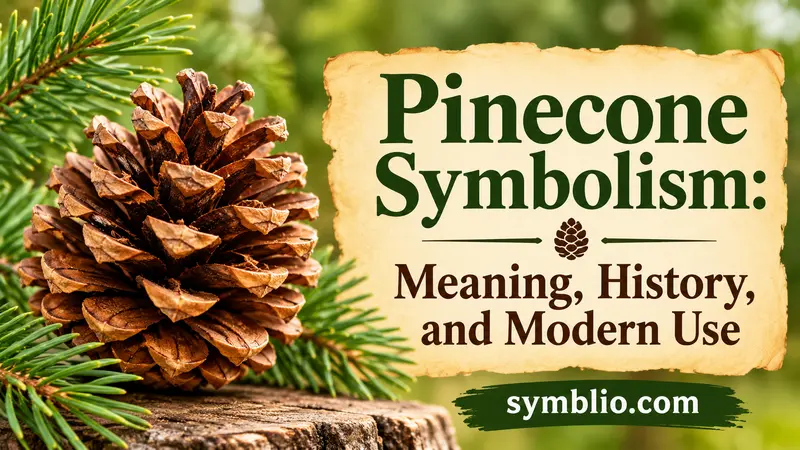
Pinecone symbolism is commonly connected with growth, renewal, fertility, protection, and longevity. Found beneath evergreen trees and frequently used in seasonal decorations, pinecones have attracted symbolic meaning because of their unusual structure, relationship with seeds, and connection to trees that remain green throughout the year.
A pinecone may look like an ordinary piece of nature, but its appearance offers several reasons for symbolic interpretation. Its overlapping scales protect developing seeds, while its association with evergreen trees connects it with life that continues through changing seasons. These qualities have made pinecones meaningful in different historical and cultural settings.
In the United States, pinecones are especially familiar during autumn and winter. People use them in Thanksgiving centerpieces, Christmas wreaths, natural crafts, jewelry, and rustic home decorations. Beyond their decorative purpose, they can represent family traditions, personal growth, resilience, and an appreciation for the natural world.
Understanding the history of this small natural object helps explain why it continues to appear in art, religious imagery, seasonal celebrations, and personal expression.
Quick Answer: What Does Pinecone Symbolism Mean?
Pinecone symbolism commonly represents growth, renewal, protection, fertility, and longevity in modern American culture, especially through its connection with evergreen trees, seeds, and seasonal decorations. Historically, pinecones also appeared in ancient religious imagery associated with fertility, regeneration, purification, and the continuation of life.
TL;DR: Key Meanings of Pinecones
- Growth: Represents new beginnings and the development of future possibilities.
- Renewal: Connects with evergreen trees and the continuation of life.
- Protection: Reflects the scales that shelter developing seeds.
- Fertility: Represents reproduction, abundance, and the creation of new life.
- Longevity: Draws meaning from evergreen trees that remain green throughout winter.
- Wisdom: Modern interpretations connect its distinctive shape with awareness and spiritual reflection.
What a Pinecone Represents in Nature
A pinecone is the reproductive structure of certain conifer trees. Its overlapping scales protect seeds as they develop, and many cones open when conditions become suitable for seed dispersal.
This natural function provides the foundation for several symbolic interpretations.
The protective scales suggest shelter and security. The seeds represent possibilities that have not yet become visible, while the cone’s ability to release them connects it with growth and new beginnings.
Pinecones also come from trees that often remain green during winter. This association gives them an additional connection with endurance and continuity.
Their physical appearance contributes to their symbolic appeal. The repeated arrangement of scales creates a balanced, layered pattern that appears both orderly and natural.
People may therefore interpret a pinecone as a reminder that growth takes time and that important developments often begin before they become visible.
The Main Symbolic Meanings of Pinecones
Although interpretations vary between cultures and individuals, several meanings appear repeatedly.
Growth and new beginnings are among the most recognizable associations. Since pinecones contain seeds, they naturally suggest future development and the possibility of new life.
Protection and security come from the cone’s structure. Its scales provide a protective covering, making it a suitable representation of safeguarding something valuable.
Fertility and abundance have historical connections with the many seeds contained within a cone. In older agricultural and religious traditions, reproductive imagery was often associated with prosperity and the continuation of life.
Resilience and longevity relate to the evergreen trees that produce pinecones. Their ability to remain green through cold seasons makes them natural reminders of endurance.
Wisdom and awareness are more modern interpretive associations. Some people connect the pinecone’s distinctive shape with the human pineal gland, whose name comes from its resemblance to a small pinecone. This resemblance has encouraged spiritual interpretations, although it does not establish a historical or scientific connection between pinecones and special mental abilities.
Together, these meanings explain why pinecones can represent both practical protection and the promise of future growth.
Ancient Roots and Early Pinecone Symbolism
Pinecones have appeared in artistic and religious traditions for thousands of years. Their ancient meanings were not identical everywhere, but fertility, regeneration, and ritual purification were recurring associations.
In ancient Mesopotamian art, cone-shaped objects appear in scenes involving winged supernatural figures and sacred trees. These figures are frequently shown holding a cone-like object and a container, suggesting a ritual connected with purification or the care of sacred spaces.
Scholars have debated whether these objects represent conifer cones or other botanical structures, including date palm flowers. This distinction matters because ancient images should not automatically be interpreted as literal representations of pinecones.
In ancient Greek and Roman traditions, pinecones also appeared in religious imagery. They were particularly associated with Dionysus, the Greek god connected with wine, vegetation, and celebration.
His ceremonial staff, known as the thyrsus, was sometimes topped with a pinecone. The staff became associated with fertility, vegetation, and the life-giving qualities of nature.
Pinecones also appeared in funerary art, where their connection with seeds and evergreen trees made them suitable symbols of regeneration and the continuation of life. UChicago ISAC+2
These historical examples show that the pinecone’s symbolic importance developed from recognizable natural characteristics rather than one universal religious meaning.
Pinecones and the Symbolism of Eternal Life
One of the most interesting interpretations of pinecones comes from their relationship with evergreen trees.
Unlike deciduous trees that lose their leaves during autumn, many evergreen species retain their foliage throughout winter. This quality has made evergreens natural symbols of continuity, endurance, and life beyond seasonal change.
Pinecones inherit some of this symbolism because they grow on these trees.
In funerary settings, the cone’s seeds offer another layer of meaning. Seeds can produce new plants, creating a natural connection between the ending of one life cycle and the beginning of another.
Ancient Mediterranean cultures sometimes used pinecone decorations on tombs and monuments. Their presence could suggest regeneration, fertility, and the hope of continued existence.
It is important to distinguish this historical symbolism from a universal religious belief. Different communities understood death and the afterlife in different ways, and a pinecone did not carry one fixed interpretation.
Today, someone who places a pinecone near a memorial or includes it in a remembrance arrangement might see it as a gentle representation of continuity, memory, and nature’s recurring cycles.
Pinecone Symbolism in American Culture
In the United States, pinecones are strongly associated with seasonal living, outdoor traditions, and natural decoration.
Their most recognizable appearance is during autumn and winter. Families collect them during nature walks, use them in crafts, or arrange them around candles and other decorative objects.
During Thanksgiving, pinecones often appear alongside dried leaves, pumpkins, acorns, and branches. In these arrangements, they contribute to the familiar visual language of harvest, abundance, and gratitude.
Christmas traditions provide another important setting. Pinecones are frequently attached to wreaths, garlands, ornaments, and table decorations. Their connection with evergreen branches makes them a natural addition to winter holiday displays.
In this setting, they can suggest:
- Family traditions and shared celebrations.
- Warmth during colder months.
- Appreciation for nature.
- Continuity between generations.
- The return of seasonal celebrations each year.
American interpretations are generally decorative and personal rather than tied to a single established religious meaning.
For some families, a pinecone ornament may become part of an annual tradition. For others, it simply represents a preference for natural materials and woodland-inspired decoration.
Pinecones in Christianity and Religious Traditions
Pinecones have appeared in different religious artistic traditions, including Christian, ancient Mediterranean, and Near Eastern settings.
In Christian contexts, evergreen plants are commonly associated with continued life and hope. These associations can influence how people interpret pinecones used in church decorations, holiday arrangements, or religious artwork.
However, pinecones are not a universal Christian symbol with one official theological meaning.
Their appearance in religious architecture and decorative objects has several historical explanations. Sometimes they were selected for their attractive shape, while in other cases their associations with fertility, regeneration, and abundance contributed to their use.
One famous example is the large bronze pinecone sculpture known as the Pigna, historically associated with the Vatican. Its presence reflects the long history of pinecone imagery in Roman and later Christian environments.
In some contemporary Christian households, pinecones included in Christmas decorations may simply reinforce the connection between evergreen plants, winter celebrations, and the hope associated with the holiday season.
Respecting the distinction between historical symbolism and individual religious interpretation helps prevent exaggerated claims about their spiritual meaning.
Pinecone Symbolism in Different Cultures
Pinecones have appeared in several cultural traditions, although their interpretations depend on the historical setting.
| Cultural context | Symbolic association | Historical background |
|---|---|---|
| Ancient Mesopotamia | Purification and sacred renewal | Cone-shaped objects appear in ritual scenes involving sacred trees. |
| Ancient Greece | Fertility and vegetation | Pinecones sometimes topped the ceremonial staff of Dionysus. |
| Ancient Rome | Regeneration and longevity | Pinecone imagery appeared in religious art and funerary monuments. |
| Christian artistic traditions | Continuity and decorative abundance | Pinecones appeared in religious architecture and ornamental objects. |
| Modern United States | Seasonal celebration and natural living | Used in Christmas decorations, autumn crafts, and woodland designs. |
These traditions should not be treated as interchangeable. A pinecone appearing in an ancient religious carving does not necessarily communicate the same idea as one displayed on a modern American Christmas wreath.
The object remains recognizable, but its cultural meaning changes according to the people, beliefs, and circumstances surrounding it.
The Emotional and Psychological Meaning of Pinecones
Pinecones can communicate several feelings because they combine familiar natural imagery with ideas about growth and protection.
For many people, they create a sense of comfort and connection with the outdoors. Their rough texture, earthy colors, and recognizable woodland appearance can bring to mind forests, family walks, and changing seasons.
They may also represent patience.
A seed does not become a mature tree immediately. It requires suitable conditions, time, and continued development. This process makes the pinecone a useful personal reminder that meaningful progress does not always happen quickly.
Its protective structure can suggest emotional security and the importance of preserving personal boundaries.
Some people interpret an unopened pinecone as a representation of potential that has not yet been expressed. An opened cone, by comparison, can suggest opportunity, readiness, or the release of something that has been developing.
These interpretations are personal rather than established psychological rules. Their value comes from the associations individuals create with the natural object.
Pinecone Symbolism in Dreams
Dream interpretations involving pinecones vary, and there is no scientific evidence that a particular dream image predicts future events.
Nevertheless, people sometimes use pinecones as personal symbols when reflecting on dreams.
A pinecone may suggest growth, hidden potential, protection, or a connection with nature. Its meaning in a dream often depends on the surrounding circumstances and the dreamer’s personal experiences.
For example, finding a pinecone during a peaceful forest walk might remind someone of childhood memories, outdoor activities, or a desire for a quieter lifestyle.
Seeing several pinecones together might bring to mind abundance, family, or the idea of many possibilities.
An unopened cone could represent something that is still developing, while an open cone might remind someone of sharing ideas or moving into a new stage of life.
Rather than treating these interpretations as predictions, it is more reasonable to consider what emotions and personal memories the image brings to mind.
Pinecone Meaning in Tattoos and Personal Jewelry
Pinecone imagery has a natural place in contemporary tattoo and jewelry design.
Its recognizable shape makes it suitable for both detailed illustrations and simple decorative designs. Some people choose pinecone imagery because of their interest in forests, camping, gardening, or outdoor activities.
Others connect it with personal ideas about resilience, family, and new beginnings.
Common interpretations include:
Growth and potential: A pinecone can represent personal development and the opportunities that come with new experiences.
Family and continuity: Its seeds may suggest family connections, future generations, and the continuation of shared traditions.
Protection: The overlapping scales can represent safeguarding something important.
Connection with nature: A pinecone tattoo may communicate appreciation for forests, wildlife, and environmental conservation.
Endurance: Its relationship with evergreen trees makes it a suitable choice for someone who values persistence during difficult periods.
In jewelry, pinecones may appear as pendants, earrings, charms, and decorative details. Materials such as wood, silver, bronze, and gold can change the overall appearance without necessarily changing the underlying interpretation.
Ultimately, a pinecone tattoo or accessory does not have one required meaning. Its significance depends on the intention of the person choosing it.
Pinecones in Home Decor and Seasonal Celebrations
Pinecones are especially popular in American home decoration because they are affordable, recognizable, and easy to combine with other natural materials.
During autumn, they often appear in arrangements featuring dried leaves, branches, acorns, and seasonal flowers.
At Christmas, they are frequently used with evergreen garlands, ribbons, ornaments, and wreaths. Some are left in their natural brown color, while others are painted white, silver, or gold.
Each decorative approach can communicate a slightly different feeling.
- Natural brown: Woodland simplicity and connection with the outdoors.
- White: Winter scenery, snow, and a clean seasonal appearance.
- Gold: Celebration, warmth, and traditional holiday decoration.
- Silver: Winter elegance and a cooler decorative style.
- Green: Evergreen landscapes and continuity with nature.
Pinecones also appear in wedding centerpieces, rustic event decorations, and handmade gifts.
In these settings, they are generally valued for their natural appearance rather than a formal symbolic message. Nevertheless, their associations with growth and continuity can make them appropriate for celebrations involving family and new beginnings.
The Pinecone and the Pineal Gland: Understanding the Connection
A frequently discussed association involves the pinecone and the human pineal gland.
The pineal gland is a small endocrine gland located near the center of the brain. Its name comes from its resemblance to a pinecone.
One of its established biological functions is producing melatonin, a hormone involved in regulating the body’s sleep-wake cycle.
The similarity between the gland’s shape and a pinecone has inspired spiritual and philosophical interpretations. Some modern writers connect it with the concept of the third eye, which appears in certain religious and philosophical traditions as a metaphor for inner awareness or spiritual perception.
However, the anatomical resemblance does not prove that pinecones possess special spiritual properties or that the pineal gland provides supernatural abilities.
It is useful to separate the scientific explanation from the symbolic interpretation.
The pinecone can represent awareness or reflection in modern spiritual artwork, but these meanings are personal and cultural associations rather than established medical facts.
Common Misunderstandings About Pinecone Symbolism
Pinecones have acquired many interpretations, but not every claim about them has a reliable historical or scientific foundation.
One common misunderstanding is that every ancient pinecone image represents the pineal gland or a third-eye concept.
Although modern spiritual interpretations make this connection, ancient artistic representations had different cultural and religious contexts. Some depicted ritual objects, while others were decorative or connected with fertility and regeneration.
Another misunderstanding is that pinecones always symbolize immortality. Their relationship with evergreen trees supports associations with endurance and continued life, but different cultures have assigned them different meanings.
It is also inaccurate to assume that every pinecone-shaped object in ancient artwork represents an actual pinecone. Archaeologists and art historians sometimes debate whether particular objects depict conifer cones, flowers, or other botanical forms.
Finally, pinecones are not inherently religious objects. They can appear in religious artwork, but they are also ordinary botanical structures used in decoration, crafts, and everyday life.
Recognizing these distinctions allows people to appreciate their historical importance without turning every interpretation into a universal belief.
How Pinecone Symbolism Has Evolved Over Time
Pinecone symbolism has changed as people have developed new ways of understanding nature, religion, and personal identity.
In ancient societies, pinecones were associated with fertility, sacred vegetation, ritual practices, and regeneration. Their seeds and evergreen origins provided understandable reasons for these associations.
During later periods, pinecone imagery continued to appear in religious buildings, ornamental objects, monuments, and decorative artwork. Its recognizable shape also made it useful as an architectural and artistic detail.
In modern America, its role has become more closely connected with seasonal decoration, environmental appreciation, and personal expression.
The growth of nature-inspired interior design has further increased its visibility. Pinecones are now familiar elements in rustic homes, handmade crafts, wedding arrangements, and winter decorations.
Spiritual interpretations have also expanded, particularly through the modern association between the pinecone and the pineal gland.
This evolution demonstrates how a natural object can maintain recognizable associations while acquiring new meanings in different periods.
Why Pinecones Remain Meaningful Today
Pinecones remain appealing because their symbolic associations are easy to understand without requiring specialized religious or historical knowledge.
People can recognize the connection between seeds and future growth. They can also see why an evergreen tree might represent endurance and why protective scales might suggest security.
These meanings make pinecones suitable for different personal and cultural purposes.
A family might use them in annual holiday decorations. An artist might include one in a woodland illustration. Someone interested in environmental protection might choose pinecone imagery to express appreciation for forests and natural ecosystems.
Their simplicity is part of their appeal. A pinecone does not need an elaborate explanation to suggest growth, nature, or the continuation of life.
FAQs
Pinecones are commonly interpreted spiritually as symbols of renewal, growth, protection, and the continuation of life. Some modern spiritual traditions also associate their shape with inner awareness because of its resemblance to the pineal gland.
Some people consider pinecones symbols of good fortune, abundance, and prosperity because they contain seeds and come from evergreen trees. However, there is no universal cultural tradition establishing that carrying a pinecone guarantees good luck.
A pinecone tattoo commonly represents personal growth, resilience, protection, family continuity, or appreciation for nature. Its meaning can also reflect an individual’s connection with forests, outdoor experiences, or environmental interests.
Pinecones naturally complement Christmas decorations because they grow on evergreen trees, which are closely associated with winter holiday traditions. Their earthy appearance also works well with wreaths, garlands, ornaments, and other seasonal arrangements.
Yes, fertility is one of their historical associations. Their seeds and reproductive function contributed to ancient interpretations involving abundance, reproduction, and the renewal of life, particularly in some Mediterranean religious traditions.
An open pinecone can represent opportunity, development, and the release of potential. This interpretation comes from its natural function of opening to disperse seeds, although individual meanings can differ.
Some modern spiritual interpretations connect pinecones with the third eye because the pineal gland resembles a small pinecone. This is a symbolic association, not scientific evidence that pinecones or the gland provide supernatural perception.
Conclusion
Pinecone symbolism brings together several recognizable ideas: growth, protection, fertility, renewal, and longevity. These associations come from the cone’s natural role in reproduction, its protective scales, and its relationship with evergreen trees.
Historically, pinecones appeared in ancient religious imagery, funerary monuments, and artistic traditions. Their meanings have since expanded to include seasonal celebrations, natural decoration, personal identity, and modern spiritual interpretations.
In contemporary American culture, a pinecone can be a simple reminder of family traditions, the changing seasons, or the importance of continued growth. Its appeal comes from the natural qualities people can see and understand, making it a meaningful symbol without requiring one fixed interpretation.