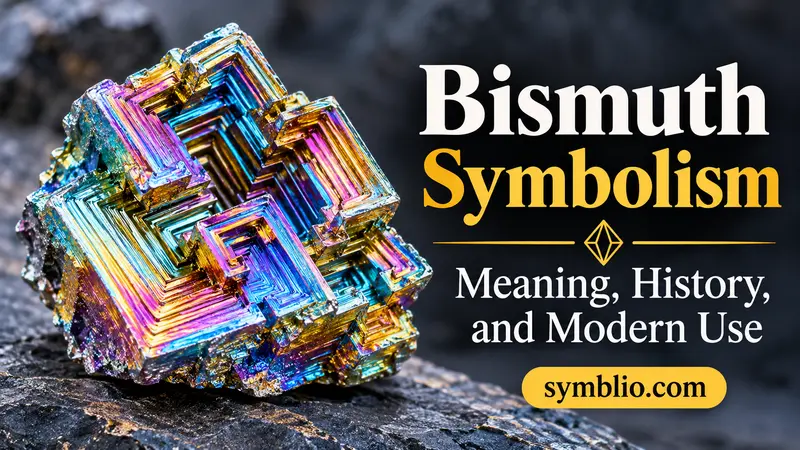
Bismuth is a distinctive metallic element known for its rainbow-colored surfaces and unusual geometric crystal formations. In modern crystal culture, bismuth symbolism is commonly connected with transformation, creativity, individuality, and the beauty that can emerge from change. Its unusual appearance makes it especially appealing to mineral collectors, artists, jewelry enthusiasts, and people interested in symbolic objects.
Unlike gemstones such as amethyst, jade, or turquoise, bismuth does not have an extensive history of traditional spiritual or religious interpretation. Much of its contemporary symbolism comes from its physical characteristics. Its colorful surface, intricate stair-step patterns, and ability to form striking structures have inspired associations with personal development, imagination, and self-expression.
In the United States, bismuth is particularly popular among mineral collectors, science enthusiasts, alternative jewelry designers, and people interested in modern crystal aesthetics. Its unusual appearance also makes it a recognizable decorative object.
Understanding its symbolism requires looking beyond its rainbow colors. Its scientific history, industrial applications, and modern cultural associations all contribute to the meanings people attach to this remarkable metal.
Quick Answer
Bismuth commonly symbolizes transformation, creativity, individuality, and personal growth in modern American crystal culture. Its rainbow-colored surface and geometric formations also inspire associations with balance, adaptability, imagination, and the ability to find beauty in unexpected changes.
TL;DR
- Transformation: Represents change and the development of new possibilities.
- Creativity: Reflects imagination, artistic expression, and unconventional thinking.
- Individuality: Celebrates uniqueness and personal identity.
- Balance: Connects geometric structure with colorful visual complexity.
- Adaptability: Suggests responding positively to changing circumstances.
- Scientific curiosity: Represents discovery, experimentation, and the natural world.
What Is Bismuth and Why Does It Look So Unusual?
Bismuth is a chemical element with the symbol Bi and atomic number 83. It is a brittle, dense metal with a naturally silvery-white appearance and a slight pinkish tint. Although it shares some physical characteristics with lead and tin, scientists recognize it as a distinct element.
Its most recognizable appearance comes from its colorful surface oxidation. When bismuth develops a thin oxide layer, different thicknesses create colors that range from gold and purple to blue, green, and pink. This optical effect produces the rainbow appearance that attracts so much attention.
Many familiar bismuth specimens also display unusual geometric formations. These structures are commonly called hopper crystals because their edges grow faster than their central surfaces, producing hollow-looking, stair-stepped shapes.
An important distinction is that the spectacular rainbow staircase specimens commonly sold to collectors are generally laboratory-grown rather than naturally occurring in that familiar form.
This combination of scientific processes and unusual visual characteristics gives bismuth its modern symbolic appeal. People often interpret its appearance as an example of how structure and creativity can exist together.
The Core Symbolism of Bismuth
Bismuth has several modern symbolic associations, although these meanings are interpretations rather than universally established historical traditions.
Transformation is perhaps its most recognizable contemporary association. Its appearance changes as a surface oxide develops, creating colors that were not visible on the freshly exposed metal. This visual change provides a natural comparison with personal development.
Creativity comes from its unusual geometric formations and rainbow appearance. Unlike ordinary metallic objects, bismuth crystals look almost architectural. Their unexpected shapes make them popular among people who appreciate experimental art and unconventional design.
Individuality is another common interpretation. Every specimen can display different colors, proportions, and surface patterns. This variation makes bismuth an appealing representation of uniqueness and personal identity.
People also associate bismuth with adaptability because its appearance and applications demonstrate how one material can serve different purposes under different conditions.
Together, these interpretations make bismuth a modern symbol of change, imagination, and the value of individual expression.
Historical Origins of Bismuth and Its Early Associations
Bismuth has a longer history in metallurgy and alchemy than it does in established spiritual symbolism.
The metal was known in Europe during the medieval period, although early metalworkers often confused it with lead and tin because of their similar appearances and physical properties. Historical accounts generally place its recognition around the fifteenth century.
For a long time, people did not clearly understand that bismuth was a separate element. Its identification became more precise through the development of European mineralogy and chemistry.
In 1753, French chemist Claude-François Geoffroy demonstrated that bismuth was distinct from lead and tin. This helped establish its identity within the developing science of chemistry.
Bismuth also has an interesting connection to South American metallurgy. Evidence shows that Inca metalworkers used bismuth-containing bronze alloys during the pre-Columbian period. This demonstrates that the metal had practical importance beyond European workshops.
However, there is little reliable evidence that bismuth had a widely established religious or spiritual symbolism in these historical societies.
Its modern symbolic meanings developed largely through its distinctive appearance and its later popularity among mineral collectors.
What Bismuth Symbolizes in Modern American Culture
In the United States, bismuth is primarily appreciated as an unusual mineral specimen, decorative object, and material associated with scientific curiosity.
Its appearance fits several interests in contemporary American culture.
Individual expression: People who enjoy unusual accessories and decorative objects may appreciate bismuth because it looks different from conventional gemstones and metals.
Scientific curiosity: Its unusual crystal structures attract people interested in chemistry, geology, and mineral collecting. It represents the connection between scientific understanding and visual beauty.
Creative design: Artists and jewelry makers sometimes use bismuth specimens as inspiration for futuristic, geometric, and colorful designs.
Personal development: In contemporary crystal culture, its changing surface is sometimes interpreted as a reminder that people can develop new perspectives and identities.
Unlike traditional American symbols associated with national holidays, religious celebrations, or established historical events, bismuth does not have a widely recognized national meaning.
Its significance is more individual. Someone might display it because of its scientific interest, while another person might value it as a personal reminder of creativity or change.
Bismuth as a Symbol of Transformation and Personal Growth
Transformation is one of the most natural symbolic interpretations of bismuth.
Its familiar rainbow appearance develops through a physical process that changes the surface of the metal. The underlying material remains bismuth, but its visible appearance becomes considerably more complex.
People often use this characteristic as a comparison for personal growth.
A person may maintain their fundamental identity while developing new interests, skills, perspectives, and relationships. Change does not necessarily require abandoning one’s original character.
Bismuth can therefore represent the idea that personal development adds new dimensions to an existing identity.
This interpretation is particularly relevant during major life transitions, including graduation, career changes, moving to a new place, or beginning a creative project.
As a decorative reminder, a bismuth specimen can represent the possibility of developing without losing one’s sense of self.
Its symbolism focuses less on dramatic reinvention and more on the gradual process of becoming comfortable with change.
The Meaning of Bismuth’s Rainbow Colors
Color plays an important role in how people interpret bismuth.
Its surface can display several colors within a single specimen, making it especially interesting to people who associate colors with emotions and personality.
The following interpretations come from general modern color associations rather than an established ancient bismuth tradition.
| Color | Common Symbolic Association | Emotional Interpretation |
|---|---|---|
| Blue | Calmness and communication | Clarity and thoughtful expression |
| Purple | Imagination and creativity | Original thinking and inspiration |
| Green | Growth and renewal | Development and fresh opportunities |
| Gold | Achievement and confidence | Optimism and accomplishment |
| Pink | Compassion and affection | Kindness and emotional warmth |
| Rainbow | Diversity and individuality | Acceptance and self-expression |
The combination of these colors makes bismuth particularly interesting as a decorative symbol.
Rather than representing one specific emotion, its multicolored appearance can suggest the coexistence of different experiences and personality traits.
For some people, this becomes a visual reminder that identity is not limited to a single characteristic.
The Geometric Structure of Bismuth and Its Symbolic Meaning
One of the most recognizable features of bismuth is its staircase-like crystal structure.
These formations have an almost architectural appearance. Their repeating edges create a sense of organization, while their unusual proportions make each specimen visually distinctive.
This contrast inspires several contemporary interpretations.
Order: The repeating geometric pattern can represent organization, structure, and the importance of establishing direction.
Balance: Its symmetrical qualities can suggest the relationship between different parts of life.
Progress: The upward appearance of the staircase-like formations can be interpreted as a representation of gradual development.
Originality: The unusual geometry demonstrates how familiar structures can produce unexpected visual results.
The staircase interpretation is especially popular in decorative contexts because it offers an easily understood comparison with personal progress.
Each level can represent a different stage of learning, experience, or development.
Although this is a modern symbolic reading rather than an established historical belief, it provides a meaningful way to appreciate the crystal’s appearance.
Bismuth Symbolism in Spiritual and Crystal Traditions
Bismuth appears in contemporary crystal-collecting and alternative spiritual communities, where people sometimes assign personal meanings to different minerals and metals.
Within these settings, it is commonly associated with transformation, creativity, balance, and adaptability.
Some modern crystal enthusiasts also connect it with self-discovery and the exploration of different perspectives.
However, it is important to distinguish these interpretations from established religious teachings.
Bismuth does not have a widely documented role in major religious traditions comparable to the historical significance of gold, frankincense, jade, or particular sacred stones.
There is also no scientific evidence that holding or displaying bismuth produces spiritual energy or changes a person’s emotional state.
People can still appreciate its symbolic value without treating these interpretations as scientific facts.
For many collectors, the appeal is simply the opportunity to connect an interesting natural element with personal experiences, creative interests, or philosophical ideas.
The Emotional and Psychological Meaning of Bismuth
Bismuth can represent several emotional ideas because of its unusual visual appearance.
Its bright colors may encourage associations with curiosity, optimism, and imagination. Its repeating geometric patterns can suggest stability and organization.
These contrasting characteristics make it an interesting symbol for people who appreciate both creativity and structure.
Self-acceptance: Its distinctive appearance can represent the idea that individuality does not need to resemble conventional expectations.
Confidence: Its unusual colors and shapes can serve as a reminder to appreciate personal differences.
Adaptability: Its changing surface offers a visual comparison with adjusting to unfamiliar situations.
Curiosity: Its scientific properties can encourage an interest in discovery and learning.
Patience: The carefully developed crystal formations can suggest that interesting results sometimes require time and suitable conditions.
These associations are personal interpretations, not scientifically established psychological effects.
Nevertheless, symbolic objects can help people express ideas that are difficult to communicate directly. A bismuth specimen may become meaningful because of the memories, experiences, or personal values someone connects with it.
Why Bismuth Appears in Jewelry, Art, and Home Decor
Bismuth’s appearance makes it particularly attractive for creative applications.
In jewelry, its colorful surfaces offer an alternative to conventional gemstones. Designers and collectors may appreciate its metallic finish, geometric shapes, and unusual color combinations.
In home decor, bismuth specimens often become conversation pieces. Their architectural appearance works well with modern interiors, science-themed displays, and collections of unusual minerals.
Artists may also use bismuth as inspiration for abstract designs, sculptures, photography, and experimental visual projects.
Its symbolic interpretations make these objects more personal.
A collector might display a specimen because it represents scientific curiosity. An artist might appreciate it as an example of unconventional beauty. Someone else might choose it because its colors remind them of a period of personal development.
In these situations, the object communicates something about the owner’s interests and preferences.
Bismuth’s decorative appeal comes from the combination of metallic texture, unusual geometry, and vivid surface colors.
Bismuth in Tattoos and Personal Identity
Bismuth-inspired tattoos are a relatively uncommon but distinctive choice for people who appreciate mineral imagery and geometric artwork.
A tattoo based on a bismuth crystal can represent several personal ideas.
- Transformation: A reminder that personal identity can develop over time.
- Individuality: Appreciation for unusual characteristics and independent thinking.
- Creativity: A connection to artistic expression and imagination.
- Progress: The staircase-like formation can represent personal milestones.
- Adaptability: A reminder to remain open to new experiences.
Some designs focus on the recognizable geometric structure, while others emphasize the rainbow colors.
A minimalist version might feature a simple stepped outline, while a more detailed design could reproduce the metallic appearance and layered colors.
Bismuth tattoos do not have a universally accepted meaning. Their interpretation depends on the person wearing them and the experiences they want the artwork to represent.
For someone interested in science, the tattoo might celebrate chemistry and mineral collecting. For someone else, it may represent the freedom to develop an unconventional identity.
Bismuth in Science, Medicine, and Everyday American Life
Bismuth has practical applications that extend far beyond mineral collections.
In the United States, one familiar connection is its use in certain stomach remedies. Bismuth subsalicylate is the active ingredient in products such as Pepto-Bismol.
Bismuth compounds have also been used in cosmetics, pigments, and other commercial applications.
Its alloys are useful in applications that require relatively low melting temperatures. Some are used in safety devices, solders, and specialized industrial materials.
Another important characteristic is that bismuth has considerably lower toxicity than lead, making it useful in certain applications where replacing lead is desirable.
These practical uses contribute to its modern associations with innovation, usefulness, and scientific progress.
There is also an interesting contrast between its appearance and its everyday applications. A material that looks like a colorful decorative sculpture can also serve practical purposes in medicine and manufacturing.
This combination makes bismuth a fitting symbol of the relationship between science, creativity, and everyday life.
Cross-Cultural Connections and Historical Distinctions
Bismuth has appeared in different metallurgical contexts, but its symbolic history should not be exaggerated.
The Inca use of bismuth-containing bronze provides an important example of its historical presence in South America. It demonstrates the sophistication of pre-Columbian metalworking and the practical value of combining different metals.
In medieval and early modern Europe, bismuth was associated more closely with mining, metalworking, and alchemical experimentation than with widely recognized religious traditions.
European alchemists and early metallurgists investigated many substances while trying to understand how metals differed and how materials could be transformed.
Bismuth’s resemblance to lead and tin made its classification particularly interesting.
However, there is no strong historical basis for claiming that the rainbow-colored bismuth crystals commonly collected today held sacred meanings in ancient civilizations.
Modern interpretations of bismuth as a symbol of transformation and creativity should therefore be understood as contemporary associations.
Recognizing this distinction allows people to appreciate its cultural history without assigning unsupported beliefs to earlier societies.
Common Misunderstandings About Bismuth Symbolism
Bismuth is sometimes presented online with exaggerated claims about its history, appearance, and supposed spiritual properties.
Understanding a few important distinctions helps separate reliable information from modern interpretations.
Misunderstanding: Bismuth has an ancient tradition of rainbow symbolism.
There is no widely documented ancient tradition specifically connecting bismuth with rainbow symbolism. Its familiar rainbow-colored crystal appearance has become especially popular in modern mineral culture.
Misunderstanding: All bismuth crystals are naturally formed.
The dramatic staircase specimens commonly displayed by collectors are generally laboratory-grown. Their appearance results from controlled crystal growth rather than the discovery of naturally occurring specimens with identical shapes.
Misunderstanding: Bismuth has a universally accepted spiritual meaning.
Its associations with creativity, transformation, and balance come largely from contemporary crystal culture and individual interpretation.
Misunderstanding: Bismuth has scientifically proven healing powers.
There is no scientific evidence that decorative bismuth crystals provide spiritual or emotional healing. Certain bismuth compounds have legitimate medical applications, but those uses are different from claims about crystal-based healing.
Misunderstanding: Bismuth and lead are essentially the same metal.
Although the two metals share some physical characteristics, they are separate chemical elements with different properties and applications.
These distinctions are important because they preserve the difference between scientific facts, historical evidence, and personal symbolism.
How Bismuth Symbolism Has Evolved Over Time
Bismuth’s modern symbolic identity developed differently from that of many traditional gemstones.
Its earlier history centered on metallurgy, mineral identification, and practical applications. Metalworkers valued its usefulness, while early scientists investigated its relationship to other heavy metals.
The identification of bismuth as a separate element in the eighteenth century strengthened its place in modern chemistry.
Later developments in industrial manufacturing expanded its applications in alloys, cosmetics, and medicine.
Its colorful crystal formations eventually became an important part of its modern public image.
As mineral collecting and alternative crystal culture gained visibility, people increasingly interpreted its visual characteristics through personal and emotional themes.
The result is a modern symbolic identity built around several recognizable ideas:
- Change without losing individuality.
- Creativity within an organized structure.
- Beauty emerging through physical processes.
- Curiosity about unfamiliar materials.
- Appreciation for unconventional appearances.
Today, bismuth is valued both as a scientific material and as an object of personal expression.
FAQs
Bismuth is most commonly associated with transformation, creativity, individuality, and adaptability in contemporary crystal culture. These meanings are inspired by its colorful surface and distinctive geometric formations rather than an established ancient symbolic tradition.
Some modern crystal enthusiasts use bismuth as a symbolic object associated with personal growth and creative expression. However, it is primarily a metallic element, and spiritual interpretations are matters of personal belief rather than scientific evidence.
A rainbow bismuth crystal can represent diversity, individuality, imagination, and the beauty of change. Its different colors also make it a popular visual representation of creative expression.
Bismuth tattoos often represent transformation, originality, personal development, and an appreciation for unconventional beauty. The geometric crystal structure can also represent progress through different stages of life.
Bismuth does not have a widely established religious meaning in major religious traditions. Its contemporary spiritual associations come mainly from modern crystal culture rather than documented religious teachings.
Bismuth metal can develop an iridescent oxide surface, creating rainbow-like colors. However, the dramatic staircase-shaped specimens commonly sold to collectors are generally produced through laboratory crystal growth.
Bismuth is generally interpreted positively in modern crystal culture. Its common associations include creativity, adaptability, individuality, and transformation, although its meaning ultimately depends on personal interpretation.
Conclusion
Bismuth is an unusual metal whose colorful appearance and geometric crystal structures have inspired a distinctive modern symbolic identity. Its most common associations include transformation, creativity, individuality, adaptability, and personal growth.
Unlike symbols with extensive religious or mythological histories, its contemporary meanings developed largely through scientific discovery, artistic appreciation, and modern mineral culture. Its history in metallurgy and medicine adds another dimension to its importance, connecting visual beauty with practical innovation.
Ultimately, bismuth symbolism offers a simple way to think about individuality and change. Its colorful surfaces and unusual structures remind us that something can remain fundamentally recognizable while developing an entirely different appearance. That contrast is what makes bismuth an interesting subject for both scientific appreciation and personal symbolism.