
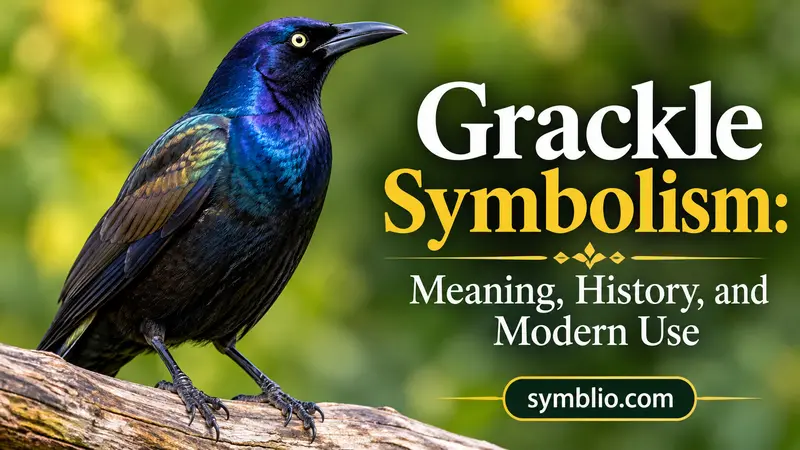
Grackles are distinctive blackbirds recognized for their glossy feathers, bright eyes, long tails, and unusually social behavior. Although they may appear completely black from a distance, sunlight reveals shades of blue, purple, green, and bronze across their plumage. These birds are familiar sights in American parks, backyards, agricultural fields, and suburban neighborhoods.
Grackle symbolism often centers on intelligence, adaptability, resourcefulness, confidence, and community. Their ability to find food in changing environments, communicate through varied calls, and gather in large groups provides several reasons people connect them with these qualities.
In the United States, grackles are familiar parts of everyday outdoor life. Some people appreciate their striking appearance and clever behavior, while others find their loud calls and large gatherings disruptive. These contrasting reactions make the grackle an interesting subject for understanding how people attach meaning to ordinary wildlife.
Unlike birds with well-documented religious or mythological histories, the American grackle does not have one universally established symbolic meaning. Much of its modern interpretation comes from its appearance, behavior, and place in the natural landscape.
Quick Answer
Grackle symbolism commonly represents intelligence, adaptability, resourcefulness, confidence, and social connection in modern American interpretations. Its glossy dark feathers can also suggest individuality and transformation, while its communal behavior makes it a natural symbol of cooperation and belonging.
TL;DR
- Intelligence reflects the grackle’s resourceful feeding habits.
- Adaptability comes from its ability to thrive in changing environments.
- Community represents its tendency to gather in large flocks.
- Confidence reflects its bold and noticeable behavior.
- Dark iridescent feathers suggest individuality and changing perspectives.
- Modern interpretations connect grackles with independence and environmental awareness.
What Does a Grackle Look Like?
A grackle is a member of the blackbird family, Icteridae. Several species exist in the Americas, including the Common Grackle, Great-tailed Grackle, and Boat-tailed Grackle.
The Common Grackle is particularly familiar throughout the eastern United States. It has a long body, strong legs, an elongated tail, and a pointed bill. Adult males often display glossy blue or purple heads with bronze or greenish body feathers. Their bright golden eyes create a noticeable contrast against their dark plumage.
Female grackles generally have less glossy feathers, although their appearance varies between populations and species.
People frequently encounter these birds in:
- Residential gardens and lawns
- Public parks and school grounds
- Agricultural fields and orchards
- Wetlands and woodland edges
- Parking lots and shopping areas
- Trees near rivers and lakes
Their distinctive appearance contributes to their symbolic associations. The contrast between dark feathers and colorful reflections makes them particularly interesting to people who interpret animal appearances as expressions of personality or character.
The Core Symbolic Meanings of Grackles
Grackles have several qualities that inspire modern symbolic interpretations. These meanings are primarily based on observable behavior rather than a single established religious tradition.
Intelligence and resourcefulness
Grackles are opportunistic feeders. They eat seeds, insects, fruits, and various other foods, adjusting their feeding habits according to what is available. Their ability to exploit different food sources makes them natural examples of resourcefulness.
Symbolically, they can represent practical intelligence, observation, and the ability to recognize opportunities.
Adaptability and flexibility
Grackles inhabit diverse environments, including wetlands, farmland, parks, and urban neighborhoods. Their willingness to live near people demonstrates their ability to adjust to changing surroundings.
This quality makes them a fitting symbol of flexibility and resilience.
Community and cooperation
Grackles frequently gather in groups, especially outside the breeding season. Their communal roosting and flocking behavior can represent belonging, communication, and shared experiences.
Confidence and individuality
Their upright posture, conspicuous calls, and glossy appearance make grackles difficult to overlook. In personal symbolism, these characteristics can represent self-expression and confidence.
Transformation and changing perspectives
The feathers of a grackle may look black in one lighting condition and reveal several colors in another. This visual characteristic can inspire associations with transformation, complexity, and the idea that appearances do not always reveal everything.
Historical Origins of Grackle Symbolism
The grackle’s symbolic history is less clearly documented than that of birds such as eagles, ravens, and owls. There is no single ancient tradition that establishes the American grackle as a universal symbol of wisdom, protection, or spiritual transformation.
Understanding its history requires separating the bird’s natural history, its name, and the meanings people have developed around it.
The English word grackle comes from the Latin graculus, a name associated with the European jackdaw. The term entered English during the eighteenth century as naturalists developed more formal classifications for birds.
Early European descriptions of American grackles frequently emphasized their dark plumage, loud vocalizations, and feeding habits. Their relationship with agricultural landscapes was particularly noticeable.
Farmers sometimes viewed large flocks negatively because grackles consumed corn and other crops. At the same time, these birds also ate insects and other small animals.
This mixed relationship influenced their reputation. Rather than representing only something positive or negative, grackles became recognizable examples of wildlife that can be both useful and inconvenient to human communities.
Their modern symbolic meanings developed largely through observation and personal interpretation rather than a continuous, documented tradition.
Grackle Symbolism in American Culture
In the United States, grackles are familiar birds in both rural and urban environments. Their presence in everyday settings makes them accessible subjects for nature photography, birdwatching, and personal reflection.
American interpretations often focus on their ability to survive in environments shaped by human activity.
In suburban neighborhoods, grackles may gather around lawns, parking areas, and outdoor dining spaces. Their comfort around people can suggest adaptability and familiarity with changing surroundings.
In agricultural communities, their relationship with crops creates a more complicated impression. Large groups can consume significant quantities of grain, sometimes making them unwelcome visitors. Nevertheless, they also contribute to ecosystems by eating insects and other organisms.
These contrasting experiences show why the bird does not carry one fixed cultural meaning.
For some Americans, the grackle represents cleverness and independence. For others, it is simply a familiar neighborhood bird with an unmistakable voice.
Its symbolic importance is therefore largely personal rather than institutional. It does not have a recognized national holiday, major religious celebration, or widely established American ceremonial role.
The Meaning of a Grackle’s Black and Iridescent Feathers
One of the most noticeable features of a grackle is its unusual feather coloration.
From a distance, the bird may look entirely black. Under direct sunlight, however, its feathers reflect blue, violet, green, and bronze shades. This effect is called iridescence.
The changing appearance creates several possible symbolic interpretations.
Black: Independence and the unknown
Black is frequently associated with mystery, privacy, authority, and independence in modern American visual culture. When people apply these associations to grackles, their dark plumage may suggest self-reliance or a preference for standing apart.
However, black does not automatically represent something negative. In clothing, design, and art, it can communicate elegance, simplicity, or strength.
Blue and purple: Expression and individuality
The blue and purple reflections on a grackle’s head can suggest creativity, individuality, and originality.
These colors are often used in modern visual design to communicate imagination, distinction, and sophistication.
Green and bronze: Nature and renewal
Green reflections may encourage associations with growth, natural environments, and renewal. Bronze can suggest maturity, endurance, and the passage of time.
The most interesting feature is the combination of these colors. A grackle does not have a single visual identity under every lighting condition. Its appearance changes with its surroundings, making it a natural inspiration for symbolism about complexity and perspective.
Intelligence and Resourcefulness in Grackle Behavior
Grackles are opportunistic birds with flexible feeding habits. Their diet includes seeds, agricultural grains, fruits, insects, and other small animals.
They frequently forage on the ground, searching through grass and soil for food. They may also follow agricultural machinery because disturbed ground exposes insects and other potential food sources.
Some grackles have been observed using unusual feeding techniques. They can open acorns with their specialized bills and have been recorded using different materials during a behavior known as anting.
Anting involves allowing ants to move across the feathers. Scientists believe the behavior may help birds manage parasites, although its full purpose is not completely understood.
These observations help explain why grackles can represent intelligence and practical problem-solving.
In personal interpretation, encountering a grackle may serve as a reminder to:
- Pay attention to available opportunities.
- Consider different approaches to a problem.
- Remain flexible when circumstances change.
- Use observation before making decisions.
- Recognize the value of practical knowledge.
The grackle’s example is not about being clever for its own sake. It is about responding effectively to the environment.
Community, Communication, and Social Connection
Grackles are highly social birds. They often gather in large flocks, particularly during migration and winter roosting periods.
These gatherings can contain thousands of birds, sometimes alongside other blackbird species. Their collective behavior makes them interesting examples of social organization in nature.
Their vocal communication is another distinctive feature. Grackles produce a variety of calls, whistles, squeaks, and other sounds. Their voices are often described as harsh or metallic.
From a symbolic perspective, these behaviors suggest several ideas:
Belonging: A flock represents the comfort and protection that can come from being part of a community.
Communication: Their varied calls suggest the importance of expressing information and responding to others.
Coexistence: Mixed flocks demonstrate how different species can share the same general environment.
Collective strength: Large groups can represent the benefits of shared awareness and cooperation.
However, community does not necessarily mean complete agreement. Grackles compete for food and defend nesting areas. Their social behavior illustrates that cooperation and competition can exist together.
Adaptability and Survival in Changing Environments
Grackles are particularly noticeable because several species have adapted successfully to environments influenced by human development.
The Common Grackle uses open woodlands, marshes, farmland, and suburban areas. Great-tailed Grackles have also expanded their range considerably across parts of the United States during the last century.
Urban parks, lawns, agricultural fields, and scattered trees provide feeding and nesting opportunities.
This flexibility makes adaptability one of the most convincing modern interpretations of grackle symbolism.
The bird can represent the ability to adjust without losing its essential characteristics.
For people experiencing a new school, unfamiliar surroundings, changing responsibilities, or a major transition, this interpretation can offer a useful reminder that adjustment does not require abandoning individuality.
The grackle also demonstrates that successful adaptation is not always about finding perfect conditions. Sometimes it involves learning to work with the environment that already exists.
Spiritual Interpretations of Seeing a Grackle
Some people interpret encounters with birds through personal spirituality. A grackle appearing in a garden, sitting near a window, or crossing someone’s path may become a meaningful moment of reflection.
There is no universally accepted spiritual rule explaining what a grackle’s appearance means. Its interpretation depends on individual beliefs and the circumstances surrounding the encounter.
Several common personal interpretations include:
A reminder to observe: The grackle’s alert behavior may inspire someone to pay closer attention to their surroundings.
A lesson in adaptability: Its presence may encourage flexibility during a period of change.
A reminder of community: Seeing several grackles together can prompt reflection on friendships, family, and social relationships.
An invitation to express individuality: Its unusual appearance may encourage people to appreciate their own distinctive qualities.
These interpretations are personal rather than established religious teachings.
A grackle visiting a yard does not provide reliable evidence of a supernatural message or predict a particular future event. Its presence is usually explained by ordinary factors such as food, shelter, nesting opportunities, and seasonal movement.
Grackle Symbolism Across Different Cultures
Grackle-related interpretations vary according to geography and the particular bird species involved.
In Mexico, the Great-tailed Grackle is commonly known as the zanate or zanate mexicano. It is a familiar bird in cities, agricultural areas, and open landscapes.
A notable Mexican legend explains how the zanate acquired its voice. In the story, the bird was originally voiceless and obtained seven songs from a sea turtle. These songs represented seven human passions: love, hate, fear, courage, joy, sadness, and anger.
The story gives the bird a connection with communication and the range of human emotions.
It is important to understand that this is a particular folkloric tradition, not a universal belief shared by every Mexican community.
In other cultures, blackbirds and dark-colored birds may have different associations. Some traditions connect them with intelligence, seasonal change, or the natural world. Others interpret particular species through religious stories or local folklore.
However, these broader blackbird associations should not automatically be assigned to American grackles.
A careful interpretation recognizes the differences between species, geographical regions, and cultural traditions.
Emotional and Psychological Meaning of Grackles
People often connect animal behavior with human emotions and personality traits. Grackles provide several interesting examples because their appearance and behavior can create contrasting impressions.
Independence: A grackle can represent someone who feels comfortable being different without constantly seeking approval.
Resilience: Its adaptable behavior reflects the ability to handle unfamiliar circumstances and adjust to change.
Social connection: Large flocks illustrate the importance of friendship, cooperation, and shared experiences.
Confidence: Its noticeable appearance can encourage people to express their individuality without worrying about standing out.
There is no scientific evidence that seeing a grackle reveals someone’s personality or emotional condition. These meanings are creative interpretations based on the bird’s observable qualities.
Grackle Symbolism in Dreams
Dream interpretations involving grackles are subjective. Unlike some familiar dream symbols, grackles do not have a widely established interpretation in major psychological traditions.
Nevertheless, their behavior can provide useful starting points for personal reflection.
A grackle appearing alone might suggest independence or self-reliance to someone who associates the bird with those qualities.
A flock of grackles could bring thoughts of friendship, community, or social activity.
A grackle calling loudly might remind someone of communication, an unresolved conversation, or the need to express an opinion.
A grackle displaying its iridescent feathers could inspire thoughts about individuality and seeing beyond appearances.
The emotional atmosphere of the dream also matters. A peaceful encounter may create a different personal association from an uncomfortable or confusing one.
Rather than treating a dream as a prediction, it is more reasonable to consider the bird alongside the dreamer’s recent experiences and personal associations.
Grackle Symbolism in Tattoos and Personal Art
Grackles can make distinctive subjects for bird-inspired artwork because of their dark feathers, bright eyes, and colorful reflections.
Although grackle tattoos are less conventional than eagle, raven, or owl tattoos, their appearance offers several artistic possibilities.
People who choose grackle-inspired artwork may associate the bird with:
- Independence and self-expression
- Adaptability and resourcefulness
- Individuality and confidence
- Community and belonging
- Appreciation for overlooked wildlife
The artistic style can influence the interpretation.
A realistic grackle tattoo may emphasize the bird’s natural beauty. A design showing several birds together may focus on family or friendship. A minimalist silhouette may communicate simplicity and independence.
Some designs incorporate branches, flowers, or natural landscapes to create a connection with environmental appreciation.
There is no fixed traditional meaning attached to grackle tattoos. Their significance depends on the individual, the design, and the reason for choosing the bird.
Grackles in Art, Photography, and Modern Media
Grackles offer interesting visual possibilities for photographers, illustrators, and nature artists.
Their feathers are particularly attractive subjects because their colors change according to lighting and viewing angle. A photograph taken in direct sunlight may reveal details that are difficult to notice in an ordinary image.
In visual art, grackles can represent everyday nature, urban wildlife, and the relationship between human communities and the environment.
Their presence in city parks and residential neighborhoods also makes them useful subjects for exploring the natural world within developed landscapes.
On social media, birdwatching communities share photographs and observations of grackles, often highlighting their unusual expressions, vocalizations, and bold behavior.
Their reputation as noisy and sometimes troublesome birds also makes them subjects of humor. People sometimes photograph their gatherings or describe their confident behavior in playful ways.
These modern representations show how a bird can become culturally recognizable without requiring an ancient symbolic tradition.
Common Misunderstandings About Grackle Symbolism
Several misconceptions can arise when people interpret grackles through broader bird symbolism.
Grackles are not automatically symbols of bad luck.
Their black feathers sometimes lead people to associate them with negative ideas. However, dark plumage alone does not establish an association with misfortune, death, or danger.
Grackles are not the same as crows or ravens.
Although all three may appear dark from a distance, they belong to different bird families. Their cultural histories and biological characteristics should not be treated as interchangeable.
A grackle visiting a home is not necessarily a supernatural sign.
Birds visit residential areas because they provide food, water, nesting locations, and shelter.
Not every blackbird tradition applies to grackles.
Stories about ravens, European blackbirds, and other species may have their own cultural backgrounds. Applying those meanings directly to American grackles can create misleading interpretations.
Their behavior is not always evidence of human-like intentions.
A grackle competing for food or making loud calls is behaving according to its natural needs. Symbolic interpretations should remain separate from scientific explanations.
Positive and Negative Interpretations of Grackles
Grackles can inspire positive or negative reactions depending on someone’s experiences with them.
Their intelligence, adaptability, and social behavior are often appreciated. However, their loud calls, large gatherings, and feeding habits can make them unwelcome in some situations.
Neither interpretation completely defines the bird.
| Context | Positive Interpretation | Possible Negative Association |
|---|---|---|
| Dark feathers | Independence and individuality | Mystery or unfamiliarity |
| Large flocks | Community and belonging | Crowding and disruption |
| Feeding behavior | Resourcefulness | Competition |
| Loud calls | Communication and expression | Noise and disturbance |
| Adaptability | Flexibility and resilience | Opportunistic behavior |
This contrast makes the grackle an interesting example of how symbolism depends on perspective.
A farmer protecting crops may view the bird differently from a photographer appreciating its iridescent feathers. Both responses reflect genuine experiences, but neither represents the complete meaning of the species.
The Changing Meaning of Grackles in Modern American Life
The way Americans understand grackles continues to develop alongside changing attitudes toward wildlife.
Historically, their relationship with agriculture influenced much of their reputation. Large flocks could damage crops, making them a concern for farmers.
Today, grackles are also appreciated as recognizable parts of urban ecology. Birdwatchers observe their feeding habits, vocalizations, and seasonal movements, while photographers highlight their unusual coloration.
Environmental awareness has also encouraged more people to pay attention to familiar species rather than focusing exclusively on rare or endangered animals.
This is especially relevant because Common Grackle populations have experienced substantial long-term declines despite the species remaining widespread.
Their presence in ordinary neighborhoods should not be mistaken for proof that their populations are unaffected by environmental changes.
Modern interpretations increasingly allow room for both appreciation and ecological awareness. The grackle can represent adaptability while also reminding people that familiar wildlife deserves attention and conservation consideration.
Grackle Symbolism Compared With Other Black Birds
Grackles are sometimes confused with other dark-colored birds, especially crows, ravens, and starlings. Although they share certain physical characteristics, their symbolism and cultural reputations differ.
Grackle: Commonly associated in modern personal interpretations with adaptability, resourcefulness, individuality, and community.
Crow: Frequently represents intelligence, observation, and transformation in different cultural traditions.
Raven: Often appears in mythology and folklore in connection with creation stories, knowledge, death, and change.
Starling: Can suggest communication, collective movement, and adaptability because of its flocking behavior.
These are broad interpretive associations rather than universal definitions. Each bird has a distinct biological identity and cultural history.
The grackle stands out because its symbolism is closely connected to everyday observation. It does not need an elaborate mythological background to inspire ideas about flexibility, individuality, and social behavior.
FAQs
In personal spiritual interpretations, grackles can represent adaptability, intelligence, individuality, and community. These associations come mainly from their natural behavior rather than an established universal religious tradition.
There is no widely established American tradition that identifies seeing a grackle as either good luck or bad luck. Some people simply interpret the encounter positively because they associate the bird with resourcefulness and flexibility.
A black grackle may represent independence, confidence, and individuality in modern symbolic interpretations. Its dark appearance and colorful iridescent feathers can also suggest complexity and the importance of looking beyond first impressions.
A grackle tattoo can represent independence, adaptability, self-expression, or social connection. Its meaning depends on the person’s experiences and the artistic details included in the design.
They can represent transformation in personal symbolism because their feathers reveal different colors under changing light. Their ability to live in different environments also makes them a natural example of adjustment and change.
A flock of grackles can symbolize community, communication, cooperation, and collective strength. Their large gatherings make these associations especially understandable.
Not necessarily. Both birds may inspire associations with intelligence and adaptability, but crows have a much more extensively documented presence in mythology and folklore than American grackles.
Conclusion
Grackle symbolism brings together several qualities inspired by the bird’s natural appearance and behavior. Intelligence, adaptability, resourcefulness, individuality, and community are among the most recognizable modern interpretations.
In the United States, grackles are familiar birds that live alongside people in parks, gardens, agricultural landscapes, and urban neighborhoods. Their glossy feathers, unusual voices, and social behavior give them a distinctive place in everyday wildlife.
Although they do not have one universally established ancient symbolic meaning, their characteristics offer useful ways to think about independence, flexibility, and belonging. The grackle reminds us that even familiar birds can reveal something interesting when we take the time to observe them.


