Japanese crane symbolism is associated with longevity, happiness, good fortune, peace, and lasting relationships. The crane, particularly the red-crowned crane known in Japan as tancho, holds an important place in Japanese art, traditional clothing, folklore, and celebrations.
For centuries, Japanese artists have featured cranes in paintings, decorative screens, silk textiles, and traditional crafts. The bird became a symbol of long life and prosperity, partly through cultural beliefs shared with China.
Today, crane imagery has meaning beyond Japan. In the United States, people commonly recognize Japanese paper cranes as symbols of peace, hope, remembrance, and goodwill. Others appreciate crane designs for their connection with Japanese heritage, wedding traditions, and natural beauty.
Understanding this symbol requires looking at both the living bird and the cultural traditions that transformed it into an enduring image.
Quick Answer: What Does Japanese Crane Symbolize?
Japanese crane symbolism commonly represents longevity, good fortune, happiness, peace, and lasting love. In traditional Japanese culture, cranes are associated with long life and auspicious occasions, while paper cranes have become internationally recognized symbols of peace, hope, and remembrance.
TL;DR: Key Symbolic Meanings
- Longevity: Represents wishes for a long and healthy life.
- Good fortune: Appears in traditional celebrations and auspicious artwork.
- Peace: Paper cranes express hopes for a peaceful world.
- Lasting love: Pairs of cranes represent harmonious marriages.
- Hope: Origami cranes communicate encouragement and goodwill.
- Cultural heritage: Reflects Japanese artistic traditions and craftsmanship.
What Does the Japanese Crane Look Like?
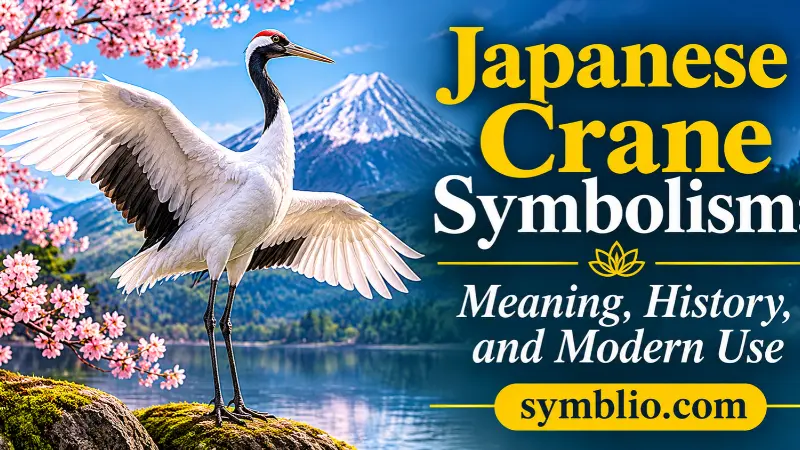
The Japanese crane, scientifically known as Grus japonensis, is also called the red-crowned crane or tancho. It is a large bird with a predominantly white body, black neck and wing markings, and a distinctive patch of bare red skin on the top of its head.
Its appearance makes it particularly recognizable in traditional Japanese artwork. The contrast between white feathers, dark markings, and the bright red crown creates a distinctive design.
Red-crowned cranes inhabit parts of East Asia, including Japan, China, and the Korean Peninsula. In Japan, the species is particularly associated with eastern Hokkaido, where some cranes remain throughout the year.
The bird’s physical characteristics contribute to its cultural appeal. Its graceful movements, broad wings, and courtship displays have inspired painters, textile designers, and craftspeople.
Japanese artwork frequently shows cranes standing in wetlands, flying over water, or appearing in pairs. These compositions communicate ideas about nature, harmony, and happiness.
Although the red-crowned crane is especially important in Japanese symbolism, traditional artwork may also depict other crane species. Therefore, not every crane image should automatically be interpreted as a scientifically accurate representation of the red-crowned crane.
The Historical Origins of Crane Symbolism
The crane’s association with longevity and good fortune in Japan developed partly through cultural exchange with ancient China.
Chinese traditions included the belief that cranes could live for a thousand years. This was a symbolic expression of exceptional longevity rather than a scientific statement about the bird’s actual lifespan.
Traditional stories also connected cranes with immortals and long life. In some artistic representations, immortal figures appeared riding cranes, presenting the bird as a symbol associated with an extraordinary existence.
These ideas gradually influenced Japanese artistic and cultural traditions. Crane imagery became increasingly associated with longevity, happiness, and auspicious occasions.
However, cranes appeared in Japanese poetry even before these associations became firmly established. In early Japanese literature, including the Manyoshu, cranes appeared as part of natural landscapes, particularly coastal settings.
This distinction is important because the crane did not always carry one fixed symbolic meaning. Its interpretation developed through literature, cultural exchange, folklore, and artistic practices.
Longevity and the Wish for a Long Life
Longevity is among the oldest and most recognizable meanings associated with the Japanese crane.
The traditional belief that a crane could live for a thousand years made it an appropriate image for expressing wishes for a long and healthy life. Families and communities used crane designs in objects intended to celebrate important occasions or communicate blessings.
The crane frequently appears alongside the turtle, another traditional symbol of longevity. In Japanese decorative traditions, these two animals form a familiar pairing representing an exceptionally long life.
This combination appears in paintings, textiles, household decorations, and celebratory objects.
The meaning is particularly relevant during birthdays, family milestones, and occasions when people wish someone continued happiness and good health.
In modern Japan, crane imagery still communicates these positive wishes. It offers a recognizable way to express respect for older generations and appreciation for a long life.
For American audiences, the longevity association helps explain why Japanese crane artwork appears in traditional gifts and decorative objects celebrating meaningful life events.
Good Fortune, Happiness, and Prosperity
Japanese cranes are also associated with good fortune and happiness.
Traditional Japanese art often includes animals, plants, and natural elements that communicate favorable wishes. Cranes became an important part of this visual language because of their established connection with longevity and auspicious occasions.
Their appearance in decorative artwork can suggest hopes for a prosperous household, a successful future, and happiness within a family.
Crane designs are particularly recognizable in celebratory decorations. Artists may combine them with pine trees, bamboo, plum blossoms, or turtles. Each element contributes a different positive association.
Pine trees remain green throughout the year and are commonly associated with endurance. Bamboo is valued for its strength and flexibility, while plum blossoms are connected with the arrival of spring.
Together, these images create compositions that communicate wishes for resilience, happiness, and continued prosperity.
This symbolism explains why cranes appear in traditional Japanese decorative arts rather than being limited to paintings of wildlife.
Love, Marriage, and Lasting Relationships
Cranes have an established connection with marriage and lasting relationships in Japanese culture.
Their natural behavior contributes to this association. Crane pairs often maintain long-term partnerships, cooperate in raising their young, and perform recognizable courtship displays.
People have interpreted these behaviors as expressions of companionship and loyalty.
In traditional Japanese wedding clothing, crane designs communicate wishes for a harmonious and enduring marriage. The uchikake, a formal outer kimono worn in certain traditional wedding ceremonies, may feature beautifully embroidered cranes alongside other auspicious patterns.
Paired cranes are particularly meaningful. Their appearance together represents two people building a shared life and maintaining affection through changing circumstances.
The designs may also include waves, pine trees, and other decorative elements associated with good fortune and endurance.
This symbolism is not limited to wedding clothing. Crane patterns can also appear on wedding gifts, decorative fabrics, and objects associated with family celebrations.
For American readers, paired Japanese cranes offer an appealing image for wedding artwork, anniversary decorations, and gifts celebrating long-term relationships.
However, their meaning is best understood through the specific Japanese artistic tradition rather than assuming that every crane image automatically represents romantic love.
Peace and the Story of Sadako Sasaki
One of the most recognizable modern meanings of the paper crane is peace.
This association is closely connected with the story of Sadako Sasaki, a Japanese girl who was exposed to the atomic bombing of Hiroshima in 1945. She later developed leukemia and was hospitalized as a child.
During her illness, Sadako began folding paper cranes. Her activity was connected with the Japanese tradition of senbazuru, which involves making a collection of one thousand folded cranes.
The traditional practice carries wishes for good fortune, healing, and the fulfillment of hopes. Sadako’s story gave this familiar craft an additional association with peace and remembrance.
She died in 1955, and her memory became closely connected with the Children’s Peace Monument in Hiroshima Peace Memorial Park.
The monument honors Sadako and the children affected by the atomic bombing. Visitors from Japan and other countries continue to leave paper cranes there as expressions of hope for a world without war.
The story spread internationally, particularly after the publication of Eleanor Coerr’s children’s book Sadako and the Thousand Paper Cranes in 1977.
Today, American schools, community organizations, and peace-focused projects sometimes use folded paper cranes to communicate messages of friendship, remembrance, and opposition to nuclear weapons.
The connection between paper cranes and peace is therefore a modern cultural development rooted in an older Japanese tradition.
The Meaning of Senbazuru: One Thousand Paper Cranes
Senbazuru literally means one thousand cranes. It refers to a collection of origami cranes traditionally connected together in decorative arrangements.
The practice is associated with wishes for good fortune, long life, recovery, and happiness. Some people make the cranes for themselves, while others create them for family members, friends, or people experiencing difficult circumstances.
The number one thousand has symbolic importance because of the traditional belief connecting cranes with extraordinary longevity.
Folding a large collection also requires patience and dedication. Each crane represents an individual act of attention, making the finished arrangement a visible expression of time and goodwill.
The tradition has a documented history in Japanese craft culture. A book titled Hiden Senbazuru Orikata, published in Kyoto in 1797, presented instructions and illustrations for making linked origami cranes from a single sheet of paper.
This publication demonstrates that the craft developed into a sophisticated artistic practice well before the twentieth-century association with Hiroshima.
Today, senbazuru arrangements can be found in Japanese cultural celebrations, peace memorials, schools, and community projects around the world.
Japanese Crane Symbolism in Traditional Art and Kimono
The crane has a long history as a decorative subject in Japanese art.
During the Edo period (1603–1868), artists created paintings and folding screens featuring cranes in different natural settings. Some compositions showed birds flying over water, while others depicted groups feeding, nesting, or gathering in wetlands.
These paintings often emphasized movement and the beauty of the natural environment.
Gold backgrounds, flowing water, and carefully arranged birds created elegant compositions suitable for formal interiors and important occasions.
Crane designs also became popular in traditional textiles. Silk garments could feature embroidered or dyed cranes combined with flowers, pine branches, and geometric patterns.
In particular, crane imagery became associated with formal clothing and wedding celebrations.
The visual arrangement mattered as much as the individual bird. A pair of cranes could communicate marital happiness, while a group of cranes could suggest prosperity and a favorable future.
The motif remains recognizable in modern Japanese decorative arts, where traditional designs are adapted for contemporary clothing, gifts, and household objects.
What Japanese Crane Symbolism Means in the United States
Japanese crane symbolism has several recognizable interpretations in American culture.
The most prominent modern association is peace, largely because the story of Sadako Sasaki introduced the paper crane to international audiences.
In the United States, students may encounter paper cranes during lessons about Hiroshima, World War II, Japanese culture, and peace education.
The bird also appears in cultural exchange activities, where folding origami becomes a way to learn about Japanese craftsmanship and traditions.
Beyond education, Americans may appreciate crane imagery for its connection with longevity, family happiness, and meaningful relationships.
Some people choose Japanese crane artwork because they have a personal connection with Japan, while others simply appreciate the bird’s appearance and the cultural ideas attached to it.
Crane designs can also appear in:
- Japanese-inspired interior decoration.
- Wedding invitations and anniversary artwork.
- Jewelry and decorative accessories.
- Origami workshops and cultural exhibitions.
- Peace memorials and educational displays.
- Paintings, illustrations, and textile patterns.
There is no single American interpretation of the Japanese crane. Its meaning depends on the context in which people encounter it.
For someone studying Japanese history, it may represent cultural heritage. For someone attending a peace memorial, it may communicate remembrance and hope.
Emotional and Psychological Meaning of the Crane
The crane can communicate several emotional ideas through its appearance and cultural associations.
Hope and encouragement: A paper crane can represent the wish for better circumstances. When given as a gift, it may communicate support without requiring a lengthy explanation.
Patience and dedication: Folding origami cranes requires concentration and repeated movements. Creating a large collection can become an exercise in patience and personal commitment.
Connection and companionship: Paired cranes often suggest cooperation, loyalty, and shared responsibility. Their imagery can represent the importance of maintaining relationships.
Peace and reflection: The association with Hiroshima gives paper cranes a connection with remembrance and the desire to prevent future suffering.
Appreciation for life: The traditional connection with longevity encourages reflection on family, health, and the value of time.
These interpretations are not universal psychological responses. People may connect with crane imagery for personal reasons that differ from traditional cultural meanings.
Nevertheless, the combination of natural beauty, artistic tradition, and historical associations gives the crane a recognizable emotional vocabulary.
Japanese Crane Tattoos and Their Meanings
Japanese crane tattoos often represent longevity, peace, happiness, loyalty, and personal hope.
Some people choose a crane because they appreciate Japanese art and want a design connected with its traditional visual heritage. Others are drawn to the bird’s association with lasting relationships or a meaningful personal experience.
Different tattoo compositions can communicate different ideas.
- Flying crane: May represent freedom, hope, or moving toward a new chapter.
- Standing crane: Can suggest patience, dignity, and calmness.
- Two cranes: Often represent companionship and lasting love.
- Crane with flowers: May combine the bird’s associations with seasonal beauty and renewal.
- Crane with a sun: Can suggest hope, vitality, and new beginnings.
- Origami crane: Commonly represents peace, remembrance, and personal wishes.
Color also influences the visual impression. White feathers create a clean, elegant appearance, while the red crown provides a distinctive focal point.
Some designs use traditional Japanese artistic elements, including waves, clouds, and floral patterns.
Anyone choosing this imagery should understand the difference between a living crane motif and an origami crane associated with the history of Hiroshima. Both can carry positive meanings, but their cultural backgrounds are not identical.
Colors and Their Symbolic Associations
Color plays an important role in the visual presentation of Japanese crane artwork.
The red-crowned crane naturally combines three prominent colors: white, black, and red. Artists may preserve these colors in realistic illustrations or incorporate gold and other shades into decorative compositions.
| Color | Common Association | Symbolic Interpretation |
|---|---|---|
| White | Purity and simplicity | Clarity, peace, and elegance |
| Red | Vitality and celebration | Energy, happiness, and auspicious occasions |
| Black | Contrast and dignity | Formality, balance, and visual strength |
| Gold | Prosperity and celebration | Good fortune and ceremonial beauty |
| Silver | Elegance and refinement | Grace and understated beauty |
These associations should be treated as general artistic interpretations rather than fixed rules governing every Japanese design.
For example, gold backgrounds in traditional paintings can contribute to a sense of celebration and visual richness without necessarily giving every bird a separate symbolic meaning.
The relationship between color, composition, and occasion often matters more than an isolated color choice.
Japanese Crane Symbolism in Other Asian Cultures
The crane also carries important associations in other East Asian traditions.
In China, cranes have traditionally been connected with longevity, wisdom, and immortality. Their appearance alongside figures associated with long life helped establish the bird as an auspicious image.
These ideas influenced Japanese decorative traditions and contributed to the crane’s association with good fortune.
In Korea, the red-crowned crane also has cultural importance. It appears in traditional visual arts and has associations with longevity, dignity, and favorable fortune.
The bird is particularly recognizable in East Asian art because its elegant appearance lends itself to symbolic and decorative compositions.
However, these traditions should not be treated as interchangeable. Japan’s paper-crane association with Hiroshima and international peace has its own specific historical background.
Similarly, the importance of cranes in traditional Chinese and Korean artwork developed through their respective cultural and artistic histories.
Understanding these distinctions helps prevent the mistake of assuming that every Asian crane design carries exactly the same meaning.
Common Misunderstandings About Japanese Crane Symbolism
Although crane symbolism is widely recognized, several misunderstandings can lead to inaccurate interpretations.
The crane does not actually live for one thousand years.
The traditional longevity association comes from historical beliefs and symbolic storytelling. It is not a biological fact.
Every crane image does not represent peace.
The peace association is particularly connected with origami cranes and the legacy of Sadako Sasaki. Traditional paintings and wedding textiles may communicate different ideas.
The crane is not exclusively a religious symbol.
Its meaning developed through literature, artistic traditions, folklore, and cultural exchange. It is not limited to Shinto or Buddhist religious practice.
All crane designs do not represent marriage.
Paired cranes are particularly associated with harmonious relationships, but individual cranes may symbolize longevity, good fortune, or simply the beauty of nature.
Japanese cranes and paper cranes are not identical concepts.
The Japanese crane is a living bird, while an origami crane is an artistic representation created through paper folding. Their symbolic associations overlap, but their histories differ.
Recognizing these distinctions makes it easier to appreciate the symbol without oversimplifying its cultural background.
How Crane Symbolism Has Evolved in Modern Culture
The meaning of the Japanese crane has expanded as the bird has become more widely recognized outside Japan.
In earlier Japanese traditions, crane imagery was especially connected with longevity, good fortune, and celebratory occasions. Its presence in paintings, kimono designs, and decorative objects helped establish these associations.
During the twentieth century, the paper crane acquired an additional international meaning through the story of Sadako Sasaki.
This development introduced the bird to new audiences, particularly through schools, books, peace memorials, and cultural exchange programs.
Today, people encounter Japanese crane imagery in both traditional and contemporary settings.
Artists may use the crane to explore themes of identity, nature, remembrance, and cultural heritage. Designers incorporate it into home decorations, clothing, stationery, and jewelry.
Social media has also helped spread interest in origami and Japanese-inspired artwork. Photographs of paper-crane installations and handmade decorations allow people to share their creations across cultural boundaries.
At the same time, conservation has become another important part of the crane’s modern story. The red-crowned crane faced serious population declines because of hunting and habitat loss. Conservation efforts in Japan have helped protect the remaining population, particularly in Hokkaido.
This creates an additional way to appreciate the bird: not simply as an artistic symbol, but as a living species whose survival depends on protecting natural habitats.
The crane’s modern significance therefore includes both its cultural history and the responsibility to preserve the natural world.
FAQs
A Japanese crane can represent longevity, good fortune, happiness, and a wish for a peaceful life. These associations developed through traditional cultural beliefs and artistic practices rather than one universal religious interpretation.
Traditional East Asian beliefs associated cranes with extraordinary longevity, sometimes describing them as living for one thousand years. This idea became an artistic symbol of long life and good fortune rather than a scientific claim.
In the United States, paper cranes commonly symbolize peace, hope, remembrance, and goodwill. Their modern cultural meaning is strongly influenced by Sadako Sasaki’s story and the Children’s Peace Monument in Hiroshima.
Two cranes commonly represent lasting love, companionship, and marital harmony. Their appearance together is especially popular in traditional Japanese wedding designs.
Yes. Japanese cultural traditions associate cranes with good fortune, happiness, and longevity. They frequently appear in artwork and decorative objects created for celebrations and other favorable occasions.
A Japanese crane tattoo can represent longevity, peace, hope, loyalty, or lasting relationships. Its meaning depends on the design, including whether it depicts a single bird, a pair of cranes, or an origami crane.
Traditional crane imagery is often associated with longevity, happiness, and good fortune. Origami cranes share some of these associations but also carry a distinctive modern connection with peace and remembrance through the history of Hiroshima.
Conclusion
Japanese crane symbolism brings together several important cultural ideas, including longevity, good fortune, happiness, peace, and lasting relationships. Its traditional associations developed through East Asian beliefs and Japanese artistic practices, eventually becoming recognizable features of paintings, wedding garments, and decorative crafts.
In modern American culture, the paper crane is particularly associated with peace and remembrance because of Sadako Sasaki’s story. Meanwhile, traditional crane imagery continues to appeal to people interested in Japanese heritage, meaningful relationships, and nature-inspired design.
Ultimately, the Japanese crane represents more than an attractive bird. It connects traditional wishes for a long and happy life with modern hopes for peace, understanding, and a better future.