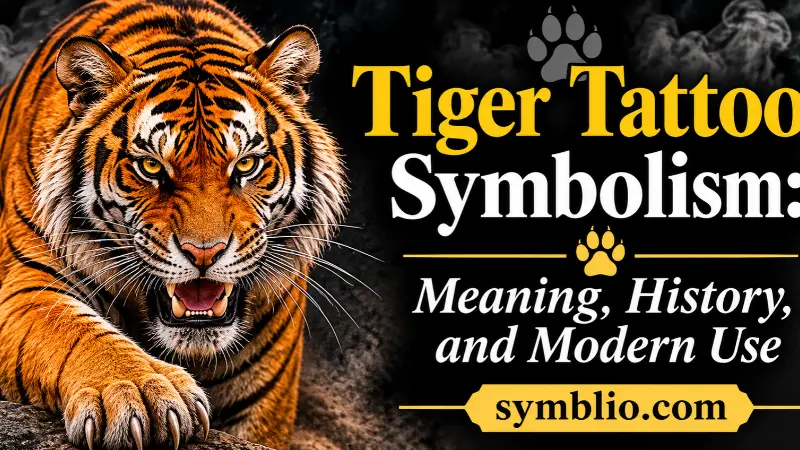
A tiger tattoo is often chosen to represent courage, independence, confidence, and the ability to face difficult situations. The image of this large striped cat carries a strong visual presence, making tiger tattoo symbolism especially meaningful to people who associate the animal with personal strength and determination.
In the United States, tiger tattoos appear in traditional American tattoo designs, Japanese-inspired artwork, realistic portraits, and contemporary geometric styles. Some people choose a tiger because they admire its natural beauty, while others connect it with overcoming challenges, protecting loved ones, or expressing an independent personality.
However, the tiger does not carry exactly the same meaning in every culture. Its historical associations include royalty, guardianship, spiritual authority, and the forces of nature. Understanding these traditions helps explain why the animal remains an important subject in tattoo art.
Quick Answer
Tiger tattoo symbolism commonly represents strength, courage, independence, confidence, and protection in modern American culture. Historically, tigers have also been associated with guardianship, authority, spiritual power, and good fortune in several Asian traditions.
TL;DR
- Tigers commonly represent courage, confidence, and personal strength.
- Chinese traditions associate tigers with guardianship and protection.
- Japanese art connects tigers with courage and the natural world.
- Hindu traditions associate the tiger with the goddess Durga.
- Tiger tattoos can express independence and personal resilience.
- Design details influence how people interpret an individual tattoo.
What a Tiger Tattoo Looks Like
A tiger tattoo usually features the animal’s recognizable orange coat, black stripes, muscular body, and distinctive facial markings. Artists may portray a tiger standing, walking, resting, leaping, or looking directly toward the viewer.
Some designs focus on the animal’s face, emphasizing its eyes, whiskers, and striped forehead. Others show the entire body, allowing the artist to communicate movement and the tiger’s relationship with its surroundings.
Common visual approaches include realistic portraits, traditional tattoo artwork, Japanese-inspired compositions, black-and-gray illustrations, and minimalist outlines.
The chosen style can influence the impression of the tattoo. A detailed portrait may emphasize respect for wildlife, while a stylized tiger with strong outlines may communicate confidence and determination.
Tiger tattoos also appear in different sizes. Small designs can function as personal reminders, while larger compositions provide room for additional elements such as flowers, clouds, mountains, or other animals.
The Main Meanings Behind Tiger Tattoos
Although individual interpretations differ, several associations appear repeatedly in contemporary tiger tattoo designs.
Strength and Physical Power
Strength is one of the most recognizable meanings associated with a tiger. Its muscular build, powerful movement, and position as a major predator make it a natural representation of physical capability.
In tattoo imagery, this association can extend beyond physical strength. Someone may interpret the tiger as a reminder of inner determination, the ability to handle responsibility, or confidence during difficult periods.
A tiger does not necessarily represent aggression. Its image can communicate controlled strength: the ability to remain composed while facing demanding circumstances.
Courage and Bravery
Tigers are frequently associated with courage because of their reputation as formidable wild animals. In traditional artwork and folklore, their presence often communicates fearlessness and authority.
A tiger tattoo can therefore represent someone’s willingness to face uncertainty, accept responsibility, or stand by personal principles.
In American tattoo culture, this interpretation fits a broader tradition of using animal imagery to communicate character. Eagles, wolves, lions, and tigers can all represent qualities that people admire or want to emphasize.
Independence and Freedom
Unlike domesticated animals, tigers live independently for much of their lives. Their solitary behavior has contributed to their association with self-reliance and personal freedom.
A tiger tattoo may represent someone who values independent decisions, personal boundaries, and the freedom to follow an individual direction.
This interpretation is especially relevant when the design shows a tiger walking alone through a forest or standing confidently in its natural environment.
Protection and Guardianship
Protection is another established association, particularly in East Asian traditions. Tiger imagery has appeared in paintings, decorative objects, and protective representations intended to guard people against misfortune.
For a modern tattoo owner, the animal may represent a protective attitude toward family, friends, or personal values.
This is a symbolic expression rather than a guarantee of supernatural protection. Its meaning comes from cultural tradition and personal interpretation.
Resilience and Survival
Tigers also represent resilience because they are associated with adaptability, patience, and survival in challenging natural environments.
In contemporary tattoo interpretation, this can become a personal symbol of perseverance. Someone might associate a tiger with an important period of growth, a difficult transition, or the decision to continue working toward a meaningful goal.
Ancient Roots of Tiger Symbolism
Tiger imagery has a long history across Asia, although its meaning developed differently in different regions.
In ancient China, the tiger was regarded as an exceptionally powerful animal and was sometimes described as the king of beasts. Its appearance in art and folklore reflected both admiration and fear.
Chinese artistic traditions connected tigers with protection, authority, and the natural forces governing the world. The animal also appeared in cosmological imagery, including the Four Symbols associated with directions and celestial regions.
The White Tiger, known as Bai Hu, represented the west in this traditional system. It was associated with autumn and the metal element.
During different historical periods, tiger images appeared in protective objects, paintings, and decorative arts. These representations reflected the belief that the tiger could help guard households and communities against harmful influences.
The animal’s reputation was not entirely positive, however. Its real-world danger also made it an image of fear, destruction, and unpredictable natural power.
These contrasting qualities help explain why tiger imagery developed such varied meanings. The Metropolitan Museum of Art+2
Tiger Symbolism in Japanese Art and Tattoo Traditions
Japanese tiger imagery developed through cultural exchange with mainland Asia. Since tigers are not native to Japan, artists historically learned about the animal through imported paintings, illustrations, and other artistic representations.
Japanese artists adapted the subject to their own visual traditions. Tigers frequently appeared in paintings with bamboo, clouds, wind, and mountainous landscapes.
The relationship between the tiger and dragon became particularly recognizable in East Asian art. In traditional Chinese cosmological imagery, the tiger and dragon represented contrasting forces. Their pairing could communicate balance between complementary aspects of nature.
Japanese tattoo art later incorporated tiger imagery into large compositions influenced by traditional decorative and pictorial styles. The tiger became an important subject in irezumi, the broader Japanese tattoo tradition.
Within these compositions, artists often use the animal to communicate courage, strength, and the untamed forces of nature.
Bamboo and wind can provide environmental context rather than functioning as fixed symbols with one universal interpretation. Their inclusion helps create a complete visual scene.
It is important to distinguish traditional Japanese tiger artwork from modern interpretations. Not every tiger tattoo uses historically specific imagery, and a contemporary design does not automatically represent a traditional Japanese belief. The Metropolitan Museum of Art+1
Tiger Symbolism in Chinese Culture
Chinese culture provides some of the clearest historical examples of the tiger as a protective symbol.
In traditional beliefs, tiger images were sometimes used to discourage harmful spirits and misfortune. Tiger-shaped objects, decorative clothing, and illustrations appeared in protective contexts, including items associated with children.
The tiger also represented authority and military courage. Its formidable appearance made it suitable for imagery connected with leadership and strength.
The White Tiger has a more specific meaning within Chinese cosmology. It is one of the Four Symbols, representing the western direction.
A tattoo inspired by this tradition may therefore communicate more than general confidence. It can refer to guardianship, traditional cosmology, or an interest in Chinese art and cultural history.
However, a tiger tattoo is not automatically a Chinese cultural symbol. The particular design, accompanying imagery, and personal intention determine how closely it relates to that tradition. The Metropolitan Museum of Art+1
The Tiger in Hindu Mythology
The tiger also has an important place in Hindu religious imagery, particularly through its association with the goddess Durga.
Durga is commonly depicted riding a tiger or, in some artistic traditions, a lion. These representations communicate divine strength, protection, and the ability to overcome destructive forces.
The animal serves as a visual expression of the goddess’s authority and courage. Its presence reinforces the relationship between divine power and the struggle against disorder.
A tiger tattoo inspired by Durga may therefore carry religious meaning rather than simply representing personal confidence.
People considering this imagery should recognize its significance within Hindu traditions. Depicting a religious figure or sacred subject is different from choosing an ordinary animal portrait, and cultural understanding matters when interpreting the design. hasp.ub.uni-heidelberg.de+1
What Tiger Tattoos Mean in the United States
In the United States, tiger tattoos are generally understood through a combination of personal identity, artistic preference, and broader associations with strength and independence.
American tattoo culture has incorporated animal imagery from numerous artistic traditions. During the nineteenth and twentieth centuries, sailors and travelers helped introduce Asian-inspired designs into Western tattoo environments.
Tigers became part of the wider collection of animal subjects used in American tattoo art, alongside eagles, panthers, snakes, and other recognizable figures.
Today, people may choose tiger imagery for several reasons:
- Personal confidence: The animal represents self-belief and determination.
- Independence: Its solitary nature reflects self-reliance.
- Family protection: The image expresses a protective attitude toward loved ones.
- Cultural appreciation: The design reflects an interest in Asian art or mythology.
- Wildlife admiration: The person appreciates tigers as animals and wants to represent that interest.
There is no single American interpretation that applies to everyone. Some viewers see a tiger as a symbol of courage, while others primarily appreciate its appearance and artistic possibilities.
This flexibility is one reason the image remains recognizable across different generations of tattoo art. Exosomatic+1
Emotional and Psychological Meaning
Tiger imagery can communicate several emotional qualities depending on the individual’s experiences.
For some people, the animal represents confidence. Its direct gaze and commanding presence can serve as a visual reminder to trust personal judgment.
For others, it represents emotional control. A resting tiger may suggest patience and awareness, while a tiger in motion may communicate determination and readiness for change.
The animal can also represent a person’s relationship with independence. People who value privacy, personal responsibility, or individual decision-making may connect with its solitary nature.
Another interpretation involves balancing different aspects of personality. A tiger can appear calm without losing its strength, suggesting that confidence does not always require confrontation.
These associations are not universal psychological rules. They are interpretations that individuals develop through personal experience, cultural background, and visual preference.
Different Tiger Tattoo Designs and Their Meanings
The appearance and composition of a tiger tattoo can change its interpretation. Facial expression, posture, background, and accompanying imagery all contribute to the message.
Roaring Tiger Tattoo
A roaring tiger often communicates confidence, assertiveness, and an unwillingness to remain unnoticed.
Its open mouth and intense expression create an impression of energy and determination. Some people associate this design with speaking up, defending personal values, or expressing a strong personality.
Resting Tiger Tattoo
A resting tiger presents a different interpretation. Rather than emphasizing aggression, it can represent patience, self-control, awareness, and quiet confidence.
This design suggests that strength does not always need to be displayed.
Tiger Head Tattoo
A tiger head focuses attention on the animal’s eyes, stripes, and facial expression. It commonly represents courage, alertness, and personal identity.
Because the design concentrates on the face, the artist can communicate different emotions through subtle changes in expression.
Full-Body Tiger Tattoo
A full-body tiger allows the animal’s movement and natural appearance to become central to the artwork.
Depending on its posture, it may communicate freedom, independence, determination, or appreciation for wildlife.
White Tiger Tattoo
White tigers are particularly recognizable because of their pale coats and dark stripes.
In contemporary tattoo art, they may represent individuality, uniqueness, and elegance. Some designs also draw inspiration from the White Tiger in East Asian cosmology, although a white-colored tiger tattoo does not automatically represent that specific tradition.
How Colors Influence Tiger Tattoo Symbolism
Color affects the visual character of a tattoo and can influence how viewers interpret it.
| Color or Style | Common Association | Visual Impression |
|---|---|---|
| Orange and black | Natural strength and courage | Traditional tiger appearance |
| White and black | Individuality and distinction | Unusual and striking |
| Black and gray | Restraint and determination | Realistic or dramatic |
| Red accents | Passion and intensity | Energetic composition |
| Blue accents | Calmness and individuality | Artistic interpretation |
These associations are general artistic conventions rather than fixed cultural rules.
A black-and-gray tiger, for example, does not automatically symbolize a different personality from an orange tiger. The overall composition and the person’s intended meaning matter more than color alone.
Tiger Tattoos in Modern Fashion and Popular Culture
Tiger imagery continues to appear in contemporary American visual culture. It can be found in clothing graphics, sports-related designs, illustrations, merchandise, and tattoo artwork.
The animal’s recognizable stripes make it visually effective even when artists simplify its appearance.
In fashion, tiger patterns have often communicated boldness and individuality. Tattoo artists draw on similar visual qualities when creating designs that emphasize movement, contrast, and recognizable animal features.
Social media has also expanded the range of tiger tattoo styles people encounter. Realistic portraits, minimalist illustrations, traditional Japanese-inspired compositions, and abstract designs can circulate among different artistic communities.
However, a popular design does not necessarily have an established historical meaning. Some contemporary interpretations develop through personal expression rather than inherited cultural traditions.
Common Misunderstandings About Tiger Tattoos
Despite their familiar appearance, tiger tattoos are sometimes given meanings that are too broad or historically inaccurate.
Every tiger tattoo does not represent aggression.
A tiger can represent courage, patience, protection, or independence. Its expression and posture influence the impression it creates.
Tiger imagery does not have one universal Asian meaning.
Chinese, Japanese, Korean, and South Asian traditions developed their own interpretations. Treating them as interchangeable overlooks important cultural differences.
A tiger tattoo does not automatically represent spiritual protection.
Some historical traditions used tiger imagery in protective contexts. A modern tattoo may reference those beliefs, but it does not provide literal supernatural protection.
A white tiger is not automatically a religious symbol.
It may simply represent an artistic preference for the animal’s unusual appearance. Its relationship to Chinese cosmology depends on the intended imagery and context.
A tiger tattoo does not necessarily communicate a person’s personality.
An observer might associate the design with confidence or independence, but the person wearing it may have chosen it for entirely different reasons.
Understanding these distinctions makes it easier to appreciate the image without making assumptions about the individual.
Cultural Respect and Responsible Interpretation
Tiger imagery has connections to several living cultural and religious traditions. This makes cultural context particularly important when discussing designs inspired by specific historical artwork or sacred figures.
For example, a tiger appearing alongside Durga belongs to a different visual and religious context from a traditional Japanese tiger composition or a Chinese White Tiger representation.
Combining elements from different traditions can create original artwork, but it should not be presented as an authentic historical design without supporting context.
It is also worth recognizing the difference between appreciating an animal and romanticizing its captivity or exploitation. Tigers are endangered or threatened in different parts of their range, and conservation concerns form an important part of their modern public image.
For many people, the animal’s natural beauty and ecological importance are just as meaningful as its traditional symbolic associations.
How Tiger Tattoo Meaning Has Changed Over Time
The tiger’s symbolic identity has developed through centuries of artistic and cultural exchange.
In historical China, the animal could represent authority, danger, and protection. Its image appeared in folklore and decorative art, where it reflected both respect for nature and concern about its unpredictable forces.
Japanese artists adapted tiger imagery through imported artistic traditions, creating distinctive compositions involving landscapes, wind, and other natural elements.
Religious imagery in South Asia connected the tiger with divine authority through representations of Durga.
As Asian-inspired artwork entered Western popular culture, tiger images gained new interpretations. In American tattoo settings, they became associated with personal confidence, courage, independence, and visual individuality.
Modern tattoo culture continues to combine these historical references with personal stories. Consequently, a tiger can represent an inherited cultural tradition, an individual experience, or simply admiration for one of the world’s most recognizable wild animals.
The meaning has expanded rather than settled into one permanent definition.
FAQs
A tiger tattoo commonly symbolizes courage, strength, independence, confidence, and protection. Its meaning can also reflect personal resilience or appreciation for wildlife.
Yes, tiger imagery is commonly associated with positive qualities such as bravery, determination, and guardianship. However, its historical associations with danger and aggression can also influence its interpretation.
Japanese-inspired tiger tattoos commonly represent courage, strength, and the untamed forces of nature. Their compositions may include bamboo, wind, and landscapes that connect the animal with its natural environment.
A white tiger tattoo can represent individuality, distinction, and appreciation for unusual wildlife. In a specific East Asian cultural context, it may also reference the White Tiger associated with the western direction in Chinese cosmology.
Spiritual interpretations vary by tradition. In Chinese beliefs, tiger imagery has been associated with protection, while Hindu religious art connects the tiger with the goddess Durga and divine strength.
A roaring tiger often represents assertiveness, confidence, courage, and determination. Its expression creates a more energetic impression than a resting or quietly observing tiger.
Yes. Tigers are naturally solitary animals, which has contributed to their association with self-reliance and independence. In contemporary tattoo culture, this interpretation can represent personal freedom and individual identity.
Conclusion
Tiger tattoo symbolism brings together several recognizable ideas, including courage, strength, independence, protection, and resilience. Its historical associations extend across Chinese art, Japanese visual traditions, Hindu mythology, and modern American tattoo culture.
Although the tiger is frequently portrayed as a fierce animal, its symbolism is not limited to aggression. It can also communicate patience, self-control, guardianship, and respect for nature.
Ultimately, the meaning of a tiger tattoo depends on its artistic details, cultural background, and personal significance. It remains a recognizable symbol of strength and individuality, with interpretations that continue to evolve across cultures and generations.