
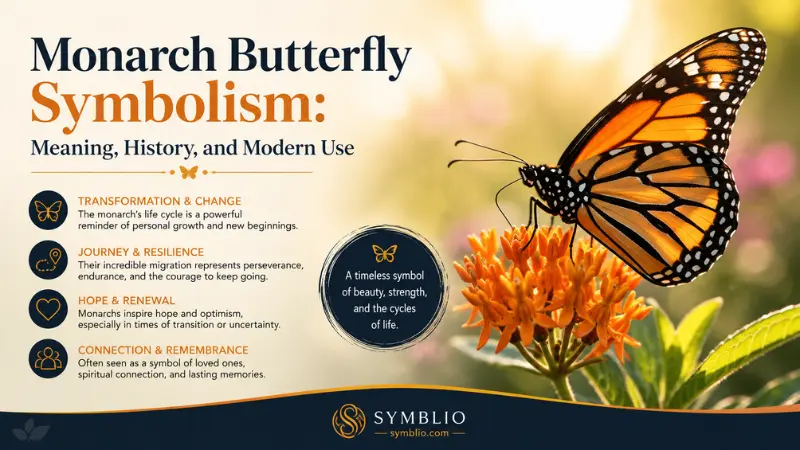
The monarch butterfly is one of North America’s most recognizable insects, and monarch butterfly symbolism has grown from its remarkable life cycle, long migration, distinctive appearance, and cultural associations. In the United States, people commonly connect monarchs with transformation, perseverance, new beginnings, remembrance, and finding one’s way through change.
Those meanings are closely tied to the butterfly itself. A monarch begins as an egg, becomes a caterpillar, forms a chrysalis, and finally emerges as a winged adult. Some generations also travel thousands of miles during seasonal migrations across North America.
Beyond personal transformation, monarchs carry cultural and environmental meanings. In Mexican and Mexican American traditions, their autumn arrival may be associated with ancestors and Día de los Muertos. In contemporary American culture, the monarch has also become an important symbol of wildlife conservation and habitat protection.
Quick Answer
Monarch butterfly symbolism most commonly represents transformation, perseverance, and hopeful change in modern American culture, reflecting the insect’s metamorphosis and remarkable migration. It can also symbolize remembrance, ancestors, and homecoming, especially in traditions associated with Día de los Muertos.
TL;DR
- Transformation comes from the monarch’s dramatic life-cycle changes.
- Migration symbolizes endurance, direction, return, and homecoming.
- Día de los Muertos traditions connect monarchs with ancestors.
- Memorial imagery often uses monarchs to represent remembrance.
- Tattoos may symbolize personal growth, recovery, freedom, or change.
- Monarchs increasingly represent conservation and environmental responsibility.
What a Monarch Butterfly Looks Like
Monarch butterflies are easy to recognize. Their wings are primarily orange, divided by dark veins and surrounded by black borders dotted with small white spots.
The striking pattern is more than decoration. Monarch caterpillars feed on milkweed, allowing them to retain chemical compounds that can make them unpleasant to predators. Their bright coloration acts as a visual warning.
For human observers, the monarch combines apparent delicacy with remarkable durability. That contrast contributes to its symbolic appeal. It looks fragile but can survive demanding journeys and dramatic physical transformation.
Monarch Butterfly Meanings at a Glance
| Context | Meaning in the USA | Common Associations | Notes |
|---|---|---|---|
| Personal growth | Transformation | Change, maturity, renewal | Inspired by metamorphosis |
| Life journey | Perseverance | Travel, direction, homecoming | Connected to migration |
| Remembrance | Continuing bonds | Ancestors, loved ones, memory | Strong in memorial contexts |
| Tattoos | Personal transition | Recovery, freedom, identity | Meaning varies by wearer |
| Nature | Conservation | Habitat, milkweed, biodiversity | Common in environmental campaigns |
| Spiritual use | Hope and renewal | Soul, rebirth, afterlife | Interpretation varies by belief |
The monarch does not have one fixed meaning. Its interpretation depends heavily on context. A butterfly beside a memorial date communicates something different from the same image used in a wildlife campaign.
Why Transformation Is Its Most Familiar Meaning
Transformation is perhaps the most widely recognized butterfly meaning because it directly reflects the animal’s life cycle.
A monarch does not simply grow while keeping the same physical form. It passes through several distinct stages: egg, caterpillar, chrysalis, and adult butterfly. The change from crawling larva to winged adult creates an unusually clear natural metaphor for personal development.
Because of this, people often use monarch imagery during major turning points. It may represent graduation, recovery, independence, parenthood, a career change, the end of a relationship, or the beginning of a new stage in life.
The symbolism is not necessarily about becoming a completely different person. It can instead represent learning, adapting, and allowing an earlier version of oneself to develop into something new.
Migration Adds Endurance, Direction, and Homecoming
Migration gives the monarch meanings that many other butterfly symbols do not carry as strongly.
Eastern North American monarchs undertake extraordinary seasonal journeys toward overwintering areas in central Mexico. Some travel more than 2,000 miles. Western monarch populations have historically used overwintering sites along coastal California and other regions.
This journey naturally supports associations with perseverance and endurance. The monarch is physically small, yet it continues across enormous distances.
As a human metaphor, this can represent continuing despite uncertainty, hardship, separation, or unfamiliar surroundings.
Migration also adds the idea of homecoming. Monarchs follow seasonal patterns of movement and return, making them meaningful symbols for people who associate life with travel, immigration, relocation, family roots, or eventually finding a place where they belong.
Monarch Butterflies and Remembrance
Monarchs frequently appear in memorial art, jewelry, tattoos, and remembrance ceremonies.
Part of this meaning comes from the butterfly’s transformation. Because it disappears into a chrysalis and later emerges in another form, people have long connected butterflies with transition, mortality, and continued existence.
For someone experiencing grief, a monarch may represent the continuing influence of a person who has died. It can serve as a visual reminder that memories, relationships, lessons, and love can continue even when someone is no longer physically present.
Some people also interpret an unexpected monarch sighting after a death as a personal sign from a loved one. That interpretation belongs to personal belief and spirituality rather than established scientific fact.
Monarch Butterflies and Día de los Muertos
One of the monarch’s most culturally significant associations comes from central Mexico.
Millions of monarchs historically arrive in their overwintering region around the same period that communities prepare for Día de los Muertos, observed at the beginning of November.
In some Mexican traditions, particularly among communities in areas where the butterflies gather, monarchs have been associated with returning ancestors or the souls of deceased family members.
This connection helps explain why monarch imagery may appear with marigolds, altars, candles, skull imagery, photographs of loved ones, and other visual elements connected with Día de los Muertos.
For Mexican American families in the United States, the monarch can therefore carry several meanings at once: migration, family, cultural heritage, remembrance, and connection with ancestors.
It is important not to treat this interpretation as universal. Mexican and Indigenous communities are culturally diverse, and beliefs differ between regions, families, and traditions.
Christian Interpretations of Butterfly Symbolism
The monarch butterfly itself does not have a specific biblical meaning.
Butterflies more broadly, however, have appeared in Christian art as symbols of resurrection, rebirth, and the soul. The connection comes from metamorphosis.
A caterpillar enters a chrysalis and later emerges in a dramatically different form. Christian artists and writers have sometimes used this process as a visual metaphor for death followed by renewed life.
A Christian who chooses monarch imagery today may therefore connect the butterfly with faith, spiritual renewal, resurrection, or hope after loss.
Still, this should be understood as part of broader butterfly symbolism rather than an ancient biblical tradition focused specifically on monarch butterflies.
What Monarch Butterflies Mean in the United States
In American culture, the monarch exists at the intersection of nature, personal symbolism, education, art, and conservation.
Many Americans first encounter monarchs through school science lessons about metamorphosis or through gardens where milkweed and nectar-producing flowers attract butterflies.
They also appear in parks, nature centers, public art, jewelry, clothing, tattoos, educational programs, and community conservation projects.
Several U.S. states have formally recognized the monarch as an official state insect or butterfly, further strengthening its place in American public culture.
Because of this familiarity, Americans may read different meanings into the same image.
On a graduation card, a monarch may represent growth.
On a memorial tattoo, it may symbolize remembrance.
In a butterfly garden, it may represent environmental stewardship.
On jewelry, it may simply express beauty, freedom, or personal transformation.
The Meaning of the Monarch’s Orange, Black, and White Colors
The monarch’s recognizable colors contribute to its visual symbolism.
Orange is often associated in modern design with warmth, movement, enthusiasm, energy, and autumn. Black creates contrast and structure, while white spots make the wing pattern instantly identifiable.
These color interpretations are modern associations rather than fixed historical meanings.
Biologically, the monarch’s colors serve a practical function. The orange-and-black pattern helps warn predators that the butterfly may be unpleasant to eat because of compounds acquired from milkweed during the caterpillar stage.
This provides a useful reminder about symbolism: natural traits do not evolve because of human symbolic meanings. People observe nature and later create meanings based on what they see.
Emotional and Psychological Meaning
Monarch imagery often appeals to people going through periods of substantial personal change.
The butterfly can represent a moment when life feels divided into a clear “before” and “after.” That may involve moving somewhere new, recovering from hardship, leaving an unhealthy situation, changing careers, becoming a parent, or rebuilding life after loss.
The full life cycle also creates a more nuanced message.
The caterpillar is not a failed butterfly. The chrysalis is not an empty stage. Each phase belongs to the same life.
As a metaphor, this can suggest that previous versions of a person still matter even when circumstances or identity change.
Migration adds another psychological dimension. Sometimes growth does not mean transforming completely. It means continuing forward until circumstances improve or until a person reaches somewhere they can settle.
Monarch Butterfly Tattoo Meaning
Monarch butterfly tattoos are usually personal rather than governed by one universal interpretation.
Common meanings include:
- Transformation
- Freedom
- Resilience
- Recovery
- Personal growth
- Migration
- Independence
- Remembrance
- Homecoming
- Cultural identity
Someone might choose a monarch after overcoming a difficult period, completing treatment, ending a relationship, moving away from home, beginning a new career, or reaching an important milestone.
Memorial monarch tattoos may include a loved one’s name, initials, birth date, memorial date, favorite flower, or another personally meaningful detail.
For people with Mexican heritage, monarch imagery may additionally represent migration, family history, ancestors, and Día de los Muertos.
The most accurate interpretation of any monarch tattoo ultimately comes from the person wearing it.
Monarchs in Jewelry, Decor, and Fashion
The monarch’s symmetrical wings and distinctive color pattern make it especially popular in decorative design.
Jewelry may feature monarch-shaped pendants, earrings, charms, brooches, or enamel pieces. These items often represent transformation, freedom, remembrance, or simply appreciation for butterflies.
Home decor uses monarchs in botanical prints, garden decorations, stained glass, wall art, textiles, and seasonal displays.
Fashion designers may use the butterfly’s wing pattern because its orange-and-black contrast remains recognizable even when stylized.
Context determines meaning.
A monarch on a summer dress might simply be decorative. A monarch pendant given after someone completes cancer treatment may represent recovery. The same butterfly engraved beside a memorial date may communicate remembrance.
Monarch Butterflies in Digital Culture
Social media has expanded the monarch’s symbolic use.
Photographs, illustrations, and animations of monarch butterflies often accompany posts about new beginnings, grief, recovery, personal milestones, moving away from home, or starting over.
The monarch also appears in digital artwork associated with environmental awareness.
Because a butterfly can communicate change without requiring extensive explanation, it works especially well as a visual shorthand online.
However, digital culture also encourages oversimplified claims. Posts sometimes assign extremely specific meanings to monarch sightings, such as guaranteed good fortune or messages predicting major future events.
Those interpretations are better understood as contemporary spiritual beliefs or personal storytelling than as established historical symbolism.
Monarch Butterflies as Conservation Symbols
Environmental concerns have added another major layer to the monarch’s American meaning.
Monarch caterpillars rely on milkweed as their host plant, while migrating adults require flowering plants and suitable habitat across large geographic areas.
This makes monarch conservation dependent on entire networks of landscapes rather than a single protected location.
Habitat loss, pesticide exposure, changing environmental conditions, and other pressures have created substantial concern about monarch populations.
As a result, the monarch has become a recognizable symbol for pollinator gardens, native planting, habitat restoration, ecological education, and cross-border conservation.
This meaning differs from the traditional idea of personal transformation.
Here, the monarch represents interconnectedness. Its survival depends on many small pieces of habitat working together across a continent.
That makes it an effective symbol for the idea that local environmental actions can contribute to a much larger ecological system.
Weddings, Funerals, and Butterfly Releases
Butterflies are sometimes used during weddings, funerals, graduations, and memorial events because releasing them can visually represent transition, freedom, farewell, or a new beginning.
The symbolism is understandable, but live butterfly releases can raise ecological and animal-welfare concerns.
Commercially bred butterflies may carry diseases, experience stress during transportation, or interfere with wild populations if they are released under inappropriate conditions.
People who want butterfly symbolism at an event can choose alternatives such as monarch artwork, paper butterflies, floral arrangements, photographs, garden planting, or decorative installations.
These options preserve the symbolic meaning without requiring the release of live animals.
Common Misunderstandings About Monarch Symbolism
One common mistake is presenting every monarch interpretation as an ancient cultural tradition.
Different meanings developed from different sources.
Transformation comes primarily from observing butterfly metamorphosis.
Migration adds associations with endurance, travel, return, and belonging.
Connections with ancestors have specific cultural roots in parts of Mexico.
Christian ideas about resurrection developed through broader butterfly imagery rather than monarch-specific scripture.
Another misunderstanding is the claim that every monarch sighting predicts something specific.
A monarch does not universally mean pregnancy, marriage, wealth, death, or upcoming good fortune.
People may personally assign those meanings to an encounter, but they should not be treated as fixed symbolic rules.
Cultural meanings also deserve care. Saying that certain Mexican traditions connect monarchs with ancestors is more accurate than claiming that all Mexican or Indigenous people hold exactly the same belief.
How Monarch Butterfly Symbolism Has Changed
The monarch’s modern symbolism developed from several different traditions rather than one continuous interpretation.
Communities in central Mexico developed cultural associations between seasonal butterfly arrivals, ancestors, and remembrance.
European Christian art developed a separate tradition in which butterflies could represent resurrection and the soul.
Later, American natural-history education made butterfly metamorphosis familiar to generations of students. Monarch migration became another widely recognized part of the species’ identity.
In recent decades, habitat concerns have added conservation to the symbolism.
Today, the monarch can therefore communicate several distinct ideas:
personal transformation, perseverance, remembrance, migration, cultural heritage, homecoming, and ecological responsibility.
Its modern meaning is broader than any single historical interpretation.
FAQs
A monarch butterfly commonly symbolizes transformation, resilience, hope, freedom, and personal growth. Its dramatic life cycle from caterpillar to butterfly makes it a natural symbol of change and renewal.
Spiritually, monarch butterflies are often associated with transformation, renewal, endurance, and the soul. Some people also view seeing one as a meaningful reminder of change, loved ones, or a new stage of life.
A monarch butterfly visiting you can be interpreted as a symbol of hope, positive change, or encouragement during a transition. The meaning is personal rather than universal and may depend on your beliefs and circumstances.
In some cultural and personal traditions, monarch butterflies are connected with remembrance and deceased loved ones. This association is especially notable in traditions surrounding Mexico’s Day of the Dead, when monarch migration overlaps with seasonal observances.
In a romantic context, a monarch butterfly can represent emotional growth, changing relationships, freedom, and a fresh beginning. It may also symbolize learning to accept change while maintaining a meaningful connection.
Some people consider seeing a monarch butterfly a positive sign associated with hope, renewal, or good fortune. However, this interpretation comes from cultural and personal symbolism rather than a universal belief.
Conclusion
Monarch butterflies carry meaning because their actual lives provide unusually clear metaphors. Metamorphosis supports ideas of transformation and renewal, while migration adds perseverance, direction, separation, homecoming, and belonging.
Cultural traditions add associations with ancestors and remembrance, while modern environmental concerns have made the butterfly a symbol of conservation and shared ecological responsibility.
At its most grounded, monarch butterfly symbolism represents experiences people already understand: changing, continuing through difficulty, remembering where they came from, honoring people they have lost, and moving toward a new stage of life.
The monarch remains meaningful because its symbolism grows from something real—a small, recognizable butterfly capable of extraordinary change and an extraordinary journey.