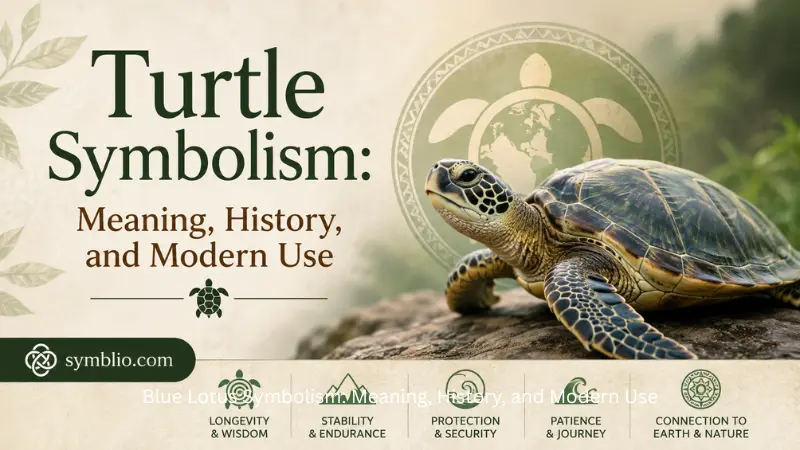
A turtle is instantly recognizable by its protective shell, compact body, and deliberate-looking movement. Turtle symbolism often grows from those physical traits, which is why turtles are commonly associated with patience, protection, longevity, resilience, stability, and steady progress.
In the United States, turtle images appear on tattoos, jewelry, coastal decor, clothing, artwork, environmental campaigns, and personal keepsakes. For some people, the animal represents the ability to keep moving without rushing. For others, its shell suggests safety, boundaries, home, or emotional protection.
Yet turtles do not carry one universal meaning. Their significance changes across cultures, religions, artistic traditions, and personal contexts. Understanding those differences helps separate documented cultural traditions from modern interpretations that developed through popular culture.
Quick Answer
Turtle symbolism commonly represents patience, protection, longevity, resilience, stability, and steady progress in modern American culture. In older cultural and religious traditions, turtles and tortoises have also been connected with creation, ancestry, endurance, long life, divination, and cosmic support.
TL;DR
- Turtles commonly represent patience, protection, longevity, and persistence.
- Their shells often symbolize safety, home, and personal boundaries.
- Some Indigenous traditions connect turtles with land, creation, and clan identity.
- Hawaiian honu can carry ancestral and cultural associations.
- East Asian traditions strongly connect turtles with longevity.
- Modern turtle imagery increasingly represents wildlife and ocean conservation.
What a Turtle Commonly Symbolizes Today
The turtle has become a broadly positive symbol in contemporary American culture.
Its most familiar meanings include patience, endurance, protection, persistence, stability, and long life. These associations make sense because they resemble traits people observe or imagine in the animal itself.
The turtle does not appear rushed. It carries a strong protective shell. Many turtle and tortoise species are capable of living for decades, while the broader turtle lineage has survived enormous environmental changes over evolutionary time.
Those characteristics create an image of durability without aggression.
A lion may symbolize strength through force. An eagle may suggest freedom through flight. A turtle represents another kind of strength: surviving, adapting, and continuing at a sustainable pace.
That distinction helps explain why people often choose turtle imagery during periods of long-term growth rather than sudden change.
| Context | Common Meaning in the USA | Typical Association |
|---|---|---|
| Personal growth | Steady progress | Persistence and patience |
| Shell imagery | Protection | Safety and boundaries |
| Sea turtle imagery | Journey | Ocean, travel, and return |
| Family symbolism | Continuity | Generations and lasting bonds |
| Cultural traditions | Context-specific meaning | Creation, ancestry, longevity |
| Conservation | Environmental care | Oceans, beaches, and wildlife |
Why the Turtle Shell Represents Protection
The shell is one of the strongest reasons turtles became symbols of protection.
Unlike an external shelter, a turtle’s shell is part of its body. That physical reality has inspired a familiar modern metaphor: carrying security wherever you go.
In personal symbolism, the shell can represent emotional boundaries. Someone may use a turtle image as a reminder that being open does not require being unprotected.
It can also communicate self-reliance. The turtle does not need to search for a separate defensive structure because its protection travels with it.
This interpretation appears frequently in tattoos and jewelry chosen after difficult experiences. In those contexts, the turtle may represent surviving hardship while keeping one’s identity intact.
The shell can also symbolize privacy. Retreating inward is not always portrayed negatively; sometimes the image expresses knowing when to step away, recover, and protect personal space.
Why Turtles Represent Patience and Steady Progress
Few modern animal symbols are as closely associated with patience as the turtle.
Its slow-looking movement encourages people to view it as deliberate rather than impulsive. That interpretation turns the turtle into a natural symbol for goals that require persistence.
The message is not simply “move slowly.”
A more useful interpretation is keep moving even when progress is gradual.
This makes turtle imagery especially relevant to education, long-term careers, recovery, relationships, financial goals, personal development, and other areas where results may take months or years.
American popular culture also reinforces the idea through stories in which a slow but consistent character succeeds because it refuses to quit.
For that reason, the turtle can represent discipline without urgency.
It reminds people that speed and progress are not always the same thing.
Longevity and the Meaning of a Long Life
Turtles and tortoises have long been connected with longevity.
Some species can live for many decades, and certain tortoises can survive for more than a century. That extraordinary lifespan has naturally encouraged humans to associate them with long life, continuity, endurance, and wisdom accumulated through experience.
Longevity symbolism is particularly important in several East Asian artistic traditions.
Turtles and tortoises have appeared alongside other long-life motifs such as cranes, pine trees, deer, and sacred mountains. In these contexts, the animal can communicate hopes for health, endurance, prosperity, and a long lifespan.
Modern American audiences may encounter these associations through Asian art, gifts, decorative objects, or family traditions.
A turtle given for an anniversary or major birthday can therefore imply more than patience. It may express a wish that a person, family, or relationship continues for many years.
Indigenous North American Traditions and Turtle Island
Turtles hold important places in the traditions of certain Indigenous nations in North America.
One of the best-known examples involves creation traditions associated with Haudenosaunee and Lenape peoples in which land comes to rest or grow upon the back of a great turtle.
These traditions contributed to the expression Turtle Island, a name used by some Indigenous people for North America or, in some contexts, the earth.
The turtle can also function as a clan symbol within particular Indigenous communities. In that setting, its meaning is not merely decorative.
A clan identity can relate to family connections, ancestry, social organization, responsibilities, and belonging.
This is why it is inaccurate to say that the turtle has one universal “Native American meaning.”
Indigenous nations have distinct languages, histories, religious traditions, and social systems. A turtle story from one nation should not automatically be applied to another.
Modern interpretations such as patience or wisdom may overlap with personal beliefs, but they should not replace the specific cultural meaning of a traditional image.
Hawaiian Honu and Cultural Identity
Sea turtles have a particularly visible place in Hawaiian imagery.
The Hawaiian green sea turtle is commonly called honu, and the animal has significance beyond its popularity in beach art and tourism.
Within Native Hawaiian culture, honu can be associated with family, ancestry, ocean relationships, and traditional concepts of guardianship. For some families, particular animals may be understood through the idea of ancestral or family guardians.
That context makes the honu different from a generic sea turtle printed on a souvenir.
Commercial imagery often reduces Hawaiian symbols to ideas such as luck, peace, or tropical relaxation. Those descriptions may fit modern tourist culture, but they do not capture every traditional meaning.
The distinction is useful for tattoos as well.
Someone using a sea turtle simply because they love marine life is making a personal choice. Someone adopting a culturally specific Hawaiian design is engaging with a living cultural tradition and should understand the difference.
Turtle Meaning in Ancient Chinese Tradition
Turtles and tortoises have held an important place in Chinese culture for thousands of years.
One particularly ancient connection involves divination. Tortoise shells were used in ritual practices in which questions concerning rulers, harvests, warfare, weather, and other important matters were recorded and interpreted.
This historical role linked the tortoise with knowledge, order, ritual authority, and attempts to understand the future.
Later Chinese art developed strong associations between turtles and longevity.
The animal’s long lifespan made it an especially appropriate emblem of endurance. Turtle imagery could therefore express hopes for a long life or lasting stability.
In some traditional cosmological imagery, the turtle also appears as a creature capable of supporting or structuring the world.
These meanings are more specific than the modern American idea that turtles simply represent moving slowly.
Turtles in Japanese and Korean Symbolism
The longevity theme extends into Japanese and Korean artistic traditions as well.
Turtles and tortoises frequently appear in decorative art connected with long life, good fortune, continuity, and endurance.
In Japanese imagery, the tortoise may be associated with legendary islands or realms connected with immortality and extraordinary longevity.
Korean art also includes turtles within established groups of longevity symbols.
The animal may appear beside natural elements such as mountains, water, pine trees, clouds, cranes, or deer.
These combinations matter because traditional symbols are often read as part of a visual system rather than individually.
A turtle placed beside another longevity emblem can strengthen the overall wish for a long, stable, and prosperous life.
That older visual tradition continues to influence decorative art and gifts today.
The Tortoise in Hindu Tradition
Tortoise symbolism has an important religious context within Hinduism.
One of the avatars of Vishnu is Kurma, represented as a tortoise.
Kurma appears in the famous narrative of the Churning of the Ocean. In the story, a mountain is used in an enormous cosmic churning, but it requires support. Vishnu assumes tortoise form and provides the foundation needed for the task.
The image naturally conveys stability and support because Kurma literally bears tremendous weight.
It can also suggest preservation, cosmic order, and the strength required to sustain a larger process.
However, those meanings should remain connected to the religious narrative.
Reducing Kurma to a generic symbol of “patience” removes much of the theological context that gives the story its significance.
Emotional and Psychological Meaning
Turtle imagery often appeals to people because it translates easily into emotional metaphors.
Someone who feels overwhelmed may identify with the protective shell. Another person may admire the turtle because it appears calm in an environment that rewards constant speed.
The animal can communicate several psychological ideas:
- protecting personal boundaries
- remaining calm under pressure
- accepting gradual progress
- becoming comfortable with independence
- recovering after hardship
- creating stability during change
The turtle can also symbolize introversion.
Retreating into a shell is a common metaphor for withdrawing from social contact. Depending on the situation, that can represent healthy privacy or excessive avoidance.
Context determines which meaning fits.
A person who chooses a turtle after learning to set boundaries may view withdrawal positively. Someone describing another person as “hiding in their shell” may intend the opposite.
Turtle Tattoos and Their Meanings
Turtles are popular tattoo subjects because the basic shape can communicate several ideas without requiring a complicated design.
A small turtle may represent patience and steady progress.
A detailed shell can emphasize protection, personal history, or the layers of experience that shape someone’s identity.
Sea turtle tattoos often add another set of associations. Because marine turtles travel large distances through the ocean, people may connect them with journeys, navigation, migration, returning home, or maintaining direction despite uncertainty.
Family designs are also common.
Several turtles may represent parents and children, siblings, generations of relatives, or a family moving through life together.
A turtle tattoo can also mark recovery from a difficult period. Instead of symbolizing dramatic victory, it may express endurance: the person survived because they kept going.
Cultural patterns require more care. Indigenous, Hawaiian, Polynesian, or religious designs can carry identities and traditions that go beyond their appearance.
A personally designed turtle can communicate resilience or protection without claiming a cultural meaning that does not belong to the wearer.
Turtle Jewelry, Gifts, and Home Decor
Turtle jewelry often carries gentle, positive associations.
A necklace or bracelet may represent protection, safe travel, patience, long life, or loyalty. Because turtles are associated with endurance, they can also work well as gifts for anniversaries and long-term friendships.
Family members sometimes exchange turtle objects as symbols of connection across distance.
The idea fits particularly well when the recipient is moving, traveling, or beginning a new stage of life. The shell can suggest carrying a sense of home even when physical surroundings change.
Home decor tends to depend on setting.
Sea turtles are common in coastal rooms, where they suggest beaches, oceans, marine life, and relaxation.
Tortoise figures may feel more connected with gardens, stability, longevity, and grounded living.
As with tattoos, cultural context matters. A decorative beach turtle should not automatically be interpreted as having the same significance as a clan emblem, honu image, East Asian longevity symbol, or Hindu religious figure.
Sea Turtles as Symbols of Journey and Return
Sea turtles add movement and navigation to the broader symbolic picture.
Unlike the familiar image of a land turtle moving slowly across a path, sea turtles spend much of their lives traveling through large marine environments.
That makes them especially suitable symbols for long journeys.
People may associate a sea turtle with leaving home, navigating uncertainty, crossing great distances, or returning to a place that remains personally important.
The symbolism can feel particularly meaningful for travelers, military families, immigrants, coastal communities, or anyone whose life includes long periods away from home.
Sea turtles also connect water with endurance.
Water symbolism often involves emotion, change, and movement. The turtle introduces stability into that environment, creating an image of remaining grounded even while circumstances keep changing.
How Conservation Changed the Modern Turtle Symbol
Environmental conservation has added a distinctly modern layer to turtle imagery.
In the United States, turtles frequently appear in campaigns involving oceans, wetlands, beach protection, wildlife crossings, plastic pollution, habitat conservation, and responsible tourism.
Sea turtles are especially prominent because their nesting behavior makes their interaction with human activity highly visible.
Beach lighting, discarded fishing gear, plastic waste, coastal construction, boat traffic, and disturbance around nesting areas can all affect marine turtle populations.
Land and freshwater turtles face different pressures, including road mortality, habitat loss, collection, and changes to wetlands.
As public awareness has grown, the turtle has become more than a personal symbol of patience.
It can now represent environmental responsibility.
A turtle on a reusable bag, educational sign, nonprofit campaign, or ocean-themed product may primarily communicate concern for wildlife rather than longevity or spiritual meaning.
Common Misunderstandings About Turtle Meaning
The biggest mistake is assuming every culture assigned turtles the same symbolic qualities.
They did not.
Similar meanings sometimes developed independently because people observed similar physical characteristics. A long-lived animal can inspire longevity symbolism in more than one place without proving that those traditions share the same origin.
Another misunderstanding comes from mixing turtles and tortoises.
Everyday symbolism frequently treats them as interchangeable, particularly when discussing slowness, shells, or long life. Historically, however, a particular myth, artwork, or religious tradition may refer specifically to a tortoise, freshwater turtle, or sea turtle.
Commercial use creates additional confusion.
A company may call an image “tribal turtle symbolism” without identifying any actual culture behind the design. Such labels can blend unrelated traditions into a style that looks traditional but has no clear historical basis.
Claims that turtles universally symbolize luck, fertility, wisdom, healing, motherhood, protection, and spiritual awakening should therefore be treated cautiously.
Some of those interpretations may belong to specific contexts. Others are modern additions.
The History of Turtle Meaning Is Not One Straight Story
There was never a single moment when humans decided what the turtle represented.
Different communities developed turtle imagery independently.
Indigenous creation narratives emerged within their own cultural settings. Ancient Chinese ritual practices developed elsewhere. Hindu religious literature gave the tortoise a theological role through Kurma. Hawaiian traditions created meanings connected with island life, ancestry, family, and ocean relationships.
Modern American symbolism added another layer by turning visible animal characteristics into personal metaphors.
The shell became emotional protection.
Measured movement became patience.
Longevity became perseverance.
Migration became journey.
Wildlife vulnerability became conservation.
These meanings can exist beside one another without being identical.
That is why the surrounding context—who created the image, where it appears, and why it is being used—is often more informative than the animal alone.
FAQs
What does a turtle symbolize?
A turtle commonly symbolizes wisdom, longevity, patience, protection, stability, and perseverance. Because turtles move slowly and carry protective shells, they are often associated with steady progress, resilience, and a grounded approach to life.
What does a turtle symbolize spiritually?
Spiritually, a turtle can represent inner peace, protection, endurance, grounding, and trusting your own pace. Some modern interpretations also connect turtles with emotional balance and staying calm during periods of change.
Is a turtle a symbol of good luck?
Yes. In several cultural traditions, turtles are associated with good fortune, long life, stability, and protection. However, the exact meaning depends on the cultural and historical context in which the turtle appears.
What does a sea turtle symbolize?
Sea turtles often symbolize endurance, emotional depth, navigation, freedom, and returning home. Their long migrations across oceans also make them a powerful modern symbol of persistence and life’s journey.
What does a turtle symbolize in Native American cultures?
Turtle meanings vary among Indigenous nations, so there is no single universal interpretation. In some traditions, turtles are connected with creation, the Earth, longevity, and stability, including stories associated with the concept sometimes called Turtle Island.
What does a turtle tattoo symbolize?
A turtle tattoo may represent long life, resilience, protection, patience, family, peacefulness, or steady personal growth. Sea turtle tattoos can additionally represent travel, freedom, connection with the ocean, and finding one’s way through life.
What does seeing a turtle mean?
Seeing a turtle is sometimes interpreted symbolically as a reminder to slow down, remain patient, protect your energy, and continue making steady progress. This is a personal or modern symbolic interpretation rather than a fixed universal meaning.
Conclusion
Turtles represent a form of strength that does not depend on speed or aggression. Their shells encourage ideas of protection and security, their longevity suggests endurance, and their steady movement makes them natural symbols of patience and persistent progress.
At the same time, turtle symbolism is broader than those familiar modern interpretations. Indigenous traditions, Hawaiian cultural relationships, East Asian longevity imagery, Hindu religious narratives, personal tattoos, and environmental campaigns all give the animal different layers of meaning.
The most accurate way to understand a turtle symbol is therefore to consider its setting. The image may express a personal reminder to keep going, a wish for long life, a connection with family or homeland, or respect for a living cultural tradition.