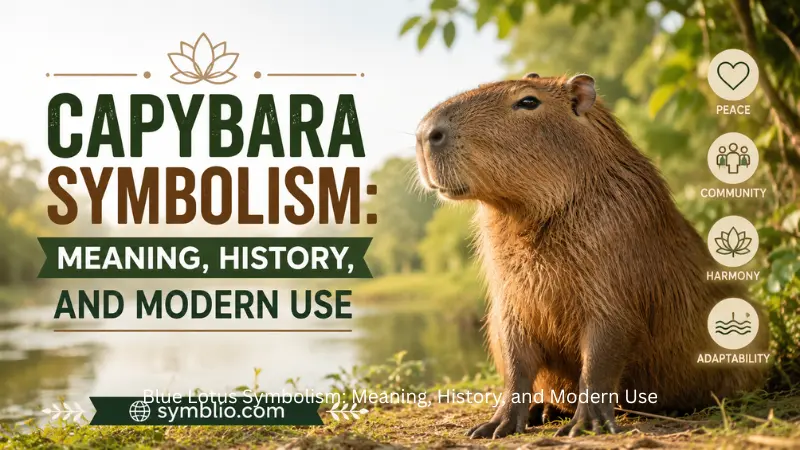
Capybaras have become one of the most recognizable animals in modern internet culture. Their relaxed expressions, social nature, and comfort around water have helped capybara symbolism develop around calmness, friendship, adaptability, and peaceful coexistence.
Unlike animals such as lions, snakes, or doves, capybaras do not carry one universal symbolic tradition stretching across many civilizations. Much of their meaning today comes from their real behavior, South American origins, zoo culture, online memes, and the personality people associate with their calm appearance.
That makes the capybara an interesting modern symbol. Its meaning combines genuine characteristics of the animal with newer cultural interpretations shaped by humor, social media, tattoos, art, and personal identity.
Quick Answer
Capybara symbolism commonly represents calmness, friendship, social harmony, and adaptability in modern American culture. Its meaning comes largely from the animal’s social behavior, semiaquatic lifestyle, relaxed appearance, and recent reputation as an easygoing figure in internet culture.
TL;DR
- Capybaras symbolize calmness, friendship, tolerance, and community.
- Their semiaquatic lifestyle can represent adaptability and flexibility.
- South American cultural connections predate modern internet popularity.
- American meanings are strongly influenced by memes and social media.
- Tattoos often express peaceful confidence, friendship, and individuality.
- Many supposed ancient meanings are modern interpretations rather than established traditions.
What a Capybara Is and Why Its Appearance Matters
The capybara is the largest living rodent in the world. Native to South America, it lives mainly around rivers, wetlands, marshes, flooded grasslands, and other environments where water is readily available.
Its appearance plays a major role in the symbolism people give it today. Capybaras have broad bodies, short legs, small ears, blunt faces, and expressions that humans often read as unusually relaxed.
When a capybara sits quietly beside other animals or rests near the water, it can appear completely unaffected by its surroundings. That appearance has become central to its cultural identity.
People often interpret the animal as representing someone who remains composed without needing to dominate a situation. The capybara does not visually suggest speed, aggression, or competition. Instead, it projects steadiness.
Its connection with water adds another dimension. Because capybaras move comfortably between land and water, they can also represent flexibility, transition, and the ability to adapt when circumstances change.
Core Capybara Meanings at a Glance
Modern capybara meaning varies depending on context.
| Context | Meaning in the USA | Common Association | Notes |
|---|---|---|---|
| Everyday symbolism | Calmness | Relaxed behavior | Strong modern association |
| Friendship | Community | Social connection | Linked to group living |
| Personal identity | Easygoing confidence | Being comfortable with yourself | Common online |
| Water imagery | Adaptability | Adjusting to change | Modern symbolic reading |
| Tattoos | Peace and individuality | Calm personality | Meaning depends on wearer |
| Memes | Being unbothered | Humor and composure | Strong internet association |
These interpretations often overlap. A person may identify with several at once, especially calmness, friendship, and the ability to avoid unnecessary conflict.
Calmness and Emotional Steadiness
Calmness is probably the strongest meaning associated with capybaras today.
Their still posture and neutral facial expression create an impression of emotional control. Online videos often show them resting quietly while activity continues around them, which has strengthened the idea that capybaras are naturally “unbothered.”
Symbolically, this calmness can represent knowing when not to react.
That does not mean passivity or weakness. Instead, the capybara can symbolize emotional steadiness: the ability to remain composed rather than allowing every inconvenience or disagreement to become a crisis.
This interpretation fits especially well with modern American conversations about stress, boundaries, burnout, and emotional regulation.
Someone who uses a capybara image may be expressing a desire to stay relaxed even when work, relationships, or social situations become chaotic.
The symbolism is still partly a human projection. Capybaras are wild prey animals that remain alert to danger. Their cultural reputation for endless relaxation comes mainly from how people interpret their appearance.
Friendship, Community, and Belonging
Capybaras are social animals, making friendship one of their most natural symbolic associations.
They frequently live in groups, communicate with one another, rest together, and depend on social structure. This behavior has encouraged people to associate them with companionship, cooperation, and comfort within a community.
The type of friendship they symbolize is usually gentle rather than intense.
Capybara imagery often suggests being comfortable around someone without needing constant conversation or entertainment. Two capybaras resting beside one another can represent the kind of friendship where simply sharing space feels enough.
That makes the animal appealing as a symbol for close friends, siblings, couples, or groups who value loyalty without drama.
Unlike wolves, which are often used to symbolize hierarchy and coordinated strength, the capybara represents a softer form of belonging. Its symbolism centers more on coexistence than competition.
Adaptability and the Symbolism of Water
Water is essential to capybara life.
They swim well, spend significant amounts of time near or in water, and use aquatic environments as places of safety and comfort. This ability to function naturally in more than one environment gives the animal a strong modern association with adaptability.
Symbolically, a capybara moving between water and land can represent adjusting to new circumstances without losing stability.
This may apply to moving to a new city, changing jobs, entering a different stage of life, or learning how to function in unfamiliar social environments.
Water itself often carries emotional associations in art and personal symbolism. It may represent change, emotion, renewal, or movement.
A capybara calmly floating or swimming can therefore suggest navigating emotional change without becoming overwhelmed.
This meaning is especially common in tattoos and illustrations where water is a major part of the design.
South American Roots and Cultural Context
Capybaras are native to South America, and their meaning begins with the environments and communities that have known the animal long before its modern internet fame.
They are found across large parts of the continent, particularly in areas with abundant freshwater habitats. Depending on the country or region, people may know them by names such as capivara, carpincho, or chigüire.
For communities living near wetlands and river systems, capybaras have historically been more than unusual wildlife. They have been part of everyday ecological life, hunting traditions, food practices, local knowledge, and regional identity.
However, it would be inaccurate to claim that all South American cultures gave the capybara one symbolic meaning.
South America contains many distinct Indigenous traditions, languages, belief systems, and regional histories. An animal can have different associations from one community to another.
For that reason, claims that capybaras universally represented wisdom, fertility, prosperity, rain, or spiritual protection should be treated carefully unless tied to a specific documented tradition.
The most accurate approach is to recognize that older cultural relationships existed without forcing them into a single symbolic definition.
Historical Meaning Was Local, Not Universal
Capybaras appeared in the material culture of some pre-Columbian communities in South America, including animal representations connected with riverine societies.
These appearances show that the animal could carry cultural significance beyond being simply part of the surrounding environment.
Exactly what that significance meant, however, depended on the people creating and using those objects.
Archaeological evidence does not support one universal ancient capybara meaning that can be applied across the entire continent.
This distinction is important because modern symbolism websites sometimes turn limited historical evidence into broad spiritual claims.
A better interpretation is that capybaras occupied different practical and cultural roles depending on place and period. They could be food animals, familiar wildlife, artistic subjects, or part of local systems of meaning.
Today’s associations with being relaxed, friendly, and “unbothered” developed much later.
What Capybaras Commonly Mean in the United States
In the United States, capybaras are primarily modern cultural symbols rather than traditional national or religious emblems.
Most Americans encounter them through zoos, wildlife videos, social media, memes, plush toys, clothing, stickers, and other merchandise.
Their American meaning usually combines four traits: calmness, friendliness, adaptability, and acceptance.
The capybara has become especially appealing because it represents confidence without aggression.
Many traditional animal symbols emphasize strength through dominance. Lions represent authority, eagles can represent freedom and power, and wolves often represent loyalty and coordinated strength.
The capybara offers a different model.
It suggests that a person can be secure without controlling everyone around them. Its relaxed image communicates comfort with oneself rather than the need to prove superiority.
That makes the animal particularly compatible with modern ideas about low-drama relationships, personal boundaries, emotional balance, and enjoying simple pleasures.
How Japanese Pop Culture Helped Shape the Modern Image
Japan played an important role in creating the capybara’s international reputation as an animal associated with relaxation.
Some Japanese zoos and wildlife parks became known for allowing capybaras to soak in warm baths during cold weather. Images of the animals sitting quietly in steaming water became widely recognizable.
The scene fits the animal perfectly from a human perspective: a large rodent appearing completely content while relaxing in warm water.
Capybara-themed characters, toys, illustrations, and merchandise also increased their popularity.
As these images spread internationally, the capybara became increasingly connected with comfort, rest, and an uncomplicated lifestyle.
Social media then amplified that image.
By the 2020s, capybaras were appearing frequently in short videos, songs, memes, animation, merchandise, and humorous online posts.
This transformed them from interesting South American wildlife into global cultural characters.
Why Capybara Memes Mean “Unbothered”
The meme version of a capybara is usually calm even when everything around it appears chaotic.
That contrast is the joke.
People project human emotions onto the animal’s neutral expression and imagine that it has decided not to become involved in whatever drama is happening nearby.
As a result, capybara memes often communicate messages such as:
“I am staying out of this.”
“This situation is not worth my stress.”
“I am comfortable doing my own thing.”
“I do not need everyone’s approval.”
The capybara therefore represents more than relaxation. It can symbolize selective attention: knowing which problems deserve a response and which ones can simply pass by.
That idea has made the animal particularly popular in digital spaces where users constantly encounter arguments, bad news, workplace stress, and social pressure.
Its humor comes from presenting emotional composure in the form of an oversized, expressionless rodent.
Capybara Tattoo Meaning
Capybara tattoos are usually personal rather than religious or ceremonial.
A person might choose one because they identify with the animal’s calm public image, enjoy its humor, or value the social qualities associated with it.
Common capybara tattoo meanings include:
- calmness
- friendship
- adaptability
- contentment
- emotional balance
- peaceful confidence
- belonging
- gentle humor
- individuality
The surrounding design can change the symbolism.
A capybara floating in water may represent remaining calm through change.
Two capybaras together can symbolize friendship, partnership, or a close relationship.
A sleeping capybara may represent rest, recovery, or rejecting constant pressure to be productive.
A capybara sitting in a warm bath can express self-care and enjoyment of simple comforts.
Flowers may give the design a softer emotional tone, while sunglasses or humorous accessories can emphasize the “unbothered” personality associated with internet culture.
Not every tattoo needs an ancient symbolic explanation. Sometimes someone chooses a capybara because the animal represents a personal memory, an inside joke, or simply something they genuinely enjoy.
Capybaras in Gifts, Decor, and Personal Style
Capybara imagery has become common in casual fashion and decorative products.
People may encounter the animal on plush toys, shirts, mugs, stickers, keychains, phone cases, bags, desk accessories, and home decor.
The meaning changes slightly depending on the style.
A realistic wildlife illustration may express interest in nature or South American animals.
A cartoon capybara holding a drink or wearing a hat is more likely to communicate humor, comfort, or a relaxed personality.
Plush capybaras often emphasize softness and coziness. They can function as comfort objects or playful gifts.
Giving someone a capybara-themed item can also carry an informal friendship message. It may suggest that the recipient is easy to be around, calming, funny, or someone with whom the giver feels completely comfortable.
Because the animal has such a gentle public image, capybara decor rarely feels aggressive or intimidating. It tends to communicate warmth and approachability.
Emotional and Psychological Meaning
People often use animal symbols to represent qualities they want to strengthen in themselves.
In that sense, the capybara can function as a reminder to reduce unnecessary emotional reactions.
Its symbolism may appeal to someone who wants to become more patient, socially comfortable, or adaptable.
It can also represent being secure enough to share space with others without constantly seeking attention.
For introverted or socially selective people, the capybara may symbolize a useful balance: enjoying community without needing to be the center of it.
Another interpretation is contentment.
Modern culture often rewards constant achievement, comparison, and productivity. The relaxed capybara offers a humorous counter-image: an animal that seems perfectly satisfied simply sitting beside water or resting with companions.
That symbolism does not necessarily reject ambition. Instead, it can represent the idea that peace should not depend entirely on achievement.
Spiritual and Religious Interpretations
Capybaras do not have a standard symbolic role in major world religions.
There is no broadly recognized Christian, Jewish, Islamic, Hindu, or Buddhist teaching that assigns the capybara a fixed spiritual meaning.
Modern spiritual interpretations sometimes connect the animal with peace, community, patience, emotional balance, and adaptability.
Those associations can be meaningful for an individual, but they should be understood as contemporary personal symbolism rather than established doctrine.
Someone might use a capybara image as a reminder to remain calm during conflict or to value cooperative relationships.
Its strong connection with water may also inspire personal interpretations involving emotional renewal or flexibility.
There is also a historical relationship between capybara meat and certain Lenten food traditions in parts of South America. That practice reflects local religious and culinary history, but it does not make the animal a general Christian symbol.
The distinction between religious tradition and personal spiritual meaning is important.
Common Misunderstandings About Capybara Symbolism
The biggest misunderstanding is assuming that every modern symbolic meaning must come from ancient mythology.
Many statements online present capybaras as ancient universal symbols of fertility, prosperity, enlightenment, protection, or good fortune.
These claims often lack clear historical context.
Modern capybara symbolism is better supported when it is connected with visible characteristics: social living, adaptability to water, calm appearance, and internet culture.
Another misunderstanding is believing that their relaxed appearance means they are completely passive animals.
Capybaras are wild animals with survival instincts, social structures, territorial behaviors, and environmental needs.
They should not be treated as oversized domestic guinea pigs simply because online videos make them appear easygoing.
A third mistake is assuming that every political or social use becomes a permanent symbolic meaning.
Capybaras have occasionally appeared in debates about development, wetlands, class, and humans expanding into wildlife habitats. In those moments, the animals may temporarily symbolize nature reclaiming space.
That meaning belongs to a specific political context rather than the species as a whole.
How Capybara Symbolism Has Evolved
Capybara meaning has developed in layers.
The earliest layer comes from South America, where people have interacted with the animal within real river and wetland ecosystems for generations.
Those relationships varied by place and included practical, cultural, and artistic dimensions.
A later layer developed through zoos, wildlife education, and popular culture, particularly the relaxing imagery of capybaras soaking in warm water.
The newest layer comes from the internet.
Memes and short-form videos transformed the capybara into a recognizable personality: calm, social, tolerant, funny, and difficult to disturb.
That online identity now influences tattoos, merchandise, fashion, gifts, and even how visitors interpret real animals at zoos and wildlife attractions.
In the United States, this modern layer is usually the most important.
The capybara has become an informal symbol for people who want connection without unnecessary conflict and confidence without aggression.
FAQs
A capybara commonly symbolizes calmness, community, adaptability, patience, and peaceful coexistence. Its relaxed social behavior makes it a modern symbol of staying composed while maintaining strong connections with others.
In modern spiritual interpretations, the capybara can represent emotional balance, cooperation, acceptance, and moving through challenges without unnecessary conflict. These meanings are symbolic interpretations rather than fixed traditional beliefs.
Capybaras have a reputation for being highly social and relatively tolerant around other animals. Because of this behavior, people often use them as symbols of peacefulness, friendship, tolerance, and getting along with others.
In internet and popular culture, capybaras often represent a relaxed attitude, emotional calm, friendliness, and being comfortable in almost any social situation. Their laid-back image has helped make them popular symbols of stress-free living.
Yes. Because capybaras live socially and are frequently seen resting or interacting peacefully in groups, they can symbolize friendship, companionship, cooperation, and belonging.
There is no universal traditional belief that capybaras bring good luck. However, in personal or modern symbolic interpretations, seeing one may be viewed as a reminder to stay calm, value supportive relationships, and adapt patiently to change.
Conclusion
The capybara’s modern image combines real animal behavior with meanings created through contemporary culture. Its social lifestyle supports associations with friendship and community, while its comfort in water lends itself to ideas of adaptability and emotional flexibility.
In the United States, capybara symbolism is most strongly connected with calmness, peaceful confidence, belonging, and an ability to remain comfortable without competing for attention. Tattoos, memes, gifts, and social media have expanded those meanings far beyond the animal’s native South American wetlands.
What makes the capybara distinctive as a symbol is its lack of aggression. It represents a form of confidence based not on dominance, but on being comfortable with yourself, your surroundings, and the people you choose to keep close.