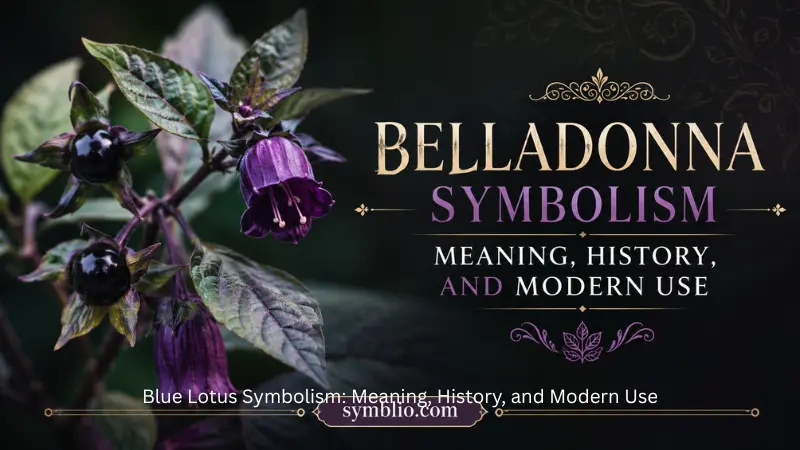
Belladonna is a plant whose appearance and reputation seem to contradict each other. Belladonna symbolism commonly centers on dangerous beauty, mortality, temptation, secrecy, self-protection, and the thin line between healing and harm. Its glossy dark berries and muted purple flowers can look attractive, yet the plant itself is highly toxic.
Also known as deadly nightshade, Atropa belladonna has accumulated meaning through botany, medicine, classical mythology, European folklore, beauty practices, Gothic literature, and modern alternative culture. These layers explain why the plant can suggest death in one context and personal strength or transformation in another.
In the United States today, belladonna is most often encountered symbolically through tattoos, dark botanical art, Halloween imagery, jewelry, fashion, fantasy, and Gothic design. Its appeal comes largely from contrast: something can be beautiful without being harmless.
Quick Answer
Belladonna symbolism commonly represents dangerous beauty, mortality, temptation, secrecy, and transformation in modern American culture. Historically, its toxicity, association with fate and death, beauty-related name, medicinal history, and European folklore shaped its darker meanings.
TL;DR
- Belladonna often symbolizes beauty combined with danger.
- Its toxicity connects the plant with death and mortality.
- Classical associations link belladonna with fate and finality.
- Its name connects beauty with risk and appearance.
- Tattoos often emphasize boundaries, transformation, or dangerous attraction.
- Folklore strengthened its connection with magic and forbidden knowledge.
What Belladonna Looks Like and Why Appearance Matters
Belladonna is a perennial plant with broad green leaves, bell-shaped flowers, and berries that darken as they ripen. Its flowers are often purple, reddish-purple, or greenish, while the mature berries can appear glossy and almost black.
That appearance is important to its symbolism because the plant does not necessarily look threatening. A person unfamiliar with it might see attractive berries and delicate flowers rather than danger.
This creates one of belladonna’s most recognizable symbolic contrasts: an appealing surface concealing serious risk.
Artists often use belladonna when they want to suggest that appearances can be misleading. A graceful branch beside a portrait may imply beauty with hidden consequences. Dark berries among soft flowers can represent something seductive that deserves caution.
Unlike symbols whose meanings come mainly from legend, much of belladonna’s imagery begins with the plant’s actual physical characteristics.
What Belladonna Commonly Symbolizes in the United States
Belladonna does not have one fixed meaning in American culture. Its interpretation usually depends on the setting, design, and intention of the person using it.
| Context | Common Meaning in the USA | Associations | Typical Interpretation |
|---|---|---|---|
| Tattoos | Dangerous beauty | Boundaries, independence, mortality | Beauty that should not be underestimated |
| Gothic art | Beauty beside death | Darkness, elegance, decay | Attraction mixed with danger |
| Witch-inspired imagery | Forbidden knowledge | Herbs, magic, secrecy | Folklore and occult aesthetics |
| Botanical art | Hidden danger | Nature, toxicity, contrast | Beauty with real consequences |
| Personal symbolism | Transformation | Survival, change, protection | Growth through difficult experience |
| Medical imagery | Healing and harm | Dosage, knowledge, control | The dual nature of potent substances |
For many Americans, the simplest reading is something beautiful that can also be dangerous.
That message can be applied in several ways. It may represent a charming person who has strong boundaries, a tempting situation with consequences, or the idea that beauty does not equal weakness.
Why Belladonna Represents Dangerous Beauty
Dangerous beauty is probably the clearest modern interpretation of belladonna.
Its berries can look appealing while the plant contains toxic compounds capable of causing severe poisoning. That real-world contrast naturally lends itself to symbolic interpretation.
In art and personal imagery, belladonna can suggest:
- attraction accompanied by risk
- beauty that demands caution
- charm with consequences
- seduction that may become destructive
- strength beneath a graceful appearance
Not every use implies deception. A belladonna tattoo, for example, may express a personal boundary rather than a threat.
In that context, the message might be: I can be soft, beautiful, or approachable without being defenseless.
That interpretation explains why belladonna frequently appears in imagery associated with independence, confidence, and self-protection.
Death, Fate, and Mortality
Belladonna has an especially strong connection with death because its botanical name carries a classical reference.
The genus name Atropa is associated with Atropos, one of the three Fates in Greek mythology. The Fates were imagined as controlling the thread of human life, and Atropos was the figure responsible for cutting that thread.
The association suits a plant known for its toxicity and helped strengthen belladonna’s connection with finality.
In symbolic art, belladonna may therefore represent:
Mortality. Beauty and life are temporary.
Fate. Certain events cannot be completely controlled.
Finality. Some endings cannot be reversed.
Acceptance of death. Mortality can be acknowledged rather than ignored.
These themes become stronger when belladonna appears beside skulls, bones, hourglasses, ravens, candles, or other images associated with impermanence.
In this setting, the plant functions almost like a botanical memento mori—a reminder that beauty exists within a limited lifespan.
How the Name Belladonna Connected Beauty With Risk
The word “belladonna” comes from Italian words meaning “beautiful woman.”
The name has historically been linked with beauty practices involving substances derived from the plant that caused the pupils to dilate. Enlarged pupils were considered attractive in certain European contexts.
This history gives the plant an unusual symbolic relationship with beauty.
Belladonna does not simply represent attractiveness. It can represent the price, danger, or pressure attached to becoming attractive.
Modern artists sometimes use this connection when exploring:
- unrealistic beauty standards
- femininity and appearance
- vanity
- seduction
- social expectations
- the risks people accept to appear desirable
In this interpretation, belladonna becomes more than a poisonous flower. It becomes a way to question what people are willing to sacrifice for beauty.
That theme remains relevant in a culture where appearance can be heavily shaped by fashion, cosmetics, social media, and public expectations.
Poison and Medicine: The Symbolism of Duality
Belladonna is also associated with a striking contradiction between poison and medicine.
The plant contains compounds such as atropine and scopolamine. Although consuming belladonna itself can be dangerous, medically controlled versions of certain related compounds have legitimate uses.
That contrast supports another major symbolic theme: something harmful in one context may become useful when understood and controlled.
Belladonna can therefore represent opposites such as:
healing and harm
knowledge and ignorance
control and recklessness
beauty and danger
medicine and poison
life and death
This makes the plant especially meaningful in apothecary-inspired imagery, medical art, or designs involving bottles, herbs, old scientific illustrations, and anatomical themes.
For someone interested in science or medicine, belladonna may symbolize the importance of knowledge rather than supernatural danger.
The lesson is not that poison and medicine are the same. It is that understanding, preparation, and dosage can radically change how certain substances affect the body.
Belladonna in European Folklore and Witchcraft Imagery
Belladonna is strongly associated in modern imagination with witches, potions, poisonous gardens, and forbidden herbal knowledge.
That connection has historical roots, but popular culture often simplifies the story.
Nightshade-family plants appear in European folklore and in accounts involving intoxicating preparations. Because some of their chemicals can cause delirium, hallucinations, confusion, and altered perception, these plants became associated with strange visions and supernatural experiences.
Over time, belladonna became connected with stories about witches, magical ointments, secret herbal practices, and dangerous potions.
However, not every dramatic claim repeated today should be treated as established historical fact. Witch-trial testimony, medical theories, superstition, folklore, religious accusations, and later storytelling often became mixed together.
Modern American culture tends to use belladonna more freely as a visual shorthand for:
- witchcraft aesthetics
- forbidden knowledge
- herbal lore
- magical danger
- secrecy
- altered consciousness
These are cultural associations rather than evidence of one universal historical ritual involving the plant.
How Belladonna’s Meaning Changed Over Time
Belladonna’s symbolism developed in layers.
Its earliest significance came from practical knowledge: it was a plant capable of causing serious physical effects.
Later medical use complicated that reputation. Belladonna-related compounds demonstrated that substances considered dangerous could also be studied and applied carefully.
Its scientific naming strengthened the link with death and fate through Atropos.
The word “belladonna” added another layer by connecting the plant with beauty and appearance.
European folklore and later storytelling pushed it further toward magic, witchcraft, poisoners, secret remedies, and altered states.
Gothic literature, horror, occult revival movements, and botanical illustration then helped transform deadly nightshade into a recognizable visual symbol.
Today, social media, tattoo culture, fashion, and digital art continue reshaping its meaning. Belladonna may now represent boundaries, feminine independence, survival, transformation, or a fascination with dark natural imagery.
Its symbolism has therefore moved from practical fear toward a broader cultural language of contradiction.
Emotional and Psychological Meaning
Belladonna can also express complicated emotional states.
One interpretation centers on self-protection. A person may identify with the idea of appearing calm, elegant, or gentle while still maintaining strong boundaries.
Another interpretation focuses on temptation.
People often feel drawn toward situations they know may be unhealthy: a destructive relationship, risky decision, obsessive goal, or attractive illusion. Belladonna can represent that tension between desire and judgment.
It may also symbolize emotional maturity after a difficult experience.
Someone who once ignored warning signs may use the plant as a reminder to recognize danger earlier. In that sense, belladonna can represent learning rather than fear.
The plant also fits themes of mortality. A person may choose belladonna imagery because it acknowledges that beauty, youth, relationships, and life itself are temporary.
None of these interpretations requires a supernatural belief. They work because belladonna provides a visual metaphor for emotional contradictions people experience in ordinary life.
Belladonna as a Symbol of Transformation
Transformation is a more modern interpretation, but it fits naturally with belladonna’s broader symbolism.
People often change after discovering that something attractive was harmful. A difficult relationship, betrayal, major loss, or personal crisis can alter how someone understands trust and boundaries.
Belladonna can represent that transition.
Instead of symbolizing the harmful experience itself, the plant may stand for the knowledge gained afterward.
This meaning often appears in tattoos and personal artwork where belladonna is paired with moths, snakes, moons, broken chains, or other symbols associated with change.
In such designs, the plant can communicate:
- learning from danger
- becoming more discerning
- protecting personal boundaries
- accepting uncomfortable truths
- leaving a harmful situation
- rebuilding after loss
The symbolism becomes less about death and more about what someone becomes after confronting difficulty.
Why Belladonna Appears in Tattoos
Belladonna works well as tattoo imagery because it is visually elegant while carrying multiple possible meanings.
A detailed botanical tattoo can simply reflect an interest in unusual plants. Additional images usually make the symbolism more specific.
Paired with a skull, belladonna often emphasizes mortality, danger, or acceptance of death.
When shown beside a snake, the plant may suggest temptation, knowledge, danger, or transformation.
A moth combined with belladonna can highlight change, darkness, mortality, or attraction to something dangerous.
In designs featuring a woman’s portrait, belladonna may focus on femininity, beauty, confidence, or dangerous attraction.
An apothecary bottle alongside belladonna usually points to poison history, medicine, chemistry, or herbal traditions.
Combined with a dagger, the flower may suggest betrayal, defense, survival, or consequences.
Some people choose the plant after leaving a destructive relationship or surviving a major life change. Others simply appreciate Gothic botany.
Because tattoos are personal, no symbolism dictionary can determine a wearer’s exact meaning. The surrounding imagery and the person’s intention matter most.
Belladonna in Gothic Fashion, Jewelry, and Decor
Belladonna fits naturally into Gothic aesthetics because it combines floral beauty with associations of poison, darkness, and mortality.
Designers may use black berries, purple flowers, antique botanical drawings, apothecary labels, or the Latin name Atropa belladonna.
These elements often appear beside:
- moths
- ravens
- moons
- bones
- snakes
- antique bottles
- candles
- Victorian-style frames
In jewelry, belladonna can suggest elegance with an unsettling edge.
Unlike the rose, whose romantic symbolism is broadly understood, belladonna is somewhat less obvious. Recognizing it can signal an interest in poisonous plants, folklore, botany, Gothic art, horror, or alternative fashion.
Its imagery also becomes more visible around Halloween. Decorations may feature fictional poison bottles, witch gardens, nightshade illustrations, or dark floral arrangements.
These uses are usually aesthetic and theatrical rather than literal recreations of historical practices.
Belladonna in Literature, Horror, and Pop Culture
Poisonous plants are useful storytelling devices because they combine ordinary nature with hidden danger.
Belladonna fits especially well in murder mysteries, Gothic stories, fantasy, historical fiction, and horror. A character who understands deadly nightshade may be portrayed as knowledgeable, secretive, medically trained, dangerous, or connected with herbal traditions.
The plant can also function as foreshadowing.
A seemingly decorative flower may warn the audience that something attractive is not safe. Writers can therefore use belladonna without explaining its symbolism directly.
Modern entertainment has strengthened the plant’s connection with:
- witches
- poisoners
- dark gardens
- supernatural characters
- secret remedies
- dangerous women
- forbidden knowledge
Digital culture has expanded these themes further.
Botanical illustrators, tattoo artists, Gothic photographers, jewelry designers, and alternative fashion communities frequently use belladonna imagery online.
As a result, many Americans now recognize the plant less through traditional flower language and more through modern Gothic, fantasy, and dark-academic aesthetics.
Common Misunderstandings About Belladonna
One mistake is treating every modern belladonna meaning as an ancient belief.
Claims that belladonna has “always” symbolized feminine power, spiritual awakening, or transformation are usually too broad. Some of these meanings are modern interpretations built from older historical associations.
Another misconception is assuming that historical medicinal use makes the raw plant safe.
It does not. Belladonna is toxic, and consuming parts of the plant can cause serious poisoning. Historical or modern medical use of isolated compounds should not be confused with casually using the plant itself.
The witchcraft connection can also be exaggerated.
Belladonna is genuinely associated with European folklore and narratives involving nightshade plants, but popular retellings often blend documented practices, accusations, legends, and later fiction.
Another misunderstanding comes from romanticizing the plant as merely a “dark feminine” flower. That aesthetic may be meaningful in art, but the physical danger of belladonna is real.
Understanding the difference between symbolic imagery and botanical reality keeps the subject both interesting and accurate.
How to Interpret Belladonna in Different Contexts
Context is the best guide to belladonna’s meaning.
When the plant appears beside mirrors, cosmetics, elegant clothing, or female portraits, it often relates to beauty, appearance, seduction, or social expectations.
Beside skulls, bones, gravestones, or hourglasses, mortality becomes more prominent.
With moons, potion bottles, herbs, or witch imagery, the symbolism usually leans toward folklore, secrecy, and magical aesthetics.
With snakes or moths, transformation and danger may become central.
In medical or scientific artwork, belladonna may represent pharmacology, toxicology, historical medicine, or humanity’s ability to study dangerous substances.
A simple botanical drawing may carry no dark message at all. It may simply celebrate the plant’s unusual appearance.
Belladonna is therefore not a symbol with one official definition. Meaning comes from the interaction between the plant’s history, its real characteristics, the surrounding imagery, and the intention of the person using it.
FAQs
Belladonna commonly symbolizes danger, mystery, forbidden beauty, death, transformation, and temptation. Its attractive appearance combined with its poisonous nature creates a strong contrast between beauty and hidden risk.
Belladonna is highly toxic, so its symbolism naturally developed around poison, caution, death, and hidden threats. Its appealing berries and flowers make the plant an especially powerful symbol of something beautiful that may also be dangerous.
In modern spiritual interpretations, belladonna may represent transformation, secrecy, intuition, boundaries, and confronting the unknown. These meanings are interpretive rather than universal and can vary between traditions.
A belladonna flower can symbolize mysterious beauty, temptation, danger, independence, and the darker side of attraction. It is often used when someone wants floral imagery that feels dramatic rather than traditionally romantic.
Yes. Belladonna has long been connected with death and mortality because of its poisonous properties. In art, literature, and modern symbolism, it can represent mortality, fatal attraction, or consequences hidden beneath beauty.
A belladonna tattoo may represent dangerous beauty, mystery, personal transformation, resilience, independence, or attraction to darker imagery. The exact meaning usually depends on the wearer and the other symbols included in the design.
Conclusion
Belladonna is unusual because many of its symbolic meanings grow directly from contradiction. It is attractive yet toxic, associated with beauty yet connected with mortality, and linked both to dangerous poisoning and medically useful compounds.
In modern American culture, belladonna symbolism most often represents dangerous beauty, death, temptation, self-protection, transformation, and the contrast between healing and harm. Gothic art, tattoos, folklore, fashion, and digital culture have expanded those meanings while giving people room to interpret the plant personally.
Belladonna’s most useful symbolic message is therefore not simply darkness or danger. It is the reminder that attraction and safety are not always the same thing, and that knowledge can change how we respond to what first appears beautiful.