
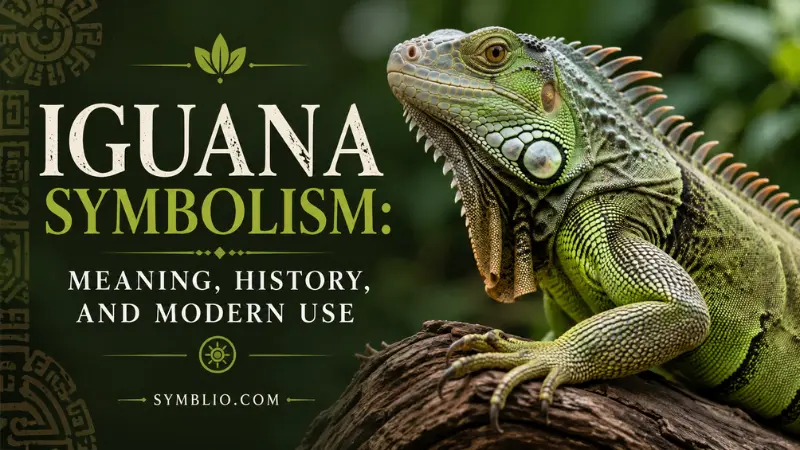
An iguana is easy to recognize: a large lizard with a long tail, rough scales, a row of dorsal spines, and a distinctive dewlap beneath its throat. In the United States, people encounter iguanas as exotic pets, wildlife in subtropical regions, tattoo imagery, decorative motifs, and increasingly familiar animals in places such as South Florida.
The meaning attached to the animal is more complicated than a simple list of traits. Iguanas have appeared in Indigenous American traditions, especially across Mesoamerica and Central America, where lizards and iguana-like creatures could be connected with fertility, abundance, the earth, celestial forces, rulership, and the structure of the cosmos. Those traditions varied considerably, so there is no single ancient “iguana meaning.”
Today, Americans may read the iguana through a more personal lens. Its ability to bask in the sun, climb, remain still for long periods, and survive in challenging environments can make it a symbol of patience, adaptation, independence, and resilience. At the same time, its status as an invasive species in parts of the United States gives the animal a very different modern association: unintended consequences and the complicated relationship between humans, pets, and ecosystems.
Quick Answer
Iguana symbolism commonly represents adaptation, patience, independence, and resilience in modern American culture, especially in tattoos, art, and personal identity. Historically, iguana and lizard imagery in Mesoamerican and Central American traditions could also be associated with abundance, the earth, celestial forces, and rulership.
TL;DR
- Iguanas commonly symbolize adaptation, patience, independence, and resilience.
- Ancient American traditions gave lizards and iguanas varied cosmological meanings.
- Mesoamerican symbolism sometimes connected reptiles with maize and abundance.
- Modern U.S. meanings are shaped by pets, wildlife, art, and tattoos.
- Florida gives the iguana an additional association with ecological change.
- Tattoo interpretations usually depend on the design and personal story.
What the Iguana Represents Symbolically
The iguana’s physical behavior explains many of the meanings people naturally attach to it.
It is not a fast, constantly active animal. It spends considerable time resting, basking, climbing, and observing its surroundings. That makes patience one of its most intuitive modern associations. The animal appears comfortable waiting rather than rushing, which can translate symbolically into self-control and deliberate action.
Its ability to live in different environments also lends itself to adaptation. Iguanas occur across tropical and subtropical parts of the Americas, while introduced populations have established themselves in environments far from their original range.
The animal’s distinctive appearance contributes another layer. Its spines, muscular tail, claws, and imposing profile can suggest self-protection and independence, even though the iguana is primarily herbivorous.
A useful distinction is that these are modern symbolic interpretations rather than universal facts about the animal. An iguana tattoo does not automatically mean resilience, for example. The owner’s intention and the surrounding imagery matter.
Why Iguanas Became Symbols of Adaptation
Adaptation is probably the most natural modern interpretation of the iguana.
The animal survives through behaviors that emphasize environmental awareness rather than constant aggression. It regulates its body temperature through basking, uses its surroundings for shelter and climbing, and relies on physical adaptations that help it function in tropical environments.
This creates an appealing metaphor for people who see themselves as adaptable. An iguana can represent someone who has learned to adjust without losing their identity.
In personal symbolism, that may translate into ideas such as:
- adjusting to a new environment
- remaining calm during change
- learning from difficult circumstances
- becoming comfortable with independence
- responding rather than reacting
The symbolism works particularly well when an iguana is shown against a changing landscape, climbing upward, or surrounded by vegetation.
Ancient Mesoamerican Roots and Reptile Symbolism
Iguana imagery has a substantial history in the Americas, but it is important not to combine every Indigenous tradition into one symbolic system.
Ancient Mesoamerican cultures frequently used reptiles in artistic and religious imagery. Maya traditions, in particular, contain numerous representations of lizards and reptilian beings. Some scholarly interpretations connect reptilian imagery with maize, abundance, and larger ideas about the structure of the world. Archaeological evidence also shows that iguanas were represented in Central American art.
In ancient Mexican traditions, the closely related category of the lizard also had calendrical importance. The Mexica included lizard as the fourth day sign in their 20-day calendar cycle, and the animal was associated with qualities such as agility and vigor.
These examples demonstrate why “iguana symbolism” should be treated carefully. Ancient peoples did not necessarily separate animals according to the same modern biological categories we use today. A particular artwork may represent a lizard, iguana, crocodilian, or composite supernatural creature, and interpretation depends on its cultural and archaeological context.
Iguanas, Abundance, and Maize
One of the more interesting historical associations comes from Maya material and iconographic traditions.
Older scholarship examining Maya imagery identified lizard imagery in connection with kan, a sign associated with maize. Lizards appear in some manuscript scenes involving offerings, while reptilian imagery can overlap with concepts of abundance and agricultural life.
This does not mean that every Maya person regarded an iguana as a direct symbol of wealth. Rather, it shows how animals could participate in a larger symbolic vocabulary involving food, agriculture, fertility, and the natural world.
For a modern reader, this history gives the iguana a richer interpretation than the familiar ideas of toughness and independence. In some contexts, it can also suggest sustenance, fertility, natural abundance, and connection to the land.
Celestial Iguanas in Indigenous Tradition
Some Indigenous traditions give iguanas an explicitly celestial dimension.
A recorded Southern Lacandon Maya narrative describes an iguana swallowing the moon during an eclipse. The story identifies these creatures as celestial iguanas rather than ordinary earthly animals.
That tradition offers a striking example of how an ordinary animal could become part of an explanation for an astronomical event. The iguana here is not merely a symbol of patience or survival; it participates in a story about the moon, darkness, the sky, and restoration.
The lesson for modern symbolism is important: animal symbolism is often narrative rather than dictionary-like. An animal can represent an event, participate in a cosmological story, or embody a relationship between humans and the natural world.
Iguana Symbolism in Central American Art
Archaeological objects from Central America provide another window into the animal’s symbolic history.
A ceramic vessel from the southern Nicoya region of Costa Rica, dated roughly between the seventh and fourteenth centuries, features an iguana on its lid. The Cleveland Museum of Art notes that Costa Rican mythology at the time of Spanish conquest connected iguanas with the sky and rulers. The object’s association with elite burials adds another possible connection with status and authority.
Other Panamanian ceramic traditions contain composite creatures combining iguana characteristics with serpent imagery. Museum scholarship suggests that such figures may have participated in beliefs concerning primordial or cosmic origins.
These examples help explain why an iguana can carry associations with authority, creation, the sky, and cosmic order in historical interpretations, even though those meanings should not be presented as universal across all Indigenous American cultures.
What Iguanas Symbolize in the United States
Modern American symbolism is less likely to come directly from ancient mythology and more likely to develop through popular culture, personal experience, art, and regional wildlife.
For many Americans, an iguana first appears as an exotic animal. Its unusual appearance makes it visually distinctive and therefore useful in illustration, fashion, home décor, logos, tattoos, and social media imagery.
In South Florida, however, the animal has become part of everyday public life. Green iguanas were introduced through the exotic pet trade and have established populations in the region. The University of Florida notes that they were first documented around Miami in the early 1960s and that subsequent releases and escapes contributed to their spread.
That gives the iguana a distinctly American modern meaning that differs from its symbolic use in ancient art: adaptation can be admirable, but uncontrolled adaptation can also create ecological problems.
A Quick Guide to Iguana Meanings
| Context | Meaning in the USA | Common Associations | Notes |
|---|---|---|---|
| Tattoos | Adaptation and independence | Resilience, individuality | Usually highly personal |
| Nature imagery | Patience and survival | Sun, plants, balance | Often emphasizes natural behavior |
| Ancient-inspired art | Abundance or cosmic connection | Maize, earth, sky | Requires cultural context |
| Florida wildlife | Environmental change | Invasion, adaptation | More ecological than spiritual |
| Jewelry and décor | Exotic individuality | Tropical life, uniqueness | Often aesthetic rather than religious |
Iguana Symbolism in Tattoos
An iguana tattoo can communicate individuality without relying on a conventional heroic animal such as an eagle, lion, or wolf.
The iguana’s unusual silhouette makes it particularly suitable for designs emphasizing personality rather than aggression. A realistic iguana may represent an appreciation for reptiles or nature, while a stylized design can emphasize transformation, independence, or connection with tropical landscapes.
Specific elements can alter the impression:
A sun-basking iguana may suggest patience, warmth, or living at one’s own pace.
An iguana surrounded by leaves can emphasize nature and environmental connection.
A highly detailed iguana may simply reflect fascination with the animal rather than a symbolic message.
A Mesoamerican-inspired iguana can refer to ancient American art, but designers should avoid treating all Indigenous traditions as interchangeable.
The most accurate interpretation is therefore often the simplest: ask what the imagery means within the individual design.
Emotional and Psychological Meaning
Symbolically, the iguana can represent a person who prefers observation before action.
That quality makes it an interesting counterpart to animals associated with speed. Instead of suggesting constant movement, the iguana can symbolize restraint, awareness, and choosing the right moment.
Its defensive appearance can also communicate boundaries. The spines and strong tail create an impression of an animal that does not need to look aggressive to appear capable of protecting itself.
There is also a useful distinction between confidence and dominance. Iguana symbolism tends to work better as a metaphor for self-possession than conquest. Its message can be, “I know how to occupy my space,” rather than “I need to control everyone around me.”
Iguanas and Independence
Independence is especially common in modern personal interpretations.
The iguana’s solitary appearance makes it easy to associate with self-reliance. A person choosing the animal as a personal emblem might use it to represent becoming comfortable with their own path, especially after a major change in circumstances.
But independence does not have to mean isolation.
A more nuanced interpretation is self-sufficiency combined with environmental awareness. The iguana survives by responding to its surroundings rather than ignoring them. That makes it a useful symbol for maintaining personal identity while still adapting to changing circumstances.
Iguana Symbolism in Nature and Home Décor
In American design, iguana imagery frequently functions as a marker of tropical or coastal atmosphere.
A carved or painted iguana can suggest:
- tropical landscapes
- warm climates
- outdoor living
- nature
- curiosity
- unconventional taste
This use is often decorative rather than religious.
That distinction matters because not every animal image carries a formal symbolic tradition. Sometimes the reason an iguana appears on a piece of art is simply that its shape, colors, and silhouette fit the visual language of a tropical setting.
The Iguana as a Symbol of Ecological Change
The modern American story of the iguana has another side.
In Florida, green iguanas are considered an invasive species. Their populations are associated with the exotic pet trade and with animals that escaped or were released. They can affect landscaping, agriculture, infrastructure, and native ecosystems.
This creates a modern symbolic contradiction.
The iguana can represent adaptability, but its Florida story also demonstrates that adaptation can have consequences when an organism enters an ecosystem where it does not naturally belong.
That makes the animal an unexpectedly useful symbol of the complicated relationship between humans and nature: admiration, commerce, companionship, environmental disruption, and conservation can all exist around the same species.
Common Misunderstandings About Iguana Symbolism
One common mistake is claiming that iguanas have one universal ancient meaning. They do not.
Another is assuming that every reptile symbol in Mesoamerican art represents an iguana. Archaeological imagery often involves multiple reptile species and composite beings, and identifying an animal from stylized artwork can be difficult.
It is also misleading to describe iguanas exclusively as symbols of “strength.” Their symbolism can involve patience, abundance, celestial stories, authority, environmental adaptation, and personal independence depending on context.
Finally, modern Florida associations should not be projected backward onto ancient traditions. An invasive species problem is a contemporary ecological issue, not an explanation for why ancient American artists depicted reptilian creatures.
How Iguana Meaning Has Changed Over Time
The symbolic history of the iguana shows a movement from cosmological animal imagery toward personal and aesthetic symbolism.
In ancient American cultures, reptiles could be incorporated into explanations of agriculture, creation, rulership, astronomy, and the structure of the world. Their significance was tied to shared stories and religious or cultural systems.
Modern Americans generally encounter the animal differently. It may be a pet, a zoo animal, a wildlife problem, a tattoo subject, or a tropical design motif.
As a result, today’s symbolism is more individualized. Someone might choose an iguana because it represents adaptation after a major life transition, while another person simply likes reptiles.
The animal has therefore moved from being part of collective cosmological imagery in some historical contexts to serving increasingly personal meanings in contemporary culture.
What Makes the Iguana a Distinctive Symbol Today?
The iguana occupies an unusual position in American symbolism because it combines qualities that do not usually appear together.
It looks formidable without being a classic predator. Although it moves deliberately, the iguana is far from helpless. Its prehistoric appearance also contrasts with how familiar it has become through the pet trade and modern wildlife encounters.
That combination makes it useful for people who want symbolism outside the usual collection of lions, butterflies, snakes, birds, and wolves.
An iguana can say What does an iguana symbolize spiritually?quieter: I adapt, I observe, I protect my space, and I do not need to move quickly to remain capable.
FAQs
There is no single spiritual meaning shared by all traditions. Depending on cultural and personal context, an iguana can be associated with adaptation, the natural world, abundance, celestial forces, or personal independence.
An iguana tattoo can symbolize individuality, patience, resilience, adaptation, or an appreciation for reptiles and nature. The surrounding imagery and the person’s reason for choosing the animal usually determine the most specific meaning.
Some Indigenous American traditions gave lizards and iguana-like creatures important roles in mythology and cosmology, but “sacred iguana” is too broad a description. Meanings differed among Maya, Central American, and other cultural traditions.
It can, particularly because of its imposing appearance, claws, spines, and tail. However, patience, adaptation, independence, and environmental awareness are often more distinctive interpretations than physical strength alone.
In modern U.S. culture, an iguana can represent adaptation, individuality, patience, and a connection with tropical nature. In South Florida, it can also symbolize the complicated consequences of exotic-pet introductions and invasive species.
There is no broadly established American tradition that treats the iguana specifically as a universal good-luck symbol. Positive interpretations usually come from broader associations such as survival, abundance, adaptation, or personal resilience.
Historical interpretations are connected to specific Indigenous traditions, artworks, myths, and cosmological systems. Modern interpretations are usually more personal and may come from tattoos, art, nature appreciation, pet culture, or experiences with iguanas as wildlife.
Conclusion
Iguana symbolism has no single fixed definition. In modern American culture, the animal most naturally suggests adaptation, patience, independence, resilience, and comfort with individuality, while historical traditions across Mesoamerica and Central America give iguana and lizard imagery additional associations with abundance, the sky, rulership, agriculture, and cosmic stories.
What makes the iguana especially interesting is the distance between those historical meanings and its contemporary American life. The same animal can appear in ancient-inspired artwork, a personal tattoo, tropical décor, an exotic-pet context, or a Florida neighborhood where its presence raises ecological questions.
Its symbolism is therefore best understood not as a secret code, but as a reflection of context: what people have believed about the animal, how they encounter it, and what qualities they choose to see in it.


