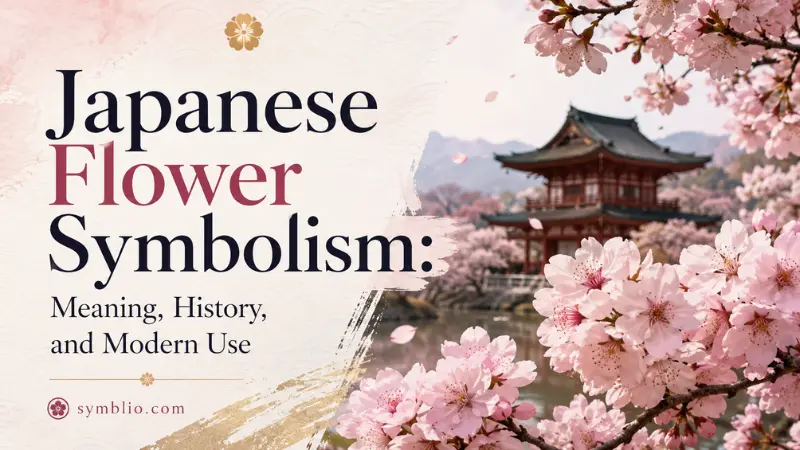
Flowers in Japan can communicate far more than beauty. A blossom may suggest a season, a character trait, a religious idea, a memory, or an attitude toward life. The Japanese tradition known as hanakotoba, literally “flower words,” gives many flowers and colors particular associations, although these meanings are not a rigid universal code.
For Americans, Japanese flowers are especially recognizable through cherry-blossom festivals, gardens, tattoos, anime and manga, fashion, wedding design, and Japanese-inspired home décor. But familiar images can lose their cultural context when they are removed from Japan. Understanding the symbolism means looking not only at flower dictionaries, but also at seasonality, poetry, religion, art, and everyday customs.
Quick Answer
Japanese flower symbolism commonly represents qualities such as impermanence, beauty, love, purity, remembrance, and seasonal change in modern American culture. Historically, Japanese flowers have also carried poetic, religious, imperial, and social meanings, with specific associations varying by flower, color, occasion, and context.
TL;DR
- Sakura often represents beauty, renewal, and life’s temporary nature.
- Chrysanthemums connect with autumn, longevity, Buddhism, and Japan’s imperial family.
- Hanakotoba developed from older floral traditions and later Western influences.
- Americans often associate Japanese flowers with Japan, spring, serenity, and aesthetics.
- Flower meanings can change according to color, setting, and cultural context.
- Modern tattoos and décor often simplify more complicated historical symbolism.
What Is Hanakotoba?
Hanakotoba (花言葉) means “flower words” and refers to Japanese flower language. It assigns associations to particular flowers and, in some cases, to colors or varieties.
It is tempting to imagine hanakotoba as a Japanese equivalent of a secret dictionary in which every flower has one permanent definition. Reality is more flexible. Japan has a much older tradition of giving plants seasonal and poetic associations, while the organized concept of flower language is generally associated with the modern period and was influenced in part by European floriography.
That distinction matters. A cherry blossom can symbolize impermanence in one context and spring, youth, celebration, or national identity in another. The flower itself is only part of the message.
Why Flowers Carry So Much Meaning in Japanese Culture
One reason flowers became such effective symbols is Japan’s strong awareness of the seasons.
A flower does not simply appear as decoration. Its arrival can announce spring, summer rain, autumn, or winter. This makes plants useful markers of time and mood. Japanese poetry and visual art have long drawn on seasonal imagery, allowing a particular blossom to evoke an entire emotional atmosphere.
Flowers also entered religious practices. Buddhist traditions incorporated floral offerings, while flowers and plants have also held significance within Shinto contexts. The development of ikebana, or Japanese flower arranging, further made the deliberate placement of natural materials an artistic practice with cultural and spiritual dimensions.
As a result, Japanese floral symbolism is broader than the modern idea of assigning one word—such as “love” or “purity”—to a flower.
Sakura and the Meaning of Impermanence
The sakura, or cherry blossom, is probably the best-known Japanese flower symbol in the United States.
Its most important traditional association is the fleeting nature of life. Cherry blossoms appear spectacularly and then fall relatively quickly, making them a natural image for impermanence. This connects with the Japanese aesthetic idea of mono no aware, an awareness of the poignancy of things that do not last.
Yet sakura symbolism is not simply melancholy. Cherry-blossom viewing, or hanami, is a social celebration. The flowers bring people outdoors for picnics, gatherings, photographs, and seasonal festivities. The Library of Congress notes that hanami was originally associated with plum blossoms before cherry blossoms became its dominant focus by the Heian period.
In the United States, cherry blossoms therefore tend to carry several meanings simultaneously: spring, renewal, friendship, beauty, Japan itself, and the reminder that beautiful moments are temporary.
The Chrysanthemum and Imperial Symbolism
The chrysanthemum, or kiku, has a very different cultural profile.
Chrysanthemums are associated with autumn in Japan and have connections to longevity and health. They also have important Buddhist associations and are commonly used as floral offerings. Most significantly, the chrysanthemum is associated with the Japanese imperial family.
The 16-petal chrysanthemum emblem appears on Japanese passports and represents the imperial institution. The flower was introduced to Japan from China and became increasingly prominent at court during the Heian period.
This makes the chrysanthemum an important reminder that “Japanese flower symbolism” cannot be reduced to gentle or romantic meanings. Some flowers have associations with institutions, religion, status, or public identity.
There is also a practical cultural distinction worth knowing in the United States: chrysanthemums are often cheerful garden flowers, while white chrysanthemums in Japan can have strong associations with funerals and offerings. The meaning depends heavily on context.
Plum Blossoms, Wisteria, and Other Important Flowers
Cherry blossoms receive most of the attention internationally, but Japanese floral culture includes many other significant plants.
Plum blossoms (ume) have long been admired for blooming earlier than cherry trees, sometimes while winter conditions remain. In classical Japanese culture, they became associated with resilience, refinement, and the arrival of spring.
Wisteria (fuji) is strongly associated with beauty and elegance and has an especially long history in Japanese art and literature. Its hanging clusters also made it a recognizable decorative motif.
Peonies (botan) are often associated with beauty, prosperity, and bravery in Japanese flower-language traditions.
Camellias (tsubaki) have distinctive associations that can change by color. Red, white, and yellow camellias can carry different meanings in hanakotoba traditions.
Lotuses have important Buddhist associations throughout East Asia. Because the flower rises from muddy water while remaining visually clean, it commonly represents purity and spiritual development.
These examples demonstrate why there is no single definition of “Japanese flower symbolism.” Different flowers participate in different cultural histories.
A Quick Guide to Common Japanese Flower Meanings
| Flower | Common Japanese Associations | U.S. Associations | Important Context |
|---|---|---|---|
| Sakura | Impermanence, spring, beauty | Japan, renewal, friendship | Especially prominent during spring |
| Chrysanthemum | Autumn, longevity, imperial identity | Fall, remembrance, Japanese culture | White varieties can have funeral associations |
| Plum blossom | Early spring, endurance, refinement | Renewal, resilience | Older poetic importance predates sakura’s dominance |
| Wisteria | Beauty, elegance | Grace, Japanese aesthetics | Common in gardens and visual art |
| Camellia | Varies by color; love and waiting among common associations | Beauty, devotion | Color can significantly change interpretation |
| Lotus | Purity, spiritual growth | Peace, meditation, spirituality | Strong Buddhist context |
The meanings above should be treated as cultural associations rather than universal rules. Hanakotoba itself varies by source, flower variety, color, and context.
Ancient Roots and the Later Development of Flower Language
The roots of Japanese floral symbolism are considerably older than the term hanakotoba.
Plants appeared in poetry, court culture, religious offerings, gardens, paintings, textiles, and seasonal celebrations long before modern flower-language dictionaries existed. The plum blossom, for example, was prominent in earlier literary traditions, while cherry blossoms became increasingly important during the Heian period.
The organized language of flowers developed much later. During the Meiji period (1868–1912), Japan encountered substantial Western cultural influence, including European ideas about floriography. Japanese traditions and imported flower-language concepts interacted rather than simply replacing one another.
That history explains why some popular online lists of Japanese flower meanings can appear surprisingly similar to Western flower-language traditions.
Flowers, Buddhism, and Religious Symbolism
Flowers have an important place in Japanese religious life, particularly in Buddhist practice.
Floral offerings can represent respect and devotion, while flowers can also serve as reminders of impermanence. A beautiful bloom does not last forever, making its beauty inseparable from its eventual decline.
The lotus is especially prominent in Buddhist symbolism because its growth from muddy water into a clean, elevated blossom provides a visual metaphor for spiritual development. Chrysanthemums, meanwhile, can appear in Buddhist offerings and memorial contexts.
This religious dimension is important when interpreting Japanese floral imagery. A flower in a temple setting may communicate something quite different from the same flower printed on clothing.
Why Seasons Matter More Than a Simple Flower Dictionary
Seasonality is one of the easiest parts of Japanese floral symbolism for Americans to overlook.
A cherry blossom does not merely mean “beauty.” Its appearance announces a particular moment in the year. Plum blossoms suggest an earlier stage of spring. Chrysanthemums evoke autumn. Morning glories and other summer flowers carry their own seasonal associations.
This makes floral imagery almost calendar-like. In traditional Japanese art, seeing a certain flower can help establish the time of year without anyone stating it explicitly.
Seasonal symbolism also explains why flowers appear so frequently on kimono, ceramics, paintings, screens, stationery, and other decorative objects. A floral design can identify a season while simultaneously creating an emotional atmosphere.
How Americans Understand Japanese Flowers
In the United States, Japanese flowers are often interpreted through a mixture of Japanese cultural knowledge and American visual culture.
Cherry blossoms are the clearest example. The annual National Cherry Blossom Festival in Washington, D.C., has helped establish sakura as a symbol of friendship between Japan and the United States. The flowers are now widely recognized by Americans who may have no familiarity with hanakotoba itself.
Japanese flowers also appear in American gardens, restaurants, fashion, stationery, tattoo designs, wedding décor, and home interiors. In these settings, they often communicate calmness, natural beauty, simplicity, or an appreciation for Japanese aesthetics.
The result is a kind of cultural translation: an American viewer may recognize a cherry blossom as “Japanese” without automatically knowing its connection to impermanence or seasonal celebration.
Why Japanese Flowers Appear in Tattoos
Japanese floral imagery is particularly common in tattoo culture because flowers can combine recognizable shapes with personal meaning.
A cherry blossom tattoo might represent a new chapter, appreciation for life, family heritage, a connection to Japan, or the idea of enjoying a moment before it passes. A lotus may be chosen for its association with spiritual growth. Chrysanthemums can suggest longevity, autumn, remembrance, or Japanese visual tradition.
But a tattoo does not have to follow a traditional Japanese definition. Personal symbolism is legitimate. Someone may choose a flower simply because its appearance reminds them of a person, place, season, or experience.
For that reason, it is better to describe Japanese floral symbolism as a vocabulary of associations than as a fixed code.
Flowers in Weddings, Gifts, and Home Décor
Japanese floral symbolism can also influence how people think about gifts and decorative arrangements.
Cherry blossoms work naturally with spring celebrations and can suggest new beginnings. Peonies can suit settings emphasizing prosperity or beauty. Floral motifs can also create a Japanese aesthetic without carrying a specific symbolic message.
In weddings and American celebrations, however, the cultural meaning may be adapted substantially. A couple might choose sakura because they love Japan or because the blossoms represent spring, rather than because they specifically intend to express impermanence.
The same principle applies to home décor. A Japanese flower print can function primarily as an aesthetic object, even when the flower has a complicated cultural history.
Color Can Change a Flower’s Meaning
Color is another reason Japanese floral symbolism cannot be reduced to a simple list.
The same species may have different associations depending on whether its flowers are red, white, yellow, pink, or another shade. Camellias provide a commonly cited example, with different colors receiving distinct associations in hanakotoba traditions.
Context can matter just as much. A white chrysanthemum in a Japanese memorial setting does not communicate the same message as chrysanthemums planted in an American backyard.
When interpreting a floral symbol, consider three things together: the flower, its color, and where it appears.
Common Misunderstandings About Japanese Flower Symbolism
One of the biggest misunderstandings is the idea that every Japanese person automatically knows and follows a fixed flower dictionary.
They do not. Hanakotoba is useful cultural knowledge, but meanings vary by source and situation. A person may recognize a flower’s traditional association without intending to communicate that association when giving or displaying it.
Another misconception is that every Japanese flower symbol has an ancient origin. Some popular flower-language meanings are comparatively modern, particularly as the organized concept of hanakotoba developed alongside Western influence during the modern period.
Finally, cherry blossoms should not be interpreted exclusively as symbols of sadness or death. Their association with impermanence is genuine, but hanami is also a joyful communal tradition, and sakura has represented friendship, spring, celebration, and national identity in different contexts.
The Darker Historical Uses of Cherry-Blossom Imagery
Cherry blossoms have also been used in political and military symbolism, particularly during Japan’s wartime history.
The short life of the blossom was appropriated as an image of the idealized warrior who was expected to sacrifice himself for the nation. During World War II, cherry-blossom imagery became associated with militaristic propaganda and the culture surrounding kamikaze pilots. The Library of Congress specifically documents this transformation in its discussion of sakura symbolism.
This history does not mean that a modern cherry-blossom design automatically carries militaristic meaning. It does mean that the flower’s symbolism has never been completely one-dimensional.
Modern interpretations should distinguish between the older aesthetic association with impermanence, wartime political appropriation, and contemporary uses centered on spring, friendship, and cultural exchange.
How Japanese Flower Symbolism Has Changed
The meaning of Japanese flowers has evolved because the culture surrounding them has evolved.
Court poetry gave flowers literary associations. Buddhist practices added religious dimensions. Garden design and ikebana developed sophisticated ways of presenting natural forms. Modern flower language introduced more explicit symbolic labels. Globalization then carried Japanese floral imagery into American and international fashion, entertainment, art, and design.
Today, a single cherry blossom can therefore operate on several levels at once. It may be a botanical object, a sign of spring, an emblem of Japan, a reference to impermanence, a reminder of friendship between countries, or simply an attractive design.
That flexibility is part of what makes floral symbolism useful: meaning depends on who is looking, where the flower appears, and what the surrounding culture brings to it.
FAQs
The cherry blossom is arguably the most recognizable Japanese floral symbol internationally. It commonly evokes impermanence, spring, beauty, and the fleeting nature of life, while also carrying associations with celebration and friendship.
A cherry blossom tattoo can represent impermanence, a new beginning, appreciation of life, or a personal connection to Japan. Its meaning is ultimately determined by the wearer rather than by hanakotoba alone.
Japan does not have a legally designated national flower. Cherry blossoms are widely treated as a national symbol, while the chrysanthemum has an especially important official association with the imperial family.
Chrysanthemums can represent autumn, longevity, health, and Buddhist or memorial associations. The flower also has a major imperial meaning because the chrysanthemum crest represents Japan’s imperial family.
Japanese people have attached seasonal and poetic meanings to plants for centuries, but hanakotoba as a named and organized language of flowers is much more modern. Its development was influenced partly by Western flower-language traditions during the modern period.
Yes. Color can alter a flower’s traditional association, and the surrounding occasion can change its meaning further. This is particularly important with flowers such as camellias and chrysanthemums.
Not necessarily. Americans often use Japanese flowers for ideas such as spring, serenity, beauty, renewal, and cultural appreciation, while some traditional Japanese associations are more specific and context-dependent.
Conclusion
Japanese floral symbolism combines season, beauty, impermanence, religion, identity, and social memory rather than assigning one permanent meaning to every flower. Sakura may express the beauty of a moment that will not last; chrysanthemums can connect autumn and longevity with imperial and Buddhist traditions; other flowers carry their own distinct histories.
For Americans, Japanese flower imagery has become part of a broader visual vocabulary seen in festivals, gardens, tattoos, weddings, fashion, and art. The most accurate way to understand Japanese flower symbolism is to look beyond a one-word definition and consider the flower’s color, season, setting, and cultural history. A blossom can be beautiful on its own, but its context is often what tells us what that beauty is meant to say.