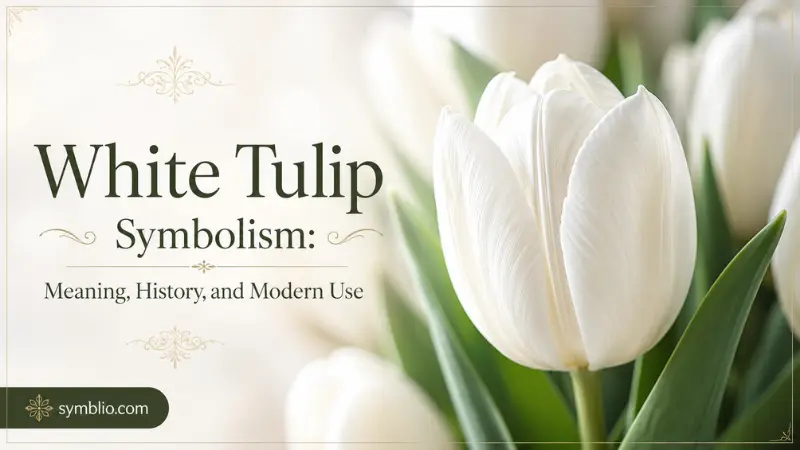
White tulips are often associated with peace, purity, sincerity, forgiveness, and new beginnings. Their clean petals and simple shape make them especially meaningful in weddings, memorials, religious ceremonies, spring decorations, and thoughtful gifts. In modern American culture, they can communicate affection without the intensity of red flowers or the cheerfulness of brighter colors.
The symbolism of the white tulip is not based on one universal tradition. Flower meanings have changed across cultures and periods, and modern interpretations often combine the symbolism of the tulip itself with the cultural associations of the color white.
That combination explains why white tulips can appear in situations that seem very different: a wedding bouquet may emphasize purity and a fresh beginning, while a sympathy arrangement may emphasize peace, respect, and remembrance.
Quick Answer
White tulip symbolism commonly represents purity, peace, sincerity, forgiveness, and new beginnings in modern American culture, especially in weddings, sympathy arrangements, religious ceremonies, and meaningful gifts. Historically, tulips carried important cultural and religious associations in Persian and Ottoman traditions before becoming widely established in European and American horticulture.
TL;DR
- White tulips commonly symbolize peace, purity, sincerity, and fresh beginnings.
- Their modern meaning combines tulip traditions with white’s cultural associations.
- Ottoman culture gave the tulip important artistic and religious significance.
- Americans often use white tulips for weddings and remembrance.
- Victorian flower language connected white tulips with apology and reconciliation.
- Today, context usually matters more than a fixed symbolic dictionary.
What Does a White Tulip Look Like?
A white tulip is a cultivated tulip whose cup-shaped flower opens in shades ranging from bright white to creamy ivory. Like other tulips, it grows from a bulb and typically produces a single upright flower on a smooth green stem.
The physical simplicity of the flower contributes to its symbolic appeal. There are no complicated petals or dramatic thorns. Instead, the flower has a clean outline, restrained color, and orderly shape.
That appearance makes white tulips particularly useful when people want floral decoration that feels elegant without appearing extravagant. In American homes, they can work equally well in a spring centerpiece, wedding arrangement, entryway vase, or memorial display.
The color itself also matters. White has long been associated in many Western settings with cleanliness, innocence, peace, and ceremonial formality. When those associations meet the seasonal character of a tulip, the result is a flower that often communicates a quiet sense of renewal.
The Core Meaning of White Tulips
The most common modern meanings can be grouped into several related ideas.
Purity is one of the clearest associations. The white petals create an uncomplicated visual impression, making the flower suitable for ceremonies connected with commitment, faith, or personal milestones.
Peace is another common meaning. White tulips do not have the visual intensity of red or orange flowers, so they can express calm rather than excitement.
Sincerity comes from the flower’s restrained appearance. A white tulip bouquet can feel thoughtful without being overly dramatic.
Forgiveness is a particularly interesting traditional association. Some flower-language traditions connected white tulips with apology, worthiness, or reconciliation. These meanings helped give the flower a role in situations where someone wanted to repair a relationship or begin again.
Finally, white tulips can represent new beginnings. Their strong connection with spring makes this interpretation especially natural: the flower emerges from a dormant bulb and appears as winter gives way to a new growing season.
Ancient Roots and Early Tulip Symbolism
The tulip’s story begins much farther east than the Netherlands, the country most commonly associated with the flower today.
Tulips originated in Central Asia and were cultivated in Persia centuries before they became fashionable in Western Europe. By the sixteenth century, tulips had become established in the Ottoman Empire, where they were cultivated extensively and incorporated into art, gardens, textiles, ceramics, and architecture.
The tulip’s importance in Ottoman culture went beyond gardening. It became a major decorative and symbolic motif, and its presence in religious and artistic settings gave the flower cultural significance that later European interpretations did not fully reproduce.
It is important, however, not to project modern white-tulip meanings backward onto every historical tulip tradition. The symbolism of a tulip in general and the later symbolism of a white tulip specifically are not always the same thing.
This distinction helps explain why modern flower meanings should be treated as evolving cultural conventions rather than permanent rules.
The Ottoman Connection
Tulips held a distinctive place in Ottoman visual culture.
The flower appeared repeatedly in decorative arts and was especially important during the period commonly called the Tulip Era, when elite Ottoman society developed an intense enthusiasm for tulips, gardens, and floral design.
Ottoman artists incorporated tulips into ceramics, textiles, manuscripts, carpets, and architectural decoration. The flower also acquired religious associations in certain Ottoman and Sufi interpretations.
This history matters because it challenges the common assumption that tulips are essentially a Dutch symbol. The Netherlands became enormously important to tulip cultivation, but the flower had already developed centuries of cultural meaning in the Middle East and Ottoman world.
White tulips should therefore be understood as part of a much larger history of tulip symbolism rather than as a symbol created exclusively in modern Western flower shops.
How Tulips Became a European and American Symbol
Tulips entered Western European horticulture during the sixteenth century after connections between the Ottoman Empire and European diplomats, gardeners, and collectors helped move bulbs westward.
By the seventeenth century, tulips had become highly desirable in the Netherlands, eventually contributing to the famous period of Tulip Mania. The flower became associated with horticultural expertise, luxury, collecting, and commercial speculation.
Over time, tulips became less associated with elite collecting and more associated with gardens and springtime.
That shift helped establish the modern emotional character of the flower. Instead of symbolizing only luxury or status, tulips became accessible signs of seasonal renewal, affection, beauty, and celebration.
In the United States, this broader interpretation became particularly useful because tulips fit naturally into spring gardening, floral gifting, Easter-related decoration, Mother’s Day arrangements, weddings, and public gardens.
White Tulip Symbolism in the United States
In contemporary American culture, white tulips are usually interpreted through a combination of color, occasion, and personal context.
At a wedding, they can suggest purity, sincerity, commitment, and the beginning of a new chapter.
At a memorial service, the same flowers may communicate peace, respect, remembrance, and quiet sympathy.
As a gift, white tulips can express thoughtful affection without automatically suggesting romance.
This flexibility is one reason the flower remains useful. A red tulip tends to create a stronger romantic message, while a yellow tulip is more likely to communicate cheerfulness or friendship. White sits in a quieter middle ground. Contemporary American floral guides commonly associate white tulips with purity, peace, forgiveness, and new beginnings.
The surrounding situation ultimately determines the strongest interpretation.
White Tulips at Weddings
White tulips are a natural choice for weddings because their symbolism fits several themes associated with marriage.
Their white color can represent sincerity and purity, while the tulip’s spring associations can suggest a new stage of life. Their upright stems and simple shape also suit modern wedding design, particularly minimalist arrangements.
A bouquet of white tulips can therefore communicate:
- a clean beginning
- honest affection
- commitment
- peace between two people
- simplicity and elegance
Unlike flowers with highly specific religious associations, tulips can remain relatively neutral. That makes them adaptable to secular ceremonies as well as religious or culturally traditional weddings.
They also combine easily with greenery and other flowers, allowing couples to create an arrangement where the white tulip provides structure without dominating the entire design.
Religious and Spiritual Associations
White flowers have broad religious associations, particularly in traditions where white represents purity, holiness, peace, or spiritual renewal.
White tulips can therefore appear in religious ceremonies and celebrations where their color fits the occasion. Contemporary floral traditions specifically identify white tulips as suitable for religious milestones and ceremonies.
However, white tulips do not have one universally recognized religious meaning.
Their significance depends on the tradition, ceremony, and community involved. It is therefore more accurate to describe them as compatible with religious symbolism of purity and peace than to claim that every religion assigns the same meaning to them.
This distinction keeps the symbolism culturally respectful.
Forgiveness, Apology, and Reconciliation
One of the most distinctive meanings associated with white tulips is forgiveness.
Flower symbolism became especially elaborate during the nineteenth-century Victorian period, when flowers were commonly assigned specific meanings and used to communicate feelings indirectly. Guides to the “language of flowers” drew meanings from literature, religion, folklore, visual resemblance, and botanical characteristics.
Within later flower-language traditions, white tulips became associated with apology, forgiveness, purity, and the possibility of beginning again.
The symbolism works because white suggests a clean slate. A white tulip can therefore function metaphorically as an invitation to move past conflict rather than as a declaration of intense emotion.
Today, most Americans are unlikely to interpret a bouquet according to a strict Victorian dictionary. Still, the older association survives in modern floral symbolism and gift guides.
Emotional and Psychological Meaning
White tulips often create an emotional impression of calmness and restraint.
Color psychology should not be treated as a universal science of fixed emotional responses. People respond to colors according to personal experience, cultural background, setting, and expectation.
Even so, the visual qualities of white tulips can influence how a floral arrangement feels.
A room filled with red flowers can appear passionate or dramatic. Bright yellow flowers can appear cheerful and energetic. White tulips tend to create a quieter atmosphere.
That makes them useful when the sender wants to show care without overwhelming the recipient.
Emotionally, the flower can suggest:
| Context | Meaning in the USA | Common Associations | Notes |
|---|---|---|---|
| Wedding | New beginning | Purity, sincerity, commitment | Often used in minimalist bouquets |
| Sympathy | Peace and respect | Remembrance, comfort | Suitable for services or home delivery |
| Apology | Reconciliation | Forgiveness, fresh start | More traditional than universally recognized |
| Religious ceremony | Purity and holiness | Faith, renewal, dignity | Meaning depends on the tradition |
| Everyday gift | Thoughtful care | Sincerity, appreciation | Usually less romantic than red tulips |
White Tulips Compared With Other Tulip Colors
Color can change the emotional message of the same flower.
Red tulips are commonly connected with romantic love and devotion. Pink tulips tend toward affection, gentleness, and appreciation. Yellow tulips are frequently associated with warmth, friendship, and cheerfulness. Purple tulips can suggest admiration, dignity, and elegance. White tulips occupy a more restrained symbolic space, emphasizing peace, purity, sincerity, and renewal.
This does not mean a person will always interpret each color identically. A bouquet’s meaning also depends on who gives it, why it is given, and what the recipient associates with that color.
For that reason, symbolism is better understood as a set of cultural signals than as a secret code.
Why White Tulips Appear in Modern Decor
Modern interior design has made white tulips particularly visible.
Their simple shape works well with contemporary decorating styles because they provide a natural element without introducing a complicated color scheme. A handful of white tulips in a glass vase can create a restrained spring arrangement, while larger displays can become part of weddings, receptions, restaurants, offices, and public events.
Their visual simplicity also makes them popular in photography and social media.
In these settings, white tulips may not carry a specific traditional message at all. They can simply represent freshness, order, spring, and understated beauty.
That is an important development in modern symbolism: sometimes the flower’s aesthetic qualities become more important than its historical dictionary meaning.
White Tulips in Personal Style and Gifting
White tulips can also communicate personal values.
Someone who chooses them may be signaling a preference for simplicity rather than extravagance. A white tulip tattoo, illustration, necklace, or decorative motif may symbolize a personal association with renewal, peace, forgiveness, or a meaningful life transition.
The interpretation becomes especially personal in tattoos.
Unlike a temporary bouquet, a tattoo can represent an experience that the wearer wants to remember permanently. A white tulip might therefore stand for starting over after a difficult period, honoring someone important, celebrating a major transition, or simply identifying with the flower’s appearance.
There is no single established tattoo meaning. The wearer’s story matters more than any generic flower-symbolism list.
Common Misunderstandings About White Tulips
One common mistake is assuming that white tulips have one fixed meaning everywhere.
They do not.
Flower symbolism changes across historical periods and cultures. Even Victorian flower meanings were not perfectly standardized; different books and traditions sometimes assigned different interpretations to the same flower.
Another misunderstanding is that white tulips automatically symbolize death. They do appear in sympathy and memorial arrangements, but that does not make them inherently funerary flowers.
The opposite mistake is also possible: assuming that they always symbolize weddings or purity. Their use at weddings is common, but the same flowers can communicate sympathy, reconciliation, respect, or simply appreciation.
Context is the key.
How White Tulip Meaning Has Changed
The history of the tulip demonstrates how symbols evolve.
In the Ottoman world, tulips carried artistic, cultural, and religious associations. In seventeenth-century Europe, they became associated with luxury, collecting, horticulture, and wealth. Later, tulips became increasingly connected with gardens, springtime, beauty, and ordinary floral enjoyment.
The Victorian language of flowers added another layer by assigning tulips specific emotional messages.
Modern Americans generally use a much looser system. People may know that white flowers suggest peace or purity without knowing a formal historical definition for the white tulip.
That evolution is normal. Symbols survive not because their meanings remain unchanged, but because people continue finding new uses for familiar images.
When White Tulips May Not Be the Best Choice
Although white tulips are versatile, they are not automatically appropriate for every situation.
If the goal is an unmistakably romantic declaration, red tulips may communicate that intention more clearly.
If someone needs a bright, celebratory gift for a friend, yellow or pink tulips may feel more natural.
For a memorial, white tulips can be appropriate, but the family’s cultural or religious preferences should take priority over generalized flower symbolism.
The safest approach is to think about the relationship and occasion first, then use color to support the message.
FAQs
White tulips commonly symbolize purity, peace, sincerity, forgiveness, and new beginnings. In the United States, their meaning changes according to context, with weddings and sympathy being two especially common uses.
They can symbolize love, but usually in a quieter form than red tulips. White tulips are more often associated with sincere affection, peace, respect, or a relationship entering a new stage.
At weddings, white tulips can represent purity, sincerity, commitment, and a new beginning. Their simple appearance also makes them popular in contemporary and minimalist wedding arrangements.
Yes, forgiveness and reconciliation are traditional associations found in modern flower-language interpretations of white tulips. The idea connects the white flower with apology, peace, and the possibility of starting fresh.
They can be appropriate for funerals and memorials because they can communicate peace, respect, and remembrance. However, local customs and the preferences of the family should matter more than a generalized flower meaning.
Red tulips are more strongly associated with romantic love and devotion, while white tulips tend to suggest peace, purity, sincerity, and renewal. The two colors can also be combined when a bouquet needs to express both love and respect.
No. Tulip symbolism has changed significantly across cultures and historical periods. The flower has important roots in Central Asian, Persian, Ottoman, European, and modern Western traditions, while the specific meaning of white tulips varies by context.
Conclusion
White tulips have become a flexible symbol because several ideas meet in one flower: the purity associated with white, the seasonal renewal associated with tulips, and centuries of cultural history surrounding the plant itself.
In the United States, white tulip symbolism most often points toward peace, sincerity, purity, forgiveness, remembrance, and new beginnings. The same flower can therefore belong to a wedding, a memorial, an apology, or an ordinary spring bouquet without becoming contradictory.
Its meaning ultimately comes from context. A white tulip does not carry one permanent message; instead, it gives people a simple visual language for expressing feelings that may be difficult to put into words.