
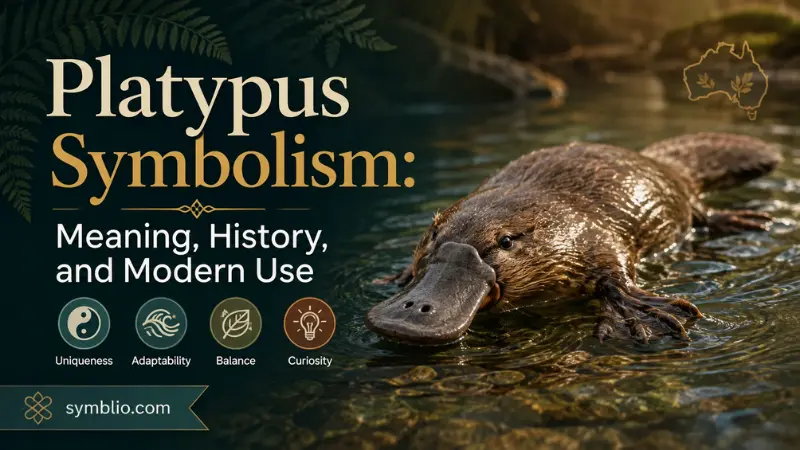
The platypus is one of nature’s most unusual mammals, combining features that seem to belong to several different animals. Because of that unusual appearance and its place in Australian cultural traditions, platypus symbolism often centers on individuality, adaptability, balance, and the freedom to exist outside familiar categories.
For American readers, the platypus can feel almost whimsical: a furry mammal with a duck-like bill, webbed feet, a broad tail, and an unusual way of reproducing. Yet its symbolism goes beyond being a funny-looking animal. Its cultural history includes Indigenous Australian Creation stories, European scientific confusion, and its later role as an emblem of Australia’s distinctive natural heritage.
Today, people may encounter the platypus in wildlife education, conservation campaigns, children’s media, illustrations, tattoos, collectibles, and internet culture. Its appeal comes partly from the simple idea that something does not have to resemble anything else to have a place in the world.
Quick Answer
Platypus symbolism commonly represents individuality, adaptability, and comfort with being different in modern American culture. In Australian Indigenous traditions, the animal also carries culturally specific meanings connected with Creation, kinship, Country, and relationships between different forms of life.
TL;DR
- The platypus commonly symbolizes individuality and unconventional identity.
- Its unusual body represents adaptation rather than confusion.
- Indigenous Australian traditions give the animal important cultural meanings.
- European scientists once struggled to classify the strange mammal.
- In America, it often appears as a symbol of quirky individuality.
- Conservation has added meanings of habitat, biodiversity, and environmental responsibility.
What the Platypus Represents Symbolically
The most recognizable meaning of the platypus is individuality.
The animal does not fit neatly into people’s familiar categories. It has fur and produces milk, characteristics associated with mammals, yet it lays eggs. Its bill resembles a duck’s, its tail recalls a beaver’s, and its feet help it move through water while also supporting burrowing.
That combination makes the platypus an especially natural symbol for people who resist simple labels.
Its symbolism can therefore include:
- individuality
- adaptability
- unconventional identity
- balance between different worlds
- curiosity
- acceptance of difference
- resourcefulness
- connection with water and nature
- coexistence
- biodiversity
The important point is that these meanings are largely modern symbolic interpretations, not a single universal religious code. A platypus image can mean something different in Indigenous Australian culture, wildlife conservation, children’s media, or an American tattoo.
Why the Platypus Symbolizes Individuality
Few animals illustrate individuality as clearly as the platypus.
It does not simply look unusual because of one feature. Its entire body combines characteristics that people normally associate with separate animals. That makes it an easy metaphor for someone whose personality, interests, or identity does not fit an expected mold.
In American culture, this can translate into a positive message:
Being different does not mean being incomplete.
The platypus does not need to become more like a duck, beaver, otter, or another familiar animal. Its unusual combination of traits is precisely what makes it recognizable.
That is why the platypus can work particularly well as a symbol for creative people, independent thinkers, unconventional personalities, or anyone who prefers defining themselves rather than accepting a ready-made category.
Adaptability and the Ability to Belong in More Than One Environment
The platypus also symbolizes adaptability.
It spends much of its life associated with freshwater environments, where its body is highly specialized for swimming, diving, feeding, and moving through river systems. Its webbed feet, dense fur, sensitive bill, and other adaptations are not random combinations; they work together as a functional design.
Symbolically, that creates an important distinction.
The platypus is not a symbol of being confused about where it belongs. It can instead represent finding a workable way to belong on your own terms.
For someone going through a major transition, a platypus image might suggest flexibility rather than surrender. It can represent the ability to adjust to new circumstances while retaining one’s defining characteristics.
The Indigenous Australian Meanings of the Platypus
The platypus has important cultural significance for Aboriginal and Torres Strait Islander peoples, and those meanings should not be reduced to a single generalized “Aboriginal symbolism.”
Different First Nations have their own languages, Country, traditions, and relationships with animals. Platypuses have numerous Indigenous names, and cultural stories can vary between communities.
One well-documented group of stories from the upper Darling River concerns the platypus’s origins and unusual combination of animal characteristics. Another Creation story describes different animal groups inviting the platypus to join them. The platypus ultimately declines to belong exclusively to one group because it shares characteristics with several groups and prefers to remain connected with all of them.
That story has sometimes been interpreted through the modern idea of individuality. But its cultural context is broader: it concerns relationships, difference, kinship, and the place of living beings within the world.
Some First Nations communities also regard the platypus as a totemic species. For those communities, the animal’s meaning is connected to cultural identity and Country rather than simply functioning as a decorative symbol.
The Platypus as a Symbol of Balance Between Categories
Another useful interpretation is balance.
The platypus appears to cross boundaries that people traditionally use to organize the natural world:
- land and water
- bird-like and mammal-like characteristics
- familiar and unfamiliar
- ancient evolutionary traits and modern adaptation
- individuality and connection
This does not mean the platypus literally represents a spiritual “balance” in every culture. Rather, its biology naturally encourages people to think about categories and boundaries.
Its symbolism becomes especially relevant when discussing people or ideas that combine qualities normally treated as opposites.
A person might be both analytical and creative. Someone might value tradition while embracing change. A community might preserve its identity while interacting with many cultures.
The platypus provides a visual shorthand for that kind of combination.
How European Science Turned the Platypus Into a Symbol of Mystery
When European naturalists encountered the platypus, its unfamiliar anatomy created genuine scientific uncertainty.
The species was scientifically described in 1799, and European naturalists debated how it should be classified. Its combination of mammalian, bird-like, and other characteristics challenged established ideas about how animals should fit into categories. Some early observers even suspected that specimens might have been artificially assembled.
That history helped create another layer of symbolism: the limits of human assumptions.
The lesson is not that science was foolish for being surprised. The platypus genuinely presented an unusual biological combination. Instead, its history demonstrates how people sometimes interpret unfamiliar things through categories they already understand.
Once the animal was studied more carefully, its unusual characteristics became evidence of adaptation and evolutionary history rather than evidence of impossibility.
This gives the platypus a modern intellectual symbolism associated with curiosity, discovery, and questioning assumptions.
Platypus Symbolism in the United States
The platypus is not a traditional American national symbol, religious emblem, or major holiday symbol.
Its American meaning is largely shaped by popular culture, education, wildlife media, humor, and the broader cultural appreciation of unusual animals.
For many Americans, the first association is simply:
“That strange animal that looks like several animals at once.”
That familiarity has made the platypus useful in children’s education and popular entertainment. It can introduce ideas about mammals, evolution, ecosystems, and biodiversity without requiring a complicated symbolic framework.
The animal can also represent the broader American appreciation for quirky individuality. In a culture where phrases such as “be yourself” and “march to your own beat” are common, the platypus provides a memorable visual example.
Its American symbolism is therefore usually playful rather than ceremonial.
What the Platypus Means in Different Contexts
| Context | Meaning in the USA | Common Associations | Notes |
|---|---|---|---|
| Personal identity | Individuality | Being different, authenticity | Often positive and playful |
| Education | Curiosity | Science, evolution, discovery | Common in children’s learning |
| Nature art | Adaptability | Water, wildlife, biodiversity | Emphasizes ecological uniqueness |
| Tattoos | Unconventional identity | Humor, independence, originality | Usually highly personal |
| Conservation | Environmental responsibility | Rivers, habitat, species protection | Connects symbolism with real ecological concerns |
| Australian culture | Distinctiveness | National identity, native wildlife | Stronger cultural context in Australia |
Emotional and Psychological Meaning of the Platypus
Symbolically, the platypus often carries a light emotional tone.
It can suggest permission to be unusual without treating unusualness as a defect.
That message can matter psychologically because people frequently compare themselves with familiar social categories. When someone does not fit those categories, difference can initially feel like a problem.
The platypus offers a different metaphor: unusual traits can coexist.
Its symbolism can therefore communicate:
- self-acceptance
- curiosity
- independence
- playfulness
- flexibility
- confidence in individuality
- openness to complexity
The animal’s quiet appearance also matters. Unlike a lion, eagle, or wolf, the platypus does not project dominance. Its symbolic appeal comes from being distinctive rather than intimidating.
That makes it especially suitable for people who want a symbol of individuality without aggressive imagery.
Why Platypuses Appear in Tattoos and Personal Art
A platypus tattoo can have several meanings depending on the person.
For one person, it may simply celebrate an unusual favorite animal. For another, it can represent feeling different from others while remaining comfortable with that difference.
A stylized platypus might symbolize:
- embracing an unconventional personality
- scientific curiosity
- Australian heritage or travel
- love of freshwater wildlife
- humor and playfulness
- individuality
- appreciation for unusual creatures
The design itself changes the message.
A realistic platypus may emphasize wildlife and conservation. A cartoon version can feel humorous and nostalgic. A minimalist outline may communicate a quieter appreciation of the animal.
Because the platypus has strong visual recognition, even a simple silhouette can communicate the basic idea without elaborate symbolism.
Platypus Symbolism in Art, Decor, and Digital Culture
In home decor, illustrations, stickers, stationery, and digital art, the platypus usually carries a lighter message.
Its unusual appearance makes it naturally suited to humorous designs. Artists can exaggerate its bill, tail, swimming posture, or facial expression without losing its recognizable identity.
Online, the animal can also function as a symbol of the unexpected.
A platypus image may accompany jokes about being unusual, misunderstood, difficult to categorize, or surprisingly capable. In this context, the symbolism is often informal rather than culturally traditional.
This is one reason the platypus works so well in modern visual culture: people can understand the joke immediately, even without knowing its biological or cultural history.
Conservation Gives the Platypus a New Symbolic Meaning
The platypus is also increasingly associated with environmental stewardship.
The species depends on freshwater ecosystems, and conservation concerns include habitat destruction, fragmentation, climate-related pressures, and declining populations in some areas.
That makes the platypus more than an emblem of uniqueness. It can represent the vulnerability of specialized wildlife.
A platypus swimming in a clean river can symbolize a healthy ecosystem. An image of the animal alongside polluted water can communicate environmental loss.
This meaning is especially relevant because the animal’s survival is connected to the condition of the waterways it inhabits.
In conservation campaigns, therefore, the platypus can symbolize a practical principle: protecting an unusual species also means protecting the ecosystem that supports it.
From Curiosity to Australian Cultural Identity
Although the platypus is native to Australia rather than the United States, its image has become strongly connected with Australian identity.
It has appeared in Australian stamps, currency, public imagery, and other forms of national iconography. It was also used as a mascot associated with the 2000 Sydney Olympics.
This association developed partly because the platypus is unmistakably unusual and uniquely Australian.
As a national image, it can communicate the country’s distinctive wildlife rather than military strength or political power. It is an emblem of biological uniqueness.
For Americans encountering the symbol, that national context is useful to remember. A platypus image may be humorous in an American gift shop but carry a much more substantial connection to place and identity in Australia.
Common Misunderstandings About Platypus Symbolism
One common mistake is assuming that the platypus has one universal spiritual meaning.
It does not.
Its cultural significance varies between communities, and Indigenous Australian traditions should not be treated as a single belief system. Stories associated with one language group or region should not automatically be presented as beliefs shared by every Aboriginal community.
Another misunderstanding is that the platypus symbolizes “not belonging.”
Some modern interpretations emphasize that idea because of its unusual characteristics. Yet at least one Indigenous Creation story is more nuanced: the platypus declines to join one animal group while maintaining relationships with several. That is closer to a story about connection across differences than simple isolation.
Finally, calling the platypus a “mistake of nature” misses the biological reality. Its unusual features are adaptations that evolved over a very long period. Its strangeness to humans does not make it biologically confused.
How Platypus Meaning Has Changed Over Time
The symbolism of the platypus has shifted considerably.
For Indigenous Australian communities, cultural relationships with the animal existed long before European scientific classification. These relationships include Creation stories, ecological knowledge, food traditions, and totemic connections.
European naturalists initially approached the platypus as a scientific puzzle. Its unfamiliar anatomy challenged existing classification systems and generated debate about where it belonged in the natural order.
Later, the animal became an emblem of Australian identity and natural uniqueness. Today, conservation has added another layer, connecting the species with freshwater ecosystems and biodiversity.
Modern popular culture has added yet another interpretation: the platypus as a lovable oddball.
The progression is revealing. The animal moved from being understood through local cultural knowledge, to being treated as a scientific curiosity, to becoming a national icon and conservation concern, while also becoming a symbol of individuality in popular culture.
Positive and Negative Platypus Symbolism
Most modern uses of the platypus are positive.
Positive associations include:
- originality
- adaptability
- curiosity
- self-acceptance
- creativity
- humor
- biodiversity
- coexistence
Negative interpretations are usually situational rather than traditional. Someone might use the animal to suggest awkwardness, strangeness, or difficulty fitting in.
Even those meanings often retain a humorous quality.
The important distinction is between being unusual and being inadequate. Modern platypus symbolism generally works better when difference is presented as a characteristic rather than a flaw.
The Platypus as a Symbol for Modern Identity
The platypus fits contemporary conversations about identity because it challenges the expectation that everything must have one obvious category.
Its appearance makes the idea easy to understand: several recognizable traits can exist together without canceling one another out.
That is why the animal can work as a symbol for individuality without becoming overly serious.
It says something relatively simple:
You can be unusual and still be completely yourself.
For modern American audiences, that is probably the most accessible interpretation of the animal. The platypus is not heroic because it dominates its surroundings. It is memorable because it occupies its own category.
FAQs
A platypus commonly symbolizes individuality, adaptability, curiosity, and acceptance of difference. Its unusual combination of traits makes it a natural metaphor for people or ideas that do not fit conventional categories.
The answer varies between First Nations and language groups. The platypus appears in Creation stories and has totemic significance for some communities, with meanings connected to kinship, Country, relationships among living beings, and cultural identity.
A platypus tattoo can represent individuality, humor, scientific curiosity, Australian connections, or appreciation for unusual wildlife. Because the animal has no single universal tattoo meaning, the personal story behind the design matters most.
Yes, particularly in modern popular culture. Its unusual appearance makes it an easy symbol for individuality and being comfortable with characteristics that do not fit familiar categories.
The platypus has culturally significant roles in some Indigenous Australian traditions, including Creation stories and totemic relationships. It would be inaccurate, however, to describe those traditions as one universal Aboriginal religion or assign the same meaning to every community.
Early European naturalists struggled to classify the platypus because it combined characteristics associated with different animal groups. Some early observers even suspected that specimens had been artificially constructed before further investigation established that the animal was genuine.
Usually, modern uses are positive or humorous, emphasizing originality and adaptability. The animal can sometimes represent awkwardness or not fitting in, but those interpretations are generally modern associations rather than a universal traditional meaning.
Conclusion
The platypus is an unusually effective symbol because its real biology already challenges simple categories. In modern American culture, it commonly represents individuality, adaptability, curiosity, and the idea that being different does not make something less complete.
Its cultural history is more substantial than its playful appearance suggests. Indigenous Australian traditions connect the animal with specific Creation stories, totemic relationships, and Country, while European scientific history turned it into a famous example of how unfamiliar nature can challenge established assumptions.
Today, platypus symbolism can carry a simple but useful message: a life that does not fit an obvious category can still have its own coherent place in the world.


