
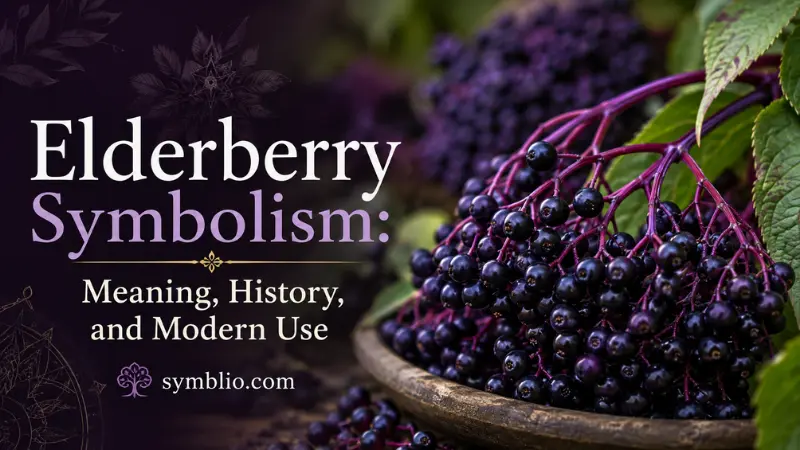
Elderberry is more than a dark berry growing in clusters on the elder shrub. Across different societies, the plant has been associated with protection, healing, household care, seasonal change, and respect for nature. In the United States, elderberry is also connected with Indigenous plant knowledge, home gardens, traditional foodways, and modern interest in herbal traditions.
The symbolism becomes especially interesting because elder has never carried only one meaning. European folklore sometimes treated the plant as a guardian of the home and a source of medicine, while other traditions regarded it with caution because of the spirits believed to inhabit it. In North America, Indigenous communities developed their own longstanding relationships with native elder species, using the plant for food, medicine, crafts, dyes, and musical instruments.
Understanding elderberry symbolism therefore means looking beyond modern herbal marketing or generalized “magical plant” lists. Its meanings developed from practical relationships with a plant that could feed people, provide useful materials, mark the seasons, and become part of local folklore.
Quick Answer
Elderberry symbolism commonly represents protection, healing, nourishment, and respect for nature in modern American culture, especially when associated with gardens, herbal traditions, seasonal food, and traditional plant knowledge. Historically, elder was also connected with household guardianship, spirits, folklore, and the careful relationship between people and the natural world.
TL;DR
- Elderberry commonly symbolizes protection, healing, nourishment, and renewal.
- European folklore connected elder with household guardianship and supernatural beliefs.
- Indigenous peoples developed longstanding food, medicinal, craft, and seasonal uses.
- Its dark berries and pale flowers create contrasting symbolic associations.
- Modern Americans often associate elderberry with natural living and traditional remedies.
- Its symbolism changes depending on cultural and personal context.
What Elderberry Represents Symbolically
The most recognizable meanings of elderberry can be grouped into several related ideas.
Protection comes from traditions in which elder was planted near homes or regarded as a plant capable of keeping harmful influences away. Healing developed partly from the plant’s long history in folk medicine. Nourishment reflects its role as a food source, while renewal fits its recurring seasonal cycle of flowering, fruiting, and regrowth.
There is also a strong theme of respect. In several European traditions, people believed that an elder tree should not simply be cut or harvested without permission. Folklore surrounding the Elder Mother or similar spirits turned ordinary harvesting into a moral relationship: take what you need, but do not treat the living plant carelessly.
That combination makes elderberry a useful symbol for something that provides benefits while demanding responsibility in return.
What the Elderberry Plant Looks Like and Why That Matters
Elderberries grow on shrubs or small trees in clusters. Depending on the species, the flowers are generally light-colored and arranged in broad clusters, followed later in the season by small dark blue, purple, or nearly black fruits.
This visual contrast contributes to some modern symbolic interpretations. The white or pale flowers can suggest freshness, beginnings, or purity, while the dark fruit can suggest maturity, mystery, autumn, or the closing part of a seasonal cycle.
The plant is also unusually versatile. Elder species have provided berries and flowers for food and traditional preparations, while their hollow stems have been useful for crafts and musical instruments. The botanical name Sambucus is associated with the Greek sambuke, a type of wind instrument linked to hollow elder stems.
So even the physical structure of elder supports a broader symbolic idea: one plant can move through several stages and serve many purposes.
Ancient Roots of Elderberry Symbolism
Elder has a long history of human use. Archaeological and historical evidence places elderberry among plants known and used in ancient societies, while Greek and Roman writers discussed its practical applications. Hippocrates and later writers described elder among useful medicinal plants.
That practical value helps explain why elder eventually acquired symbolic associations.
Before modern medicine could explain plant chemistry, people understood plants through observation. A plant that repeatedly appeared useful for food or traditional remedies could become associated with health and protection. Over generations, practical knowledge and folklore often became intertwined.
Elder therefore represents an important pattern in the history of symbolism: a symbol can emerge from repeated everyday experience rather than from a single myth or religious story.
Elderberry in European Folklore
European traditions gave elder some of its most recognizable supernatural associations.
In parts of Northern Europe, folklore described a protective female spirit living within the elder tree. In Denmark, this figure was known as Hylde-Moer, or the Elder Mother. Stories emphasized that people should treat the tree respectfully before taking wood or other parts of it. Similar beliefs appeared in Scandinavian and other European traditions, although details varied by region.
This created a distinctive form of symbolism. Elder was not simply “good” or “bad.” It could protect people, but disrespecting it could supposedly bring consequences.
That dual character is important. Modern summaries sometimes reduce elder folklore to “a magical protection plant,” but historical traditions were more complicated. The plant represented a relationship with nature governed by boundaries and respect.
Protection, Household Safety, and the Elder Tree
One of elder’s strongest traditional associations is protection of the home.
Historical folklore records describe elder being planted around houses or farms and associated with protection from witches, spirits, or other perceived threats. Some traditions also attributed protective qualities to the tree because of observations about where elder grew and how it behaved in the landscape.
This background explains why elderberry can symbolize a safe home.
Today, most Americans are unlikely to regard an elder shrub as a literal supernatural barrier. Instead, the older association can be interpreted more symbolically. An elder plant beside a house may suggest hospitality, gardening, self-sufficiency, or care for the household.
In modern design, that makes elder imagery particularly suitable for themes involving home, protection, family traditions, and connection to the land.
Healing and the Symbolism of Care
Elderberry’s association with healing has a straightforward historical foundation: elder has been used in traditional medicine for centuries.
Folk practices used different parts of elder for various purposes, while modern scientific research has examined elderberry preparations for respiratory illnesses. However, evidence for many health claims remains limited, and traditional use should not automatically be treated as proof of medical effectiveness.
Symbolically, this history gives elderberry another meaning: care.
A plant associated with preparing food, making household remedies, and helping people through seasonal illnesses naturally becomes connected with caregiving. In this sense, elderberry can symbolize the knowledge passed from one generation to another—parents, grandparents, gardeners, herbalists, and community members sharing practical knowledge about useful plants.
Its healing symbolism is therefore less about supernatural power and more about human attempts to care for one another using the natural resources around them.
Elderberry and Indigenous Traditions in North America
Elderberry symbolism in the United States should not be treated as merely an imported European tradition.
Indigenous peoples in North America have longstanding relationships with native elder species. In California, for example, Indigenous communities have traditionally gathered and cultivated blue elderberry and used different parts of the plant for food, medicine, dyes, pipes, musical instruments, game pieces, and other purposes. Elderberry’s seasonal development could also help communities recognize the timing of other harvesting activities.
This gives elderberry an important American meaning: relationship with place.
For some Indigenous communities, elderberry was not simply an abstract “symbol.” It was a living resource connected to seasonal knowledge, stewardship, food, craft, and community practices.
That distinction matters. Symbolism should not erase the practical and cultural knowledge behind a plant. Different Indigenous nations have different traditions, and their relationships with elder should not be presented as one universal Native American belief.
Elderberry Symbolism in the United States Today
Modern American interpretations tend to be more practical than supernatural.
Elderberry may appear in gardens, farmers’ markets, food products, botanical illustrations, herbal-themed packaging, nature photography, and seasonal decorations. For many people, the plant suggests natural living, traditional knowledge, gardening, wellness, and connection to the outdoors.
The berry’s dark color also makes it visually distinctive. Illustrators and designers can use clusters of dark berries to create an autumnal or botanical mood without relying on overt mystical imagery.
In contemporary American culture, elderberry is therefore often understood through a mixture of botanical identity and inherited folklore.
Someone who chooses elderberry imagery may simply love the plant. Another person may associate it with family gardening, traditional food preparation, or an interest in historical herbal practices. The meaning depends heavily on context.
A Quick Comparison of Elderberry Meanings
| Context | Meaning in the USA | Common Associations | Notes |
|---|---|---|---|
| Home and garden | Protection and care | Family, gardening, shelter | Influenced partly by older European folklore |
| Food | Nourishment and seasonal abundance | Harvest, preserves, berries | Reflects practical use of the fruit |
| Herbal traditions | Healing and caregiving | Folk medicine, wellness | Traditional use does not prove medical effectiveness |
| Indigenous traditions | Relationship with place and seasonal knowledge | Food, craft, stewardship | Meanings differ among nations and communities |
| Folklore | Respect for nature | Elder Mother, spirits, taboos | Especially associated with European traditions |
| Botanical art | Renewal and natural beauty | Flowers, berries, seasons | Often separated from older supernatural beliefs |
The Meaning of Elderberry’s Flowers and Dark Fruit
The elder plant offers an unusual visual symbolism because its flowers and fruit appear at different points in its seasonal cycle.
The flowers are generally light and delicate, while the mature berries become dark and dense. Symbolically, this contrast can represent transition: beginning and maturity, openness and depth, flowering and fruition.
That interpretation is especially useful in art and personal symbolism because it does not require a specific religious tradition.
An elderberry branch in a piece of artwork might therefore represent a period of growth reaching maturity. A flowering branch could suggest a new beginning, while fruiting elder could suggest the results of patience and seasonal work.
These are modern interpretive possibilities rather than universal historical meanings, and that distinction is worth keeping clear.
Elderberry as a Symbol of Renewal and Seasonal Change
Elderberry follows a visible annual rhythm. Flowers appear, fruit develops, and the plant changes with the seasons.
For this reason, elderberry can represent renewal, patience, and cyclical change.
The symbolism is particularly appropriate for life transitions. A person might use elderberry imagery when marking a new stage of life, returning to an old tradition, beginning a garden, or reconnecting with family practices.
Indigenous knowledge in California demonstrates how elderberry’s seasonal cycle could help communities recognize the timing of other natural resources. That makes seasonal awareness a particularly grounded interpretation of the plant.
Rather than suggesting that life is magically transformed, elderberry symbolism can express a simpler observation: change happens in stages, and each stage has its own purpose.
Emotional and Psychological Meaning
At an emotional level, elderberry can evoke feelings of comfort, familiarity, protection, patience, and connection.
The darker berries can also give the symbol a more contemplative quality. Unlike bright fruits that immediately suggest celebration, elderberries often look understated. They can therefore fit themes involving autumn, maturity, remembrance, or quiet reflection.
The psychological meaning is ultimately personal. Someone raised around elderberries may see them as familiar food or garden plants, while someone interested in European folklore may associate the same image with spirits and protection.
Elderberry in Tattoos, Jewelry, and Personal Style
Elderberry is not among the most common tattoo symbols, but botanical imagery gives it several possibilities.
A person might choose elderberry to represent:
- connection to nature
- family or inherited knowledge
- healing and caregiving
- seasonal change
- protection of the home
- personal growth
- appreciation for botanical traditions
A tattoo combining flowers and berries can emphasize the plant’s entire seasonal cycle. A branch with mature berries can place more emphasis on maturity and abundance, while flowers can shift the meaning toward beginnings.
Because elderberry folklore is culturally specific, someone using it as a personal symbol should avoid assuming that every European or Indigenous tradition assigns the same meaning to it.
Religious and Spiritual Associations
Elderberry does not have one universal religious meaning.
European folklore sometimes placed elder within traditions involving household spirits, protective beings, witches, and supernatural boundaries. Later Christian-era folklore also produced associations between elder and biblical stories, including conflicting traditions concerning Judas. These stories varied by region and should not be treated as established biblical teachings.
Modern spiritual communities may reinterpret elder as a symbol of protection, feminine wisdom, nature, healing, or transition. Those interpretations belong to contemporary spiritual practice rather than representing one universally accepted historical doctrine.
For a general American audience, the safest interpretation is to treat elderberry’s spiritual symbolism as folkloric and tradition-specific rather than universally religious.
Why Elderberry Can Have Both Positive and Dark Associations
Elderberry symbolism contains an interesting tension.
On one side, elder represents food, medicine, protection, and household care. On the other, European folklore sometimes associated it with witches, spirits, death, or supernatural punishment.
These apparently opposite meanings actually share a common foundation: respect for something considered valuable but potentially dangerous when mishandled.
The plant’s usefulness encouraged people to preserve it. Its unfamiliar chemistry and folklore surrounding it encouraged caution. Over time, those practical concerns became stories about spirits and consequences.
This is why calling elderberry simply a “good luck symbol” misses much of its cultural history.
Common Misunderstandings About Elderberry Symbolism
One common mistake is treating all elderberry folklore as if it came from a single ancient European religion. It did not. Traditions differed significantly across regions, and some popular modern claims combine material from unrelated cultures.
Another misunderstanding is assuming that elderberry has one fixed spiritual meaning. Symbolism changes according to context. A berry illustration in an American cookbook communicates something different from an elder branch used in a historical folklore display.
It is also important not to confuse traditional medicinal use with established medical evidence. Modern research has examined elderberry, but evidence remains limited for many promoted health claims.
Finally, North American Indigenous relationships with elder should not be collapsed into European folklore. Indigenous communities developed their own knowledge and practices around native elder species, and those traditions deserve to be understood on their own terms.
How Elderberry Symbolism Has Changed Over Time
The symbolic history of elderberry can be understood as a gradual movement through several layers.
First came practical value: food, materials, and traditional medicinal uses. Ancient and later European societies recognized the plant’s usefulness.
Then came folkloric interpretation. A useful plant became associated with spirits, household protection, taboos, and supernatural consequences. These beliefs varied by location but helped explain why people treated the plant with respect.
In modern America, much of the supernatural interpretation has faded from everyday life. Elderberry now more commonly evokes botanical beauty, natural foods, traditional knowledge, gardening, wellness culture, and seasonal living.
The older folklore has not disappeared, however. It remains visible in fantasy, folklore studies, botanical art, modern spiritual practices, and popular discussions of traditional plants.
FAQs
Elderberry commonly symbolizes protection, healing, nourishment, care, and seasonal renewal. European folklore adds associations with spirits and household guardianship, while North American Indigenous traditions provide distinct meanings connected with food, medicine, craft, and seasonal knowledge.
In contemporary American culture, elderberry often represents natural living, traditional plant knowledge, gardening, nourishment, and wellness. Its older protective symbolism is still recognizable, but it is generally less literal than it was in traditional folklore.
Yes, protection is one of its strongest traditional associations, particularly in European folklore where elder was sometimes planted near homes and treated as a protective plant. Modern interpretations usually understand that symbolism metaphorically rather than as a literal supernatural property.
Spiritual interpretations commonly connect elderberry with protection, nature, healing, transition, and respect for living things. These meanings vary among traditions and should not be presented as one universal religious belief.
An elderberry tattoo can represent connection with nature, family traditions, caregiving, personal growth, seasonal change, or protection. The combination of flowers and dark berries can also symbolize movement from beginnings toward maturity.
Yes, but there is no single “Native American elderberry meaning.” Indigenous communities have developed distinct relationships with native elder species, including food, medicinal, craft, musical, and seasonal uses.
European folklore sometimes described the elder as inhabited by a protective spirit or associated it with witches and supernatural beings. These traditions developed differently across regions, so they should be understood as folklore rather than a single historical belief system.
Conclusion
Elderberry symbolism is rooted in the plant’s unusually broad relationship with human life. It has provided food, traditional medicine, useful wood, dyes, musical materials, and seasonal cues, while folklore transformed that practical value into stories about protection, spirits, respect, and household safety.
In the United States today, elderberry can represent care, protection, nourishment, renewal, and connection with nature. Its meaning becomes richer when its different histories are kept distinct: European folklore tells one story, Indigenous North American traditions tell others, and modern Americans continue to create new interpretations through gardening, food, art, and personal symbolism.
Ultimately, elderberry symbolism is less about one fixed definition than about the relationship people build with a plant that has long occupied the boundary between practical usefulness and cultural imagination.


