

Tuberose symbolism is closely connected with sensuality, attraction, devotion, and remembrance. The flower is known for its tall stems and clusters of intensely fragrant white blossoms, making it especially noticeable in gardens, floral arrangements, ceremonies, and perfumes.
Unlike flowers whose meanings come mainly from color or shape, tuberose has developed much of its symbolism from fragrance and cultural use. Its scent can fill an entire room, which has helped associate the flower with romance, celebration, spiritual observance, and memory.
In the United States, tuberose is less culturally standardized than roses, lilies, or violets. Its meaning often depends on context: a wedding arrangement may suggest romantic devotion, while a memorial setting can emphasize remembrance and the lingering presence of someone loved.
Quick Answer
Tuberose symbolism commonly represents sensuality, romantic attraction, devotion, and remembrance in modern American culture, especially in weddings, fragrance, floral design, and memorial settings. Historically, its strong perfume and white flowers also connected it with celebration, spirituality, mourning, and ideas about purity and desire.
TL;DR
- Tuberose commonly symbolizes sensuality, attraction, devotion, and remembrance.
- Its intense fragrance strongly shaped its historical symbolism.
- White blossoms can suggest purity, ceremony, and spiritual reflection.
- American interpretations depend heavily on weddings, gardens, fragrance, and memorials.
- Tuberose has important cultural associations beyond its modern romantic image.
What Is Tuberose?
Tuberose is a flowering plant best known for its exceptionally fragrant, waxy white flowers. The species most commonly called tuberose is Polianthes tuberosa, now generally classified botanically within Agave as Agave amica.
The plant produces long flower spikes, with individual blossoms opening along the stem. The flowers have a sweet, heavy scent that becomes particularly noticeable in the evening and at night.
That fragrance is one of the most important clues to understanding its symbolism. Tuberose does not simply look beautiful; it announces its presence through scent. As a result, its cultural associations often concern attraction, memory, intimacy, and experiences that are difficult to ignore.
People encounter tuberose in tropical and warm-climate gardens, cut-flower arrangements, traditional ceremonies, perfumes, and floral-inspired products.
What Tuberose Commonly Means in the United States
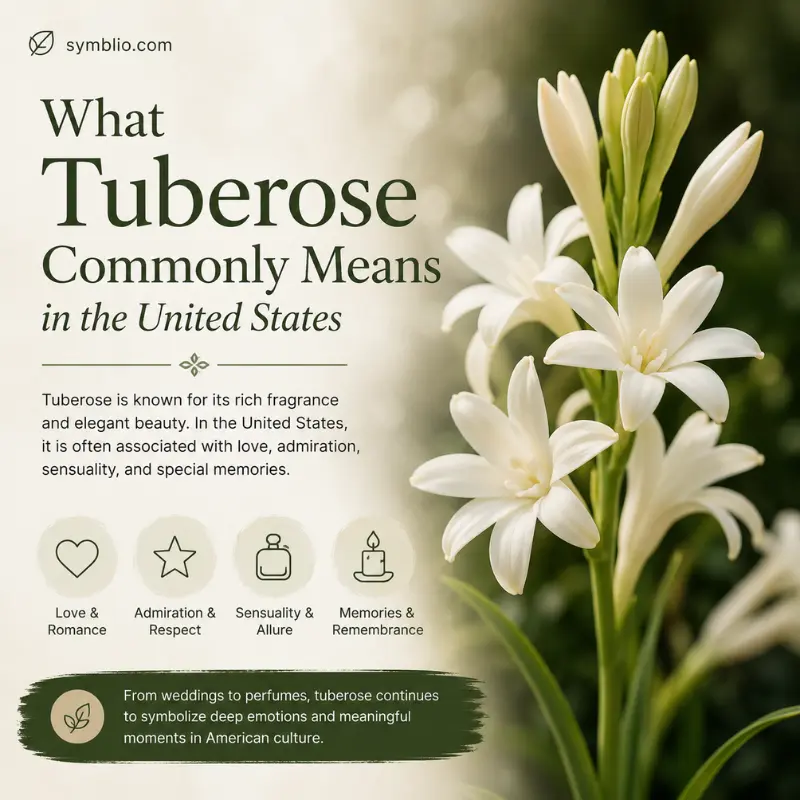
American interpretations of tuberose are generally more personal than fixed. There is no single universally recognized meaning, but several associations appear repeatedly.
Sensuality is one of the strongest. The flower’s powerful fragrance has long made it a natural symbol for physical attraction, romance, and emotional intimacy.
Devotion is another common interpretation. Its use in ceremonies can give the flower a meaning of commitment and lasting affection.
Remembrance becomes especially relevant when tuberose appears in memorial or commemorative arrangements. Fragrance is closely connected with memory, so a strongly scented flower can represent a person, place, or moment that remains emotionally present.
Its white color can also suggest purity, innocence, reverence, and ceremonial significance, although those meanings come partly from broader traditions surrounding white flowers rather than from tuberose alone.
The Fragrance That Shaped Its Symbolism
To understand tuberose, it helps to start with its scent.
Some flowers communicate through visual characteristics such as color, shape, or size. Tuberose communicates differently. Its fragrance can travel beyond the immediate space occupied by the plant.
That quality naturally lends itself to symbolic ideas about presence and attraction. Something unseen can still command attention. The flower therefore became associated with emotions that are difficult to contain or conceal.
Its scent also explains why tuberose became important in perfumery. Once a flower becomes an ingredient associated with luxury fragrance, its symbolism can shift toward sophistication, sensuality, and personal allure.
For modern readers, this is an important distinction: tuberose’s romantic reputation is not simply an arbitrary flower-language definition. It developed partly from a real sensory characteristic that people repeatedly experienced.
Ancient Roots and Early Cultural History
Tuberose originated in the Americas, particularly Mexico, before spreading through cultivation to other parts of the world.
The plant eventually became important in South Asian horticulture and ceremonial traditions, where its flowers have been used in garlands, decorations, religious offerings, weddings, and other occasions.
This history matters because tuberose symbolism cannot be treated as a purely European Victorian flower code. Different cultures developed their own relationships with the flower, and those relationships do not always emphasize the same qualities.
Its movement across regions also demonstrates how plant symbolism evolves. A flower can acquire new meanings when it enters a different religious, social, or artistic environment.
Tuberose and Mexican Heritage
Because tuberose originated in Mexico, its history is connected to the movement of plants between the Americas and other parts of the world.
Mexico’s broader floral traditions give white flowers many possible associations, including celebration, devotion, beauty, and remembrance. However, it is important not to claim that every Mexican tradition assigns one universal symbolic meaning to tuberose.
The flower’s cultural importance varies by region and occasion. Its fragrance and availability have made it useful in decorative and ceremonial settings, while its cultivation history connects it to the rich botanical heritage of Mexico.
Understanding that origin also prevents a common mistake: treating tuberose as a flower whose symbolism began entirely in Europe or Asia.
Tuberose in South Asian Traditions
Tuberose became particularly prominent in South Asia after its introduction and cultivation there.
In India, the flower is commonly known as rajnigandha, a name associated with its night fragrance. It has become familiar in garlands, wedding decorations, religious settings, and everyday floral culture.
Its white blossoms can carry associations with purity, devotion, celebration, and auspicious occasions. At the same time, the strong scent gives it an emotional quality that differs from flowers valued primarily for their appearance.
Tuberose is therefore a useful example of how symbolism can develop through actual cultural practice. Its meanings are not identical everywhere, and religious or ceremonial use should be understood within the specific tradition involved.
Why White Tuberose Can Suggest Purity and Reverence
White flowers have long been associated in many cultures with ideas such as cleanliness, innocence, peace, reverence, and spiritual attention.
Tuberose naturally participates in some of these associations because its blossoms are predominantly white. In a wedding arrangement, white tuberose may therefore suggest purity, commitment, and a formal beginning.
In a religious or memorial context, the same color can take on a more solemn character.
The meaning is shaped by the surrounding setting. A white tuberose bouquet beside wedding attire communicates something different from white tuberose placed among flowers at a remembrance ceremony.
This is why flower symbolism should never be interpreted from color alone.
Tuberose and Romance
Romance is perhaps the most recognizable modern association of tuberose.
Its fragrance is unusually noticeable, and that makes the flower feel intimate rather than merely decorative. Perfume has also strengthened this connection because tuberose has become associated with fragrances designed to project elegance and sensuality.
In romantic symbolism, tuberose can represent:
- attraction
- intimacy
- admiration
- devotion
- emotional closeness
- memorable affection
Yet tuberose is somewhat different from the classic red rose. The rose communicates romance through a widely recognized visual code. Tuberose communicates it more through scent, atmosphere, and sensory experience.
That distinction gives tuberose a more unusual role in floral design.
Tuberose in Weddings and Celebrations
Tuberose can work particularly well in ceremonial settings because its appearance is formal while its fragrance creates an atmosphere around the flowers.
In wedding traditions where it is commonly used, tuberose may represent love, devotion, celebration, purity, and the beginning of a shared life.
Garlands made from fragrant white flowers can also carry social and ceremonial significance that goes beyond decoration. Their meaning comes from the act of giving, wearing, exchanging, or displaying flowers within a particular tradition.
In the United States, tuberose weddings tend to be more individualistic. A couple might choose it because of its fragrance, appearance, cultural heritage, or connection to a meaningful place.
Tuberose and Mourning or Remembrance
Tuberose can also carry a quieter meaning: memory that remains present.
Flowers have long been part of mourning practices, but not every flower has the same role in every culture. Tuberose’s fragrance makes it particularly suited to the idea of sensory memory.
A scent can unexpectedly remind someone of a person, home, garden, celebration, or particular period of life. Because tuberose has such a distinctive perfume, it can symbolize memories that return vividly even when the original experience is gone.
In this context, tuberose does not necessarily mean grief itself. It can represent continuing remembrance and affection.
That distinction is useful in contemporary memorial design, where flowers may express appreciation for someone’s life rather than simply sorrow over loss.
Emotional and Psychological Symbolism
Tuberose symbolism often centers on emotions that are both attractive and intense.
Its fragrance can suggest confidence and presence because it is difficult to overlook. At the same time, its associations with romance can make it a symbol of emotional openness and attraction.
Psychologically, flowers with strong scent can also become tied to autobiographical memory. A particular fragrance may bring back an experience more quickly than a visual image or written description.
For this reason, tuberose can symbolize the idea that memory is sensory. Something invisible can remain connected to a person or experience long after the original moment has passed.
This interpretation is especially appropriate when someone chooses tuberose because its fragrance reminds them of family, heritage, travel, or a significant ceremony.
Tuberose Symbolism by Context
| Context | Meaning in the USA | Common Associations | Notes |
|---|---|---|---|
| Wedding | Love and devotion | Romance, commitment, purity | Often chosen for fragrance and formal appearance |
| Perfume | Sensuality and personal allure | Attraction, elegance, confidence | Scent is central to its symbolism |
| Memorial | Remembrance | Memory, affection, reverence | Meaning depends on the ceremony |
| Garden | Beauty and presence | Fragrance, evening atmosphere | Often appreciated as much for scent as appearance |
| Cultural ceremony | Devotion or celebration | Heritage, tradition, community | Interpretation varies by cultural setting |
How Tuberose Appears in Modern American Culture
Tuberose has a somewhat specialized place in contemporary American culture.
It appears frequently in luxury fragrance, wedding floristry, gardens, botanical collections, interior decoration, and floral photography. It is less likely to have a universally understood symbolic meaning than a rose, lily, or sunflower.
That relative unfamiliarity can actually make it attractive to people who want a less predictable floral symbol.
A person choosing tuberose today may be communicating something personal rather than relying on a standardized flower dictionary. The choice might reflect romance, cultural heritage, appreciation for fragrance, memories of a particular place, or simply an attraction to the flower itself.
Tuberose in Tattoos, Art, and Personal Style
Tuberose is a less common tattoo subject than roses, lotus flowers, chrysanthemums, or lilies, but its symbolism can make it meaningful for someone seeking a distinctive floral image.
A tuberose tattoo might represent romantic devotion, sensuality, remembrance, cultural heritage, or a meaningful memory associated with fragrance.
The visual design can change the interpretation. White blossoms may emphasize purity or remembrance, while a darker composition might place greater emphasis on mystery, nostalgia, or contrast.
It is important not to assume that a person’s tuberose tattoo has one fixed meaning. Contemporary tattoo culture places considerable emphasis on personal symbolism.
The same principle applies to paintings, illustrations, jewelry motifs, and digital artwork.
Common Misunderstandings About Tuberose Symbolism
One common mistake is claiming that tuberose has one universal meaning across every culture. It does not.
Another is treating flower symbolism dictionaries as historical laws. Flower-language traditions can be useful for understanding certain periods, especially Victorian-era popular culture, but they do not establish permanent meanings for every flower.
It is also misleading to describe tuberose as exclusively romantic. Its cultural uses include religious observance, weddings, decoration, perfumery, remembrance, and horticulture.
Finally, the flower’s sensual reputation should not be confused with anything inherently sexual about the plant. The association developed through fragrance, cultural use, literature, perfume, and artistic interpretation.
How Tuberose Symbolism Has Changed Over Time
The history of tuberose symbolism shows a gradual movement from plant and ceremonial use toward broader associations with fragrance, romance, luxury, and memory.
Its movement from Mexico to other parts of the world allowed different cultures to develop distinct relationships with it. In South Asia, ceremonial and religious uses became particularly important. In Western fragrance culture, its powerful scent contributed to associations with sensuality and elegance.
Modern American symbolism combines these influences with personal interpretation.
Today, tuberose can mean romance in one setting, cultural heritage in another, and remembrance somewhere else. Rather than weakening its symbolism, this flexibility explains why the flower remains useful in contemporary design.
Positive and Negative Associations
Tuberose is predominantly associated with positive or emotionally complex ideas, including:
- love
- attraction
- devotion
- beauty
- celebration
- remembrance
- purity
- elegance
- cultural heritage
Some historical flower-language traditions also connected tuberose with warnings about excessive sensuality or dangerous attraction. Such interpretations should be treated as period-specific symbolism, not as an objective meaning of the flower.
Modern American culture generally does not treat tuberose as a negative symbol. When darker meanings appear in art or literature, they are usually deliberate creative choices.
What Makes Tuberose Symbolically Distinctive?
The most distinctive feature of tuberose symbolism is the relationship between appearance and scent.
The flowers are visually delicate, but their fragrance can be remarkably strong. That contrast makes tuberose a natural metaphor for something that appears understated yet leaves a lasting impression.
It can therefore represent quiet beauty with a noticeable presence.
Its scent also creates a connection between flowers and memory. A photograph can show what a flower looked like, but fragrance can recall an entire moment. That sensory quality gives tuberose a particular emotional role that many other flowers do not share.
FAQs
Tuberose commonly symbolizes sensuality, attraction, devotion, romance, and remembrance. Its strong fragrance is central to many of these associations, while its white flowers can add meanings of purity and reverence.
Yes, tuberose is often associated with romance because of its intense fragrance and long-standing use in perfumery and celebrations. Its romantic meaning is usually more closely tied to sensual atmosphere than the traditional red rose.
A tuberose tattoo can represent love, sensuality, devotion, remembrance, or cultural heritage. Because tuberose is less standardized as a tattoo symbol, the wearer’s personal reason for choosing it is especially important.
White tuberose can suggest purity, devotion, reverence, celebration, and remembrance. The surrounding context determines which interpretation is most appropriate.
It can be associated with remembrance and mourning, particularly when used in memorial or commemorative settings. Its strong fragrance can also symbolize memories that remain vivid after someone or something is gone.
Tuberose has ceremonial and religious associations in some cultural traditions, particularly in South Asia. Its specific meaning varies by religion, region, and ritual, so it should not be assigned one universal religious interpretation.
Its exceptionally strong fragrance is a major reason. Tuberose became prominent in perfumery, and its scent-based association with attraction and intimacy contributed to its modern reputation as a sensual flower.
Conclusion
Tuberose symbolism centers on sensuality, attraction, devotion, celebration, and remembrance, with fragrance playing a larger role than it does for many other flowers. Its history stretches from its American origins to important cultural uses elsewhere, especially in South Asian ceremonies and floral traditions.
In the United States, tuberose does not have one rigid definition. Its meaning changes with the setting, whether it appears in a wedding, perfume, garden, memorial arrangement, tattoo, or work of art. The flower’s most distinctive message may be its ability to leave an impression without relying solely on appearance.
Tuberose symbolism ultimately reflects the connection between flowers, fragrance, memory, and human relationships. Its meanings remain flexible because the experiences attached to scent and ceremony are personal as well as cultural.


