
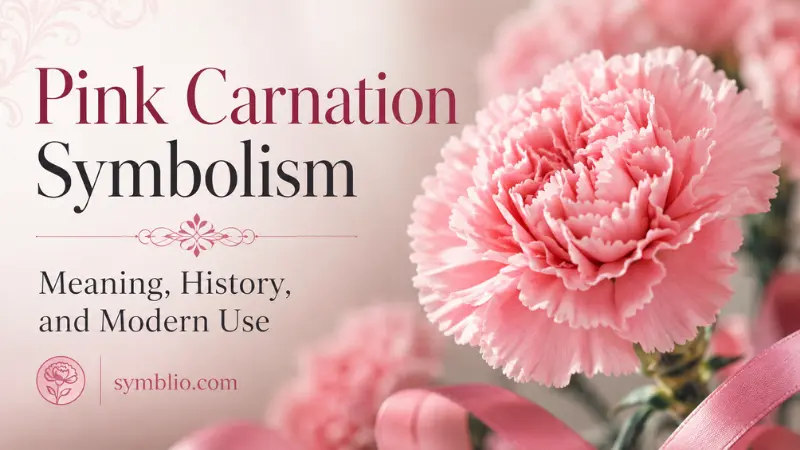
The pink carnation symbolism most commonly centers on affection, admiration, gratitude, and enduring love. Its association with motherhood is especially strong in the United States, where carnations became closely connected with Mother’s Day and personal expressions of appreciation.
The flower also carries older meanings from the European “language of flowers,” where pink carnations were associated with a woman’s love. Over time, those formal Victorian meanings became less rigid, while the flower continued to communicate warmth, affection, appreciation, and remembrance.
Quick Answer
Pink carnations commonly symbolize love, admiration, gratitude, and affection in modern American culture, especially when given to mothers or people who hold a special place in someone’s life. Historically, pink carnations were also associated with woman’s love in the Victorian language of flowers, while carnations more broadly became important symbols of motherhood and remembrance.
TL;DR
- Pink carnations symbolize affection, gratitude, admiration, and love.
- Victorian flower language linked pink carnations with woman’s love.
- Carnations became strongly associated with American Mother’s Day.
- Pink flowers often celebrate living mothers and affectionate relationships.
- The flower can express remembrance without implying grief alone.
- Modern uses include bouquets, weddings, gifts, tattoos, and home decor.
What Does a Pink Carnation Look Like?
A carnation is a flowering plant in the genus Dianthus, recognized by its layered petals and slightly frilled or ruffled edges. Pink carnations range from very pale blush shades to brighter pinks, giving the flower a softer visual character than many red or strongly colored flowers.
That appearance matters to symbolism because color and form work together. The carnation’s delicate petals can suggest tenderness, while its long-lasting quality has helped associate it with enduring affection.
In everyday American life, people encounter carnations in grocery-store bouquets, florist arrangements, gardens, corsages, weddings, funerals, Mother’s Day displays, and seasonal decorations. They are familiar rather than exotic, which gives their symbolism a practical and approachable quality.
What Pink Carnations Commonly Mean in the United States
In the United States, a pink carnation can communicate several closely related ideas:
- Affection
- Gratitude
- Admiration
- Motherly love
- Tenderness
- Remembrance
- Appreciation
The exact message depends heavily on the situation.
A pink carnation given to a mother may communicate appreciation and family love. A bouquet given to a friend can suggest affection and gratitude without necessarily carrying a romantic message. At a memorial gathering, carnations can express remembrance and continuing care.
This flexibility is one reason carnations remain useful in American floral culture. Their meaning does not require one specific relationship.
Pink Carnations and the Victorian Language of Flowers
The modern habit of assigning meanings to flowers owes much to the nineteenth-century “language of flowers.” The tradition became fashionable in Britain and America during the Victorian period, particularly from the 1820s through the late nineteenth century. Flowers could be selected and arranged to communicate feelings that might have been difficult to express directly.
Pink carnations were traditionally associated with woman’s love in several flower-meaning guides. The Royal Horticultural Society’s educational material preserves this association, while also showing that other carnation colors carried different meanings.
However, Victorian flower language was never a single universal dictionary. Different books sometimes assigned different meanings to the same plant. The symbolism therefore works better as a historical cultural convention than as a fixed rule.
That distinction is important today. Someone giving pink carnations in 2026 is usually communicating affection or appreciation rather than deliberately following a nineteenth-century floral code.
How Mother’s Day Changed Carnation Symbolism in America
The strongest American connection between carnations and motherhood comes from the creation of Mother’s Day.
Anna Jarvis promoted the first official Mother’s Day observance in 1908 in Grafton, West Virginia, in memory of her mother, Ann Reeves Jarvis. She selected the white carnation because it had been her mother’s favorite flower and encouraged people to wear or give carnations as part of the tribute.
President Woodrow Wilson officially recognized Mother’s Day as a national observance in 1914. By then, carnations had already become closely associated with the celebration.
The original tradition emphasized white carnations, particularly as a tribute to mothers who had died. Over time, floral customs developed distinctions between white and colored carnations, with pink commonly becoming associated with living mothers and affection for them.
This history helps explain why a pink carnation can feel more personal in the United States than its appearance might suggest. It is not simply a pink flower. In the American imagination, carnations became part of a national tradition surrounding family, motherhood, and appreciation.
Pink Carnations as Symbols of Motherhood
Motherhood is perhaps the most recognizable American association surrounding pink carnations.
A pink carnation can represent:
- Appreciation for a mother
- A child’s affection for a mother
- Family connection
- Caregiving
- Gratitude for guidance
- Celebration of motherhood
The meaning does not have to be limited to biological motherhood. In contemporary use, the flower can honor grandmothers, stepmothers, adoptive mothers, guardians, or other people who have played a maternal role.
The symbolism also works because pink tends to soften the traditional association between carnations and formal remembrance. A pink carnation can honor someone while keeping the emotional tone warm and celebratory.
Pink, Red, and White Carnations Have Different Associations
Carnation symbolism becomes clearer when color is considered alongside context.
| Context | Meaning in the USA | Common Associations | Notes |
|---|---|---|---|
| Pink carnation | Affection and gratitude | Motherhood, admiration, tenderness | Often feels warm and personal |
| Red carnation | Love and affection | Romance, devotion, strong attachment | Usually more emotionally direct |
| White carnation | Honor and remembrance | Mother’s Day, memorials, purity | Strong historical connection to Anna Jarvis |
| Yellow carnation | Historically negative associations | Disappointment or disdain | Less common in everyday symbolism today |
| Mixed carnations | Multiple emotions | Celebration, family, appreciation | Meaning depends on colors and occasion |
These distinctions are not universal rules. Modern floral arrangements often prioritize personal taste, seasonal availability, and visual design over traditional flower dictionaries.
Religious and Cultural Associations
Carnations also appear in European Christian art and symbolism. The flower has been used in religious imagery, including representations of the Madonna and Child. The Smithsonian notes that carnations appear in historical artwork involving Mary and Jesus, where the flower could participate in symbolism surrounding maternal and spiritual relationships.
Some European religious art also used carnations within broader systems of botanical symbolism. In medieval and Renaissance visual culture, flowers could add layers of meaning to religious scenes.
These traditions should not be treated as evidence that every pink carnation has a religious meaning today. In modern American life, a pink carnation in a bouquet is usually interpreted through relationships, occasions, color, and personal sentiment rather than theology.
Carnations also have important cultural associations outside the United States. Their meanings vary by country and historical period, which is another reason to avoid claiming that one interpretation applies everywhere.
Why Pink Carnations Feel Tender and Affectionate
Color plays an important role in the emotional impression of the flower.
Pink is commonly associated in American visual culture with softness, warmth, care, affection, and gentleness. When that color appears in a carnation, it combines with the flower’s established associations with love and motherhood.
The result is different from the emotional signal of a red carnation.
Red tends to make affection more direct. Pink can make the same emotion feel gentler and more appreciative. That is why pink carnations can work especially well when the giver wants to communicate care without making the gesture feel overly romantic.
The symbolism is therefore partly cultural and partly contextual. A flower’s meaning comes not only from a historical dictionary but also from how people understand color, relationships, and social occasions.
Pink Carnations in Weddings and Family Celebrations
Pink carnations can fit naturally into weddings because they combine romantic associations with family-oriented symbolism.
They may represent:
- Affection between partners
- Gratitude toward family
- Devotion
- Tenderness
- A loving home
- Appreciation for parents
Their availability and durability also make carnations practical choices for large floral arrangements.
In a wedding, however, the flower does not automatically mean “romantic love.” Its significance may come from the overall arrangement. Pink carnations mixed with roses can emphasize romance, while carnations combined with family photographs or memorial flowers may emphasize family history and remembrance.
The surrounding objects help determine the message.
Pink Carnations in Mourning and Remembrance
Carnations can also appear in funerals and memorial arrangements, although their symbolism is not inherently negative.
The Mother’s Day connection is particularly relevant because Anna Jarvis originally promoted white carnations as a tribute to mothers. That history helped connect carnations with remembrance as well as celebration.
A pink carnation at a memorial can therefore communicate continuing affection rather than simply sorrow.
This distinction matters. Flowers used at funerals often carry multiple messages at once: love for the person who died, appreciation for their life, family connection, and remembrance.
The pink carnation’s softer color can make that message feel affectionate rather than stark.
Why People Choose Pink Carnations as Gifts
A flower gift is partly a form of social communication. The recipient considers not only the flower but also why it was given.
Pink carnations work well when someone wants to say:
“I appreciate you.”
They can also communicate:
“You matter to me.”
or:
“I am grateful for the love and care you have given me.”
That makes them suitable for Mother’s Day, birthdays, anniversaries, thank-you gestures, family celebrations, and ordinary moments of appreciation.
They are particularly useful when the relationship is emotionally important but does not necessarily call for a strongly romantic flower.
Pink Carnation Symbolism in Tattoos and Personal Style
A pink carnation tattoo can carry a more individualized meaning than a traditional bouquet.
Someone might choose the flower to represent:
- A mother or grandmother
- Family heritage
- Gratitude
- A meaningful relationship
- Feminine affection
- A memory
- Personal growth
- A particular period of life
The tattoo’s surrounding imagery can change the interpretation. A name or date may make the design memorial-focused. A mother’s handwriting can emphasize family connection. A butterfly, heart, ribbon, or other decorative element can shift the design toward transformation, love, or remembrance.
There is no single universal “pink carnation tattoo meaning.” The strongest interpretation usually comes from the person’s own reason for choosing it.
Pink Carnations in Home Decor and Modern Design
In contemporary interiors, pink carnations are often used less as coded symbols and more as visual expressions of warmth.
A vase of pink carnations can make a room feel welcoming and cared for. Their familiar appearance also suits cottage-inspired interiors, traditional floral arrangements, spring decorations, and casual dining spaces.
Graphic designers and artists may use carnations differently. A pink carnation can suggest femininity, family, tenderness, nostalgia, or celebration depending on the surrounding imagery.
On social media, the flower may simply function as an attractive image. Emojis, photographs, and floral illustrations often lose the detailed symbolic vocabulary that existed in Victorian flower language.
That is not necessarily a loss. It shows how symbolism evolves as communication changes.
Common Misunderstandings About Pink Carnation Symbolism
One common misconception is that every flower color has one permanent meaning.
It does not.
Flower symbolism has always varied between traditions, books, countries, and periods. Even Victorian flower dictionaries did not agree perfectly with one another.
Another misconception is that pink carnations are exclusively Mother’s Day flowers. Mother’s Day is their strongest American cultural association, but they are also used for weddings, birthdays, appreciation, memorials, and ordinary floral gifts.
It is also misleading to assume that a pink carnation is automatically romantic. The flower can express love, but the type of love depends on context. A child giving one to a parent is communicating something different from a partner presenting the same flower.
How the Meaning Has Evolved
The story of the pink carnation shows how symbols change rather than remaining fixed.
During the Victorian period, flower dictionaries gave carnations specific coded meanings. In the United States during the early twentieth century, carnations became especially connected with Mother’s Day through Anna Jarvis and the growing national observance.
Commercialization then expanded the flower’s visibility. Interestingly, Jarvis herself became strongly opposed to the commercial development of Mother’s Day, despite having helped establish the floral tradition surrounding it.
Today, most Americans do not consult a formal flower dictionary before choosing carnations. Instead, meaning comes from color, occasion, relationship, memory, and cultural familiarity.
The symbol has therefore moved from a coded Victorian message toward a more flexible language of affection.
What Pink Carnations Communicate Today
In 2025–2026 American culture, pink carnations are best understood as flowers of affectionate appreciation.
They can celebrate a living mother, honor a family member, express gratitude, mark a meaningful relationship, or preserve a memory. Their symbolism is usually positive, although the same flower can appear in memorial settings.
Their strength as a symbol comes partly from that flexibility. A pink carnation does not demand one interpretation. Instead, it gives the giver a familiar visual language for communicating care.
FAQs
Pink carnations commonly symbolize affection, gratitude, admiration, and tenderness. In the United States, they also have a strong association with motherhood and appreciation.
They can. Pink carnations became associated with Mother’s Day through the broader American tradition of giving carnations to honor mothers, although Anna Jarvis originally promoted white carnations specifically.
A pink carnation tattoo can represent a mother, family relationship, gratitude, remembrance, or affection. The personal story behind the tattoo usually matters more than any fixed traditional definition.
They can express romantic affection, but they are not exclusively romantic. Their softer associations with gratitude, family, admiration, and motherhood make them suitable for many non-romantic relationships.
Pink carnations are commonly associated with affection and living relationships, while white carnations have a particularly strong historical association with remembrance and Mother’s Day. The distinction is cultural rather than an absolute rule.
Carnations have appeared in Christian and European religious art, including images of the Madonna and Child. However, a pink carnation in modern American life usually has a personal or cultural meaning rather than a specifically religious one.
Yes. Although they are often associated with affection and celebration, carnations can also appear in memorial arrangements. A pink carnation may communicate continuing love and remembrance rather than grief alone.
Conclusion
The meaning of a pink carnation comes from several layers of cultural history: Victorian flower language, American Mother’s Day traditions, color symbolism, family relationships, and modern floral customs. Its most recognizable associations today are affection, gratitude, admiration, motherhood, and remembrance.
Pink carnation symbolism is therefore less about one secret definition than about the relationship and occasion surrounding the flower. Whether placed in a Mother’s Day bouquet, wedding arrangement, memorial display, tattoo, or simple vase at home, the flower usually communicates a form of caring connection—and that flexibility helps explain why it remains familiar in American culture.


