The eastern bluebird is one of North America’s most recognizable songbirds, known for its bright blue back, warm reddish breast, gentle song, and association with open countryside. Eastern bluebird symbolism is especially strong in the United States, where the bird commonly represents happiness, spring, hope, and the return of better days.
Its symbolism is not based on one ancient legend or religious tradition. Instead, it developed from the bird’s appearance, seasonal behavior, pleasant song, presence around farms and gardens, and long-standing place in American culture. The result is a symbol that feels cheerful without requiring a complicated interpretation.
Quick Answer
Eastern bluebird symbolism commonly represents happiness, hope, spring, and renewal in modern American culture, especially when the bird appears in gardens, artwork, state symbols, or nature settings. Historically, its cheerful appearance and return in spring helped establish associations with optimism, countryside life, and the arrival of brighter seasons.
TL;DR
- Bluebirds commonly symbolize happiness and optimism in the United States.
- Their spring appearance connects them with renewal and fresh beginnings.
- Missouri adopted the eastern bluebird as its state bird in 1927.
- New York chose the bird as its state bird in 1970.
- Bluebird imagery often suggests peaceful countryside and natural beauty.
- Modern conservation has added meanings of stewardship and environmental care.
What the Eastern Bluebird Looks Like and Where It Appears
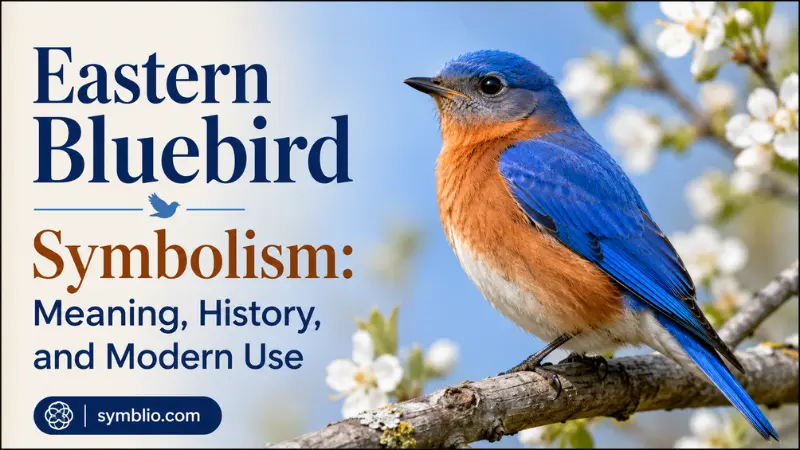
The eastern bluebird (Sialia sialis) is a small thrush found across much of eastern and central North America. Adult males have vivid blue upperparts, a rusty or reddish-orange throat and chest, and a pale belly. Females have softer, less intense coloring, while young birds have spotted plumage.
The bird favors open habitats rather than dense forest. Meadows, fields, orchards, parks, rural roadsides, large yards, and areas with scattered trees can all provide suitable habitat. Eastern bluebirds also readily use specially constructed nest boxes.
These physical and behavioral traits matter symbolically. A bluebird sitting on a fence post or appearing against a green spring landscape creates a visual impression of openness, color, and seasonal change. Its symbolism therefore grows naturally from what people actually see.
What It Commonly Means in the United States
In American culture, the most familiar meaning attached to the bluebird is happiness.
Missouri’s official state-symbol information explicitly describes the eastern bluebird as a symbol of happiness. The state selected it as its official bird in 1927, partly because the species was common there and already carried this cheerful cultural association.
The meaning is usually uncomplicated. A bluebird can suggest a pleasant day, emotional optimism, good fortune, or the possibility that circumstances are improving.
That does not mean every bluebird sighting has a fixed symbolic message. Context matters. A bluebird painted beside flowers may emphasize spring, while one shown near a home may suggest peaceful domestic life. In a conservation setting, the same bird can represent care for local wildlife.
Why Bluebirds Became Associated With Happiness
The happiness association has several understandable sources.
First, the bird is visually striking. Its blue plumage contrasts strongly with green grass, trees, and spring landscapes. Second, its song is generally described as pleasant and musical. Third, eastern bluebirds are often encountered in open spaces where people can see them clearly rather than deep inside thick woodland.
The timing of their appearance also matters. In northern parts of their range, bluebirds arrive relatively early in spring and remain into fall. Their return can therefore coincide with warmer weather, growing plants, and renewed outdoor activity.
Missouri’s conservation officials connect this seasonal experience directly with the familiar idea of the “bluebird of happiness.”
In other words, the symbolism is partly environmental psychology: people associate the bird with the pleasant circumstances in which they tend to notice it.
Spring, Renewal, and New Beginnings
The bluebird is also a natural symbol of spring and renewal.
For generations, Americans have noticed the connection between bluebirds and the changing seasons. When a bluebird returns to an open landscape after winter, its appearance can become a small sign that the environment is changing.
This makes the bird useful as a symbol for:
- starting over
- leaving winter behind
- welcoming a new season
- restoring optimism
- beginning a new chapter
- appreciating change
Nineteenth-century American naturalist Florence Merriam described the bluebird as a poetic symbol of spring, an interpretation that fits the bird’s seasonal behavior and appearance.
The symbolism is therefore more grounded than the idea that a bluebird automatically predicts good luck. It reflects a recognizable seasonal experience.
The Bluebird in American History and State Identity
The eastern bluebird has an unusually visible place in American state symbolism.
Missouri selected it as the state bird on March 30, 1927. Official state information identifies happiness as a central reason for the choice and also notes the bird’s red, white, and blue coloring, which gave it an obvious connection to American patriotic imagery.
New York later adopted the bluebird as its state bird in 1970. The species had long been associated with the state’s open farms, orchards, and countryside.
This history changed the bird’s symbolism in an important way. It became more than a pleasant wild animal. For residents of Missouri and New York, it could also represent place, regional identity, and pride in local nature.
| Context | Meaning in the USA | Common Associations | Notes |
|---|---|---|---|
| Spring landscape | Renewal | New beginnings, warmer weather | Linked to seasonal return |
| Garden or yard | Happiness | Peace, beauty, enjoyment | Common in everyday nature encounters |
| Missouri state symbolism | Happiness and identity | Pride, nature, patriotism | State bird since 1927 |
| New York state symbolism | Regional identity | Countryside, conservation | State bird since 1970 |
| Artwork and decor | Optimism | Cheerfulness, peaceful living | Often used as a decorative nature motif |
| Conservation | Stewardship | Wildlife protection, habitat | Reflects modern environmental awareness |
The Meaning of Its Blue Color
Color contributes strongly to the bird’s symbolism.
Blue commonly carries associations such as calmness, openness, trust, and clear skies in American visual culture. The eastern bluebird’s vivid blue feathers make those associations easy to incorporate into artwork and design.
Yet the bird is not simply a “blue symbol.” Its reddish-orange breast creates a visual contrast that adds warmth. The combination of blue, red, and white has also been noted in Missouri’s official symbolism as fitting an American patriotic color scheme.
This combination can produce several readings at once:
Blue may suggest calm, sky, and openness.
Red can add warmth, vitality, and liveliness.
White can contribute a sense of simplicity and clarity.
These are visual associations rather than fixed rules. A person choosing a bluebird image may focus on one aspect while another viewer notices something different.
Bluebirds, Home, and Family Life
The eastern bluebird has another symbolic dimension connected with home.
The species commonly nests in cavities, including natural tree hollows and specially designed birdhouses. People across the United States have created “bluebird trails” and installed nest boxes to provide additional nesting opportunities.
That behavior has made the bird familiar around homes, farms, parks, and community spaces.
As a result, a bluebird near a house can suggest:
- belonging
- peaceful domestic life
- care for living things
- family continuity
- connection with the outdoors
The symbolism should not be confused with a universal belief that bluebirds specifically represent marriage or family in every tradition. Those meanings are contextual rather than fixed.
Historical Changes in Bluebird Symbolism
The meaning of the bluebird has changed alongside American landscapes.
Earlier generations often encountered bluebirds around small farms, orchards, fence rows, and open fields. Changes in land use reduced suitable habitat in many areas. New York’s state environmental agency notes that the abandonment of many small farms led to the loss of fence posts, orchards, and open fields that bluebirds used for nesting and feeding.
The bird later became a symbol of conservation as people worked to restore nesting opportunities.
This is an important shift. The bluebird once primarily represented the pleasant countryside. Today it can also represent the responsibility to preserve that countryside.
Nest boxes are especially meaningful in this respect. They turn symbolism into practical stewardship: people do not merely admire the bird; they create habitat where it can reproduce.
The Bluebird and American Cultural Memory
The bluebird occupies a familiar place in American literature, art, music, and popular culture. Writers and artists have repeatedly used the bird as a shorthand for cheerful landscapes and positive emotional states.
This cultural familiarity helped make the phrase “bluebird of happiness” understandable even to people who know little about ornithology.
At the same time, the cultural image can become simplified. The real eastern bluebird is a wild animal with specific habitat needs, seasonal behavior, competition for nesting cavities, and changing population patterns. Its symbolic image is much simpler: a flash of blue associated with pleasant things.
That contrast is part of what makes the symbol effective. People can understand the image immediately without knowing the bird’s entire natural history.
Emotional and Psychological Meaning
On a personal level, the bluebird can symbolize optimism without certainty.
Seeing one does not guarantee that something good will happen. Instead, the bird can represent the decision to notice something positive in the present moment.
Someone might choose a bluebird image after moving to a new place, beginning a new stage of life, recovering from a difficult period, or simply wanting a reminder of happiness. In these cases, the symbol functions as a personal association rather than a universal code.
Its emotional character is usually gentle. Unlike symbols associated with danger, authority, or dramatic transformation, the bluebird tends to communicate ordinary happiness: sunlight, open space, birdsong, spring weather, and the pleasure of being outdoors.
Bluebird Symbolism in Art, Decor, and Personal Style
Bluebirds work especially well in visual design because their shape and color are immediately recognizable.
In American homes, bluebird imagery can appear in paintings, garden decorations, ceramics, greeting cards, seasonal artwork, and nature-themed decor. The image often complements flowers, branches, fences, cottages, or rural landscapes.
Artists may use the bird to create different moods:
- A bluebird with blossoms emphasizes spring.
- A bluebird beside a nest emphasizes home and family.
- A single bird on a branch can suggest peaceful solitude.
- Several bluebirds may emphasize community and abundance.
- A bluebird in a wide landscape can suggest freedom and openness.
The symbol is therefore flexible without becoming completely arbitrary.
Eastern Bluebird Meaning in Tattoos and Personal Symbols
A person who chooses a bluebird tattoo may be expressing happiness, hope, freedom, or a connection with nature.
For some people, the image can represent a fresh start. For others, it may commemorate a particular place, season, family memory, or meaningful encounter with wildlife.
There is no single traditional “bluebird tattoo meaning.” Tattoo symbolism is personal, and the same design can carry different significance for different people.
A bluebird combined with flowers may emphasize renewal, while one paired with a date or landscape may preserve a particular memory. In American tattoo culture, the bird’s recognizable appearance makes it especially adaptable to personal storytelling.
Religious and Cross-Cultural Interpretations
The eastern bluebird does not have one universally established religious meaning in Christianity, Judaism, Islam, or another major religion.
That distinction is important because modern symbolism websites sometimes assign highly specific spiritual meanings to individual birds without historical evidence. The eastern bluebird’s strongest documented cultural associations are American and secular: happiness, spring, countryside life, state identity, and conservation.
Birds more generally have religious symbolism in many traditions. They can represent freedom, the soul, divine care, or communication between earthly and spiritual realms. However, those broader bird traditions should not automatically be treated as specific eastern bluebird traditions.
The most historically defensible interpretation is therefore to separate general bird symbolism from the eastern bluebird’s particular American cultural history.
Conservation Gave the Bluebird a New Meaning
The eastern bluebird experienced significant population declines in parts of its range during the twentieth century, but conservation efforts and nest-box programs helped support its recovery. Audubon’s field guide notes that populations have increased in recent decades, with birdhouses contributing to improved nesting opportunities.
That history adds a modern layer to the symbol.
Today, the bluebird can represent restoration in a practical environmental sense. Its story demonstrates how changes in land use can harm wildlife and how organized conservation can help.
New York’s environmental agency describes the bird’s comeback as closely connected with education, nesting-box programs, and efforts by conservation organizations and individuals.
For modern Americans, then, the bluebird can stand for more than personal happiness. It can also represent the idea that damaged habitats can be improved through sustained care.
Common Misunderstandings About Bluebird Symbolism
One common mistake is treating bluebird symbolism as a universal spiritual system. It is not.
Another is assuming that every bluebird represents good luck. Happiness is the strongest traditional American association, but happiness and luck are not identical. A bluebird can symbolize optimism without suggesting that fortune is guaranteed.
It is also important not to confuse the eastern bluebird with every other bluebird species. North America has three commonly recognized bluebirds: eastern, western, and mountain bluebirds. Their ranges and appearances differ, and a symbolic interpretation tied specifically to the eastern bluebird should not automatically be applied to all three.
Finally, modern symbolic meanings should not be presented as ancient facts. Much of the eastern bluebird’s familiar symbolism developed through American literature, seasonal observation, state identity, art, and everyday experience rather than through a single ancient mythology.
How Americans Understand the Bluebird Today
In contemporary American culture, the bluebird remains a straightforward symbol of happiness and hope, but its meaning has become broader.
In contemporary American culture, the bluebird remains a straightforward symbol of happiness and hope, but its meaning has expanded. Nature enthusiasts may associate it with biodiversity and conservation, while residents of Missouri or New York may connect it with regional identity and pride. Artists often use the bird to suggest spring, peaceful countryside, or optimism. As a personal symbol, it can mark a happier chapter, preserve a meaningful memory, or represent a fresh beginning.
Its continued appeal comes partly from its accessibility. You do not need specialized knowledge to understand why a bright blue bird appearing on a spring morning might feel hopeful.
The symbol works because the cultural meaning grows from an actual encounter with the natural world.
What the Eastern Bluebird Can Symbolize in Different Contexts
The meaning becomes clearer when the surrounding context is considered.
Nature: Spring, renewal, and appreciation for wildlife.
Gardens: Happiness, peace, and connection with nature.
State imagery: Regional identity and civic pride.
Artwork: Optimism, beauty, and rural calm.
Personal keepsakes: Meaningful memories, hope, or new beginnings.
Conservation: Habitat restoration and environmental stewardship.
This flexibility explains why the bluebird remains useful as a symbol without requiring a single fixed interpretation.
FAQs
The eastern bluebird most commonly symbolizes happiness, hope, spring, and renewal in American culture. It can also represent peaceful countryside life, regional identity, and conservation.
It can be interpreted positively, but happiness is a more established American association than good luck. The bird’s cheerful appearance and springtime presence are the main reasons it acquired its optimistic reputation.
A bluebird tattoo can represent happiness, hope, freedom, a fresh start, or a meaningful connection with nature. Its exact meaning depends on the person’s reason for choosing the image and any other elements in the design.
Missouri adopted the eastern bluebird as its state bird in 1927 because it was common in the state and was already regarded as a symbol of happiness. Its red, white, and blue coloring also fit easily into American patriotic imagery.
It is not universally recognized as a specific religious symbol. Birds have religious meanings in many cultures, but the eastern bluebird’s strongest documented symbolic associations come from American culture, nature, literature, state identity, and conservation.
Yes, especially in American symbolism. Because bluebirds are associated with spring and the return of warmer seasons, they can represent renewal, fresh starts, and the beginning of a more hopeful period.
“Bluebird symbolism” can refer broadly to several species and cultural traditions. Eastern bluebird symbolism is more specifically connected with the eastern United States, Missouri and New York state identity, American spring imagery, happiness, and conservation.
Conclusion
The eastern bluebird became a symbol of happiness because its appearance, song, habitat, and seasonal return naturally encouraged positive associations. American culture strengthened those associations through literature, state symbolism, artwork, and everyday encounters with the bird.
Today, eastern bluebird symbolism extends beyond simple cheerfulness. It can represent spring, hope, home, regional pride, and the restoration of wildlife habitat. Its meaning remains most convincing when connected to the real bird: a small songbird whose return to open landscapes has given generations of Americans a visible reminder of changing seasons and the value of preserving nature.