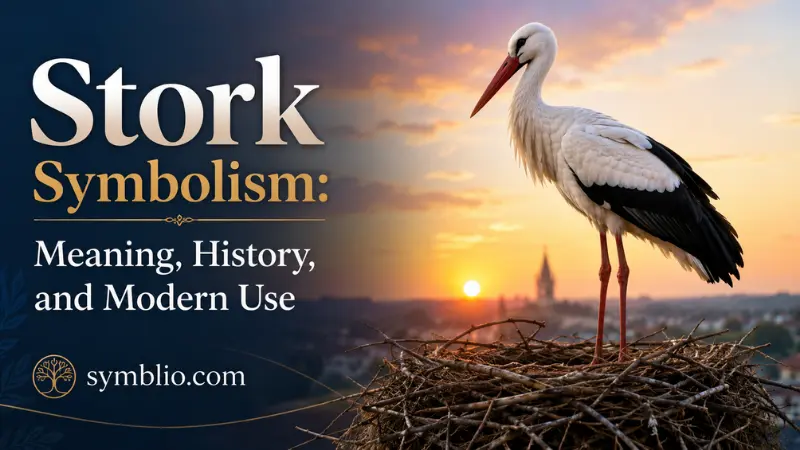
Storks are among the few birds whose cultural meaning is almost instantly recognizable. In the United States, a stork carrying a bundled baby is strongly associated with childbirth, new families, and the arrival of a newborn. The image appears on baby announcements, nursery decorations, greeting cards, and illustrations, even though the actual bird has little to do with human reproduction.
That association is only one part of the story. Storks have also been connected with parental care, family responsibility, good fortune, seasonal renewal, migration, and the movement between different stages of life. Those ideas developed from observations of the birds themselves as well as from European folklore and older traditions.
The symbolism remains interesting today because the stork occupies two worlds at once. It is both a real wetland bird and a familiar cultural character. In modern America, that distinction matters: someone may recognize the stork as a birth symbol without knowing anything about the older stories that gave the image its meaning.
Quick Answer
Stork symbolism commonly represents birth, new family life, and the arrival of a child in modern American culture, especially in baby announcements, nurseries, and celebrations. Historically, storks have also been associated with parental devotion, family duty, good fortune, seasonal renewal, and journeys between worlds.
TL;DR
- Storks commonly symbolize childbirth and new family beginnings in the United States.
- European folklore helped establish the familiar baby-delivery story.
- Ancient traditions associated storks with parental care and family responsibility.
- Migration contributed to ideas of renewal, return, and seasonal change.
- Modern Americans often use storks in baby-related designs and celebrations.
- Wood storks also connect the image with wetland conservation in the Southeast.
What Does a Stork Symbolize?
The most recognizable meaning is birth. In American culture, the stork is often imagined carrying a newborn in a cloth bundle. This makes the bird an easy visual shorthand for pregnancy, childbirth, parenthood, and the beginning of family life.
Other meanings developed from different observations and traditions:
- New beginnings: Migrating storks return seasonally, making them natural symbols of renewal.
- Family devotion: Ancient writers described storks as unusually attentive to their parents and offspring.
- Good fortune: In European folklore, storks nesting near homes could be regarded as favorable signs.
- Caregiving: Their association with raising young contributed to ideas of parental responsibility.
- Transition: Migration and flight encouraged associations with journeys between places and stages of life.
- Community and home: Nesting close to human settlements made the bird particularly visible in domestic folklore.
Not every culture assigns all of these meanings to the bird. Symbolism depends heavily on local traditions and on which species people encounter.
Why Are Storks Associated With Babies?
The baby-delivery story has a complicated history rather than one clearly documented starting point. European folklore, particularly traditions associated with Germany and northern Europe, played an important role in shaping the familiar version.
One reason the story worked so well was the bird’s behavior. White storks traditionally nested near human settlements, including rooftops and chimneys, and their seasonal movements were conspicuous. Their return could coincide with spring, a season already associated with renewal and new life.
Folklore eventually transformed these observations into a story: the stork carried newborn children to families and delivered them to their homes.
Nineteenth-century literature helped spread and standardize the image. Hans Christian Andersen’s 1838 fairy tale “The Storks” became particularly influential in popularizing the association between the bird and newborn children.
The familiar American illustration—a long-legged white bird flying with a cloth-wrapped infant—is therefore better understood as a piece of folklore than as an ancient universal belief.
Ancient Roots and the Idea of Family Duty
Long before the modern baby-shower image, storks appeared in classical discussions of family behavior.
Greek and Roman writers portrayed storks as examples of filial devotion. Stories claimed that older storks were cared for by their offspring, making the birds a convenient model for human children who owed responsibilities to aging parents. The Greek word pelargos, meaning stork, was connected with the concept of filial duty in later traditions.
Whether these stories accurately described stork behavior is less important to symbolism than the lesson ancient writers drew from them. The bird became a moral example: children should care for parents just as parents care for children.
That interpretation gives stork symbolism a broader meaning than childbirth. It connects the bird with reciprocal family responsibility—the idea that care moves between generations.
Storks in Ancient Egyptian Symbolism
Bird symbolism was especially important in ancient Egyptian religious thought, although modern claims about specific species require caution because ancient observers did not always distinguish storks, herons, ibises, and other long-legged birds in the same way modern ornithologists do.
Some Egyptian representations associated stork-like birds with the ba, an aspect of the individual associated with personality and existence after death. The broader image of a bird leaving the body and traveling between earthly and spiritual realms contributed to the symbolic relationship between birds, souls, and transition.
This does not mean that ancient Egyptians universally regarded the modern concept of a stork as a simple “symbol of the soul.” The historical picture is more complicated. Some famous Egyptian bird associations are also better identified with herons or ibises.
Still, the connection is useful when studying the wider symbolism of stork-like birds: flight naturally lends itself to ideas about movement, departure, return, and passage between different realms.
European Folklore and the Stork’s Reputation
European folklore expanded the bird’s symbolic range considerably.
In parts of northern and central Europe, storks were associated with household luck. A stork choosing to nest on or near a home could be interpreted as a favorable sign. Because the birds returned seasonally, their arrival could also suggest the return of life after winter.
This helped combine several ideas:
A stork near the home can symbolize family protection.
Its return in spring represents renewal and seasonal change.
The nest often suggests family life, shelter, and caregiving.
A stork carrying a newborn has become an emblem of a new generation.
These associations reinforced one another over time.
Some Slavic traditions also connected migrating storks with unborn souls and the movement of life from one world into another. Such beliefs show why the bird could become associated with both birth and transition rather than with childbirth alone.
What Stork Symbolism Means in the United States
In the United States, the strongest popular meaning is newborn life and family expansion.
The classic stork image became especially recognizable through twentieth-century children’s culture, greeting cards, baby products, nursery decorations, and birth announcements. The symbolism is usually lighthearted rather than religious.
A stork on a baby announcement generally signals the arrival of a new child.
On nursery artwork, the image may suggest a new stage of family life and the excitement surrounding a growing household.
When used on a baby-shower decoration, the stork usually communicates celebration, anticipation, and the welcoming of a new family member.
This version varies the sentence openings and should remove that specific consecutive-sentence warning.
We are celebrating an expected or newly arrived child.
Americans may recognize this visual language even without knowing the European folklore behind it. That is one reason the symbol has survived: its meaning can be understood immediately without explanation.
A Quick Comparison of Stork Meanings
| Context | Meaning in the USA | Common Associations | Notes |
|---|---|---|---|
| Baby announcements | Birth and arrival of a child | Family, celebration | Most recognizable modern use |
| Nursery decor | New family life | Childhood, caregiving | Usually playful rather than religious |
| European folklore | Good fortune and fertility | Home, spring, children | Traditions vary by region |
| Classical traditions | Filial responsibility | Parents, children, duty | Based on ancient literary accounts |
| Nature symbolism | Renewal and seasonal return | Migration, wetlands | More common among bird enthusiasts |
| Conservation | Wetland health and wildlife | Habitat, recovery | Especially relevant to the American Southeast |
Why Storks Represent New Beginnings
Migration is one of the most useful natural explanations for the bird’s connection with renewal.
Many stork species undertake substantial seasonal movements. The white stork, famous in European folklore, migrates between breeding grounds and wintering areas. Its return becomes a visible event: a bird disappears for part of the year and then comes back to familiar places.
Humans naturally attach meaning to such cycles.
A returning bird can suggest:
- a new season
- a return home
- continuity
- renewal
- another generation
- the continuation of family life
This does not make migration a supernatural sign. It explains why people repeatedly used seasonal bird behavior as material for stories and metaphors.
Emotional and Psychological Meaning
Stork imagery tends to evoke hopeful family emotions because its most familiar modern setting is the arrival of a baby.
The symbol can communicate anticipation without showing pregnancy or childbirth directly. That makes it useful in public and family settings where a softer image is preferred.
Psychologically, the stork can also represent a transition from one identity to another. A newborn changes the structure of a family, so the bird may stand for the beginning of a new role: becoming a parent, becoming a sibling, or welcoming another generation.
Its association with nests adds another layer. A nest is literally a place where young birds are raised, so it naturally reinforces ideas of home, shelter, caregiving, and belonging.
Stork Symbolism in Baby Showers and Birth Announcements
The stork remains a recognizable decorative motif even though modern families have many other ways to announce a birth.
Common uses include:
- baby-shower invitations
- nursery wall art
- birth announcements
- greeting cards
- baby clothing
- party decorations
- scrapbook designs
- personalized gifts
The image is particularly effective because it tells a story without requiring words. A stork carrying a bundle immediately signals infancy and family celebration.
Modern use also tends to be less literal than older folklore. Most Americans using the image do not actually believe a supernatural bird delivers babies. Instead, they are borrowing a familiar cultural symbol.
Stork Symbolism in Tattoos and Personal Style
A stork tattoo can carry several meanings depending on the design and the person’s reason for choosing it.
A person might associate the bird with:
- parenthood
- a child’s birth
- family heritage
- renewal
- migration
- returning home
- personal transformation
- devotion to family
The surrounding imagery changes the interpretation. A stork with a baby emphasizes birth, while a flying stork may emphasize travel or freedom. A stork among reeds or wetlands may have a stronger connection to nature.
Because symbolism is personal, a tattoo should not automatically be interpreted as evidence of one particular life event.
Religious and Spiritual Interpretations
Storks do not have one universal religious meaning.
Christian and European folklore sometimes connected storks with purity, family care, and charitable behavior. Some later traditions incorporated the bird into stories about the birth of Christ, although these narratives belong more to folklore than to central Christian doctrine.
Elsewhere, migrating birds have been associated with souls, seasonal passage, or movement between earthly and spiritual realms.
The safest interpretation is therefore contextual. A stork in a religious artwork does not automatically carry a single established theological meaning. Its significance depends on the tradition, period, artist, and surrounding symbols.
Positive and Negative Associations
Most modern American uses of the stork are positive, but historical folklore was not uniformly cheerful.
The bird could represent good fortune, fertility, parental devotion, and family continuity. At the same time, European traditions sometimes connected storks with loss, misfortune, or unusual events involving childbirth. Folklore could also attribute human moral qualities to birds in contradictory ways.
This is a useful reminder that symbols rarely have one permanent definition.
The familiar American image has largely separated the stork from those darker associations. Today, a stork on a greeting card is overwhelmingly likely to be understood as a cheerful reference to a new baby.
Wood Storks and American Conservation
The symbolism of the stork changes when the subject is the wood stork, a native species of the southeastern United States.
Wood storks are closely tied to wetlands, where changes in water levels can affect feeding and nesting. Their history in the United States includes serious population declines caused in part by habitat loss. The species was listed as endangered in 1984 and later reclassified as threatened in 2014 following substantial conservation work.
That history gives the wood stork a distinctly modern American symbolic possibility: environmental recovery.
Seeing a wood stork in a restored wetland can represent more than wildlife. It can point toward habitat protection, ecological restoration, and the ability of conservation efforts to reverse serious declines.
This meaning is quite different from the nursery stork, but both emerge from the same basic human tendency to attach meaning to an animal’s relationship with family, place, and survival.
Common Misunderstandings About Stork Symbolism
One common misconception is that the baby-delivery story is an ancient belief shared by every culture. It is not. The familiar version developed through particular European folklore and later popular culture.
Another mistake is treating every long-legged bird in ancient art as a stork. Herons, ibises, cranes, and storks can look similar, and historical sources sometimes blur those distinctions.
It is also misleading to assume that storks universally symbolize fertility. Birth is certainly central to modern Western folklore, but other traditions emphasized filial duty, migration, good fortune, souls, or nature.
Understanding those differences makes the symbol more interesting rather than less meaningful.
How Stork Meaning Has Changed Over Time
The stork’s symbolic history can be understood as a series of overlapping interpretations.
Ancient traditions: The bird became associated with family duty, parental care, and moral behavior.
European folklore: Nesting near homes and seasonal migration encouraged associations with good fortune, household prosperity, and new life.
Nineteenth-century literature: Stories helped strengthen the connection between storks and newborn babies.
Twentieth-century American culture: Advertising, children’s books, greeting cards, and baby celebrations turned the stork into a familiar birth symbol.
Modern America: The image remains associated with babies but also appears in nature education, wildlife conservation, design, tattoos, and nostalgic imagery.
The meaning therefore did not emerge from one single source. It accumulated through observation, folklore, literature, family traditions, and popular culture.
FAQs
A stork can symbolize transition, renewal, family care, and movement between stages of life. In some historical traditions, stork-like birds were also associated with souls and journeys between worlds, but these interpretations vary by culture.
The association developed largely through European folklore, especially traditions in northern and central Europe. Seasonal return, nesting near homes, and stories about birds carrying children gradually became the familiar baby-delivery image.
A stork tattoo may represent parenthood, a child’s birth, family devotion, renewal, travel, or returning home. The exact meaning depends on the person’s reason for choosing the image and the other elements in the tattoo.
In several European traditions, a stork nesting near a home was considered favorable. In modern American culture, the bird is more strongly associated with birth and family celebration than with general luck.
There is no single universal Christian doctrine assigning one meaning to the stork. European Christian folklore sometimes connected the bird with purity, care, and family virtues, but those associations should be distinguished from official religious teaching.
Usually not in modern American culture. Some historical European stories gave storks less favorable associations, but today’s common American image is overwhelmingly positive and centers on babies, family, and new beginnings.
In a symbolic or artistic context, seeing a stork may suggest renewal, family, seasonal change, or a new beginning. In ordinary life, however, a stork is simply a wild bird, so any symbolic interpretation is cultural rather than a proven prediction of future events.
Conclusion
The stork became a symbol of birth because several ideas came together: nesting near homes, seasonal migration, stories about parental care, European folklore, and later children’s literature and popular culture. In the United States, those traditions eventually produced one of the most recognizable images of a newborn—the stork carrying a bundled baby.
Today, stork symbolism is still primarily about birth, family, and new beginnings, but its older meanings add useful context. The bird can also represent responsibility between generations, returning home, seasonal renewal, and—in the case of the American wood stork—efforts to protect threatened wetland ecosystems.
Its lasting appeal comes from the fact that the symbol connects an ordinary bird with experiences people already understand: caring for family, leaving and returning home, and welcoming the next generation.