House finches are among the most familiar small birds in American neighborhoods, especially around gardens, parks, farms, and backyard feeders. Their cheerful songs, social behavior, and the red plumage of adult males have made them easy to notice. For many people, house finch symbolism centers on home, companionship, adaptability, and the simple pleasures of everyday life.
The bird also has an unusually interesting American history. House finches were originally native to western North America and Mexico, but birds released around New York in the early 1940s established an eastern population that spread rapidly. Today, the species is widespread across much of the United States and is closely associated with human neighborhoods.
That combination of ordinary familiarity and remarkable adaptability gives the house finch a useful symbolic place in modern culture. It is less a symbol of grand mythology than a reminder of how meaning can grow from repeated encounters with an animal in everyday life.
Quick Answer
House finch symbolism commonly represents home, companionship, adaptability, vitality, and appreciation for ordinary joys in modern American culture. Its association with backyards and family spaces reinforces ideas of belonging, while its history of adapting to changing environments can suggest resilience and adjustment.
TL;DR
- House finches commonly symbolize home, companionship, and everyday happiness.
- Their social behavior supports themes of community and connection.
- Red male plumage can suggest vitality, warmth, and confidence.
- Their American expansion gives adaptability a particularly fitting interpretation.
- Backyard encounters often make their symbolism personal rather than ceremonial.
- Modern uses include art, decor, nature writing, tattoos, and personal reflection.
What a House Finch Looks Like and Why Appearance Matters
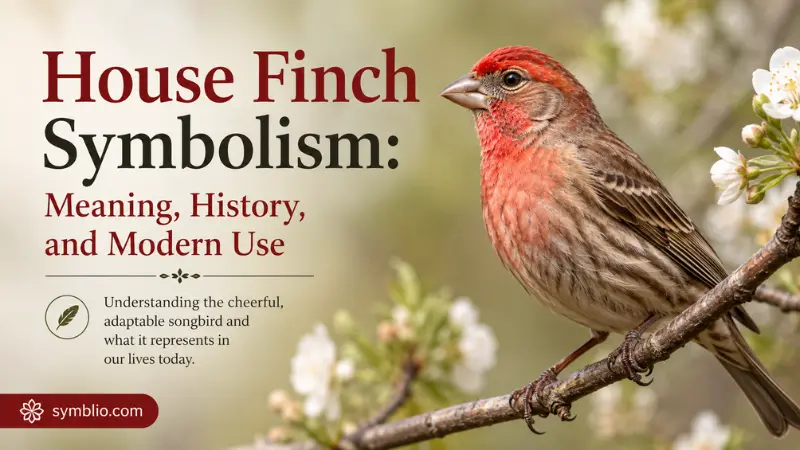
The house finch is a small songbird with a relatively large bill, brown-streaked body, and distinctive wing markings. Adult males usually have red coloring on the forehead, throat, breast, and rump, although the color can range toward orange or yellow depending on the pigments available in their diet. Females lack the male’s red coloration and are primarily brown and streaked.
That visual difference contributes to the bird’s symbolic appeal.
Red commonly attracts attention because people associate the color with warmth, vitality, affection, celebration, and confidence. In the case of the house finch, however, the symbolism should not be treated as a fixed biological message. The bird’s red feathers have a natural explanation: pigments from food consumed during molt influence their coloration.
Symbolically, people may still interpret the red male as a lively accent against the more subdued colors of the female and surrounding landscape. The contrast makes the bird easy to recognize and helps explain why it often appears in artistic representations of backyard wildlife.
What It Commonly Means in the United States
In the United States, the house finch has no single official symbolic meaning. Its symbolism is mostly informal and develops from its appearance, behavior, habitat, and relationship with people.
The most natural interpretations include:
- Home: The bird frequently appears around houses, gardens, and feeders.
- Companionship: House finches commonly forage and move in groups.
- Adaptability: They thrive in cities, suburbs, farms, and other human-modified environments.
- Vitality: The male’s red plumage and active behavior suggest liveliness.
- Everyday happiness: Their bubbling songs and familiar presence can make ordinary outdoor spaces feel more pleasant.
- Community: Their tendency to gather makes them an easy metaphor for social connection.
The word “house” itself strengthens the association with domestic life. Unlike a bird encountered only in remote wilderness, the house finch often becomes part of someone’s daily surroundings.
That familiarity matters. A person may never consciously decide that a house finch represents belonging, yet seeing one repeatedly at a kitchen window can create exactly that emotional association.
How the House Finch Became a Symbol of Adaptability
Adaptability is one of the most convincing meanings associated with this bird because it is grounded in its actual history.
House finches are native to western North America, including the southwestern United States and Mexico. In the early 1940s, birds were transported from California to New York for sale as cage birds. They were marketed as “Hollywood finches.” When the trade was shut down, some were released, and an eastern population became established.
The population subsequently expanded across much of the eastern United States and southern Canada. House finches proved highly capable of living near people, using residential areas, agricultural landscapes, parks, and other semi-open habitats.
That history creates a grounded symbolic lesson: circumstances can change without eliminating the possibility of finding a workable place within them.
For modern readers, the house finch can therefore represent adjustment rather than perfection. It suggests making use of available surroundings, remaining socially connected, and finding opportunities in familiar places.
Home, Belonging, and the Meaning of the Backyard
The house finch is particularly suited to symbolism about belonging because people often encounter it close to home.
It may perch in a backyard tree, visit a feeder, gather around shrubs, or sing from a nearby roofline. Cornell’s bird guide describes the species as common in residential backyards, urban centers, city parks, farms, and forest edges.
This makes the bird different from symbols that depend on distant landscapes.
A house finch can represent the idea that meaningful experiences do not always require travel. A familiar yard can become a place of observation, routine, and connection. Seeing the same birds from season to season can also give a household a sense of continuity.
For someone decorating a home with a house finch image, the message may therefore be simple: this is a place where life gathers.
Social Behavior and Symbolism of Companionship
House finches are social birds and are frequently seen in groups outside the nesting period. They commonly gather in trees, shrubs, open areas, and at feeding stations.
That behavior naturally supports symbolism involving companionship.
A house finch can represent:
- friendship
- family connection
- neighborhood life
- cooperation
- belonging
- the comfort of familiar company
This does not mean the bird literally symbolizes human friendship in scientific or religious tradition. Rather, people often interpret animal behavior through familiar human concepts.
The effect is especially noticeable when several finches appear together. One bird may evoke a pleasant encounter; a small group can suggest community.
The Red House Finch and Symbolism of Vitality
The male house finch’s red coloring is one of its most recognizable features. Red can carry many associations in American visual culture, including warmth, energy, affection, celebration, and attention.
When these associations are applied to a house finch, they can produce a symbolic reading of vitality and emotional warmth.
Yet the bird offers an interesting contrast. Its body is not entirely red. Much of its plumage remains brown and muted, allowing the brighter areas to stand out.
That contrast can symbolize a quieter form of vitality: liveliness existing within ordinary life rather than requiring constant drama. A red-headed finch perched on a plain backyard fence can visually express how something small can bring color into a routine setting.
Historical Roots and the Bird’s Unusual American Story
The house finch does not have the kind of famous ancient mythology associated with creatures such as the eagle, owl, or raven. Its strongest historical symbolism in the United States developed much later.
The eastern population has a particularly unusual origin. In the early 1940s, birds captured in California were transported to the New York City area for the cage-bird trade. After the commercial sale became illegal, birds were released. The first nesting pair on Long Island was documented in 1943, and the population subsequently expanded.
This history complicates the symbolism in an important way.
The house finch can symbolize adaptation and settlement, but its story also reminds us that human actions shape wildlife populations. Its presence in the eastern United States is not an ancient natural tradition; it is partly the result of a twentieth-century interaction between people, commerce, law, and wildlife.
That distinction keeps symbolic interpretation historically responsible.
House Finch Symbolism Compared With Other Common Meanings
| Context | Meaning in the USA | Common Associations | Notes |
|---|---|---|---|
| Backyard sighting | Familiarity and home | Comfort, routine, belonging | Often personal rather than traditional |
| Group of finches | Companionship | Friendship, community, family | Based on observable social behavior |
| Red male finch | Vitality | Warmth, energy, liveliness | Color symbolism is cultural |
| Bird near a garden | Everyday joy | Nature, renewal, appreciation | Connects wildlife with domestic spaces |
| House finch artwork | Connection to home | Simplicity, nature, affection | Meaning depends on the artist and setting |
The table shows why the bird does not have one universal definition. Context changes the interpretation.
Emotional and Psychological Meaning
People often attach meaning to animals because repeated encounters create emotional associations.
A house finch may appear during breakfast, while someone works in the garden, or during a quiet afternoon near a window. Over time, the bird can become connected with a particular period of life.
That makes its symbolism highly personal.
For one person, a house finch might represent childhood because the birds visited a parent’s backyard. For another, it might symbolize a new home after moving to a different neighborhood. Someone recovering from a difficult transition might notice the bird’s ordinary persistence and interpret it as a reminder that daily life continues to offer small points of interest.
These interpretations are psychological associations rather than established rules. The same bird can therefore mean comfort to one person and simply “a familiar backyard bird” to another.
House Finch Symbolism in Art, Decor, and Personal Style
House finch imagery fits naturally into American nature-inspired design.
Artists may portray the bird on branches, beside berries, among garden plants, or near a feeder. In home decor, such images can reinforce themes of domestic warmth and connection with nature.
The bird can also appear in:
- wildlife paintings
- garden illustrations
- greeting cards
- bird-themed stationery
- educational artwork
- nature photography
- jewelry and decorative objects
- tattoos and personal artwork
A house finch tattoo, for example, can be chosen to represent a connection to home, a particular place, family memories, or an appreciation for ordinary wildlife.
Unlike symbols with standardized religious meanings, a house finch tattoo usually depends heavily on the individual’s story.
House Finch Symbolism in Mourning and Remembrance
Birds are sometimes used in American remembrance art because flight can provide a visual metaphor for absence, memory, and continuing connection.
A house finch can work within that framework, particularly when the bird has a personal connection to someone who has died.
For example, a person might associate a loved one with backyard birdwatching. In that situation, an image of a house finch could represent memory without claiming that the bird itself is a supernatural messenger.
That distinction is important. There is no universal religious doctrine saying that seeing a house finch after someone’s death carries a specific message. The meaning comes from personal memory, family tradition, or individual spirituality.
Cross-Cultural and Religious Interpretations
The house finch does not have a widely established religious symbolism comparable to birds that occupy major roles in specific traditions.
Its scientific range includes Mexico and much of North America, but broad claims about an ancient universal “house finch meaning” would be misleading.
More generally, birds appear in many religious and cultural traditions as symbols of freedom, communication, spirit, movement, or transition. Those broader bird associations can influence how people interpret a house finch, but they should not be presented as a traditional house-finch doctrine.
For an American audience, the most reliable interpretation comes from the bird’s actual characteristics and the personal context in which it appears.
Why the House Finch Can Represent Resilience Without Being a Hero Symbol
Resilience is sometimes portrayed through dramatic animals that survive extreme conditions. The house finch offers a quieter alternative.
Its story involves adapting to human-dominated environments and expanding into new regions. The eastern population’s development from a relatively small introduction into a widespread population illustrates successful adjustment at the species level.
Symbolically, this can represent ordinary resilience rather than heroic struggle.
The lesson is not “overcome everything.” It is closer to “find ways to live within changing circumstances.” That makes the house finch especially appropriate for themes of moving, starting over, adjusting to a new neighborhood, or creating familiarity in unfamiliar surroundings.
Modern American Meaning and Everyday Encounters
Today, many Americans encounter house finches through backyard bird feeding and casual birdwatching.
They commonly visit feeders for seeds and may also feed on buds, berries, flowers, and small fruits. Their presence around homes has helped make them one of the recognizable birds of residential America.
Modern symbolism therefore tends to be understated.
A house finch does not need to appear in a ceremonial setting to become meaningful. Its value can come from repetition: the same species returning to the same yard, appearing during a particular season, or becoming part of a family’s shared habit of watching birds.
Digital culture has also made this kind of personal nature observation easier to share. A photograph posted online may function as a small record of place, season, or personal experience rather than as a formal symbol.
Common Misunderstandings About House Finch Symbolism
One common mistake is assuming that every bird sighting has a fixed spiritual message. There is no universal rule that assigns a specific prediction or supernatural meaning to a house finch.
Another mistake is treating the bird’s red coloring as proof of a particular emotional or spiritual quality. Red can inspire symbolic associations, but the biological reason for the plumage is related to dietary pigments.
The bird’s history can also be oversimplified. Its eastern expansion was not simply a natural migration story; it followed human-assisted introduction connected to the former cage-bird trade.
Finally, house finches should not be confused with purple finches or other similar species. Identification matters because symbolic interpretation begins with knowing which animal you actually observed.
The Complicated Side of the House Finch Story
The house finch’s popularity should not erase the less comfortable parts of its history.
The eastern population originated from birds involved in an illegal commercial trade. Later, house finches also became associated with a major outbreak of mycoplasmal conjunctivitis among eastern songbirds beginning in the 1990s. Scientists used observations from birdwatchers and citizen scientists to study how the disease spread through house finch populations.
This does not make the bird a negative symbol.
Instead, it demonstrates why symbolism should not replace natural history. A species can be visually appealing and culturally beloved while still having a complicated ecological story.
For modern interpretation, adaptability remains a reasonable theme, but it should be understood alongside the real consequences of human interaction with wildlife.
How House Finch Meaning Has Evolved
The symbolic identity of the house finch has changed alongside its geographic presence.
In its western range, it was a familiar native songbird. In the East, it became an unexpected newcomer during the twentieth century. As its population expanded, it transformed from an unusual sight into a common backyard bird.
That evolution has influenced the way Americans encounter it.
Today, many people do not think about its unusual introduction when they see a house finch at a feeder. They simply recognize a familiar neighborhood bird. The symbol has therefore shifted from novelty toward familiarity.
This is an important part of its modern meaning: something can become part of home through repeated presence.
FAQs
A house finch commonly symbolizes home, companionship, adaptability, vitality, and appreciation for everyday nature. Its meaning is usually personal or cultural rather than tied to a formal religious tradition.
There is no single established spiritual meaning for the house finch. Some people interpret its presence as a personal reminder of home, connection, renewal, or resilience, but those interpretations depend on individual beliefs.
A house finch tattoo can represent home, family memories, a meaningful place, companionship, or appreciation for nature. The specific meaning usually comes from the person’s relationship with the bird rather than from a standardized tattoo tradition.
It can represent affection or companionship, particularly because house finches are often seen in pairs or groups. However, there is no universal tradition that defines the species specifically as a symbol of romantic love.
Seeing one does not automatically carry a supernatural message. A person may give the encounter personal significance because the bird reminds them of a home, season, person, or meaningful period in their life.
The association comes largely from its common presence around houses, gardens, residential neighborhoods, and bird feeders. Its name reinforces the connection, while its familiarity turns ordinary backyard encounters into symbols of belonging and routine.
Not necessarily. The bird is usually interpreted positively, but symbolism depends on context and personal experience. Its history also includes human-caused introduction and disease ecology, so it is better understood as a complex real animal than as a universally positive emblem.
Conclusion
House finch symbolism is best understood through the bird’s real relationship with American everyday life. Its presence around homes supports ideas of belonging and companionship, while its social behavior suggests community and its adaptability provides a natural metaphor for adjusting to change.
The bird’s story also shows why symbolism benefits from historical context. A familiar backyard visitor can have a complicated past involving migration, commerce, human intervention, and ecological change. That history does not diminish its appeal; it makes the symbol more specific and grounded.
For many Americans, the house finch ultimately represents something modest but meaningful: life continuing close to home, with small moments of color and companionship appearing in ordinary places.