
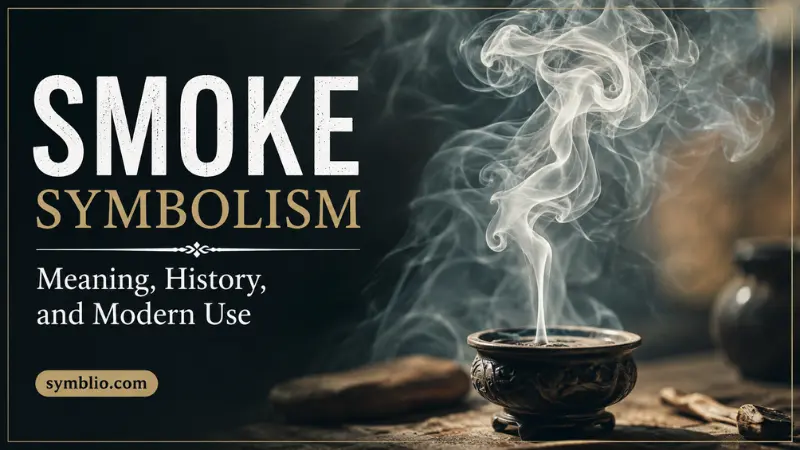
Smoke is one of the most recognizable visual signs of fire, and its symbolism changes depending on what produces it and where it appears. In American culture, smoke can suggest danger, uncertainty, transformation, memory, secrecy, or spiritual communication, while its long history also connects it with prayer, offerings, ceremony, and social rituals.
People encounter smoke in ordinary and dramatic settings: campfires, fireplaces, incense, barbecues, wildfire alerts, candles, religious ceremonies, photography, movies, and public celebrations. Because smoke can rise, spread, obscure, linger, and eventually disappear, it gives artists and storytellers a natural way to represent things that are changing or difficult to hold onto.
Its meaning is therefore rarely fixed. Smoke from a church censer communicates something very different from smoke rising after a house fire. Understanding the context is essential to understanding the symbol.
Quick Answer
Smoke symbolism commonly represents danger, uncertainty, change, and something hidden becoming visible in modern American culture. Historically, smoke has also been associated with prayer, purification, offerings, communication, mourning, and the movement between the visible and unseen worlds.
TL;DR
- Smoke often represents danger, uncertainty, or something concealed.
- Rising smoke can suggest prayer, communication, or release.
- Fire and smoke together commonly symbolize destruction and renewal.
- Indigenous American traditions give smoke and tobacco specific ceremonial meanings.
- Modern art uses smoke to express memory, identity, and impermanence.
- Wildfire smoke has strengthened its association with environmental danger.
What Smoke Physically Represents
Smoke is produced when material burns or smolders and releases airborne particles and gases. Unlike the solid object that created it, smoke has no permanent shape. It curls, disperses, gathers, and disappears.
That physical behavior explains much of its symbolic vocabulary.
Smoke can be seen but not grasped, making it a natural image for uncertainty. It can conceal an object behind a haze, giving it associations with secrecy and confusion. It can rise toward the sky, which helps explain its connection with prayer and spiritual communication. And because smoke remains after a fire has changed the original material, it can represent the trace left behind by an event.
The surrounding setting determines the emotional message. Smoke from a fireplace can evoke warmth and home. Smoke from a wildfire can signal danger. Incense can create a sense of ceremony. Smoke used in photography or theater may simply create atmosphere.
The symbol works because people instinctively notice these physical qualities.
The Most Common Meanings of Smoke
Several meanings appear repeatedly in American symbolism.
Danger is among the most immediate. Smoke can warn people that something is burning before flames become visible. The familiar saying “where there’s smoke, there’s fire” reinforces the idea that smoke can serve as evidence of a hidden problem.
Mystery and uncertainty come from smoke’s ability to obscure. A smoky scene can make people unsure about what lies behind it. Writers and filmmakers use this quality when they want an environment to feel ambiguous without explicitly explaining why.
Transformation comes from the relationship between smoke and fire. Something solid becomes altered through burning, while smoke marks the transition. For this reason, smoke can represent endings, change, or the aftermath of an important event.
Memory and impermanence are also common. Smoke appears briefly and then fades, making it a useful metaphor for moments, memories, relationships, and experiences that cannot be permanently held.
Spiritual communication has a different historical foundation. In many religious traditions, smoke from incense or offerings has been associated with worship, prayer, purification, or communication with the divine.
Ancient Roots of Smoke as a Sacred Symbol
Smoke acquired religious meaning long before modern ideas about symbolism existed.
Burning aromatic materials created something unusual: an earthly substance visibly rising into the air while releasing a fragrance that could fill a sacred space. That combination made smoke useful in ritual.
Ancient religious traditions used incense, burnt offerings, and aromatic substances for different purposes. The specific meanings varied, so it is misleading to claim that all ancient cultures viewed smoke in exactly the same way.
In ancient Israelite tradition, smoke appears in descriptions of divine presence, sacrifice, and incense. Biblical imagery also connects rising incense smoke with prayer.
Incense likewise became important in Christian traditions, particularly in Catholic and Orthodox worship. Its smoke can mark sacred space, honor people or objects involved in worship, and symbolize prayer.
Across parts of Asia, incense has also played roles in Buddhist, Daoist, Confucian, and other ritual settings. Historical research shows that plant-derived smoke has served religious, social, medicinal, and practical purposes in different communities.
The important point is that sacred smoke does not have one universal meaning. Its symbolism depends on the tradition, substance, ritual, and community using it.
Smoke Symbolism in Indigenous North American Traditions
Smoke has an especially important and complex history in Indigenous cultures of North America.
Tobacco was cultivated and used by Indigenous peoples long before European colonization, but practices differed considerably between nations and regions. In some communities, tobacco held ceremonial or sacred status rather than functioning simply as a recreational product.
Archaeological research in the southeastern United States has documented smoking pipes associated with Mississippian-era ceremonial practices. Researchers have found evidence that tobacco smoking could have religious and social significance in these communities.
Other Indigenous traditions used tobacco in ceremonies involving respect, communication, relationships, or important communal events. Research on peoples of the Pacific Northwest, for example, documents ceremonial smoking as part of social and spiritual practices.
This history deserves careful treatment. The popular American phrase “peace pipe” can oversimplify many distinct Indigenous traditions into a single stereotype. A better understanding recognizes that ceremonial tobacco practices vary by nation and community.
For that reason, smoke imagery should not automatically be labeled “Native American symbolism.” Specific cultural contexts matter.
What Smoke Means in American Culture
In the United States, smoke has developed meanings that combine older traditions with modern experiences.
Americans commonly associate smoke with warning because smoke detectors, emergency broadcasts, wildfire maps, and fire safety education make smoke an everyday sign of potential danger. Wildfire smoke has become especially significant in regions affected by large fires, where hazy skies can represent environmental risk rather than simple atmosphere.
Smoke can also symbolize comfort and home. A chimney releasing smoke may suggest a warm house in winter. A campfire creates a different association: friendship, outdoor recreation, storytelling, and shared experience.
Barbecue creates another distinctly American setting. Smoke rising from a smoker or grill can signal patience, cooking, regional tradition, and hospitality.
At the same time, cigarette smoke has a complicated cultural history. By the twentieth century, smoking had become associated with social identity, sophistication, rebellion, stress, and popular entertainment, while later public-health awareness changed how many Americans viewed tobacco smoke. The National Park Service notes that smoking had become widespread across American society by the nineteenth century and could function as a social activity among workers and communities.
Modern smoke symbolism therefore contains both nostalgia and caution.
Smoke as a Symbol of Mystery and the Unknown
Smoke is particularly effective when a creator wants to suggest that something cannot be seen clearly.
A person emerging through smoke may appear uncertain or dramatic. A smoky room can represent confusion. A cloud of smoke around an object can hide information from the viewer.
This association is partly physical rather than purely historical. Smoke interferes with visibility, so people naturally connect it with incomplete knowledge.
That is why smoke appears frequently in detective stories, thrillers, fantasy imagery, album artwork, and cinematic scenes. It can create uncertainty without requiring dialogue.
The phrase “smoke and mirrors” adds another layer. It has become an American expression for deception, distraction, or an impressive appearance that conceals what is really happening.
Here, smoke does not represent spirituality or transformation. It represents misdirection.
Smoke, Fire, and Transformation
Smoke rarely appears alone in symbolism. Its strongest relationship is with fire.
Fire consumes, changes, heats, illuminates, and destroys. Smoke is one of the visible consequences of that process.
Together, fire and smoke can represent a dramatic transition:
Fire changes the material. Smoke records the change.
That makes smoke useful for expressing personal transformation. In visual art, it may represent leaving an old identity behind. In literature, it may appear after a conflict to suggest that life has been permanently altered.
Smoke can therefore carry both positive and negative interpretations. It may represent destruction after a disaster, but it can also symbolize the movement from one stage of life into another.
The distinction depends on what happens to the person or object surrounded by the smoke.
Smoke and Mourning
Smoke can also evoke loss because it is associated with disappearance.
A candle that has gone out, incense used during a funeral, or smoke rising into an empty sky can suggest that something has passed from physical presence into memory.
Religious traditions sometimes reinforce this connection through funeral and memorial ceremonies. Incense has been used in Christian funerary contexts, while other cultures have their own practices involving smoke, fragrance, fire, or burning offerings.
In secular American culture, smoke in mourning imagery is less standardized. It often works metaphorically rather than as a fixed funerary symbol.
An artist might use fading smoke to communicate the feeling of someone being present in memory but absent physically. The meaning comes from the image’s association with disappearance rather than from a universal rule.
Smoke as a Sign of Impermanence
One of smoke’s clearest symbolic qualities is its temporary nature.
A cloud appears, changes shape, becomes thinner, and disappears. Nothing about it remains stable for long.
This makes smoke an effective symbol for:
- fleeting experiences
- changing circumstances
- lost opportunities
- fading memories
- temporary beauty
- emotional uncertainty
- the passage of time
The symbolism is especially common in photography and fine art, where smoke can create an image that looks beautiful precisely because it cannot remain fixed.
Unlike stone, metal, or wood, smoke cannot easily be possessed. Its temporary nature makes it a visual reminder that some experiences can only be witnessed.
Smoke in Religious and Spiritual Imagery
Religious smoke symbolism varies greatly, but several recurring ideas can be identified.
Rising smoke may represent prayer ascending. Fragrant smoke may signify an offering. Smoke surrounding a sacred space may mark that space as separate from ordinary life.
In Christianity, incense has a long-established ritual meaning, with rising smoke associated with prayer and worship.
Similar ideas appear in other religious contexts, but they should not be collapsed into one generalized “spiritual smoke” tradition. Buddhist, Hindu, Daoist, Jewish, Christian, Indigenous, and other practices have their own histories and ritual rules.
For modern Americans, incense may therefore symbolize religion, meditation, remembrance, relaxation, or simply a familiar scent. The same visible smoke can carry very different meanings depending on who is using it and why.
A Quick Comparison of Smoke Meanings
| Context | Meaning in the USA | Common Associations | Notes |
|---|---|---|---|
| Wildfire | Danger and environmental threat | Evacuation, warning, uncertainty | Strong contemporary association |
| Campfire | Comfort and connection | Outdoors, friendship, storytelling | Usually positive |
| Incense | Prayer or ceremony | Religion, meditation, remembrance | Depends on tradition |
| Smoke after destruction | Loss and aftermath | Fire, disaster, rebuilding | Often emotionally serious |
| Artistic smoke | Mystery or change | Film, photography, identity | Meaning depends on composition |
| Smoke as evidence | Hidden trouble becoming visible | Suspicion, investigation | Reflected in common expressions |
Why Smoke Appears in Tattoos and Personal Art
Smoke works well in tattoo and visual design because it can connect separate images without creating a hard boundary.
An artist might use smoke around an animal, skull, flower, landscape, flame, or object to suggest movement or transformation. In these cases, the smoke does not necessarily have an established cultural meaning. Its purpose may be compositional.
When it is deliberately symbolic, smoke tattoos can represent change, memory, uncertainty, loss, freedom, or an experience that has passed.
A person may also choose smoke because it communicates something personal without using a literal image. Instead of showing a specific event, smoke can represent the feeling of leaving something behind.
The meaning should therefore come from the design and the individual’s story rather than from a universal tattoo dictionary.
Smoke in Film, Fashion, and Digital Culture
Modern visual culture uses smoke largely because it photographs well.
Film directors use smoke and atmospheric effects to change the mood of a scene. It can make a location look dangerous, dreamlike, mysterious, crowded, or emotionally distant.
Fashion photography uses similar effects to create movement and atmosphere. Digital artists can create artificial smoke around portraits, objects, and landscapes to suggest energy or transformation.
Social media has also made smoke a common visual effect. A photograph may use translucent smoke simply because it creates layers and movement.
This is an important distinction: not every smoke image is symbolic. Sometimes smoke is simply an aesthetic device.
When it does carry meaning, viewers usually interpret it through the surrounding imagery.
Common Misunderstandings About Smoke Symbolism
One common mistake is assuming that smoke always means something negative.
Smoke can signal fire, danger, pollution, or destruction, but incense and campfire smoke can communicate completely different emotions.
Another mistake is treating smoke as universally spiritual. Many cultures have sacred smoke traditions, but smoke also has practical, social, artistic, and environmental meanings.
It is also inaccurate to assume that smoke from tobacco automatically carries the same symbolism as ceremonial smoke. The cultural history of tobacco is complex, and Indigenous ceremonial practices should not be treated as interchangeable with modern commercial smoking.
Finally, smoke should not automatically be interpreted as evidence of deception. The expression “smoke and mirrors” has a specific cultural meaning, but ordinary smoke does not inherently represent dishonesty.
How the Meaning of Smoke Has Changed
The history of smoke symbolism shows a gradual expansion rather than one simple replacement of meanings.
Ancient ritual traditions gave smoke associations with offerings, sacred space, prayer, and communication. Indigenous North American societies developed their own distinct ceremonial relationships with tobacco and smoke.
Later American culture added new meanings through industrialization, tobacco advertising, popular entertainment, fire safety, environmental awareness, and mass media.
Today, smoke can appear in a single day as a campfire comfort, wildfire warning, religious symbol, cooking tradition, cinematic effect, or environmental concern.
That flexibility explains why smoke remains useful in modern symbolism. Its meaning changes because people’s relationship with smoke changes.
Positive and Negative Smoke Symbolism
Smoke has no inherently positive or negative meaning.
Its interpretation depends heavily on context:
Positive associations can include warmth, ceremony, prayer, community, remembrance, creativity, and transition.
Negative associations can include danger, destruction, pollution, confusion, concealment, and loss.
There is also a neutral category. Smoke from a grill, theatrical effect, or artistic installation may have little symbolic meaning beyond creating an atmosphere.
This makes smoke different from symbols with more consistent cultural associations. Its ambiguity is part of its identity.
FAQs
What does smoke symbolize spiritually?
Smoke can symbolize prayer, offerings, purification, sacred presence, or communication with the divine in some religious traditions. The specific interpretation depends on the religion and ritual rather than on smoke itself.
What does smoke symbolize in American culture?
In modern American culture, smoke commonly suggests danger, uncertainty, transformation, memory, or something hidden becoming visible. It can also represent comfort and community when associated with fireplaces, campfires, or cooking.
What does a smoke tattoo symbolize?
A smoke tattoo can represent change, impermanence, memory, mystery, freedom, or leaving something behind. Its meaning depends heavily on the other imagery and the personal reason for choosing it.
Is smoke a positive or negative symbol?
It can be either. Smoke from a wildfire may symbolize danger, while incense smoke may represent prayer and a campfire may suggest friendship or comfort.
Why is smoke associated with mystery?
Smoke obscures vision and constantly changes shape, so it naturally suggests uncertainty and incomplete information. Artists and storytellers use these qualities to create ambiguity or suspense.
Does smoke symbolize transformation?
Yes, especially when it appears with fire. Because fire changes one material into another while producing smoke as an aftermath, smoke can represent transition, destruction, renewal, or the trace left by change.
Why is smoke important in religious symbolism?
Smoke from incense and offerings has been used in many religious traditions as part of worship, purification, remembrance, or communication with the divine. These practices have different histories and meanings, so they should be understood within their specific cultural contexts.
Conclusion
Smoke is a flexible symbol because its physical behavior supports several different interpretations. It can warn of danger, obscure what cannot yet be understood, preserve the memory of something that has disappeared, or mark a transition from one state to another.
In the United States, smoke symbolism draws from ancient religious practices, Indigenous histories, everyday experiences with fire, modern environmental concerns, popular entertainment, and personal art. Its meaning depends less on smoke alone than on the setting surrounding it.
The most useful way to read smoke is therefore to ask what produced it, where it appears, and what the surrounding image or ritual is trying to communicate. That context turns an ordinary cloud of particles into a symbol of danger, prayer, memory, change, or something still waiting to be understood.


