
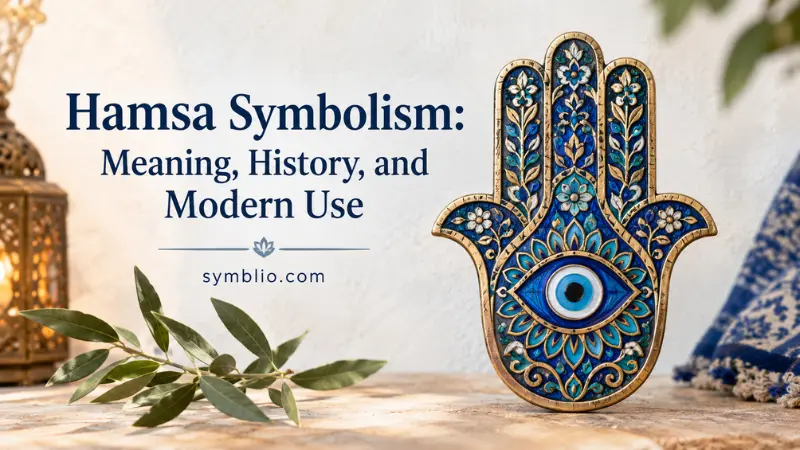
The hamsa is an open hand, usually shown with five fingers and often an eye in the center of the palm. Today, hamsa symbolism is commonly associated with protection, good fortune, and the desire to guard against the evil eye, making the image familiar in jewelry, home décor, artwork, and personal accessories in the United States.
Its history, however, is more complicated than a simple “good luck” meaning. The hamsa has been used across Jewish and Muslim communities, particularly throughout the Middle East and North Africa, while scholars continue to debate the precise origins of its earliest forms. The Arabic word khamsa means “five,” referring to the five fingers of the hand.
For Americans encountering the symbol today, that history creates several layers of meaning. A person may see a hamsa as a religious object, a family tradition, a cultural emblem, a piece of jewelry, or simply a visual reminder of protection. Understanding those differences makes the symbol much more meaningful than treating it as a generic decorative charm.
Quick Answer
Hamsa symbolism commonly represents protection from harm and the evil eye in modern American culture, especially in jewelry, home décor, and personal accessories. Historically, it has also carried Jewish, Muslim, and Middle Eastern and North African cultural meanings connected with blessing, protection, and spiritual identity.
TL;DR
- The hamsa commonly symbolizes protection and defense against the evil eye.
- Its name comes from khamsa, the Arabic word for five.
- Jewish and Muslim communities developed distinct interpretations of the symbol.
- American culture often treats the hamsa as a protective decorative emblem.
- Hamsa jewelry can express faith, heritage, identity, or personal meaning.
- Modern commercial use sometimes removes the symbol from its cultural context.
What the Hamsa Actually Looks Like
The basic hamsa resembles a human hand displayed with the palm facing outward. Its five fingers may appear naturally proportioned, but many traditional designs use a highly symmetrical form in which the two outer fingers curve outward or appear nearly identical.
An eye frequently appears in the center of the palm. This combination of hand and eye is particularly important because the symbol is strongly associated with protection against the “evil eye,” a widespread belief that an envious or harmful gaze can bring misfortune.
Not every hamsa contains an eye, however. Some designs use geometric patterns, flowers, Hebrew or Arabic lettering, or other decorative elements instead. The hand itself can carry the protective meaning even without the central eye.
The symbol appears on pendants, bracelets, necklaces, wall ornaments, pottery, textiles, door decorations, and other objects. Museum collections document hamsa-shaped ornaments from North Africa and the Middle East, including jewelry associated with Amazigh communities.
What Does the Hamsa Symbolize?
At its most consistent level, the hamsa represents protection.
That protection can be understood in several related ways:
- protection from envy or the evil eye
- protection of the household
- blessing and good fortune
- safeguarding children and family
- spiritual reassurance
- cultural identity
- connection to ancestry and tradition
The open palm itself contributes to the symbolism. A raised hand can communicate “stop,” creating a visual barrier between the wearer and whatever is considered harmful.
This helps explain why the hamsa and evil-eye imagery are often displayed together. The hand acts as a protective gesture, while the eye directly references the threat it is traditionally intended to counter.
The meaning is not identical in every community. For some people, the hamsa is primarily religious or cultural. For others, it is an inherited family symbol. In contemporary American settings, it can also function as a generalized sign of protection without a specific religious commitment.
Ancient Roots and the Question of Origins
The exact origin of the hamsa remains difficult to establish.
Researchers have proposed connections between hand-shaped protective imagery and older traditions of the ancient Mediterranean and Near East. Similar hand motifs existed before the modern Jewish and Muslim meanings associated with the hamsa developed.
That does not mean the modern hamsa can simply be assigned to one ancient religion. Its history developed across regions where cultures, languages, religions, and artistic traditions interacted for centuries.
One important documented example comes from the Alhambra in Granada, Spain. A large hand motif appears on the fourteenth-century Puerta Judiciaria, an Islamic architectural setting that demonstrates how the hand had become established within medieval Islamic visual culture.
Museum collections also show how the khamsa became part of protective jewelry in North Africa. A nineteenth- to early twentieth-century Moroccan ornament at the Metropolitan Museum of Art, for example, is described as a khamsa motif associated with protection from the evil eye.
Because of this complex history, claims that the hamsa “belonged originally” to only one modern religious community should be treated cautiously.
The Hamsa in Jewish Tradition
The hamsa became an important symbol within several Jewish communities, especially among Sephardic and Mizrahi Jews with historical connections to the Middle East and North Africa.
It is sometimes called the Hand of Miriam, referring to Miriam, the sister of Moses. In Jewish contexts, the symbol can represent protection and is sometimes connected with the idea of the hand of God.
The hamsa also became associated with Jewish folk practices and later with Kabbalistic symbolism. It appears in Jewish jewelry, household objects, art, and ceremonial contexts.
Its presence in Jewish life is particularly visible in Israel, where hamsas appear alongside other familiar Jewish visual symbols. My Jewish Learning notes that the symbol has become widespread in Jewish and Israeli material culture, including necklaces, wall decorations, keychains, and other household objects.
That does not mean every Jewish person regards the hamsa as a religious requirement. Its importance varies considerably according to family tradition, community, and individual belief.
The Hamsa in Muslim Tradition
In Muslim communities, the hamsa is commonly known as the Hand of Fatima, referring to Fatima, the daughter of the Prophet Muhammad.
The symbol has been particularly prominent in parts of North Africa and the Middle East, where it has appeared in jewelry, household decoration, architecture, textiles, and other forms of visual culture.
Its association with protection from the evil eye is especially important in folk traditions. At the same time, Muslims do not all interpret the hamsa in exactly the same way. Some regard it as a cultural tradition, while others may be uncomfortable with amulets or protective objects because of particular theological understandings of protection and divine power.
That distinction matters. Saying that “Islam teaches that the hamsa protects people” oversimplifies a much more diverse religious landscape.
What the Five Fingers Represent
The number five is central to the hamsa’s identity.
The Arabic name khamsa literally refers to five, making the five fingers an obvious part of the word and visual design. In some interpretations, the number five has additional religious associations.
Within Islamic contexts, the five fingers have sometimes been connected symbolically with the Five Pillars of Islam. Within Jewish interpretations, the five fingers can receive other religious or protective associations.
These interpretations should not be treated as one universal explanation. The same visual feature can acquire different meanings depending on the community using it.
The important point is that the number five is not accidental decoration. It is built into the name and visual structure of the symbol.
What the Hamsa Means in the United States
The American interpretation of the hamsa is broader than any single religious tradition.
In the United States, people commonly encounter hamsas in jewelry stores, home décor, tattoo designs, art, fashion, and spiritual marketplaces. Many Americans recognize the hand as a sign of protection even if they do not know its Jewish, Muslim, Middle Eastern, or North African history.
That creates several distinct American meanings.
| Context | Meaning in the USA | Common Associations | Notes |
|---|---|---|---|
| Jewish communities | Protection and cultural heritage | Miriam, family, Jewish art | Meaning can be religious or cultural |
| Muslim communities | Protection and cultural tradition | Fatima, family, North African and Middle Eastern heritage | Interpretation varies by individual |
| Jewelry | Personal protection or good fortune | Necklaces, bracelets, charms | Often separated from a specific faith |
| Home décor | Protection and welcoming symbolism | Entryways, wall art, decorative pieces | Often treated as a cultural motif |
| Tattoos | Personal identity or protection | Eyes, flowers, geometric patterns | Meaning is usually individualized |
American popular culture has therefore turned the hamsa into something that can operate on several levels at once.
Why People Wear Hamsa Jewelry
Jewelry gives the hamsa a particularly personal form.
A necklace or bracelet stays close to the wearer, making the symbol suitable for expressing protection, family connection, faith, or personal identity. In Jewish and Muslim communities, such jewelry can also function as a visible connection to cultural heritage.
In mainstream American fashion, however, the hamsa is frequently sold as a general protective charm. It may appear beside evil-eye beads, geometric pendants, crystals, or other spiritually themed accessories.
This wider marketplace has made the symbol accessible to people outside its traditional communities. It has also created a responsibility for wearers and designers to understand what the image represents rather than treating it as meaningless decoration.
Hamsa Symbolism in Tattoos
A hamsa tattoo often carries a more personal meaning than a piece of mass-produced jewelry.
People may choose the image to represent protection, family, resilience, cultural heritage, spirituality, or a reminder to avoid negativity. Some designs include an eye in the palm, while others use flowers, geometric patterns, ornamental details, or lettering.
Tattoo culture also encourages combinations between symbols. A hamsa may be incorporated into a larger design rather than functioning as a standalone image.
Because the hamsa has identifiable Jewish, Muslim, Middle Eastern, and North African associations, someone considering the design should understand that other people may read it as more than a generic “good luck” symbol. That is not necessarily a problem, but awareness helps prevent accidental misrepresentation.
Hamsa Symbolism in Home Décor
The hamsa is especially common in decorative objects intended for the home.
A hamsa mounted near an entrance can suggest protection of the household. A wall hanging may express cultural identity or simply create a visual reminder of safety and well-being.
This use has historical precedents. Protective hand motifs have appeared on jewelry and domestic objects in Middle Eastern and North African societies, including objects intended to guard against the evil eye.
In contemporary American interiors, the symbol is also common in eclectic and globally inspired décor. That newer decorative role does not erase its older meanings, but it does show how symbols change when they move between cultures.
Emotional and Psychological Meaning
Symbolic objects often work because people give them personal associations.
For someone who grew up seeing a hamsa in a family home, the image might evoke grandparents, childhood, religious traditions, or a particular cultural community. For another person, it may represent a simple intention to feel safe.
The open hand can also communicate a psychological boundary: keep harmful influences away.
That interpretation does not require believing that the object literally controls events. A person can use a hamsa as a reminder of values such as protection, calm, family connection, or cultural belonging.
In this sense, its emotional function comes partly from the meaning the wearer attaches to it.
Hamsa Symbolism and the Evil Eye
The evil eye is one of the most important concepts for understanding the hamsa.
Belief in the harmful effects of envy or an injurious gaze appears in many cultures and predates the modern use of the hamsa. The hamsa became one visual response to that broader concern.
The eye in the palm makes the connection especially obvious. Instead of simply displaying a hand, the design presents a hand that appears to confront or guard against harmful attention.
The hamsa should therefore not be treated as synonymous with the evil eye. The two are related symbols, but they are not the same symbol.
The evil eye describes a belief about harmful envy or a gaze, while the hamsa is one of several traditional protective responses to that threat.
How the Meaning Has Changed Over Time
The hamsa has moved through several overlapping stages of meaning.
In older regional traditions, it functioned primarily as a protective object. Its use was connected to concerns about misfortune, envy, family welfare, and the evil eye.
Jewish and Muslim communities subsequently incorporated the form into their own cultural and religious environments, giving it different names and interpretations.
In the modern period, the hamsa increasingly entered commercial design. Today it can appear on products far removed from the communities in which its meanings developed.
Its modern American interpretation therefore exists on a spectrum:
protective amulet → religious symbol → cultural emblem → personal accessory → decorative motif
None of these uses completely replaces the others.
Common Misunderstandings About the Hamsa
One common misunderstanding is that the hamsa belongs exclusively to either Judaism or Islam. Both traditions have important connections to the symbol, but its broader history crosses cultural and regional boundaries.
Another mistake is assuming that every hamsa has exactly the same religious meaning. A Jewish hamsa, a Muslim family’s inherited ornament, and a decorative necklace purchased from an American fashion store may look nearly identical while carrying very different personal meanings.
It is also misleading to describe the hamsa simply as an ancient “good luck symbol.” Good fortune can be part of its modern interpretation, but protection from the evil eye is a more historically central theme.
Finally, the symbol should not automatically be treated as a supernatural guarantee of safety. Many people use it as a cultural, religious, or personal reminder rather than making a literal claim about its powers.
Is the Hamsa a Religious Symbol or a Cultural Symbol?
The answer is both, depending on context.
Within particular Jewish and Muslim communities, the hamsa can carry religious and cultural associations. In other settings, it functions primarily as a regional cultural symbol or decorative motif.
This flexibility helps explain its popularity in the United States. American culture frequently separates visual symbols from their original contexts and gives them new personal meanings.
At the same time, commercial popularity can make historical context disappear. A respectful understanding recognizes both realities: the hamsa can be personally meaningful to someone buying a necklace in the United States, while also carrying centuries of cultural associations that existed long before the modern jewelry market.
Cultural Appreciation and Modern Use
Using a hamsa does not automatically mean someone is disrespecting the cultures associated with it. The more important question is whether the person understands that the symbol has a history.
For Arab Americans and members of Middle Eastern and North African diasporas, the hamsa can also express heritage and belonging. Contemporary discussion of Arab symbols in the United States increasingly frames them as ways of maintaining cultural identity across generations.
The best approach is therefore neither to declare every nontraditional use offensive nor to pretend that cultural context does not matter.
A hamsa can be appreciated as art while still being recognized as a symbol with Jewish, Muslim, Middle Eastern, and North African histories.
Hamsa Symbolism in Modern American Culture
By 2025 and 2026, the hamsa exists comfortably across several American cultural spaces.
It appears in fashion, jewelry, interior design, tattoo culture, artwork, social media imagery, and contemporary spiritual aesthetics. The symbol has also entered digital communication; the hamsa emoji was added to Unicode in 2021, making the image easier to use in everyday digital expression.
Its popularity reflects a larger American tendency to personalize symbols. People often combine inherited religious imagery with individual identity, fashion, family traditions, or personal spirituality.
That variety is now part of the symbol’s modern life.
FAQs
The hamsa most commonly symbolizes protection, especially protection against the evil eye. Depending on context, it can also represent blessing, family, cultural heritage, faith, and good fortune.
The hamsa has important associations in both Jewish and Muslim traditions. It is sometimes called the Hand of Miriam in Jewish contexts and the Hand of Fatima in Muslim contexts, although interpretations vary within both communities.
A hamsa tattoo can represent protection, personal identity, cultural heritage, spirituality, or a desire to keep harmful influences away. The meaning ultimately depends on the person wearing it.
The eye reinforces the hamsa’s association with protection from the evil eye. It creates a visual combination of the protective hand and the harmful gaze that the tradition seeks to repel.
It can be interpreted as a good-luck or protective symbol, especially in modern popular culture. Historically, however, protection from harm and the evil eye is a more precise description of its central role.
Yes. Hamsas have long appeared on household and decorative objects, and modern American homes may display them as cultural, religious, artistic, or protective symbols. The meaning depends on the household and its traditions.
The symbol combines a simple, recognizable design with associations of protection and identity. Its use in jewelry, fashion, art, and home décor has also introduced it to Americans who may encounter it outside Jewish or Muslim religious contexts.
Conclusion
The hamsa is best understood as a protective hand whose meaning changes with the culture and person using it. Its connections to the evil eye, Jewish and Muslim traditions, Middle Eastern and North African cultures, family life, and personal protection explain why the symbol has remained recognizable across generations.
In the United States, hamsa symbolism has expanded beyond its traditional settings. It can mark religious identity, cultural heritage, personal protection, family connection, or simply an appreciation for a distinctive form of traditional art.
What makes the symbol worth understanding is not a claim that one interpretation is universally correct. Its history shows how a single image can travel across communities while acquiring new meanings without completely losing its older ones.


