
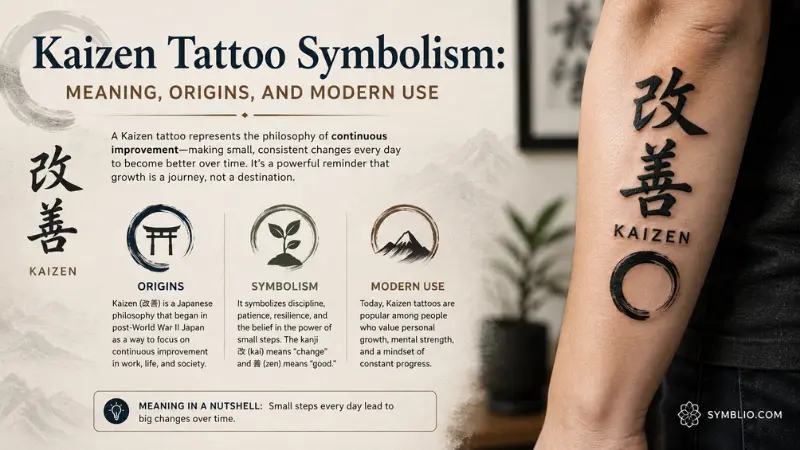
A kaizen tattoo is usually chosen as a reminder that lasting change rarely happens in one dramatic moment. Kaizen tattoo symbolism centers on steady improvement, self-discipline, learning from mistakes, and becoming better through repeated effort.
The tattoo may feature the Japanese characters 改善, the Romanized word KAIZEN, or a design that combines the term with imagery such as mountains, arrows, waves, or circles. In the United States, it is especially meaningful to people interested in fitness, recovery, business, sports, habit-building, and personal development.
The cultural background matters, however. Kaizen is Japanese, but it is not an ancient spiritual tattoo symbol. The ordinary Japanese word means improvement or betterment, while its internationally recognized connection with continuous improvement developed through modern Japanese management and manufacturing practices.
Quick Answer
Kaizen tattoo symbolism most often represents continuous improvement, discipline, persistence, and gradual personal growth. The idea comes from the Japanese word 改善 (kaizen), meaning improvement or betterment, which later became internationally associated with continuously finding better ways to work, learn, and develop.
TL;DR
- Kaizen represents steady improvement rather than instant transformation.
- 改善 is the standard Japanese written form of kaizen.
- Americans often connect it with discipline and personal growth.
- Its global reputation grew through Japanese continuous-improvement practices.
- Kaizen is not another word for Zen Buddhism.
- Accurate lettering is important when using Japanese characters.
What a Kaizen Tattoo Represents
At its simplest, a kaizen tattoo represents the decision to keep improving.
That improvement might involve physical strength, emotional maturity, professional skill, financial habits, education, relationships, creativity, or another part of life. The tattoo does not necessarily celebrate a finished accomplishment. Instead, it can represent an ongoing process.
This makes kaizen different from symbols centered on victory or completion. A trophy, crown, or finish line usually suggests that something has been achieved. Kaizen points in another direction: there is always another adjustment, lesson, or useful step available.
For many wearers, its message is therefore not “I have become perfect.”
It is closer to “I intend to keep learning.”
What the Japanese Word 改善 Means
Kaizen is written in Japanese as 改善 and pronounced roughly kai-zen.
As an ordinary Japanese word, 改善 means improvement or betterment. It can describe making a situation, process, condition, or method better. The broader international meaning of an organized philosophy of continuous improvement developed from that basic idea.
The word contains two kanji:
- 改 relates to changing, revising, or correcting.
- 善 can carry meanings such as good, goodness, or virtue.
For that reason, English explanations sometimes summarize kaizen as “change for the better.” That phrase captures the spirit of the word, although “improvement” is the more straightforward translation.
For tattoo purposes, this distinction is useful. Kaizen is not a secret phrase with a mystical translation. Its appeal comes largely from how an ordinary idea—improvement—can become a personal rule for living.
How Kaizen Became Linked With Continuous Improvement
The meaning Americans usually associate with kaizen is strongly connected with modern Japanese workplace and manufacturing culture.
During the decades after World War II, Japanese companies developed systems focused on quality, efficiency, problem-solving, employee participation, and repeated improvements to established processes. Kaizen became closely identified with this approach.
Toyota is one of the organizations most strongly associated with the term. The company identifies kaizen, or continuous improvement, as a central element of the Toyota Way and continues to describe improvement as an ongoing process rather than a one-time project.
As Japanese management practices became internationally influential, kaizen entered English-language business vocabulary. It came to describe an approach in which many practical improvements can accumulate into substantial long-term change.
That history explains why the tattoo commonly suggests consistency rather than sudden transformation.
What Kaizen Commonly Means in the United States
In contemporary American culture, kaizen has moved far beyond factories and corporate management.
People now apply the concept informally to:
- exercise and athletic training
- studying and education
- career development
- entrepreneurship
- habit-building
- creative work
- financial discipline
- recovery from setbacks
- personal organization
The basic logic remains similar: identify something that can be improved, make a useful change, observe the result, and continue.
That interpretation fits particularly well with American fitness and self-development culture, where measurable progress often occurs through repeated small actions. Someone lifting weights does not become stronger from one workout. A musician does not master an instrument in one practice session. A student does not learn a language from a single lesson.
A kaizen tattoo turns that process into a visible reminder.
Why Kaizen Symbolizes Discipline
Motivation is temporary. Discipline is repeated behavior.
That distinction helps explain why kaizen is often associated with self-discipline.
Continuous improvement depends on returning to the process even when enthusiasm has faded. One workout may feel insignificant. One hour of studying may seem small. Saving a modest amount of money may not immediately change someone’s life.
Repeated consistently, however, small actions can produce meaningful results.
The kaizen tattoo can therefore symbolize a willingness to continue doing useful work without needing instant rewards.
This meaning makes it especially appropriate for someone who values routine, patience, accountability, and long-term effort.
Kaizen as a Symbol of Personal Growth
Personal growth is probably one of the most natural modern interpretations of a kaizen tattoo.
Growth does not always mean becoming more productive or successful. It can also involve learning to communicate better, recognizing mistakes, changing harmful habits, developing patience, setting boundaries, or gaining emotional maturity.
Kaizen provides a framework for seeing identity as unfinished.
Instead of dividing life into “before” and “after,” the symbol suggests a continuing process. A person can improve without rejecting who they were yesterday.
That makes the tattoo less about proving something to other people and more about maintaining a private standard: keep becoming more capable, aware, or intentional.
Resilience, Recovery, and Starting Again
A kaizen tattoo can also symbolize recovery after a difficult period.
Some transformation symbols emphasize dramatic rebirth. The phoenix, for example, is often associated with destruction followed by renewal. Kaizen communicates a quieter kind of resilience.
Its message is based on rebuilding one step at a time.
That can make the concept meaningful after career failure, financial problems, athletic setbacks, academic struggles, or another period that required someone to rebuild routines and confidence.
Failure also fits naturally into kaizen symbolism because improvement depends on feedback. A mistake can reveal what should change next.
The tattoo can therefore serve as a reminder that a setback does not erase earlier progress. The next improvement is still available.
Progress Without Perfection
Kaizen is often interpreted as an alternative to perfectionism.
Perfection asks whether the result is flawless. Kaizen asks whether something can become better than it is now.
Those questions create different attitudes toward progress.
A perfectionist may delay beginning because the ideal result seems unreachable. Someone applying an improvement mindset can instead focus on the next practical change.
Within continuous-improvement systems, the current method is not treated as permanently finished. Toyota’s own description of its philosophy emphasizes continuing to seek better methods rather than remaining satisfied with the present state.
As tattoo symbolism, that idea can be summarized simply:
Better does not have to mean perfect.
Kanji vs. KAIZEN in English Letters
A kaizen tattoo can be written as 改善 or KAIZEN, and both versions can communicate the same basic concept.
The visual effect differs, however.
改善
Using the Japanese characters connects the tattoo directly to the word’s language of origin. The characters can be arranged horizontally or vertically and often work well in compact designs.
The drawback is that incorrect Japanese lettering may go unnoticed by someone who cannot read it.
KAIZEN
The Romanized form is immediately recognizable to English-speaking viewers. It can also fit minimalist typography, geometric designs, bracelets, banners, or small script tattoos.
Neither version is automatically more meaningful.
The best choice depends on whether the wearer values the Japanese written form, immediate readability, or a particular visual style.
Kaizen Is Not the Same as Zen Buddhism
One of the most common misunderstandings comes from the final syllable of kaizen.
The zen in kaizen is not the same written character used for Zen Buddhism.
Kaizen contains 善, a character associated with goodness or virtue. Zen Buddhism uses 禅, a different kanji associated with Zen and meditation.
So a kaizen tattoo does not automatically symbolize Buddhism, meditation, enlightenment, or Zen philosophy.
A wearer can personally combine those ideas if they are meaningful to them, but that would be an individual interpretation rather than the literal meaning of 改善.
Understanding the difference prevents a common cultural and linguistic mistake.
Symbols Commonly Paired With Kaizen
Kaizen does not require any additional imagery, but some people combine the word with another symbol to make the tattoo more personal.
Mountain
A mountain can emphasize long-term effort, challenge, and gradual advancement. It works well when kaizen represents a difficult goal that requires patience.
Upward Arrow
An arrow adds a clear visual suggestion of progress and direction. It can make the improvement theme immediately understandable.
Koi Fish
A koi can introduce ideas of perseverance, determination, and movement through difficulty. When paired thoughtfully with kaizen, it creates a design focused strongly on persistence.
Waves
Waves can suggest change, adaptation, motion, and learning to respond to changing circumstances.
Circle
A simple circle may represent continuity or an ongoing process. If the design specifically imitates a Zen ensō, however, it introduces a separate Buddhist artistic tradition rather than an inherent part of kaizen.
Steps or Path
Stairs, footprints, or a path can make incremental progress visually literal: each stage leads toward another.
The strongest combinations usually add a distinct idea instead of repeating the word with unnecessary decoration.
Does Tattoo Placement Change the Meaning?
Placement does not change the dictionary meaning of kaizen, but it can change how the tattoo functions personally.
A wrist or forearm tattoo remains easy for the wearer to see, which suits someone who wants the word as a daily reminder.
A chest tattoo may feel more private and personal.
A design along the spine, ribs, calf, or upper arm can accommodate vertical Japanese lettering.
Larger placements also allow kaizen to be combined with mountains, waves, koi, or other imagery.
The choice is therefore less about traditional placement rules and more about whether the tattoo is meant to be private, visible, decorative, or frequently seen by the wearer.
Kaizen Meanings at a Glance
| Context | Common Symbolism | Main Idea |
|---|---|---|
| Personal growth | Self-improvement | Become better gradually |
| Fitness | Discipline and consistency | Small efforts accumulate |
| Career | Skill development | Keep learning and adjusting |
| Recovery | Rebuilding | Progress can restart after setbacks |
| Sports | Refinement and practice | Improve details repeatedly |
| Daily life | Better habits | Focus on manageable changes |
Cultural Respect and Accurate Use
Choosing a word from another language does not automatically make a tattoo disrespectful. Problems usually arise when the wearer invents a false history or uses incorrect writing.
Kaizen is sometimes described online as an ancient Japanese spiritual philosophy. That description is misleading.
The Japanese word 改善 simply means improvement or betterment, while the globally familiar idea of kaizen as systematic continuous improvement is strongly connected with modern Japanese management practice.
Another mistake is treating the two kanji as though each one provides a perfectly separate English word and then presenting “change for the better” as a mysterious literal formula. Kanji compounds function as complete words, so improvement remains the clearest basic meaning.
Anyone planning to tattoo 改善 should also verify:
- the characters are correct
- their order is correct
- the orientation works properly
- decorative fonts have not distorted the forms
Having the final artwork checked by someone who reads Japanese can prevent a permanent lettering mistake.
Is Kaizen Always a Positive Symbol?
Kaizen is generally positive because improvement is central to its meaning.
Its most common associations include:
growth, adaptability, patience, discipline, learning, responsibility, consistency, and persistence.
However, personal improvement can become unhealthy when interpreted as a requirement to optimize every part of life constantly.
Kaizen does not have to mean that the present self is inadequate.
A more balanced interpretation is that something can be accepted as it is while still having room to improve.
Rest can be useful. Satisfaction can be healthy. Not every part of life needs constant measurement.
For tattoo symbolism, this distinction creates a more sustainable message: improve because growth matters, not because you must prove your worth every day.
How the Meaning Evolved From Workplace Idea to Personal Motto
Kaizen provides a good example of how symbolism changes when ideas move between contexts.
In Japanese, 改善 functions as a word for improvement. In modern Japanese industry, kaizen became closely associated with systematic efforts to improve work, quality, efficiency, and processes. Toyota formally places kaizen within its broader principle of continuous improvement.
Outside Japan, the concept expanded.
People began applying the same logic not only to manufacturing but also to leadership, productivity, fitness, learning, and personal habits.
That change explains the modern tattoo interpretation.
A factory might ask, “How can this process work better?”
A person wearing the tattoo may instead ask, “What can I do a little better today?”
The setting changed, but the central idea of improvement remained recognizable.
What a Kaizen Tattoo Can Say About the Wearer
A tattoo is personal, so no design can reveal someone’s personality with certainty.
Still, choosing kaizen commonly communicates certain values.
The wearer may value:
- consistency over short bursts of motivation
- learning over pretending to know everything
- gradual progress over instant results
- adaptability over stubbornness
- effort over perfection
- responsibility for personal development
There is also a degree of humility in the concept.
Kaizen does not announce that someone has finished becoming who they want to be. It acknowledges that development continues.
That quality gives the tattoo a quieter message than many symbols of strength or achievement.
It does not necessarily say “I conquered.”
It says “I continue.”
Choosing a Kaizen Tattoo With Intention
Before getting the tattoo, decide what improvement actually means in your life.
For one person, kaizen might represent consistent exercise. For another, it could mark rebuilding after failure, learning a craft, developing better habits, or refusing to become complacent.
Then decide how literally you want to express the idea.
A simple 改善 design keeps the focus on the Japanese word. KAIZEN makes the message easier for an American audience to recognize. Additional imagery can introduce another layer of meaning, but it should support rather than overwhelm the concept.
Most importantly, avoid choosing the tattoo because of a false claim that kaizen is an ancient mystical teaching.
Its real meaning is more practical—and arguably more useful.
Improvement happens by recognizing what can change and continuing to work on it.
Frequently Asked Questions
What does a kaizen tattoo symbolize?
A kaizen tattoo usually symbolizes continuous improvement, discipline, personal growth, and consistent effort. It is often chosen as a reminder to focus on gradual progress rather than expecting immediate transformation.
What does 改善 mean?
改善 (kaizen) means improvement or betterment in Japanese. In international usage, the word is also strongly associated with continuous improvement in workplaces, organizations, and personal development.
Is kaizen a spiritual Japanese symbol?
Not traditionally. Kaizen is a Japanese word for improvement, and its famous continuous-improvement meaning is strongly associated with modern management rather than an ancient religious tradition.
Is kaizen related to Zen Buddhism?
No. Kaizen uses 善, while Zen Buddhism is written with 禅; they are different characters with different meanings.
Is a kaizen tattoo good for personal growth?
Yes, if the wearer connects improvement with personal development. It can represent learning from mistakes, maintaining better habits, developing skills, or continuing to move forward after setbacks.
Should I tattoo KAIZEN or 改善?
Both can work. 改善 uses the standard Japanese spelling, while KAIZEN is easier for most English-speaking Americans to recognize and avoids mistakes caused by poorly reproduced kanji.
Can kaizen symbolize overcoming hardship?
It can, although recovery is a modern personal interpretation rather than the literal definition of the word. In that context, kaizen represents rebuilding gradually and continuing to make progress even after setbacks.
Conclusion
Kaizen tattoo symbolism is centered on a practical idea: improvement happens through continued effort, learning, correction, and adjustment. Its roots lie in the Japanese word 改善, meaning improvement, while its modern international associations have been shaped by the Japanese approach to continuous improvement.
For many Americans, that idea translates naturally into personal growth, fitness, recovery, education, career development, and better habits. The tattoo does not need to promise perfection or dramatic transformation.
Its message is simpler: find the next useful improvement, make it, and continue.


