
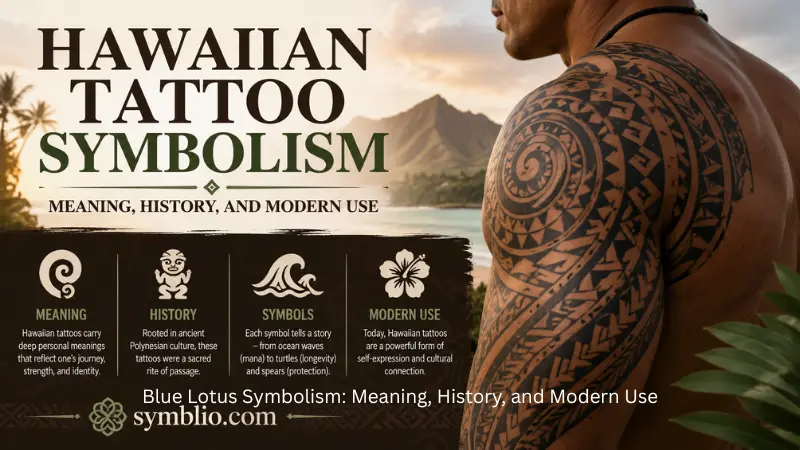
Hawaiian tattoo symbolism is closely connected with identity, ancestry, family, remembrance, responsibility, and relationships to people and place. In traditional Hawaiian culture, tattooing was not simply decorative body art. A tattoo could mark an important experience, express grief, show loyalty, commemorate a person, or carry meaning understood through a particular family or community.
Today, Hawaiian-inspired tattoos appear throughout the United States, from traditional hand-tapped work in Hawaiʻi to contemporary designs in mainstream tattoo studios. That popularity has also created confusion. Hawaiian tattooing often gets grouped with every geometric “Polynesian” tattoo, even though Hawaiian, Samoan, Māori, Tongan, Tahitian, and other Pacific traditions have distinct histories and cultural conventions.
Understanding Hawaiian tattoos therefore requires more than matching individual shapes with one-word definitions. The person, placement, family history, practitioner, cultural setting, and reason for receiving the tattoo may all shape what it communicates.
Quick Answer
Hawaiian tattoo symbolism most commonly represents identity, ancestry, family connections, remembrance, responsibility, and cultural belonging in modern American culture. Historically, Hawaiian tattooing also served purposes such as mourning, marking important events, expressing loyalty, adornment, and connecting a person with particular people, places, or spiritual relationships.
TL;DR
- Hawaiian tattooing is traditionally known as kākau.
- Meanings often involve ancestry, identity, remembrance, and cultural responsibility.
- Historical tattoos could mark grief, loyalty, experiences, or social relationships.
- No universal dictionary explains every traditional Hawaiian tattoo pattern.
- Modern revival connects tattooing with Native Hawaiian cultural continuity.
- Hawaiian and other Polynesian tattoo traditions are related but not identical.
What Hawaiian Tattoos Commonly Symbolize Today
In modern Hawaiʻi and the wider United States, Hawaiian tattoos can communicate several overlapping ideas.
Ancestry is one of the most important. A culturally grounded tattoo may connect a person with parents, grandparents, earlier generations, or a broader genealogy.
Family responsibility can be just as significant. Rather than simply celebrating where someone came from, a tattoo may remind the wearer of obligations to relatives, children, community, or future generations.
Remembrance is another established theme. Memorial tattoos are common in modern American tattoo culture, but permanent body marking associated with mourning also has historical precedent in Hawaiʻi.
Other common meanings include courage, personal commitment, cultural pride, belonging, spiritual connection, and attachment to Hawaiʻi.
The meaning is not automatically determined by appearance, however. Two tattoos with similar geometric elements may represent very different experiences because the wearers, families, and circumstances differ.
| Context | Common Meaning | Important Distinction |
|---|---|---|
| Family-centered tattoo | Ancestry, responsibility, continuity | Meaning may be personal or genealogical |
| Memorial tattoo | Grief, remembrance, enduring bonds | Mourning has documented historical precedent |
| Cultural tattoo | Identity, belonging, Hawaiian heritage | More than decorative island imagery |
| Spiritual context | Relationship, commitment, protection | Not every motif has supernatural meaning |
| Hawaiian-inspired design | Strength, ocean, travel, personal story | May be modern rather than traditional |
| Decorative “Polynesian” tattoo | Style and visual identity | Should not automatically be labeled Hawaiian |
What Kākau Means in Hawaiian Tattoo Tradition
Kākau is a Hawaiian term associated with tattooing and marking the skin. Traditional Hawaiian tattoo practice is also frequently discussed as kākau uhi, especially in modern cultural revitalization.
Hawaiian-language references distinguish among several tattoo-related expressions rather than treating uhi as a simple universal synonym for every kind of tattoo. That distinction matters because English-language explanations sometimes flatten Hawaiian terminology into definitions that are broader than the language itself supports.
Traditional methods may involve hand-tapping rather than an electric tattoo machine. A toothed or pointed tattooing implement carries pigment into the skin while another tool strikes it in a controlled rhythm.
For culturally grounded practitioners, however, technique is only part of the practice. Preparation, genealogy, knowledge, relationships, and the appropriateness of a design can matter as much as the physical application.
A traditional Hawaiian tattoo is therefore better understood as a cultural practice expressed through the body, not simply as a recognizable graphic style.
How Tattoos Functioned in Earlier Hawaiian Society
Historical Hawaiian tattooing did not serve a single purpose.
Tattoo practices varied among communities, families, islands, and circumstances. Historical descriptions record tattoos used in connection with major events, personal relationships, loyalty to leaders, grief, spiritual associations, social identity, and adornment.
This variety explains why attempts to define Hawaiian tattooing solely as “warrior symbolism” are misleading.
Some tattoos may indeed have been associated with warriors or courage, but warfare was only one part of a much broader tradition. Men and women could both receive tattoos, and designs appeared on many areas of the body.
Earlier Hawaiian tattooing was flexible enough to respond to the life and social environment of the wearer. Meaning came from context as well as form.
Mourning and Remembrance Have Strong Historical Roots
Grief is among the clearest documented meanings associated with Hawaiian body marking.
When a loved one or respected leader died, people could mark or scar their bodies as expressions of sorrow. Tattooing was one way grief became physically visible and permanent. Historical records of Hawaiian tattooing repeatedly connect body marks with bereavement and remembrance.
This history gives memorial tattoos an important place in discussions of Hawaiian symbolism.
A modern tattoo honoring a parent, grandparent, sibling, partner, or other relative may carry a deeply personal meaning even if its design differs from historical examples. The underlying idea remains recognizable: the body becomes a lasting place for memory.
That does not mean every modern memorial design represents a direct continuation of a specific ancient custom. Personal symbolism and documented tradition should remain distinct.
Still, remembrance is not a modern meaning invented by tattoo culture. It has genuine historical roots in Hawaiʻi.
Ancestry, Family, and Cultural Identity
Genealogy plays a major role in many contemporary discussions of traditional Hawaiian tattooing.
For Native Hawaiians, ancestry can connect an individual with generations of family, cultural knowledge, and relationships to Hawaiʻi. A tattoo informed by genealogy may therefore communicate far more than family pride.
It can also represent kuleana, a Hawaiian concept commonly associated with responsibility, privilege, and obligation.
In that sense, a tattoo does not have to say, “Look at what I have achieved.” It may instead remind the wearer of what they owe to family, community, or those who come after them.
This distinction makes Hawaiian identity symbolism different from generic motivational tattooing.
A tattoo may honor the past while setting expectations for the wearer’s conduct in the present. Genealogy establishes relationships; responsibility determines how those relationships continue.
Contemporary revitalization has reinforced the importance of designs connected with genealogy and personal cultural context rather than randomly selected motifs.
Protection and Spiritual Meaning Need Context
Protection frequently appears in modern explanations of Hawaiian tattoos, but it is easy to oversimplify.
A traditional tattoo should not be treated like a standardized charm in which one geometric shape automatically guarantees safety, luck, or strength.
Older Hawaiian spiritual life involved relationships among people, ancestors, deities, places, natural forces, and inherited knowledge. Tattoo meanings could exist inside those relationships rather than inside an isolated shape.
For a modern wearer, a tattoo associated with protection may represent being guided by ancestors, strengthened by family, reminded of personal responsibilities, or grounded by cultural identity.
Someone outside that cultural setting may use “protection” more personally, perhaps viewing a tattoo as a reminder of resilience after hardship.
Both interpretations can matter, but they should not be confused with a claim that every traditional Hawaiian pattern possesses the same supernatural function.
Why Hawaiian Tattoo Patterns Do Not Have One Fixed Dictionary
Online tattoo guides often present neat equations:
triangle = strength
wave = change
shark tooth = protection
turtle = longevity
The reality is more complicated.
Polynesia includes numerous Indigenous cultures whose tattoo traditions developed through different histories, languages, and social systems. Designs found in Hawaiʻi cannot automatically be interpreted through explanations taken from Sāmoa, Aotearoa New Zealand, Tahiti, Tonga, or the Marquesas.
Even within Hawaiian traditions, tattooing historically varied among places, families, and circumstances.
A repeating triangle, line, band, or black field may contribute to the composition without carrying one universal English-language definition.
That does not mean traditional designs lacked meaning. It means the meaning could depend on knowledge that existed alongside the design: who created it, who received it, where it appeared, and why it was applied.
Readers should therefore be cautious of websites claiming to provide an exact translation for every Hawaiian tattoo motif.
Geometric Designs and Nature-Inspired Imagery
Historical Hawaiian tattoos included geometric forms such as lines, bands, repeated triangular elements, dark fields, crescents, dots, and combinations arranged around the body’s shape.
These patterns could emphasize movement, create visual contrast, or connect one part of a larger composition with another.
Modern Hawaiian-inspired tattoos often expand the visual vocabulary considerably.
People now choose sea turtles, sharks, waves, hibiscus flowers, mountains, native plants, birds, suns, ocean scenes, and other imagery associated with Hawaiʻi.
These subjects can carry valid personal symbolism, but personal meaning should not automatically be advertised as ancient Hawaiian tradition.
A hibiscus tattoo, for example, might represent a wedding in Hawaiʻi, a family trip, beauty, or affection for the islands. An ocean design might commemorate a surfing career or a childhood spent near the sea.
Those stories are meaningful because they belong to the wearer. They do not need an invented ancient origin to become significant.
Tattoo Placement Can Change the Message
Placement is an important part of tattoo design because the body is not a flat canvas.
Traditional Hawaiian tattooing could appear on different parts of the body, and historical examples show considerable variation rather than one required arrangement.
A long design following the leg communicates differently from a small shoulder tattoo. Bands emphasize the circumference of a limb, while larger compositions can follow muscle, movement, and body structure.
Placement can also influence visibility. A tattoo displayed openly may function as a public statement of identity, while a less visible design may carry a more private meaning.
One particularly important modern example is the familiar Hawaiian-style armband. Although many people assume that this form is an unchanged ancient Hawaiian convention, a widely circulated modern armband style became especially prominent during the Hawaiian cultural revival of the late twentieth century rather than representing a single standard ancient layout.
Modern does not mean meaningless. A newer form can still become an important expression of identity and cultural pride.
European Contact Changed Hawaiian Tattooing
Tattooing existed in Hawaiʻi before sustained European contact.
When European visitors began documenting Hawaiian life in the late eighteenth and early nineteenth centuries, they recorded tattooed people, patterns, and practices through written descriptions and artwork.
Contact also introduced new visual possibilities. Foreign letters, words, objects, and other imagery could appear alongside established Hawaiian forms.
Over time, much larger social and political changes disrupted the conditions in which Hawaiian traditions had been transmitted.
Western religious influence, political transformation, disease, demographic loss, and pressures on Native Hawaiian language and cultural institutions reshaped Hawaiian society during the nineteenth and early twentieth centuries.
Tattoo knowledge did not simply vanish on a single date, nor did every practice disappear in the same way. Instead, transmission became fragmented, and later generations had to work with surviving cultural knowledge, Hawaiian-language materials, historical accounts, museum collections, visual records, and living practitioners.
This is why modern Hawaiian tattoo revival involves both continuity and reconstruction.
Cultural Revival Gave Tattooing a New Public Role
The Hawaiian Renaissance of the late twentieth century renewed public interest in Hawaiian language, hula, voyaging, genealogy, traditional arts, history, and Native Hawaiian identity.
Tattooing became part of that broader cultural renewal, although its revival developed gradually.
By the late twentieth century, practitioners were increasingly studying older Hawaiian designs and methods while restoring hand-tapped tattooing and the cultural protocols surrounding it. Historical accounts describe the revival of kākau gaining momentum after the wider Hawaiian cultural renaissance had already begun.
That revival added another layer of symbolism: cultural continuity.
For some Native Hawaiian wearers, receiving a traditional tattoo can affirm that Hawaiian cultural practices belong to living communities rather than solely to museums or historical books.
The tattoo can acknowledge ancestors while also asserting a contemporary identity.
In this setting, preservation does not necessarily mean freezing every design exactly as it appeared two centuries ago. Cultural traditions can continue through careful learning, adaptation, and transmission while remaining accountable to the communities that sustain them.
Hawaiian Tattoos in Modern U.S. Culture
Hawaiian tattoos now exist within several overlapping cultural settings in the United States.
Within Native Hawaiian communities, tattooing may express genealogy, cultural commitment, family relationships, identity, remembrance, or personal responsibility.
In mainstream American tattoo culture, Hawaiian and Polynesian-inspired styles are also popular for their bold geometric compositions. Sleeves, shoulder pieces, chest designs, leg work, and armbands have made the broader visual style recognizable far beyond the Pacific.
Surfers, travelers, athletes, military personnel, celebrities, and people with family connections to Hawaiʻi have all contributed to its visibility.
Social media has expanded that exposure further. A tattoo created for one person’s genealogy can circulate online thousands of miles away from the cultural explanation that originally accompanied it.
As a result, people sometimes copy a design because they like its appearance without knowing whether it represents a particular family, practitioner, culture, or story.
Modern visibility therefore brings both appreciation and risk of misunderstanding.
Hawaiian and Polynesian Tattoos Are Not Identical
Hawaiians are part of the wider Polynesian world, but Hawaiian tattoo and Polynesian tattoo are not exact synonyms.
Pacific peoples share ancient connections, yet their cultures developed distinct languages, artistic traditions, political histories, and tattoo practices.
Samoan tatau, Māori tā moko, and Hawaiian kākau should therefore be identified by their own cultural traditions whenever possible.
A Samoan peʻa should not simply be labeled an ancient Hawaiian tattoo. Likewise, Māori facial moko belongs to Māori culture, not Hawaiian tradition.
Contemporary tattoo artists sometimes combine influences from several Pacific cultures. Such work may be intentional and artistically sophisticated, but it is more accurate to call it contemporary Polynesian-inspired work than to invent a specifically Hawaiian origin for every motif.
Recognizing cultural distinctions does not deny the relationships among Polynesian peoples. It treats those relationships more precisely.
Cultural Appropriation and Misuse
The growth of Polynesian-inspired tattooing has raised questions about cultural appropriation.
There is no single opinion shared by every Native Hawaiian about who should receive Hawaiian-inspired tattoos. Views differ among individuals, families, practitioners, and communities.
The clearest problems occur when someone copies culturally specific work without understanding it, falsely claims Hawaiian ancestry or status, or markets an invented meaning as authentic tradition.
Another problem is treating Polynesian cultures as interchangeable.
Labeling Māori, Samoan, Marquesan, Tahitian, and Hawaiian designs collectively as “Hawaiian tribal tattoos” removes the cultural identity of the people who developed them.
Respectful interest begins with accuracy.
A person does not need to invent a sacred story for a tattoo simply because they admire Hawaiʻi. A contemporary design inspired by the ocean, landscape, or personal memories can be described honestly as personal symbolism.
Traditional or genealogy-based work deserves greater care because its meaning may extend beyond individual preference.
Choosing a Hawaiian-Inspired Tattoo Respectfully
Anyone considering a Hawaiian or Hawaiian-inspired tattoo should begin with purpose rather than appearance.
Ask why the design matters.
Is it connected with Hawaiian ancestry? A family relationship? A period of life spent in Hawaiʻi? A memorial? Cultural participation? Or simply appreciation for an artistic style?
The answer helps determine what kind of tattoo is appropriate.
For traditional work, seeking a practitioner with genuine knowledge of Hawaiian tattooing is especially important. Some designs may be developed for a particular individual instead of selected from a catalog.
Someone without Hawaiian ancestry can also avoid unnecessary problems by not claiming a genealogical, chiefly, spiritual, or cultural status that does not belong to them.
For a personal island-inspired tattoo, honesty is usually better than artificial antiquity. A wave can represent your relationship with the ocean without being presented as a thousand-year-old Hawaiian symbol. A flower can commemorate a meaningful experience without needing a fabricated traditional definition.
Respectful tattoo choices combine curiosity with restraint: learn what is known, acknowledge what is uncertain, and do not turn cultural complexity into a decorative myth.
How Hawaiian Tattoo Meaning Has Evolved
Hawaiian tattooing has carried different meanings in different eras.
Earlier practices included remembrance, adornment, loyalty, social relationships, spirituality, and connections with significant people, places, or events.
European contact introduced new imagery while political and cultural upheaval gradually disrupted the transmission of many Native Hawaiian traditions.
Twentieth-century commercial tattoo culture then popularized designs that were often marketed broadly as “tribal” or “Polynesian,” sometimes without explaining their specific origins.
The modern cultural revival has moved in another direction.
Many Native Hawaiian practitioners and wearers now emphasize genealogy, historical knowledge, responsibility, cultural identity, and continuity. Tattooing can be aesthetically striking while also serving as evidence that Hawaiian cultural practices remain alive and adaptable.
The symbolism has therefore not traveled in a straight line from ancient Hawaiʻi to the present. It has changed with Hawaiian society itself.
FAQs
Hawaiian tattoos can symbolize ancestry, family relationships, identity, remembrance, responsibility, loyalty, spiritual connections, or significant life experiences. Their meaning depends on cultural context and the wearer rather than one universal symbol chart.
Kākau is a Hawaiian term used for tattooing, while kākau uhi appears in discussions of traditional tattoo practice. Hawaiian vocabulary includes more specific tattoo terms as well, so uhi should not simply be treated as an exact English synonym for every tattoo.
Some tattoos may carry protective or spiritual associations, especially when connected with ancestors, relationships, or culturally grounded practices. However, it is inaccurate to claim that every triangle, tooth-like shape, or geometric pattern automatically means protection.
No. Hawaiian tattooing belongs to the broader Polynesian cultural world, but Hawaiian, Samoan, Māori, Tongan, Tahitian, Marquesan, and other tattoo traditions have their own histories and conventions.
Yes. Remembrance is particularly relevant because grief and mourning are among the historically documented reasons Hawaiians marked their bodies. A modern memorial tattoo may use a contemporary design while still expressing the enduring idea of carrying someone’s memory.
There is no single rule accepted by every Hawaiian person or practitioner. A respectful approach avoids false claims of ancestry or status, distinguishes personal designs from traditional ones, and seeks knowledgeable guidance when culturally specific imagery is involved.
No universal dictionary exists for every Hawaiian tattoo element. Meaning can depend on the complete composition, wearer, genealogy, placement, practitioner, family knowledge, and circumstances in which the tattoo was created.
Conclusion
Hawaiian tattoo symbolism is best understood through relationships rather than isolated shapes. Tattoos have expressed grief, identity, family connections, loyalty, cultural belonging, personal experience, adornment, and spiritual relationships, while their exact meanings have always depended on context.
In modern Hawaiʻi and across the United States, the tradition also represents cultural continuity. Native Hawaiian tattoo practitioners and wearers have helped reconnect body art with genealogy, responsibility, historical knowledge, and living cultural identity.
Understanding a Hawaiian tattoo therefore requires a better question than “What does this pattern mean?” Ask who created it, who wears it, why it was chosen, and what cultural or personal relationships give the design its meaning.


