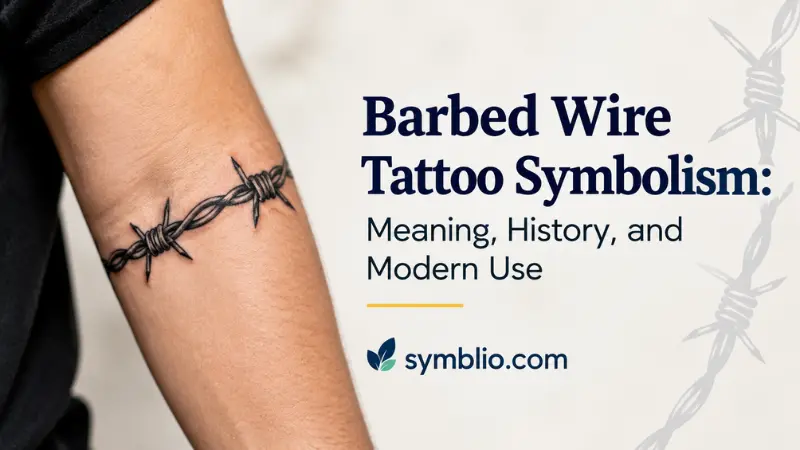
Barbed wire tattoo symbolism often centers on protection, personal boundaries, hardship, resilience, and freedom after restriction. The design can look simple—a strand of twisted wire with sharp barbs—but its associations come from the very real purposes barbed wire has served in American history.
Barbed wire itself became especially important in the United States during the late 19th century, when inexpensive fencing changed farming and ranching across the American West. Over time, the image became associated not only with property lines and protection but also with conflict, confinement, military barriers, and separation.
In tattoo culture, those associations become personal. One person may see barbed wire as a reminder of surviving a difficult period, while another may use it to represent emotional boundaries or independence. For some people, particularly those familiar with 1990s tattoo fashion, it is simply a recognizable decorative design.
Understanding the symbol requires looking at both its historical associations and the personal meaning a tattoo wearer gives it.
Quick Answer
Barbed wire tattoo symbolism commonly represents protection, personal boundaries, resilience, hardship, or the desire for freedom in modern American tattoo culture. Its historical associations with American fencing, military barriers, confinement, and separation can add meanings related to struggle, restriction, endurance, or overcoming obstacles.
TL;DR
- Barbed wire often represents protection, boundaries, and resilience.
- Its American history is closely connected to fencing and the Western frontier.
- Military and confinement associations added darker interpretations over time.
- The 1990s made barbed wire armbands a recognizable tattoo trend.
- Broken wire can suggest freedom, change, or overcoming restriction.
- Today, many designs carry personal rather than fixed meanings.
What Does a Barbed Wire Tattoo Look Like?
A barbed wire tattoo usually depicts a thin strand of twisted metal with sharp points placed at intervals. Artists may render it realistically, simplify it into clean black lines, or incorporate it into a larger composition.
The design can appear as:
- A band around the upper arm or wrist
- A strand crossing the forearm, shoulder, chest, or back
- Broken or cut wire
- Wire wrapped around another image
- Barbed wire surrounding lettering
- Wire combined with flowers, hearts, crosses, skulls, animals, or other imagery
- A crown-like arrangement around the head or upper body of a design
The visual structure matters because a continuous loop suggests enclosure or protection, while broken wire can suggest escape or release.
A delicate version may communicate something different from a heavily shaded, realistic design. The same basic symbol can therefore shift considerably depending on line style, surrounding imagery, placement, and the person’s reason for choosing it.
The Original Purpose of Barbed Wire
Barbed wire was not originally created as a tattoo symbol. Its most important early American role was practical.
During the 19th century, farmers and landowners needed inexpensive ways to control livestock and establish property boundaries. Wood could be expensive or difficult to obtain in some parts of the developing American West, while ordinary wire did not always provide an effective barrier.
Several inventors developed forms of wire fencing, with Joseph Glidden’s 1874 patent becoming particularly important to the development and spread of modern barbed wire.
The technology transformed the landscape. Fences could separate farmland from grazing areas and help landowners control livestock without building large wooden barriers.
That practical function created an important symbolic foundation: barbed wire was something that marked a boundary and prevented passage.
Modern tattoo interpretations of protection, separation, and boundaries can therefore be connected to the physical purpose of the object itself.
How Barbed Wire Became Associated With the American West
Barbed wire became closely connected with the transformation of the American frontier.
Before widespread fencing, the open range allowed cattle to move across large areas. As private landownership and agricultural development expanded, fencing increasingly divided previously open spaces.
The change created economic and social conflicts. Some ranchers opposed fencing because it restricted access to grazing areas and water. Farmers and landowners, meanwhile, viewed fences as practical tools for protecting crops and property.
This history gives barbed wire a complicated American association. It can represent security and ownership, but it can also represent restriction and division.
That tension remains important when interpreting the tattoo. The same object that protects one person can confine another.
What Barbed Wire Commonly Symbolizes in the United States
In modern American tattoo culture, several meanings appear repeatedly.
Protection
Because barbed wire keeps people or animals from crossing a boundary, it can symbolize protection.
A person may use the design metaphorically to communicate that they have learned to protect their privacy, emotions, relationships, or personal space.
Personal Boundaries
The design can represent the idea of maintaining a clear line between oneself and others.
This interpretation does not necessarily suggest hostility. It can simply communicate independence and the importance of deciding who or what is allowed into one’s life.
Resilience
The combination of a fragile-looking line and sharp defensive points can suggest endurance.
Some people interpret the design as a reminder that difficult experiences did not permanently defeat them.
Restriction
A fence is also something that prevents movement. Consequently, barbed wire can symbolize feeling trapped by circumstances, expectations, relationships, or past experiences.
Freedom
This interpretation often appears when the tattoo shows broken or cut wire.
A severed strand can visually communicate leaving behind a limitation or moving beyond a difficult period.
Barbed Wire Tattoo Meanings at a Glance
| Design or Context | Common Meaning in the USA | Common Associations | Notes |
|---|---|---|---|
| Continuous barbed wire band | Protection or boundaries | Strength, toughness | Often also decorative |
| Broken barbed wire | Freedom from restriction | Change, independence | The break is central to the message |
| Wire around another symbol | Protection or conflict | Personal experience | Meaning depends heavily on the central image |
| Barbed wire with religious imagery | Sacrifice or suffering | Christian imagery | Usually a personal interpretation |
| 1990s-style armband | Style and nostalgia | Tattoo culture, pop culture | Often recognized as a period-specific design |
Military, War, and Confinement Associations
Barbed wire acquired additional associations through military use and the history of fortified boundaries.
During wartime, wire barriers could restrict movement and protect military positions. In the 20th century, barbed and similar forms of wire also became associated with prisons, detention facilities, and camps.
These associations gave the material a darker symbolic vocabulary.
A tattoo featuring barbed wire may therefore suggest:
- Confinement
- Separation
- Fear of restriction
- Endurance during hardship
- A difficult chapter of life
- Escaping a limiting situation
However, these meanings should not automatically be assigned to every tattoo. A person wearing a barbed wire design is not necessarily referencing imprisonment, military service, or trauma.
The historical association exists, but the individual’s intention matters more.
Why Barbed Wire Became Popular in 1990s Tattoo Culture
The barbed wire armband became particularly recognizable in the 1990s.
A single strand wrapped around the upper arm became a popular style associated with the era’s broader fascination with bold, compact tattoo designs. The motif also entered mainstream entertainment and fashion culture.
Pamela Anderson’s appearance with a barbed wire armband connected the design strongly with the 1996 film Barb Wire. Her tattoo became one of the most recognizable examples of the style and helped make the design familiar to a much wider audience.
The trend eventually became so strongly associated with the decade that the armband developed a second meaning: 1990s nostalgia.
Today, someone may choose the style because they genuinely like its appearance, because it reminds them of that period, or because they want to reinterpret an older tattoo design in a contemporary way.
Barbed Wire as a Symbol of Personal Boundaries
One of the most relevant modern interpretations is emotional protection.
Unlike a literal fence, a tattoo cannot physically keep anyone away. Its purpose is expressive. It can communicate the idea that the wearer has established limits around personal relationships, privacy, or emotional access.
For example, someone might connect the design with learning to say no, becoming more independent, or protecting themselves after difficult experiences.
The symbolism becomes especially clear when the barbed wire surrounds another meaningful image. A heart enclosed by wire, for example, may suggest guarded emotions, while wire surrounding a name may represent a complicated relationship.
These interpretations are not universal rules. They come from the visual relationship between the elements.
Broken Barbed Wire and the Idea of Freedom
A continuous strand suggests an intact barrier. A broken strand changes the story.
When a tattoo shows wire that has snapped apart, the design can suggest:
- Breaking free from limitations
- Leaving a difficult period
- Personal independence
- Rejecting control
- Starting over
- Overcoming an obstacle
The broken section gives the viewer a visual point of transition.
This is one reason broken-wire designs can feel more optimistic than an enclosed or tightly wrapped band. The image does not simply show a barrier; it shows that the barrier no longer has complete control.
Barbed Wire and Religious Imagery
Barbed wire sometimes appears alongside Christian imagery, particularly crosses, crowns, or references to suffering and sacrifice.
An important distinction is necessary here: barbed wire itself is not a traditional Christian symbol. Its association with Christian themes largely comes from visual comparisons with the crown of thorns connected with the crucifixion of Jesus.
When artists combine barbed wire with a cross or similar imagery, the resulting tattoo may represent suffering, sacrifice, faith during hardship, or perseverance.
The meaning belongs to the complete composition rather than to barbed wire alone.
This distinction prevents a modern tattoo interpretation from being mistaken for an ancient religious tradition.
Emotional and Psychological Associations
Symbolic tattoos often function as visual reminders of experiences rather than universal messages.
Barbed wire can communicate several emotional contrasts:
Protection and vulnerability: The wire protects something while also signaling that the protected area may be sensitive.
Pain and endurance: The sharp barbs can represent difficult experiences, while the continuous wire suggests persistence.
Restriction and freedom: A fence blocks movement, but broken wire suggests the possibility of escape.
Distance and connection: A barrier separates people, yet surrounding another symbol can show that the relationship remains important.
These contrasts make the design flexible. Someone may use it to acknowledge a difficult past without wanting that past to define their entire identity.
What Different Tattoo Designs Can Suggest
Small design changes can alter the overall interpretation.
A simple armband often emphasizes the visual shape and may have little meaning beyond personal style.
A broken strand more clearly suggests release or overcoming restriction.
Barbed wire wrapped around a flower can create a contrast between beauty and protection, softness and defense.
Wire surrounding a heart may suggest guarded emotions or complicated relationships.
Wire paired with a cross can introduce themes of faith, suffering, sacrifice, or perseverance.
Wire combined with dates or names is usually more personal, with the added elements providing clues about the tattoo’s specific story.
The design should therefore be interpreted as a whole rather than by assigning one universal definition to the wire.
Is Barbed Wire a Positive or Negative Symbol?
It can be either.
Positive interpretations include:
- Strength
- Protection
- Independence
- Resilience
- Personal boundaries
- Freedom after hardship
More negative interpretations include:
- Confinement
- Conflict
- Isolation
- Pain
- Separation
- Emotional defensiveness
The contrast is not a contradiction. Barbed wire naturally carries both sides because its practical function combines protection with restriction.
A fence protects what is inside, but it also limits movement. That dual function explains why the tattoo can communicate either security or confinement depending on context.
Common Misunderstandings About Barbed Wire Tattoos
One common mistake is assuming every barbed wire tattoo represents prison experience.
Barbed wire certainly has associations with prisons and confinement, but that does not make the tattoo a universal prison symbol. Many people choose it for aesthetic reasons, personal boundaries, resilience, nostalgia, or a completely individual story.
Another misconception is that the number of barbs automatically communicates a specific biography or criminal history. Claims that particular numbers of barbs have universally standardized meanings should be treated cautiously. Tattoo traditions vary, and there is no reliable universal code that allows a person’s life story to be decoded simply by counting the barbs.
The safest interpretation is to consider the design, surrounding imagery, cultural setting, and—when appropriate—the wearer’s own explanation.
How the Meaning Has Changed Over Time
The symbolism has developed through several stages.
First, barbed wire was primarily an agricultural technology. Its association with boundaries came from its practical use.
As fencing transformed the American West, it also became connected with disputes over land, access, and the end of the open range.
Military and institutional uses added associations with conflict, separation, and confinement.
Later, tattoo culture transformed the object into a personal image. The 1990s armband turned it into a mainstream fashion motif, while contemporary tattoo artists and clients increasingly use the design within individualized compositions.
As a result, modern meanings range from simple decoration to deeply personal references to hardship or freedom.
Where Barbed Wire Tattoos Appear Today
The design remains recognizable even though its popularity has changed.
Contemporary versions can appear on:
- Upper arms
- Forearms
- Wrists
- Shoulders
- Calves
- Ankles
- Chest
- Back
Modern artists may also combine barbed wire with realistic shading, minimalist linework, lettering, flowers, animals, religious imagery, or geometric designs.
The classic upper-arm armband remains recognizable as a 1990s style, while newer compositions often use the wire as one element within a larger visual story.
In digital culture and popular entertainment, the image can also be used to communicate toughness, rebellion, danger, restriction, or a rough-edged aesthetic without necessarily carrying a personal tattoo meaning.
What Barbed Wire Can Say About Identity
A symbolic tattoo can become part of how someone presents their identity.
Barbed wire may suggest a person who values independence, has experienced significant change, or wants a visible reminder of personal limits. It can also simply communicate a preference for an industrial, Western, rebellious, or traditional tattoo aesthetic.
The important point is that symbolism does not work like a dictionary.
Two people can wear nearly identical tattoos while attaching completely different stories to them. One may remember a difficult chapter, while another simply likes the design.
That flexibility is one reason barbed wire continues to appear in contemporary tattoo culture.
FAQs
A barbed wire tattoo commonly represents protection, boundaries, resilience, hardship, restriction, or freedom. The exact meaning depends on the wearer’s personal experience and the other elements included in the design.
Not necessarily. Barbed wire has associations with confinement because it is used around prisons and other restricted areas, but many tattoos have nothing to do with incarceration.
Broken barbed wire often represents freedom, escape from restrictions, personal change, or overcoming an obstacle. The visual break distinguishes it from a continuous barrier.
Barbed wire itself is not a traditional Christian symbol. When paired with crosses or other Christian imagery, it may be used to express suffering, sacrifice, faith, or perseverance, sometimes through comparison with the crown of thorns.
The armband became a recognizable part of 1990s tattoo and popular culture, helped by prominent entertainment and fashion appearances. Today, that particular style often carries a strong 1990s association in addition to any personal meaning.
Yes. Many people interpret it as protection, resilience, independence, or surviving a difficult experience. The same design can have positive or negative associations depending on the surrounding imagery and personal story.
There is no reliable universal system in which the number of barbs automatically reveals a person’s history. Claims about fixed meanings based on counting barbs are better treated as tattoo folklore than as an established symbolic code.
Conclusion
Barbed wire has a distinctive place in American visual culture because its history combines agriculture, property boundaries, frontier development, conflict, and confinement. Those associations eventually gave the image a vocabulary that tattoo culture could adapt for personal expression.
Today, barbed wire tattoo symbolism can communicate protection, emotional boundaries, resilience, restriction, independence, or freedom after hardship. A traditional armband may also evoke 1990s tattoo culture, while a broken strand or personalized composition can tell a much more individual story.
The most accurate interpretation is rarely a single fixed definition. Barbed wire represents a boundary, and what that boundary means—security, separation, struggle, or freedom—depends on the person and the story behind the tattoo.