
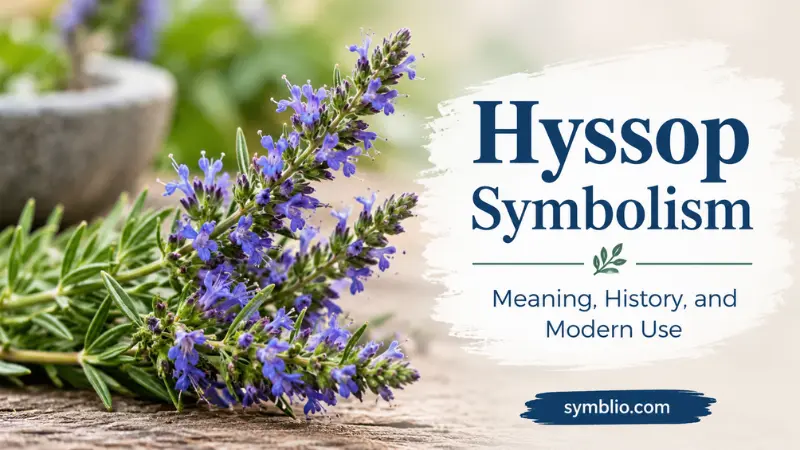
Hyssop symbolism is closely associated with purification, cleansing, renewal, and religious devotion. The name hyssop refers to aromatic plants used in traditional medicine, ritual practices, cooking, and religious ceremonies, although the biblical plant called “hyssop” may not correspond exactly to the plant known by that name today.
For many Americans, hyssop is most familiar from the Bible rather than everyday gardens or popular culture. References to hyssop in Jewish and Christian traditions have helped give the plant associations with cleansing, repentance, protection, and spiritual renewal.
Today, hyssop can also represent a personal desire to begin again, clear away what no longer serves a person, or reconnect with faith and tradition. Its symbolism depends heavily on whether it appears in a religious, historical, botanical, or personal context.
Quick Answer
Hyssop symbolism commonly represents purification, renewal, and spiritual cleansing in modern American religious contexts, especially when connected with biblical imagery. Historically, hyssop has also been associated with ritual cleansing, protection, healing practices, humility, and restoration.
TL;DR
- Hyssop commonly symbolizes purification, cleansing, and renewal.
- Biblical references connect it with ritual cleansing and repentance.
- Jewish and Christian traditions give hyssop strong religious associations.
- The exact biblical identity of hyssop remains botanically uncertain.
- Modern Americans may use hyssop as a symbol of fresh beginnings.
- Tattoos and artwork can turn its traditional meanings into personal statements.
What Is Hyssop?
Hyssop is a name used for aromatic plants in the mint family, particularly the species Hyssopus officinalis. The plant produces narrow leaves, upright stems, and small flowers that may appear blue, purple, pink, or white depending on the variety.
The plant has a long history of culinary, medicinal, and ornamental use. Its strongly scented leaves and flowers made it useful in traditional herbal practices and gave it a natural connection with cleanliness and freshness.
The biblical references to hyssop are more complicated. Scholars have debated which plant ancient writers meant because the biblical descriptions and later botanical identification do not provide enough certainty to establish a single modern species.
That uncertainty matters. The symbolic tradition is more certain than the botanical identification.
What Does Hyssop Commonly Symbolize?
The strongest symbolic associations surrounding hyssop are:
- Purification
- Cleansing
- Repentance
- Renewal
- Spiritual devotion
- Protection
- Humility
- Restoration
Purification is probably the most recognizable theme. In biblical contexts, hyssop appears in situations involving ritual cleansing and sacred preparation.
Renewal follows naturally from that idea. Cleansing can represent leaving behind impurity, guilt, disorder, or an earlier stage of life and moving toward a restored state.
Hyssop can therefore carry a symbolic sequence: cleansing, repentance, restoration, and renewal.
Ancient Roots and Early Symbolism
Hyssop’s religious symbolism is especially prominent in the Hebrew Bible. One well-known example appears in the Passover story, where hyssop is used to apply blood to the doorposts of Israelite homes.
Another important reference appears in Psalm 51, where the speaker asks to be purified with hyssop. In this setting, the plant becomes closely connected with moral and spiritual cleansing rather than simply physical cleanliness.
Hyssop also appears in descriptions of purification rituals. These references helped establish a symbolic association between the plant and the removal of impurity.
The meaning developed from the practical use of a plant into a broader religious metaphor. Hyssop could represent an action that moves a person from an unclean or troubled state toward restoration.
Hyssop in Jewish Tradition
Hyssop has an important place in Jewish biblical tradition because of its appearances in the Hebrew Scriptures.
Its association with Passover is particularly significant. In Exodus, hyssop functions as an instrument used during the marking of Israelite homes, linking the plant with protection and deliverance.
Other biblical purification rituals also mention hyssop. These passages connect it with ceremonial cleansing and preparation.
It is important, however, not to treat every modern herbal plant labeled “hyssop” as automatically identical to the biblical plant. The historical identity of biblical hyssop remains debated.
The symbolic tradition can therefore be discussed with greater confidence than a claim that a particular modern species was definitely the plant used in every biblical passage.
Hyssop in Christian Symbolism
Christian interpretations inherited much of hyssop’s symbolism from the Hebrew Bible.
The plant is often associated with repentance, purification, forgiveness, and spiritual renewal. Psalm 51 has been particularly influential because its reference to hyssop occurs within a prayer for cleansing.
Christian readers may therefore encounter hyssop as a symbol of a person seeking reconciliation and a renewed relationship with God.
Hyssop also appears in the New Testament, contributing to its continued presence in Christian art and interpretation. Over time, artists and writers used the plant to evoke biblical purity, sacrifice, humility, and devotion.
Its meaning is not limited to one theological interpretation, but purification remains the central thread.
Why Purification Became Its Strongest Meaning
Hyssop’s connection with purification developed from its role in ritual practices rather than from an abstract belief that the plant possessed supernatural qualities.
In biblical traditions, particular plants and materials could serve specific ceremonial purposes. Hyssop’s repeated appearance in cleansing contexts gave it a recognizable symbolic function.
That history explains why hyssop often represents clearing away impurity rather than simply being “holy.”
The distinction is useful. The symbol is less about status and more about transition: something unclean becomes clean, someone burdened by wrongdoing seeks forgiveness, or a person prepares for a new spiritual condition.
Hyssop and Repentance
Repentance is another important meaning associated with hyssop.
Psalm 51 connects the plant with a plea for cleansing after wrongdoing. As a result, hyssop can represent the recognition of mistakes followed by a sincere desire for restoration.
This symbolism differs from simple guilt. Guilt focuses on awareness of wrongdoing, while repentance involves a movement toward change.
For that reason, hyssop can symbolize accountability followed by renewal.
In modern religious artwork, writing, or personal symbolism, someone may choose hyssop to express the idea that acknowledging the past can become the beginning of a different future.
Protection, Passover, and Deliverance
Hyssop also carries an association with protection because of its role in the biblical Passover narrative.
The plant itself was not the source of protection. Instead, it served as an instrument within a larger religious act. The symbolism therefore comes from the story and ritual context surrounding its use.
For people familiar with the Exodus narrative, hyssop may evoke:
- protection of the household
- deliverance from danger
- obedience
- faith
- transition from oppression toward freedom
This gives hyssop a second major symbolic direction. While purification looks inward toward cleansing, Passover imagery can point outward toward protection and deliverance.
Hyssop Symbolism in the United States
In the United States, hyssop does not have the same everyday visibility as roses, lilies, olive branches, or crosses. Its symbolism is strongest among people familiar with biblical traditions, Christian art, Jewish scripture, religious education, or historical herbalism.
American interpretations commonly emphasize spiritual cleansing and renewal.
A person may encounter hyssop in a sermon, Bible study, religious artwork, devotional writing, or a discussion of biblical plants. In these settings, the plant usually functions as a reference to scripture rather than as a common decorative symbol.
Its relatively specialized cultural role can actually make it useful for personal symbolism. Someone who chooses hyssop may be intentionally referencing a particular biblical story rather than using a generic symbol of peace or beauty.
Emotional and Psychological Associations
Hyssop can represent an emotional process as much as a religious concept.
Its traditional meanings can suggest:
- letting go of past mistakes
- seeking forgiveness
- beginning again
- restoring personal integrity
- moving from disorder toward clarity
- reconnecting with one’s values
These interpretations should not be treated as universal psychological effects. Symbolism depends on personal experience and cultural background.
For a religious person, hyssop might represent reconciliation with God. For someone interested in historical symbolism, it might represent ritual cleansing. Another person may simply interpret it as a reminder that renewal requires conscious change.
The common thread is transition from an unwanted condition toward restoration.
Hyssop in Art, Literature, and Religious Design
Hyssop can appear in religious artwork as a relatively subtle botanical reference.
Artists may include the plant when depicting biblical purification, Passover, repentance, or other scriptural themes. Because many viewers may not immediately recognize the plant, its presence can function as a visual detail with specialized meaning.
In literature, hyssop can also work as shorthand for purification or repentance. A writer familiar with biblical language may use the plant to suggest spiritual cleansing without explaining the entire reference.
This makes hyssop an example of cultural symbolism that depends heavily on context. Without biblical knowledge, a viewer may simply see an aromatic herb. With that knowledge, the same plant can carry a much more specific meaning.
Hyssop in Tattoos and Personal Symbolism
Hyssop is less common as a tattoo subject than roses, crosses, olive branches, or lilies, but its specialized symbolism can make it meaningful for someone with a strong connection to biblical imagery.
A hyssop tattoo may represent:
- spiritual renewal
- repentance
- forgiveness
- religious devotion
- a new beginning
- protection
- personal transformation
The design can become even more specific when combined with other imagery. A person might pair hyssop with scripture-inspired elements, a cross, a doorway, or other symbols connected with faith and renewal.
Because tattoo meanings are personal, the same botanical design does not have one fixed interpretation. The surrounding imagery and the wearer’s intention matter.
Hyssop in Gardens, Herbalism, and Everyday Life
Modern hyssop also has a practical identity separate from its religious symbolism.
Hyssopus officinalis is an aromatic herb that has been cultivated as a garden plant. Its flowers can attract pollinators, and its leaves have traditional culinary and herbal uses.
That practical identity can create a more natural form of symbolism. A gardener might associate hyssop with cultivation, fragrance, seasonal growth, or traditional herbal knowledge.
These meanings should not be confused with biblical symbolism. A modern garden planting does not automatically carry a religious message.
| Context | Meaning in the USA | Common Associations | Notes |
|---|---|---|---|
| Biblical study | Purification | Cleansing, repentance | Strongest religious association |
| Passover imagery | Protection and deliverance | Faith, household protection | Rooted in Exodus |
| Christian symbolism | Spiritual renewal | Forgiveness, restoration | Influenced by biblical passages |
| Gardening | Growth and tradition | Herbs, flowers, cultivation | More botanical than religious |
| Tattoo art | Personal renewal | Faith, transformation | Meaning depends on design |
Cross-Cultural and Religious Connections
Hyssop’s most important symbolic traditions come from Jewish and Christian scripture, but plants identified with hyssop have also existed within broader Mediterranean herbal traditions.
The word itself has a long history, while the precise identification of biblical hyssop remains uncertain. This makes simple claims about a single continuous symbolic meaning across every ancient culture unreliable.
Instead, it is better to distinguish between documented religious symbolism and broader herbal traditions.
In Jewish and Christian contexts, purification is particularly well established. In herbal traditions, the plant’s fragrance and practical uses can produce associations with freshness and cleansing without carrying the same theological meaning.
Common Misunderstandings About Hyssop
One common misunderstanding is that modern Hyssopus officinalis has been definitively proven to be the exact plant called hyssop in every biblical passage. The evidence does not support that level of certainty.
Another mistake is treating hyssop as a universal symbol of healing. Although the plant has a history of herbal use, biblical symbolism primarily concerns ritual and spiritual cleansing.
It is also misleading to describe hyssop as a universally recognized American symbol. Its religious meaning is real and historically important, but its recognition varies considerably among Americans.
Finally, hyssop symbolism should not be reduced to “good luck” or generic positive energy. Its traditional meanings are much more specific: purification, repentance, protection, and renewal.
How Hyssop’s Meaning Has Changed Over Time
Hyssop’s symbolism has shifted from a concrete ritual object toward a broader metaphor.
In biblical contexts, hyssop participates in specific ceremonies and narratives. Later Jewish and Christian interpretation expanded those references into ideas about moral cleansing, repentance, and spiritual restoration.
Modern audiences may encounter the plant outside its original religious setting. In a garden, it may simply be an herb. In a tattoo, it can become a personal symbol of starting over. In religious artwork, it may still point directly toward biblical purification.
The plant therefore demonstrates how symbolism can survive even when everyday familiarity declines. People may forget the practical details of an ancient ritual while retaining the larger idea associated with it.
What Hyssop Can Represent Today
For a modern American audience, hyssop can be understood through several related themes rather than one rigid definition.
Purification is the central idea.
Renewal describes what follows purification.
Repentance adds the moral dimension of recognizing wrongdoing and changing direction.
Protection comes from the Passover narrative.
Humility can emerge from the plant’s association with cleansing rather than status or power.
Together, these meanings make hyssop particularly appropriate for symbolism involving a conscious transition from an old state to a restored one.
FAQs
Hyssop primarily symbolizes purification and ritual cleansing in biblical contexts. It also becomes associated with repentance, protection, and spiritual restoration through passages involving Passover and cleansing rituals.
Biblical passages describe hyssop being used in ritual contexts involving cleansing. Those repeated associations helped turn the plant into a broader symbol of purification and renewal.
A hyssop tattoo can represent spiritual renewal, repentance, forgiveness, faith, or a personal new beginning. Its precise meaning depends on the person’s religious background and the other elements included in the design.
It can be, particularly because of its role in the Passover story in Exodus. In that context, hyssop is connected with an act that marked and protected Israelite households.
Not necessarily. The exact botanical identity of biblical hyssop remains uncertain, so modern Hyssopus officinalis should not automatically be treated as identical to every biblical reference.
Hyssop has traditional herbal associations, but its strongest biblical symbolism concerns purification rather than medical healing. Modern interpretations sometimes connect cleansing with restoration, but those ideas should be kept distinct from claims about medicinal effects.
In Christian symbolism, hyssop commonly represents purification, repentance, forgiveness, and spiritual renewal. These associations are strongly influenced by its use and imagery in the Hebrew Bible.
Conclusion
Hyssop symbolism centers on purification, renewal, repentance, and protection, with its strongest meanings coming from Jewish and Christian biblical traditions. Its role in Passover and cleansing passages explains why the plant has remained connected with spiritual restoration.
In modern America, hyssop is more specialized than many familiar symbols, but that can make it especially meaningful in religious artwork, personal writing, gardens, and tattoos. Its enduring message is not simply cleanliness; it is the idea of leaving an old condition behind and moving toward restoration with intention.


