
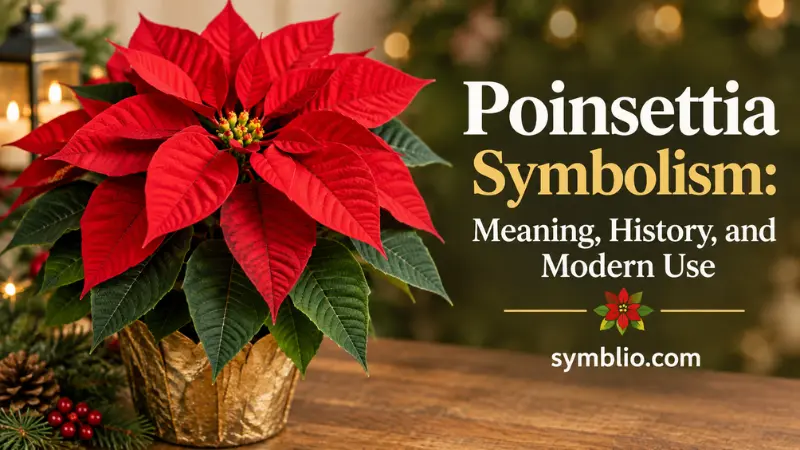
The poinsettia is one of the most recognizable plants of the American holiday season. For many people, poinsettia symbolism immediately brings to mind Christmas, celebration, warmth, generosity, and seasonal tradition. Its bright red bracts and dark green leaves appear in homes, churches, stores, offices, holiday cards, and public displays every December.
Yet the plant’s story began long before it became a familiar Christmas decoration in the United States. Native to Mexico, the poinsettia had cultural uses and associations there before it became connected with Christian Christmas celebrations. Its later history in the United States also involves diplomacy, horticulture, commercial growing, and changing holiday customs.
Understanding the poinsettia means looking beyond its red-and-green appearance. Its symbolism developed from several traditions that gradually came together: Indigenous Mexican uses, colonial Christmas customs, Christian imagery, American holiday culture, and the modern practice of giving and displaying seasonal plants.
Quick Answer
Poinsettia symbolism commonly represents Christmas, celebration, generosity, and seasonal warmth in modern American culture, especially in holiday decorating, church displays, and gifts. Historically, the plant also carried associations with purity in pre-Columbian Mexico and became connected with Christmas through Mexican Catholic traditions.
TL;DR
- Poinsettias are strongly associated with Christmas in the United States.
- The plant originated in Mexico, where it had earlier cultural uses.
- Red bracts helped connect poinsettias with holiday color traditions.
- Mexican Christmas traditions helped establish the plant’s seasonal identity.
- Giving a poinsettia can suggest generosity, goodwill, and celebration.
- Modern varieties extend its symbolism beyond traditional red.
What the Poinsettia Looks Like and Why Its Appearance Matters
The poinsettia is a shrub native to Mexico and belongs to the Euphorbia family. In nature, it can become much larger than the compact plants commonly sold during the holidays. Commercial varieties are cultivated to remain relatively short and bushy, making them practical for indoor seasonal decoration.
What most people call the flower is actually a group of modified leaves called bracts. The small yellow structures in the center are the plant’s true flowers. As the plant enters its flowering cycle, the upper bracts develop their familiar colors.
Red remains the most recognizable variety, but modern poinsettias are also available in white, pink, cream, green, and combinations of several colors.
That visual transformation contributes to the plant’s symbolic appeal. A green plant suddenly displaying vivid red leaves fits naturally into the colors already associated with Christmas in the United States.
The Mexican Roots Behind Poinsettia Symbolism
The poinsettia’s original cultural history belongs to Mexico rather than the United States. Indigenous peoples knew the plant by names including cuetlaxóchitl, and historical accounts describe its red leaves as valued for their color and beauty. The plant also had practical uses, including applications involving its dye and latex.
Some historical accounts connect the plant with ideas of purity among the Aztecs. That association is important because it shows that the plant’s symbolic history did not begin with Christmas. Its meaning changed as different communities encountered and used it.
The plant therefore illustrates an important feature of symbolism: objects can accumulate meanings rather than having one permanent interpretation. A plant that once carried cultural and practical associations in Mexico eventually became one of the most recognizable Christmas plants in American homes.
How the Poinsettia Became a Christmas Plant
The poinsettia’s connection with Christmas developed in Mexico after the arrival of Spanish missionaries. Franciscan traditions incorporated the colorful plant into Christmas-related celebrations and nativity displays.
The Spanish name flor de Nochebuena, meaning “flower of the Holy Night,” reflects this connection with Christmas Eve. The plant’s seasonal color and flowering period made it especially suitable for Christmas celebrations.
This history explains why poinsettias are more than ordinary winter decorations. Their association with Christmas has a specific cultural pathway: a Mexican plant became part of local Christmas traditions, and those traditions later helped shape its international identity.
The plant’s use in nativity settings also contributed to associations with religious celebration, purity, and the Christmas story.
Joel Poinsett and the Plant’s American Identity
The English name “poinsettia” comes from Joel Roberts Poinsett, a U.S. diplomat and amateur botanist who served in Mexico during the 1820s. He encountered the plant there and brought specimens back to the United States.
Poinsett’s involvement helped introduce the plant to American horticultural circles. It was subsequently exhibited and cultivated, eventually spreading beyond specialist gardens.
There is some uncertainty around the simplified version of the story that credits Poinsett alone with introducing the plant to the United States. Historical discussions have pointed out that other horticulturists also played roles in its early spread.
Still, his name became permanently attached to the plant. That connection gives the poinsettia an unusual place in American cultural history: a plant native to Mexico became identified in English with an American diplomat.
What Poinsettias Commonly Symbolize in the United States
In modern American culture, the strongest association is Christmas.
A poinsettia displayed in December usually communicates that the holiday season has arrived. Unlike many symbols that require interpretation, the plant’s meaning often comes from context. A red poinsettia on a Thanksgiving-to-Christmas display, for example, will usually be understood as seasonal decoration rather than as a statement about botany or Mexican history.
Several related meanings commonly accompany this Christmas association:
- Celebration: The bright colors suit festive gatherings and public displays.
- Welcome: Plants placed near entrances can create a warm holiday atmosphere.
- Generosity: A poinsettia given as a gift can express goodwill.
- Tradition: Repeated yearly use connects the plant with family and community customs.
- Faith: In churches, poinsettias may support Christmas and nativity imagery.
- Seasonal renewal: The plant’s annual appearance marks a recurring point in the calendar.
These meanings overlap, but they are not identical. Someone buying a poinsettia for an office may simply be participating in holiday decor, while someone giving one to a family member may intend a more personal message of goodwill.
Poinsettia Colors and Their Different Associations
Color changes the impression a poinsettia creates. Red remains the conventional Christmas choice, while other colors can soften or broaden the symbolism.
| Poinsettia Color | Common U.S. Association | Typical Setting | Symbolic Impression |
|---|---|---|---|
| Red | Christmas and celebration | Homes, churches, offices | Tradition and festivity |
| White | Peace and elegance | Weddings, churches, formal decor | Calm and simplicity |
| Pink | Warmth and affection | Gifts and home decor | Gentleness and friendliness |
| Cream | Sophistication | Interior displays | Soft seasonal elegance |
| Green | Nature and freshness | Contemporary decor | Renewal and understated style |
These associations should not be treated as fixed rules. Color symbolism changes according to the setting, personal preference, and broader cultural context.
For example, a white poinsettia at a church may have a different emotional effect from a white poinsettia used in a modern winter-themed interior.
Religious Meaning and Christmas Traditions
Poinsettias are particularly visible in Christian settings during the Christmas season. Their connection with nativity displays developed in Mexico and later became part of broader Christmas decoration traditions.
In churches, poinsettias may be placed around altars, nativity scenes, entrances, or other seasonal displays. Their presence can reinforce themes associated with Christmas, including celebration, reverence, light, and the birth of Christ.
However, the plant itself is not a universal Christian symbol with one official theological meaning. Its religious significance largely comes from its historical use in Christmas celebrations rather than from a single doctrine.
That distinction matters. A poinsettia can have Christian associations in one setting while functioning simply as a seasonal decoration in another.
Poinsettias in American Homes and Public Spaces
The poinsettia became deeply established in American holiday culture because it works well as a decorative plant. Its compact commercial form fits tables, windowsills, reception desks, churches, shopping centers, and entryways.
American horticultural research also helped transform the plant into the form consumers recognize today. Researchers worked on growth, flowering, branching, color development, and durability, making it easier to produce compact plants suitable for the holiday market.
This agricultural history is part of the symbolism too. Modern Americans usually encounter the poinsettia as a deliberately cultivated seasonal plant rather than as the large tropical shrub found in its native environment.
Its appearance in November and December has become so predictable that the plant itself can function as a visual signal: the holiday season is beginning.
The Emotional Meaning of Giving a Poinsettia
A poinsettia can carry a personal message when given as a gift.
The meaning usually depends on the relationship between the giver and recipient. A workplace gift may communicate appreciation or seasonal goodwill. A plant given to a neighbor may suggest friendliness. A poinsettia presented to a family member may become part of a recurring holiday tradition.
Unlike a bouquet of cut flowers, a potted poinsettia can remain part of the household for a period of time. That can make the gift feel connected with continuity and the season itself.
In Mexican popular tradition, receiving a poinsettia has also been associated with good luck and prosperity.
The important point is that the plant’s emotional message is generally positive without being highly specific. It can express warmth, celebration, appreciation, or seasonal goodwill without requiring a complicated symbolic interpretation.
Poinsettia Symbolism in Weddings, Memorials, and Other Events
Although Christmas dominates its modern identity, poinsettias can appear outside ordinary holiday decorating.
White or pale varieties may be used in winter weddings because their appearance fits formal floral arrangements. Red varieties may appear at December memorial services or community events because the season itself influences the choice of flowers.
Their meaning changes with context. At a wedding, a poinsettia can function primarily as a winter floral element. At a memorial service in December, it may evoke seasonal remembrance rather than celebration alone.
This flexibility shows why color, setting, and occasion should be considered before assigning one universal meaning to the plant.
Poinsettias in Fashion, Tattoos, and Modern Personal Style
Poinsettias are less common tattoo subjects than roses, lilies, or other flowers, but they can still carry recognizable meanings when used in body art.
A poinsettia tattoo may represent Christmas memories, Mexican heritage, family traditions, winter, or a personal connection to someone associated with the holiday season. The meaning becomes especially personal when the design includes dates, names, ornaments, religious imagery, or other flowers.
In fashion and graphic design, poinsettias often function as immediate seasonal imagery. Their distinctive red-and-green appearance makes them useful for greeting cards, wrapping paper, clothing, advertisements, social media graphics, and holiday packaging.
Modern digital culture has therefore expanded the plant’s visual role. A stylized poinsettia can communicate “Christmas” almost instantly, even without accompanying words.
Cross-Cultural Meanings of the Poinsettia
The poinsettia is strongly associated with Christmas in many places, but its meaning varies across cultures.
In Mexico, the plant’s connection with Nochebuena reflects its long-standing relationship with Christmas Eve traditions. Its Indigenous history also predates that association.
In the United States, the plant became closely tied to commercial Christmas culture and household decorating. In other countries, it may be recognized primarily as an imported holiday plant.
This distinction prevents a common mistake: assuming that today’s American interpretation represents the plant’s entire history.
The poinsettia has moved through several cultural settings, and each has contributed something different to its modern identity.
Common Misunderstandings About Poinsettia Symbolism
Several popular stories about poinsettias simplify or exaggerate their history.
One common misconception is that the plant’s entire symbolic meaning comes from Christmas. In reality, its Mexican history predates its Christian holiday associations.
Another misconception is that Joel Poinsett personally created the plant’s popularity from nothing. He played an important role in introducing and cultivating it in the United States, but horticultural networks and later commercial growers were also essential to its spread.
It is also inaccurate to treat every poinsettia as a religious object. Many Americans use the plant simply because it has become a familiar part of seasonal decoration.
Understanding these distinctions makes the symbolism more useful rather than less meaningful.
How Poinsettia Meaning Has Changed Over Time
The poinsettia’s symbolic evolution can be understood as a series of overlapping stages.
First came its Indigenous Mexican history and practical uses. Later, colonial Mexican Christmas traditions connected the plant with Nochebuena and nativity celebrations. During the 19th century, the plant entered American and European horticultural culture. Eventually, commercial cultivation transformed it into a widely available Christmas plant.
By the modern era, its American identity had become strongly seasonal. Agricultural research made compact, attractive poinsettias easier to produce, while nurseries and retailers helped establish the plant as a standard part of Christmas decorating.
The result is a symbol with several layers: Mexican heritage, Christmas tradition, American horticulture, gift-giving, decoration, and seasonal memory.
Why Poinsettias Remain Important in American Holiday Culture
Poinsettias remain recognizable because their symbolism is reinforced every year.
Their appearance coincides with Christmas decorating, their colors fit familiar holiday palettes, and their compact form works in homes and public spaces. The U.S. Department of Agriculture has described the poinsettia as a major holiday plant, while agricultural research has played a significant role in developing the forms consumers commonly purchase.
The plant also benefits from repetition. Families may buy one every December, churches may use them year after year, and businesses may display them as part of their annual decorations.
That repeated experience turns a botanical species into a cultural marker. Seeing a poinsettia can remind someone not only of Christmas but also of previous holidays, family gatherings, familiar places, and personal traditions.
FAQs
A poinsettia most commonly symbolizes Christmas, celebration, warmth, and seasonal goodwill in the United States. Its earlier Mexican history also includes associations with purity and practical cultural uses.
A red poinsettia is most strongly associated with Christmas and festive celebration. Its color also makes it suitable for expressing warmth, welcome, and traditional holiday spirit.
Poinsettias became connected with Christian Christmas celebrations through Mexican traditions involving Christmas Eve and nativity displays. Their religious meaning is therefore primarily associated with Christmas rather than representing a universal Christian doctrine.
A poinsettia tattoo can represent Christmas, family memories, Mexican heritage, winter traditions, or a meaningful person associated with the holiday season. The surrounding design usually provides clues about the intended personal meaning.
Yes. White poinsettias are often associated with peace, simplicity, elegance, and winter settings, although these meanings are contextual rather than universal. Their lighter color can also make them suitable for formal events and religious spaces.
Their Christmas association developed in Mexico, where the plant became connected with Christmas Eve traditions and nativity displays. Its seasonal coloring and later popularity in American holiday decorating strengthened that connection.
No. The plant’s cultural history in Mexico predates its Christmas symbolism. Its meaning developed over time as Indigenous traditions, Mexican Christian customs, European horticulture, and American holiday culture influenced how people viewed it.
Conclusion
The meaning of a poinsettia is closely tied to Christmas in contemporary American culture, but its story reaches much further back. The plant originated in Mexico, carried earlier cultural associations, became part of Mexican Christmas traditions, and eventually developed into a major American holiday plant.
Today, poinsettia symbolism can suggest celebration, generosity, warmth, family tradition, religious observance, or simply the arrival of the holiday season. Its meaning depends partly on where it appears and how people use it.
What makes the poinsettia especially interesting is the way its symbolism has accumulated over time. A Mexican plant became a Christmas tradition, an American commercial crop, and a familiar seasonal reminder—while still carrying traces of the much older culture from which it came.


