
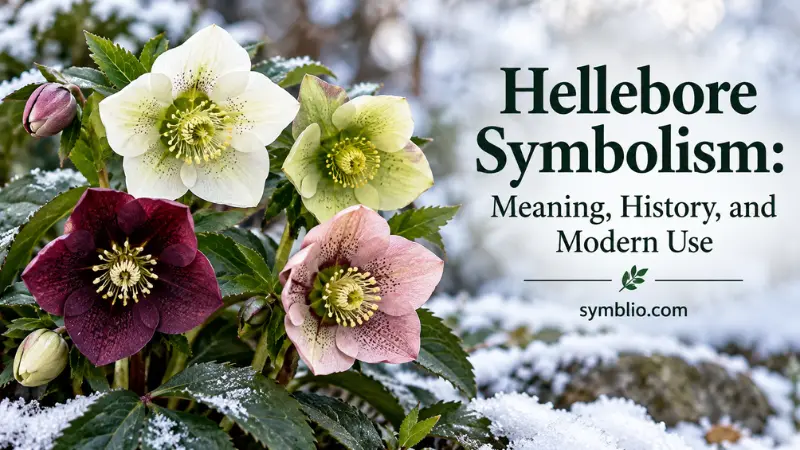
Hellebore symbolism is closely connected with hope, resilience, renewal, and quiet beauty, largely because hellebores can bloom during the coldest part of the year. Their flowers appear when many other garden plants are dormant, giving them a natural association with endurance and the promise of spring.
Hellebores are members of the Helleborus genus in the buttercup family, not true roses. Some species are commonly called Christmas roses or Lenten roses because of their winter and early-spring flowering periods. Their nodding flowers can appear in white, green, pink, purple, and dark shades, while their leathery foliage often remains attractive through winter.
For Americans today, hellebores are most often encountered as ornamental garden plants, winter-blooming flowers, and seasonal decorations. Their symbolic appeal comes less from a single fixed definition than from the combination of their unusual flowering season, historical associations, and changing flower-language traditions.
Quick Answer
Hellebore symbolism commonly represents hope, resilience, renewal, and beauty during difficult seasons in modern American culture. Historically, hellebores also became associated with healing, protection, Christmas and the Nativity, while some traditions connected the plant with sorrow or melancholy.
TL;DR
- Hellebores commonly symbolize hope, resilience, and renewal.
- Winter flowering helped connect them with endurance and new beginnings.
- Christmas rose traditions gave some hellebores Christian associations.
- Ancient Greek traditions connected hellebore with medicine and healing.
- White, pink, green, and dark flowers can suggest different moods.
- Modern Americans mainly encounter hellebores in gardens and seasonal design.
What Hellebores Look Like and Why Appearance Matters
Hellebores are perennial flowering plants with sturdy stems, divided leaves, and cup- or bowl-shaped flowers. Many varieties remain evergreen or semi-evergreen, which means their foliage can provide structure even when surrounding plants have gone dormant.
The flowers are particularly noticeable because of their timing. Helleborus niger, commonly called the Christmas rose, can produce white flowers during winter and early spring. Other hellebores flower later, particularly around the period traditionally associated with Lent.
The plant’s appearance naturally contributes to its symbolism. A flower that opens during a cold, relatively quiet part of the gardening year can suggest persistence without needing an elaborate symbolic tradition behind it.
The name “Christmas rose” can also create confusion. Hellebores are not related to roses; they belong to the Ranunculaceae, or buttercup, family. The common name reflects the appearance and flowering season rather than botanical relationship.
The Core Meaning: Hope During Winter
The most accessible modern interpretation of the hellebore is hope during a difficult season.
That association comes directly from nature. Winter traditionally represents dormancy, darkness, and inactivity in temperate climates, while flowering suggests the return of growth. Hellebores complicate that seasonal pattern because they can flower while many familiar garden plants are still dormant.
This makes the plant especially suitable as a metaphor for:
- hope during hardship
- patience during uncertain periods
- endurance
- renewal
- quiet optimism
- anticipation of change
The symbolism does not mean that every hellebore automatically represents hope. Rather, people can read these qualities into its unusual seasonal behavior.
Its beauty is also relatively restrained. Hellebores often have downward-facing or nodding flowers rather than large, dramatic blooms. That visual character can support associations with humility, reflection, and understated elegance.
Ancient Greek Roots and the Idea of Healing
Hellebore has a much older history than its modern garden symbolism suggests.
In ancient Greek medicine and mythology, hellebore was associated with purging and treatment. A well-known myth tells of Melampus, a legendary healer who used hellebore in treating the daughters of King Proetus, who were described as suffering from madness.
Historical scholarship treats the story as a mixture of mythology and ancient medical thinking rather than as a straightforward medical record. Nevertheless, the story helps explain why hellebore acquired an association with healing, restoration, and the attempt to bring someone back into balance.
Ancient medical traditions also used hellebore as a purgative. Those historical practices should not be confused with modern medical treatment, particularly because hellebores can be harmful if eaten.
This ancient background gives the flower a more complicated symbolic history than the modern “hope and winter” interpretation suggests. It connects the plant with both healing and danger.
From Medicine to Protection and Purification
The historical use of hellebore in purging influenced symbolic interpretations of cleansing and removal.
In older medical frameworks, illness was sometimes understood as an imbalance that had to be corrected by removing harmful substances from the body. Hellebore became part of that worldview because of its physiological effects.
As a result, symbolic interpretations can connect the plant with:
- purification
- restoration
- protection
- recovery
- removing what is harmful
- returning to balance
These meanings should be understood historically rather than as claims about supernatural properties.
Modern readers may find the cleansing interpretation useful as a metaphor for personal change: leaving behind an old situation, recovering from a difficult period, or making space for something new.
Christmas Rose and Christian Symbolism
One of the most recognizable symbolic traditions surrounding hellebores comes from the name Christmas rose.
Helleborus niger is particularly associated with this name because of its winter flowering. In European Christian traditions, winter-blooming white flowers could become associated with Christmas, the Nativity, purity, and the arrival of Christ.
A later language-of-flowers tradition explicitly connected Christmas rose with the Nativity. This is an important distinction: the Christian association developed through cultural and religious interpretation rather than being an inherent botanical meaning.
White flowers also reinforce the connection. In Western Christian visual traditions, white can suggest purity, innocence, peace, and sacred celebration. When a white hellebore flowers around Christmas, those existing associations can reinforce one another.
For American audiences, this makes hellebore particularly suitable for understated winter arrangements and seasonal garden displays.
Lenten Rose and the Symbolism of Transition
Another common name, Lenten rose, connects certain hellebores with the Christian season of Lent.
The connection comes from flowering time rather than from the plant being a religious object. Some hellebores flower in late winter or early spring, overlapping with the traditional Lenten calendar.
That seasonal timing can create associations with:
- reflection
- preparation
- restraint
- spiritual renewal
- transition from winter toward spring
The distinction between Christmas rose and Lenten rose is useful because it shows how the same botanical group can acquire different meanings depending on when and where people encounter it.
One plant can therefore participate in several symbolic calendars.
What Hellebores Symbolize in the United States
In contemporary American culture, hellebore symbolism is primarily botanical and decorative rather than formal or universally recognized.
Gardeners often appreciate hellebores because they provide flowers during a season when relatively few plants are blooming. Their symbolism therefore tends to emerge from gardening experience: persistence, seasonal change, and anticipation of spring.
They can also appear in:
- winter garden designs
- cottage-style gardens
- seasonal floral arrangements
- wedding flowers
- botanical photography
- holiday decorating
- greeting cards
- nature-inspired artwork
American interpretations are generally less standardized than the meanings associated with roses, lilies, or chrysanthemums. Someone receiving a hellebore may not automatically recognize a specific symbolic message.
That flexibility can actually make the flower useful for personal symbolism. Its meaning can be shaped by the season, color, occasion, and relationship between the people involved.
Hellebore Colors and Their Different Associations
Color can change the emotional impression of a hellebore even when the basic symbolism remains similar.
| Hellebore Color | Common Symbolic Association | Typical Emotional Impression | Modern Context |
|---|---|---|---|
| White | Purity, hope, peace | Calm and reflective | Christmas, weddings, winter decor |
| Pink | Affection, gentleness | Warm and welcoming | Gardens, bouquets, personal gifts |
| Green | Renewal, nature, balance | Fresh and understated | Spring gardens, botanical design |
| Purple | Reflection, individuality | Sophisticated and contemplative | Floral arrangements, gardens |
| Very Dark | Mystery, seriousness, contrast | Dramatic and restrained | Contemporary gardens and design |
These associations are interpretive rather than universal rules. Flower color symbolism varies between cultures, historical periods, and individuals.
The important point is that color can guide how viewers emotionally read the plant. A white hellebore may feel more traditional and ceremonial, while a nearly black flower may appear more dramatic or introspective.
Emotional and Psychological Symbolism
Hellebores work especially well as symbols of quiet endurance.
Unlike flowers associated with exuberant celebration, hellebores often appear in muted winter surroundings. Their flowers may look delicate, yet the plant can continue growing through cold conditions.
That contrast can represent a form of strength that is not loud or aggressive.
People may therefore associate hellebores with:
- staying hopeful during uncertainty
- accepting seasonal change
- recovering gradually
- appreciating understated beauty
- remaining grounded during difficult circumstances
The plant can also symbolize patience. A winter garden does not promise immediate transformation. Instead, it offers small signs that another season is approaching.
That makes hellebore imagery appropriate for personal reflections about transition, recovery, or starting a new chapter without requiring a dramatic interpretation.
Hellebores in Weddings and Celebrations
Hellebores can work especially well in weddings held during late winter or early spring.
Their symbolism of renewal fits naturally with marriage as a new stage of life. White varieties can also complement wedding traditions involving purity, peace, and simplicity, while pink and darker varieties can create a less conventional floral palette.
Their seasonal character gives them another advantage: they communicate a sense of place and time.
A winter wedding featuring hellebores can visually acknowledge the season rather than attempting to make the event look like a midsummer garden. That makes the flowers useful for couples who prefer natural, understated arrangements.
The symbolism remains personal, however. A couple may choose hellebores simply because they like the flowers, without assigning them a particular message.
Mourning, Reflection, and More Somber Meanings
Hellebore symbolism is not exclusively positive.
The flower’s history includes associations with melancholy, illness, and older medical practices. Its winter flowering can also create a reflective mood that works naturally in memorial or remembrance settings.
Dark-colored hellebores may reinforce this interpretation because of their subdued appearance.
Still, calling the hellebore a universal “mourning flower” would be misleading. In the United States, flowers such as chrysanthemums, lilies, and roses have much stronger established associations with funerals and remembrance.
A hellebore used in a memorial setting is more likely to communicate quiet remembrance, endurance, or seasonal reflection than a standardized funeral message.
Why Hellebores Appear in Modern Gardens
Modern gardening may be the most important setting for hellebore symbolism.
Hellebores are valued for winter and early-spring interest, and many varieties tolerate shaded conditions. Their evergreen or semi-evergreen foliage can also provide structure when other plants have lost their leaves.
This makes the plant a natural symbol of continuity.
A garden containing hellebores can suggest that beauty does not disappear simply because the landscape enters a quieter season. The flowers become reminders of ongoing growth rather than dramatic seasonal spectacle.
That interpretation fits contemporary American gardening culture, where people often use plants to express ideas about natural cycles, sustainability, seasonal awareness, and personal taste.
Hellebore Symbolism in Tattoos, Art, and Personal Style
Hellebore tattoos are less common than rose, lotus, sunflower, or chrysanthemum tattoos, which gives the flower a more distinctive quality in body art.
Someone choosing a hellebore tattoo might use it to represent:
- resilience through a difficult period
- renewal after change
- winter birth or a winter memory
- quiet strength
- personal growth
- appreciation for botanical beauty
A white hellebore tattoo can emphasize simplicity and hope, while a darker botanical illustration can create a more gothic or contemplative mood.
The historical association with healing can also appeal to someone who sees the flower as a reminder of recovery. That meaning is personal rather than a fixed cultural code.
In illustration and fashion, hellebores can similarly communicate a natural, vintage, botanical, or winter-inspired aesthetic.
Cross-Cultural and Historical Differences
Hellebore symbolism should not be treated as one universal tradition.
Ancient Greek sources connect the plant with medicine, mythology, and purging. Later European traditions developed associations with Christmas and Lent. Flower-language traditions added further meanings, sometimes based on literary or religious associations rather than widespread everyday practice.
This history demonstrates an important feature of symbolism: meanings often accumulate.
A plant does not have to receive one official symbolic definition. Different communities can notice different characteristics and build cultural meanings around them.
For hellebores, the most important characteristics have been their medicinal reputation, unusual flowering season, association with Christian calendars, and distinctive appearance.
Common Misunderstandings About Hellebore Symbolism
One common mistake is assuming that every hellebore has the same symbolic history.
The genus contains multiple species and hybrids, and common names such as Christmas rose and Lenten rose can refer to different plants or groups. The timing of flowering also varies.
Another misunderstanding is that “Christmas rose” means the plant is a rose. Botanically, it is not. Hellebores belong to the buttercup family.
It is also important not to romanticize historical medicinal use. Hellebores contain compounds that can be harmful, and some species are recognized as potentially harmful if eaten and irritating to the skin. Their historical use in medicine belongs to a very different medical context from modern healthcare.
Finally, claims that hellebore has one secret or universally accepted spiritual meaning are too simplistic. Its symbolism has changed across time and cultures.
How Hellebore Meaning Has Changed Over Time
The symbolic journey of the hellebore is unusually varied.
In ancient Greek contexts, it was linked with medicine, purification, and stories about illness. Medieval and later European traditions continued to associate it with medicinal ideas while also developing religious and seasonal associations.
The Christmas rose tradition shifted attention toward winter flowering and Christian celebration. The Lenten rose name added another religious-season connection.
Modern gardening has moved the emphasis again. Today, many Americans encounter hellebores primarily as attractive winter garden plants rather than medicinal herbs or religious symbols.
The result is a layered meaning: healing from the past, winter endurance in the present, and renewal looking toward the future.
FAQs
A hellebore commonly symbolizes hope, resilience, renewal, and endurance through difficult seasons. Historical traditions also connect it with healing, purification, Christmas, and reflection.
In the United States, hellebores are most commonly appreciated as winter-blooming garden flowers. Their symbolic associations with resilience, renewal, and hope come largely from their ability to flower during the colder months.
A hellebore tattoo can represent resilience, recovery, personal renewal, or quiet strength. The meaning is highly individual because hellebore does not have one universally recognized tattoo code.
Yes, particularly Helleborus niger, which is commonly called the Christmas rose because it can flower around the Christmas season. The name helped create associations with the Nativity, winter, purity, and hope.
It can have a reflective or somber association because of its history and winter appearance, but it is not a standard American mourning flower. In memorial settings, its meaning is more likely to be personal and connected with remembrance or endurance.
White hellebores can suggest purity, peace, hope, and renewal. Their winter flowering can strengthen the impression of light and new beginnings during a dormant season.
No. Despite names such as Christmas rose and Lenten rose, hellebores belong to the buttercup family, Ranunculaceae. The common names refer to appearance and flowering season rather than botanical relationship.
Conclusion
Hellebore symbolism brings together several different traditions, but its modern meaning is easiest to understand through the plant itself. A flower that appears during winter naturally suggests hope, endurance, renewal, and the possibility of change.
Its history adds additional layers. Ancient Greek traditions connected hellebore with medicine and purification, while later European traditions associated certain hellebores with Christmas and Lent. Modern American culture tends to encounter the plant primarily through gardening, seasonal design, weddings, botanical art, and personal symbolism.
Ultimately, hellebore symbolism is less about one fixed definition than about the meeting of winter, history, and renewal. Its quiet flowers offer a useful reminder that a dormant season is not necessarily an ending; sometimes it is simply part of the cycle before growth returns.


