
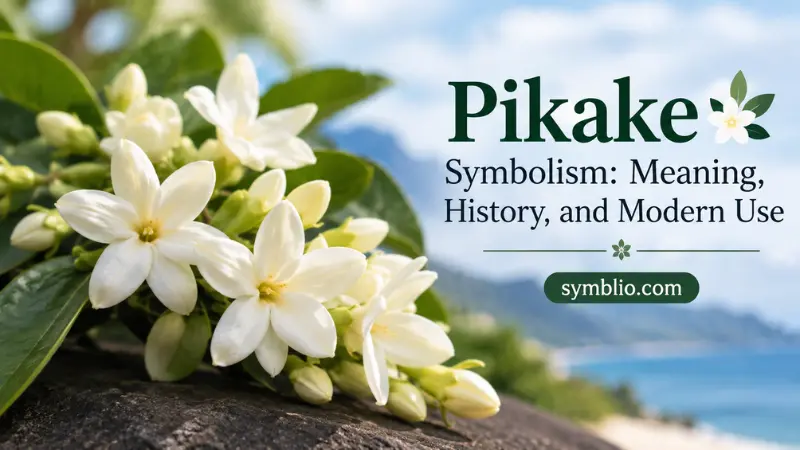
Pikake symbolism is closely connected with love, purity, beauty, humility, and celebration, especially through the flower’s long association with Hawaiian lei traditions. Pikake is the Hawaiian name for Jasminum sambac, commonly called Arabian jasmine, a small white flower known for its exceptionally sweet fragrance.
Unlike many flowers whose symbolic meanings come primarily from ancient mythology, pikake developed much of its cultural importance through its fragrance, appearance, use in lei, and connection with Hawaiʻi’s royal history. Its meaning is therefore best understood through Hawaiian cultural practice rather than through a single universal definition.
For Americans today, pikake is especially recognizable as a fragrant lei flower associated with Hawaiʻi, weddings, celebrations, hula, hospitality, and personal adornment. Its white blossoms and scent also give it broader associations with affection, elegance, simplicity, and peaceful celebration.
Quick Answer
Pikake commonly symbolizes love, purity, humility, and celebration in modern American culture, particularly through Hawaiian lei, weddings, and other special occasions. Historically, the flower became associated with Hawaiʻi through Princess Kaʻiulani and the Hawaiian word for peacock, while its white, fragrant blossoms developed additional associations with beauty and affection.
TL;DR
- Pikake commonly represents love, purity, humility, and celebration.
- It is Jasminum sambac, a jasmine introduced to Hawaiʻi from Asia.
- Princess Kaʻiulani helped establish its Hawaiian name and royal association.
- Pikake lei are strongly associated with weddings and special occasions.
- Its fragrance contributes to associations with affection and elegance.
- Today, pikake appears in lei, gardens, perfume, weddings, and Hawaiian design.
What Is Pikake?
Pikake is a fragrant jasmine with small white flowers. Its scientific name is Jasminum sambac, and the plant belongs to the olive family, Oleaceae. In Hawaiʻi, it is grown both ornamentally and commercially for lei production.
The flowers can occur in several forms, including single, semi-double, and double varieties. The single-flowered type is particularly important for commercial lei making because the flower buds can be strung efficiently.
The plant originated in tropical Asia rather than Hawaiʻi. It is also known by names such as Arabian jasmine and sampaguita. In the Philippines, for example, Jasminum sambac is the national flower.
That international background matters because pikake is an example of how a plant can become strongly associated with a place after being introduced there and incorporated into local cultural traditions.
Why Pikake Became a Hawaiian Symbol
Pikake’s Hawaiian identity has an unusual connection to both a flower and a bird.
The Hawaiian word pīkake can mean “peacock,” while it also became the name for Jasminum sambac. Hawaiian dictionaries explain that Princess Kaʻiulani was fond of both the jasmine flowers and peacocks, which contributed to the flower receiving the same name.
Princess Kaʻiulani, a member of the Hawaiian royal family, reportedly kept white peacocks in her gardens at Waikīkī. The connection between the bird and flower gave pikake a distinctive place in Hawaiian cultural history.
This history also shows why it is misleading to describe pikake as simply an “ancient Hawaiian flower.” The plant itself was introduced from India, while its Hawaiian identity developed through later cultural history.
The Meaning of White Pikake Flowers
White flowers frequently carry associations with purity, simplicity, innocence, and peace in American floral traditions, and pikake fits comfortably within some of those associations.
In Hawaiʻi, a University of Hawaiʻi publication specifically describes pikake as symbolizing purity, simplicity, humility, strength, and divine hope.
Those meanings are not necessarily universal rules for every pikake lei. Floral symbolism depends on context, the occasion, the people involved, and the cultural tradition being followed.
The flower’s physical qualities also help explain these associations. Its blossoms are small and white rather than brightly colored or visually imposing, while its fragrance is remarkably noticeable. The contrast between modest appearance and strong scent makes pikake an especially memorable flower.
Pikake and Hawaiian Lei Traditions
The strongest modern cultural association of pikake is probably the lei.
Lei have a much longer history in Hawaiʻi than pikake itself. Polynesian ancestors brought the tradition of lei making to the Hawaiian Islands, and lei became part of social, ceremonial, religious, and personal life. Over time, many different plants were incorporated into lei making.
Pikake became particularly useful because its fragrant white flowers could be strung into attractive lei. University of Hawaiʻi materials identify it as an important commercial lei flower.
As Hawaiʻi’s population and cultural life changed, introduced ornamental plants such as pikake became important sources of lei material for celebrations and ceremonies.
This gives pikake a symbolic meaning that goes beyond the flower itself: the act of giving or wearing a fragrant lei can communicate affection, welcome, honor, celebration, or connection.
What Pikake Represents in the United States
In the broader United States, pikake is most strongly associated with Hawaiʻi and Hawaiian-inspired celebrations.
Someone encountering a pikake lei may understand it as a sign of hospitality, affection, celebration, or connection with Hawaiian culture. Visitors may encounter the flower at hotels, weddings, cultural events, gardens, or Hawaiian-themed celebrations.
However, mainland American interpretations should not be treated as identical to Hawaiian cultural meanings. A flower used as a decorative element in a mainland wedding does not automatically carry every cultural meaning associated with lei traditions in Hawaiʻi.
The most accurate interpretation depends on how and why the flower is being used.
Pikake Symbolism at Weddings
Pikake has a particularly strong connection with romantic love and marriage.
Fragrant pikake lei are worn by brides in Hawaiʻi, and wedding traditions may pair pikake with other important lei materials. Contemporary Hawaiian wedding guidance describes brides wearing multistring pikake lei while grooms may wear maile.
The flower works naturally in wedding symbolism because several qualities come together:
- White petals suggest purity and simplicity.
- Fragrance creates a memorable sensory association.
- Lei represent connection and affection.
- The flower has a strong association with Hawaiian celebration.
- Its delicate appearance suits formal ceremonial clothing.
For this reason, pikake can symbolize love expressed through beauty, presence, and shared celebration rather than romance alone.
Pikake and Humility
One of the more distinctive meanings attributed to pikake is humility.
The idea fits the flower’s appearance: pikake blossoms are relatively small and understated, yet their fragrance can fill the surrounding space. A person encountering the plant may notice its scent before noticing the individual flowers.
This creates a useful symbolic contrast between modest appearance and noticeable character.
The association should not be interpreted as a universal Hawaiian rule about personality. Instead, humility is one of the meanings specifically associated with pikake in Hawaiian cultural writing.
Pikake and Love
Love is one of the most common modern interpretations of pikake, particularly because the flower is used in wedding lei.
Its symbolism can extend beyond romantic relationships. A lei may express affection between family members, friends, communities, or hosts and guests.
The flower’s fragrance also contributes to this association. Fragrance can become strongly connected with memory, so a pikake lei may represent not simply affection at a particular moment but also the memory of a person, place, ceremony, or period of life.
That makes pikake especially appropriate for occasions where people want to create lasting emotional memories.
Pikake in Other Asian Cultures
Pikake’s story does not begin in Hawaiʻi.
Jasminum sambac has long been cultivated across tropical and subtropical parts of Asia. It is known by different names and has different cultural associations in different countries.
In the Philippines, the flower is called sampaguita and serves as the national flower. In China, jasmine is associated with tea and fragrance, while the plant is also cultivated commercially in several Asian countries for flowers, perfume, and other uses.
These traditions should not be collapsed into one universal meaning. The same species can carry different cultural associations depending on local history.
Pikake therefore represents an interesting case of cultural adaptation: an Asian plant acquired a distinctive Hawaiian name and identity while remaining connected to wider Asian traditions.
Emotional and Psychological Associations
Pikake can evoke several emotions through its sensory characteristics.
Calm and comfort
Fragrance is closely connected with memory and emotion, so the scent of jasmine may remind someone of gardens, ceremonies, vacations, family events, or tropical settings.
Affection
Because pikake is frequently used in lei and weddings, it can communicate warmth and personal affection.
Elegance
The small white flowers and strong fragrance create an understated form of beauty. Unlike a large ornamental flower that dominates a visual arrangement, pikake can communicate elegance through detail and scent.
Belonging
A lei can signify participation in a particular event or community. Pikake therefore may represent connection and belonging when used in ceremonial settings.
These psychological associations vary from person to person. A person’s memories can influence the meaning of any fragrant flower.
Pikake in Modern Design, Fashion, and Decor
Pikake appears in modern Hawaiian-inspired design in several forms.
The flower is used in lei, floral arrangements, gardens, perfume, personal adornment, and decorative imagery. Hawaiian horticultural resources also note its use in perfume and its importance as a landscape plant.
Its visual simplicity makes it suitable for designs emphasizing:
- tropical elegance
- wedding themes
- Hawaiian identity
- floral patterns
- white-and-green color palettes
- fragrance and beauty
- understated decoration
The flower can also appear in quilt and decorative motifs, demonstrating that its cultural presence is not limited to physical lei.
Pikake in Tattoos and Personal Symbolism
Pikake can also be chosen as a personal floral motif.
Someone selecting a pikake tattoo might associate the flower with Hawaiʻi, family, love, a wedding, a meaningful trip, cultural heritage, or a personal memory.
A tattoo does not have a single fixed interpretation. Two people may choose the same flower for entirely different reasons.
A pikake tattoo can also be combined with other Hawaiian-inspired imagery, but cultural context matters. Using a Hawaiian flower as decoration is different from claiming cultural traditions or meanings that the wearer does not understand.
Common Contexts and Their Meanings
| Context | Meaning in the USA | Common Associations | Notes |
|---|---|---|---|
| Hawaiian lei | Affection and celebration | Aloha, welcome, connection | Meaning depends on occasion and lei type |
| Wedding | Love and commitment | Bride, ceremony, family | Especially associated with fragrant bridal lei |
| Garden | Beauty and fragrance | Calm, elegance, tropical setting | Primarily an ornamental use |
| Tattoo | Personal memory or identity | Hawaiʻi, love, travel, family | Individual meaning varies |
| Perfume | Sensual fragrance and elegance | Jasmine, floral beauty | Draws on the flower’s strong natural scent |
Common Misunderstandings About Pikake
One common misunderstanding is assuming that pikake is native to Hawaiʻi. It is not. University of Hawaiʻi horticultural sources identify Jasminum sambac as originating in tropical Asia and describe it as an introduced plant in Hawaiʻi.
Another misconception is that every Hawaiian flower has one fixed symbolic definition. Hawaiian lei traditions are more varied than that. Different plants, colors, arrangements, occasions, and community traditions can affect interpretation.
It is also inaccurate to treat pikake as simply another word for plumeria. Pikake is jasmine, specifically Jasminum sambac, while plumeria belongs to an entirely different plant group.
Finally, the flower’s association with romance should not erase its broader meanings. Pikake can represent family affection, hospitality, celebration, beauty, remembrance, and connection as well.
How Pikake’s Meaning Has Evolved
Pikake’s story illustrates how symbolism can develop through cultural exchange.
The plant originated in Asia. After arriving in Hawaiʻi, it became part of the islands’ horticultural and lei traditions. Its association with Princess Kaʻiulani and the Hawaiian word for peacock added another layer to its identity.
As Hawaiʻi developed into a multicultural society, introduced flowers became increasingly important for meeting demand for lei used at graduations, proms, retirement celebrations, legislative events, and other occasions. Pikake was among the introduced plants that became important in this changing lei culture.
Today, pikake can therefore carry several overlapping meanings: an Asian-origin jasmine, a Hawaiian cultural flower, a lei material, a wedding flower, and a personal symbol of affection or memory.
Why Pikake Still Matters Today
Pikake remains relevant because its symbolism is tied to real cultural practices rather than an abstract list of meanings.
A person wearing a pikake lei may be participating in a celebration, expressing affection, honoring a tradition, or remembering a meaningful experience. The flower’s fragrance adds a sensory dimension that visual symbols alone cannot provide.
Its history also reflects Hawaiʻi’s complex cultural landscape. Pikake is not an ancient native Hawaiian plant, yet it became an established part of Hawaiian life and lei culture. That distinction makes its story more interesting, not less meaningful.
FAQs
Pikake commonly symbolizes love, purity, humility, simplicity, and celebration. In Hawaiʻi, these meanings are especially connected with its fragrant flowers and use in lei.
A pikake lei can communicate affection, welcome, celebration, or connection. At weddings, fragrant pikake lei are particularly associated with the bride and the celebration of love.
No. Pikake, or Jasminum sambac, originated in tropical Asia and was introduced to Hawaiʻi. It later became strongly associated with Hawaiian lei culture.
The Hawaiian name is connected with the word for peacock. Historical and dictionary sources associate the flower’s name with Princess Kaʻiulani’s fondness for both jasmine and peacocks.
At weddings, pikake commonly represents love, affection, beauty, and celebration. Its use as a fragrant lei also connects the flower with Hawaiian ceremonial traditions.
Pikake is a type of jasmine: specifically Jasminum sambac. It is also called Arabian jasmine and has other regional names, including sampaguita in the Philippines.
Yes. Floral symbolism is contextual, and a pikake lei can represent affection and connection between family members or friends as well as romantic partners.
Conclusion
Pikake symbolism combines love, purity, humility, beauty, and celebration with a distinctive Hawaiian cultural history. Although the plant originated in Asia, its fragrant white flowers became closely connected with Hawaiʻi through lei making, royal history, weddings, and everyday floral traditions.
Today, pikake can represent a particular place, relationship, memory, or celebration. Understanding the flower in context makes its symbolism more meaningful than treating it as a fixed list of definitions.
Ultimately, pikake symbolism reflects how a flower can travel across cultures and acquire new meanings while retaining connections to its earlier history. Its modest white blossoms, memorable fragrance, and role in lei continue to give it a recognizable place in Hawaiian and American floral culture.


