
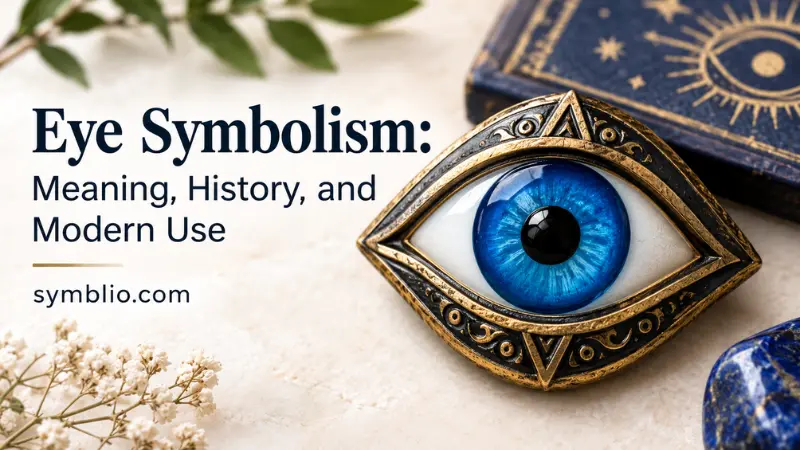
The eye is one of the most recognizable symbols in human culture. Eye symbolism can represent awareness, protection, knowledge, observation, healing, intuition, or spiritual watchfulness, depending on the design and cultural setting.
Part of the eye’s symbolic importance comes from its everyday function: people use sight to recognize danger, understand their surroundings, communicate emotion, and connect with other people. An image of an eye therefore carries meanings that extend beyond simple vision.
In the United States, eye imagery appears in religious art, jewelry, tattoos, advertising, fashion, architecture, and popular culture. Some designs have specific historical backgrounds, while others use the eye simply as a visual shorthand for seeing, noticing, or being watched.
Quick Answer
Eye symbolism commonly represents awareness, protection, knowledge, and observation in modern American culture, especially in jewelry, tattoos, art, and spiritual imagery. Historically, eyes have also represented healing, divine watchfulness, protection from harm, and supernatural or religious power.
TL;DR
- Eyes commonly symbolize awareness, knowledge, protection, and observation.
- Ancient Egyptian art connected the eye with healing and restoration.
- The Eye of Providence represents divine watchfulness in American history.
- The evil eye tradition associates eye imagery with protection from harm.
- Tattoos and jewelry often personalize eye symbolism around identity or awareness.
- Modern media can also use eyes to suggest surveillance or secrecy.
Why the Human Eye Became a Symbol
The eye naturally lends itself to symbolism because seeing is closely connected with understanding. Someone who can see what is happening has access to information that another person may not have.
Eyes also communicate emotion without words. A person’s gaze can suggest affection, fear, suspicion, confidence, sadness, or attention. Artists have therefore used eyes to express ideas that would otherwise require a larger scene or explanation.
There is another important association: the eye can watch without speaking. An eye depicted above a doorway, on an object, or inside a geometric design can suggest that something is observing events. Depending on context, that observer may be protective, divine, human, or simply symbolic.
What Eyes Commonly Represent Today
In contemporary American culture, several meanings appear repeatedly.
Awareness is one of the most straightforward. An eye can suggest paying attention, noticing what others overlook, or becoming more conscious of one’s surroundings.
Knowledge is another common association. Because vision allows people to gather information, an eye can represent learning, insight, or understanding.
Protection often appears in religious and folk traditions. Protective eye designs may be displayed as jewelry, artwork, or decorative objects.
Observation can have either a positive or negative tone. An eye may represent vigilance and responsibility, but it can also suggest surveillance or a lack of privacy.
Identity has become particularly relevant in personal artwork and tattoos. A person’s chosen eye design may represent personal awareness, memory, spirituality, family, or an important period of life.
Ancient Egyptian Eye Symbolism
One of the best-known historical examples is the wedjat, or Eye of Horus. Ancient Egyptian examples show a stylized eye combining human and falcon features.
The symbol was associated with the restored eye of Horus. Because the eye was understood as healed or made whole, the wedjat became associated with restoration, regeneration, protection, and well-being. Amulets bearing the design were used by both living people and the dead.
This history matters because modern references to an “Egyptian eye” sometimes combine several different ideas under one label. The Eye of Horus has a particular mythological and historical background; it should not automatically be treated as interchangeable with every other eye symbol.
Ancient Egyptian culture also associated eye-related imagery with protection against harmful forces. Archaeological objects suggest that eye-like motifs could serve protective purposes, although individual objects do not always preserve enough information to establish their exact original meaning.
The Eye of Providence in American Culture
In the United States, one of the most recognizable symbolic eyes is the Eye of Providence, usually depicted as an eye within a triangle.
Its place in American history is connected to the Great Seal of the United States. The reverse design adopted in 1782 includes an unfinished pyramid topped by an Eye of Providence. The National Archives describes the design as part of the symbolism developed during the creation of the national seal.
The imagery is accompanied by Latin inscriptions. One, Annuit Coeptis, has traditionally been translated in connection with divine favor toward the nation’s undertakings. The other, Novus Ordo Seclorum, refers to a new order of the ages.
Because of this history, Americans may encounter the eye in contexts involving religion, government history, national symbolism, or discussions of the country’s founding era.
It is important, however, to distinguish the historical Eye of Providence from later interpretations that attach unrelated theories or hidden meanings to the design.
The Evil Eye and Protective Traditions
The evil eye is a different symbolic tradition. It refers broadly to the belief that a harmful gaze, often connected with envy or ill will, can cause misfortune or harm.
Protective eye amulets developed in different cultures and periods. The specific designs, beliefs, colors, and practices vary considerably, so the evil eye should not be treated as a single tradition with one universal meaning.
Museum collections provide evidence of eye-related protective objects from ancient contexts. For example, some ancient Egyptian objects have been interpreted as abstract eye motifs intended to ward off the evil eye.
The important distinction is that an eye used against the evil eye is meant as a protective symbol. It does not necessarily represent the same idea as the Eye of Horus or the Eye of Providence.
Eye Symbolism Across Cultures
Eye imagery appears in many cultural and religious settings, but its interpretation changes from one tradition to another.
| Context | Meaning in the USA | Common Associations | Notes |
|---|---|---|---|
| Eye of Providence | Divine watchfulness | Faith, providence, American history | Connected to the Great Seal |
| Eye of Horus | Protection and restoration | Healing, renewal, ancient Egypt | Based on Egyptian mythology |
| Evil eye | Protection from harmful attention | Envy, safeguarding, folk belief | Traditions vary by culture |
| Artistic eye | Awareness and perception | Knowledge, emotion, observation | Meaning depends on the artwork |
| Eye tattoo | Personal symbolism | Identity, memory, spirituality | Highly individual interpretation |
These traditions sometimes overlap in modern design, but their historical origins are not identical.
Religious Meanings of the Eye
Religious symbolism often uses the eye to communicate the idea of divine observation or spiritual awareness.
In Christian-influenced American art, the Eye of Providence can suggest God’s watchfulness and providence. Its appearance in the Great Seal gives the image an additional historical connection to the early United States.
Other religious traditions also use eyes or visual metaphors involving sight. However, similar-looking symbols do not necessarily share the same theology. A careful interpretation should consider the surrounding imagery, text, religious setting, and historical period.
This is especially important when a modern decorative design borrows an eye from a tradition without retaining its original religious context.
The Emotional Meaning of Eye Imagery
An eye can communicate emotion because people naturally read meaning into another person’s gaze.
A wide-open eye may suggest alertness or surprise. A closed eye can suggest rest, peace, mourning, meditation, or withdrawal. A single staring eye may create a feeling of attention or scrutiny.
Artists often manipulate these associations deliberately. A gentle eye can make an image feel personal, while a highly realistic or exaggerated eye can make the viewer feel observed.
That emotional flexibility explains why eye imagery works particularly well in portraits, album artwork, posters, tattoos, and visual storytelling.
Eyes as Symbols of Knowledge and Awareness
The connection between sight and knowledge is especially common in modern symbolic language.
An eye can represent someone who “sees the truth,” recognizes a problem, or understands something previously hidden. In this sense, the symbol is less about supernatural vision and more about perception.
Educational and artistic settings can use eyes to communicate curiosity and observation. A design featuring an eye surrounded by books, stars, diagrams, or other intellectual imagery can reinforce the idea of learning.
The symbol can also represent self-awareness: seeing one’s own behavior clearly and becoming more conscious of personal choices.
Eye Tattoos and Personal Identity
Eye tattoos are particularly open to individual interpretation. Two people can choose similar designs while intending completely different meanings.
One person might associate an eye with a loved one who watched over them. Another might use it to represent awareness after a major life change. Someone else may choose an Egyptian-inspired eye because of an interest in ancient history.
The surrounding tattoo elements often provide important clues. A flower can shift the mood toward beauty or remembrance, while geometric patterns can create a more abstract interpretation.
Because of this, there is no universal definition for an eye tattoo. The wearer’s personal story usually matters more than a generalized symbolism list.
Eye Jewelry, Fashion, and Home Decor
Eye imagery is common in contemporary accessories because the basic shape is immediately recognizable.
Necklaces, bracelets, rings, earrings, and decorative objects may use an eye to suggest protection or awareness. Some designs borrow from established traditions, while others use the shape primarily for visual appeal.
In American home decor, eye motifs can appear in paintings, textiles, sculptures, and eclectic interior designs. The meaning may range from spiritual protection to artistic interest.
Consumers should not assume that every eye-shaped object carries a religious or supernatural message. Sometimes the eye is simply a recognizable graphic element.
Eyes in Social Media and Popular Culture
Digital culture has expanded the number of meanings associated with eye imagery.
An eye can suggest watching, noticing, revealing information, or paying attention. In online communication, eye-related imagery may also be used humorously to indicate curiosity or interest.
Entertainment media frequently uses eyes when a story involves surveillance, secret knowledge, supernatural abilities, or hidden information. This has strengthened the association between an isolated eye and the idea of being watched.
At the same time, social media has made symbolic imagery easier to separate from its historical context. A design may circulate widely because it looks distinctive even when many viewers are unfamiliar with its original meaning.
When Eye Symbolism Suggests Surveillance
Not every eye carries a comforting or protective message.
In modern American culture, an eye can also represent monitoring and surveillance. Cameras, security systems, tracking technologies, and fictional depictions of constant observation have reinforced this interpretation.
The same visual feature can therefore communicate opposite ideas depending on context. An eye above a doorway may suggest protection, while an eye beside a camera may suggest surveillance.
This dual meaning is useful when interpreting artwork: ask who is looking, what they are looking at, and why before assigning a symbolic meaning.
Common Misunderstandings About Eye Symbols
One frequent mistake is assuming that every eye symbol has the same origin. The Eye of Horus, Eye of Providence, and evil-eye amulets belong to different traditions and should be interpreted separately.
Another misunderstanding is assuming that an eye automatically represents something secret or conspiratorial. Modern entertainment sometimes uses eye imagery to create that association, but the historical meanings are much broader.
It is also easy to confuse a contemporary decorative design with an ancient symbol. Similar shapes can emerge independently, and museums caution that some simple eye-like motifs may have lost their original meaning or may have served primarily decorative purposes.
How Eye Symbolism Has Changed Over Time
The eye has moved between religious, protective, artistic, political, and commercial settings.
Ancient Egyptian traditions gave particular eye forms associations with healing, restoration, and protection. Later religious and folk traditions developed their own uses of eye imagery. In the United States, the Eye of Providence became part of a major national emblem in the eighteenth century.
Today, the symbol has become more flexible. A person may encounter an eye as a historical emblem in a museum, a protective motif in jewelry, a personal statement in a tattoo, or a visual metaphor for surveillance in a television series.
Its meaning is therefore increasingly determined by context.
How to Interpret an Eye Symbol Correctly
When you encounter an eye symbol, consider five questions:
- What does the eye look like? Is it realistic, Egyptian-style, inside a triangle, or part of an amulet?
- What surrounds it? Other symbols often reveal the intended meaning.
- Where is it being used? A religious building, tattoo studio, museum, fashion item, and film can create very different interpretations.
- What culture or historical period does it reference?
- Is the meaning traditional or personal? Modern creators often adapt older imagery for new purposes.
These questions prevent a common mistake: treating a visual similarity as proof that two symbols have the same history.
FAQs
An eye can symbolize spiritual awareness, divine observation, protection, or insight, depending on the religious tradition. The specific design and surrounding imagery are important when identifying its intended meaning.
An eye tattoo may represent awareness, protection, memory, personal identity, or spiritual belief. Because tattoo meanings are highly personal, the wearer’s intended message is usually more important than a universal symbolism list.
No. The Eye of Horus comes from ancient Egyptian mythology and is associated with the restored eye of Horus, including healing and protection. The evil-eye tradition concerns harmful attention or envy and includes its own protective customs.
The Eye of Providence is associated with divine providence and appears on the reverse of the Great Seal of the United States. Its historical use dates to the design adopted by Congress in 1782.
No. An eye can represent protection or awareness, but it can also suggest surveillance, suspicion, judgment, or unwanted observation. The surrounding context determines the tone.
Sight gives people information about their surroundings, so the eye naturally became a metaphor for perception and understanding. Modern art frequently uses eyes to communicate awareness, observation, or insight.
Eyes are visually prominent and closely connected with seeing, attention, and human interaction, making them useful symbolic forms. Different cultures developed their own interpretations rather than sharing one universal meaning.
Conclusion
The meaning of an eye depends heavily on its cultural and visual context. It can represent awareness and knowledge, protection and healing, divine watchfulness, personal identity, or even surveillance.
Eye symbolism has a particularly broad presence in the United States because Americans encounter eye imagery in national history, religious art, fashion, tattoos, entertainment, and everyday design. Understanding the specific tradition behind an image makes its meaning clearer and avoids confusing separate symbols simply because they share the shape of an eye.
The most useful question is not simply “What does an eye mean?” but which eye, in which tradition, and in what setting? That context turns a familiar image into a much more precise symbol.


