
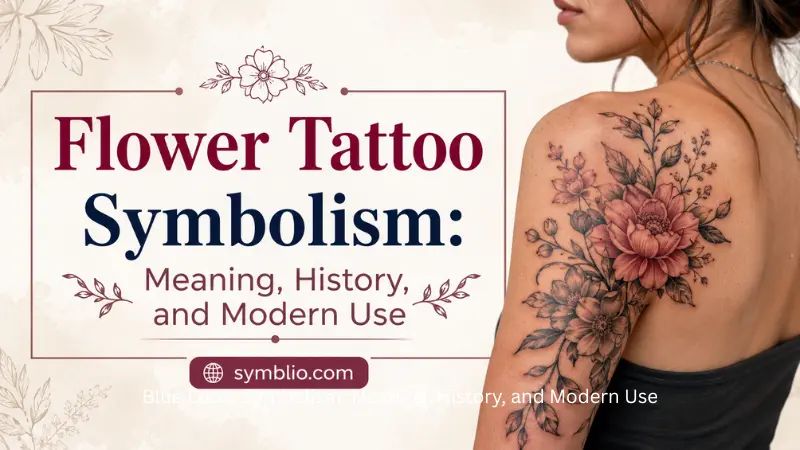
Flowers are among the most adaptable images in tattoo art. Flower tattoo symbolism can express love, remembrance, resilience, beauty, grief, spiritual belief, family identity, or a major life transition. The exact message depends on the flower, its color, its condition, and the personal story of the person wearing it.
Part of their appeal comes from familiarity. Americans encounter flowers at weddings, funerals, graduations, anniversaries, religious celebrations, memorials, and everyday moments of affection. Turning a flower into permanent body art can preserve the emotional meaning of one of those moments.
At the same time, floral designs carry histories that extend beyond modern tattoo culture. Roses inherited centuries of romantic associations, lotuses developed important meanings within Asian religious traditions, and red poppies became connected with wartime remembrance. Understanding those backgrounds helps explain why similar designs can communicate very different ideas.
Quick Answer
Flower tattoo symbolism most commonly represents personal growth, love, beauty, remembrance, resilience, or a meaningful stage of life in modern American culture. Historically, individual flowers have also carried specific religious, artistic, romantic, seasonal, and memorial meanings across different cultures.
TL;DR
- Floral tattoos often represent love, growth, memory, identity, or resilience.
- Individual flower species can carry very different cultural meanings.
- Victorian flower language influenced many familiar Western associations.
- Americans often use floral tattoos to commemorate people and life events.
- Color, placement, and artistic style can change the message significantly.
- Cultural meanings should be understood rather than treated as universal rules.
What Flower Tattoos Commonly Mean in the United States
In contemporary American tattoo culture, flowers usually communicate something personal rather than belonging to a single fixed symbolic system.
Growth is one of the most common interpretations. A flower begins as a seed or bud, develops gradually, blooms, fades, and sometimes returns the following season. That natural cycle makes floral imagery useful for representing recovery, maturity, change, and the beginning of a new chapter.
Love is another major association. Roses remain particularly connected with romance, while other flowers may represent affection for a child, parent, spouse, friend, or someone who has died.
Flowers can also symbolize the ability to remain gentle without being weak. A tattoo combining delicate petals with thorns, dark shading, or difficult growing conditions may express the idea that vulnerability and endurance can exist together.
The most important point is that a floral tattoo does not automatically have one meaning. Personal experience often matters more than a dictionary definition.
Why Flowers Carry So Many Meanings
Flowers naturally lend themselves to symbolism because people encounter them at emotionally important moments.
Bouquets accompany romantic relationships and celebrations. Floral arrangements appear at funerals and memorial services. Certain flowers bloom around particular holidays and seasons. Others have religious, national, or regional associations.
Their biological life cycle also provides an intuitive symbolic vocabulary.
A bud can suggest possibility or youth.
A flower in full bloom may represent confidence, fulfillment, beauty, or a moment worth preserving.
A wilted flower can suggest loss, mortality, disappointment, or the end of a relationship.
A new flower growing beside an older one may represent family generations, parenthood, or continuity after loss.
Because people already use flowers to communicate without words, they translate naturally into permanent visual symbols.
How Floral Symbolism Developed Before Modern Tattooing
People were assigning meanings to flowers long before floral tattoos became common.
Religious art, mythology, literature, court traditions, and folk customs all contributed to floral symbolism. Different societies developed their own associations based on local plants, seasonal cycles, religious teachings, and social practices.
In the English-speaking world, flower symbolism became especially fashionable during the nineteenth century. Victorian-era guides attempted to assign messages to individual plants, creating what became known as the language of flowers, or floriography.
A flower could stand for an emotion that social convention made difficult to express directly. Roses became strongly associated with passionate love, while other plants communicated friendship, remembrance, innocence, faithfulness, jealousy, or mourning.
These systems were never completely standardized. Different floral dictionaries sometimes assigned different meanings to the same plant.
That uncertainty still matters. Many modern tattoo meanings draw partly from Victorian flower language, but they should be understood as cultural associations rather than rigid definitions.
From Ancient Body Marking to American Tattoo Culture
Tattooing itself is far older than modern floral design.
Archaeological evidence shows that people have permanently marked their skin for thousands of years. The 5,300-year-old body commonly known as Ötzi the Iceman carries dozens of tattooed markings. Other tattoo traditions developed independently in Africa, Asia, the Pacific, the Americas, and Arctic regions.
Historically, tattooing could communicate status, ancestry, spiritual protection, achievement, group belonging, healing practices, mourning, or personal identity.
In the United States, tattooing became strongly associated with sailors, military communities, traveling performers, bikers, and other subcultures during parts of the nineteenth and twentieth centuries. Floral designs existed alongside anchors, hearts, names, eagles, ships, and military imagery.
Over time, tattooing moved much further into mainstream American life. A nationally representative 2023 survey found that roughly one-third of American adults had at least one tattoo. Among tattooed adults, remembering or honoring a person or something important was one of the most commonly reported motivations.
That helps explain the popularity of flowers. They can commemorate someone while remaining visually attractive and understandable outside a specific subculture.
Common Flowers and What They Often Suggest
There is no universal flower dictionary, but several associations appear regularly in contemporary American tattoo design.
| Flower | Common U.S. Interpretation | Other Associations | Important Context |
|---|---|---|---|
| Rose | Love, passion, remembrance | Beauty, grief, devotion | Color and thorns can alter meaning |
| Lotus | Growth, purity, transformation | Enlightenment, spiritual practice | Important in Asian religious traditions |
| Lily | Purity, remembrance, renewal | Faith, funerals, innocence | Meaning varies greatly by lily type |
| Sunflower | Happiness, warmth, loyalty | Optimism, vitality | Often chosen for positive personal symbolism |
| Poppy | Remembrance, sacrifice | Sleep, death, war memory | Red poppies carry specific memorial associations |
| Cherry blossom | Change, beauty, impermanence | Spring, renewal, Japanese culture | Cultural background matters |
The table provides useful starting points, but the wearer’s explanation should take priority over outside assumptions.
Rose Tattoos: Love, Grief, and Emotional Complexity
The rose is probably the clearest example of a flower whose meaning changes with context.
In Western culture, red roses are closely connected with romantic love and desire. That makes a red rose tattoo a natural choice for devotion, partnership, or passionate attachment.
Roses also appear in memorial tattoos. A flower placed beside a name, date, portrait, or short phrase may commemorate someone who has died.
Thorns introduce another layer. A rose with visible thorns can suggest that love includes pain, that beauty comes with risk, or that someone survived a difficult relationship without rejecting the possibility of affection.
Black or heavily shaded roses are sometimes used for grief, endings, darker aesthetics, or personal transformation. They do not have one universally negative meaning.
The rose’s versatility is exactly why assumptions can be misleading. Two people wearing similar roses may be expressing completely different experiences.
Lotus Tattoos: Purity, Growth, and Spiritual Aspiration
The lotus has become a popular symbol of transformation, but its history deserves more care than the common slogan about a flower growing from mud.
Lotus imagery has important roles in several South and East Asian religious traditions. In Buddhist art, the flower can represent purity and enlightenment because it emerges from muddy water while producing a clean blossom. Lotus imagery also appears extensively in Hindu religious art and is associated with divine figures, creation, beauty, prosperity, and spiritual order in different contexts.
Modern American tattoo wearers often adapt these associations into personal ideas such as overcoming hardship, developing spiritually, or rebuilding life after difficulty.
That interpretation can be meaningful without claiming that every lotus has the same religious meaning.
A lotus combined with specifically Buddhist or Hindu sacred imagery carries a different cultural weight from a simple botanical lotus. Someone choosing the former should understand the tradition being referenced rather than treating sacred imagery as decorative shorthand.
Lilies, Daisies, and Sunflowers: Different Forms of Hope
Not every positive floral tattoo communicates the same type of optimism.
Lilies frequently appear in religious, ceremonial, and mourning settings. In American imagery, white lilies may suggest purity, peace, innocence, faith, or remembrance. Because lilies are also common funeral flowers, they can carry both hopeful and mournful associations.
Daisies often suggest simplicity, youthfulness, affection, innocence, or an uncomplicated connection with nature. Their open shape and familiar appearance make them popular for lighter, playful designs.
Sunflowers are frequently interpreted as warmth, positivity, vitality, and loyalty. Their large blooms and association with sunlight naturally support optimistic imagery, although a wearer may choose one for a completely personal reason.
Putting these flowers together can create a layered composition. A lily, daisy, and sunflower bouquet could represent three relatives, several stages of life, or nothing more complicated than favorite flowers.
Poppies and Memorial Meaning in the United States
The poppy demonstrates how historical events can transform a flower’s meaning.
After World War I, red poppies became widely associated with soldiers who died during wartime. Their connection with the battlefields of Europe and wartime remembrance eventually became part of American commemorative culture as well.
In the United States, the red poppy remains a recognized symbol connected with military sacrifice and remembrance, particularly around Memorial Day.
A red poppy tattoo may therefore honor a service member, veteran, or relative affected by war. In that context, the flower carries more historical specificity than a general floral memorial.
Poppies can have other meanings too. Their connection with sleep and opium has given them associations with dreams, altered consciousness, death, and rest in art and literature.
The surrounding imagery usually tells the reader which interpretation matters.
Cherry Blossoms, Peonies, and Chrysanthemums Across Cultures
Some flowers commonly used in American tattoos arrive with meanings shaped strongly by Asian cultures.
Cherry blossoms are closely associated with Japan and seasonal change. Their brief flowering makes them particularly suitable for ideas about impermanence, changing seasons, new beginnings, and appreciation of temporary beauty.
They also have a distinct American connection. Japan’s gift of cherry trees to Washington, D.C., in 1912 became associated with friendship and goodwill between the two nations.
The peony has several histories. Victorian flower language sometimes gave it meanings quite different from those found in East Asian art. In Chinese visual traditions, the flower has long been associated with prosperity, status, and abundance.
The chrysanthemum also changes meaning across cultures. Chinese art has connected it with autumn and longevity, while in Japan it carries an important imperial association as well as seasonal and longevity symbolism.
These examples show why simply searching for “the meaning” of a flower can produce contradictory answers. Geography and cultural tradition matter.
How Color Changes a Floral Tattoo’s Message
Color can strengthen, soften, or completely redirect a flower’s interpretation.
Red commonly emphasizes passion, romantic love, sacrifice, or intensity. Pink often creates a gentler association with affection, tenderness, friendship, or femininity, although those meanings are not mandatory.
White flowers frequently suggest innocence, peace, spirituality, mourning, or simplicity. Their meaning depends heavily on the species and cultural setting.
Yellow can convey happiness, friendship, warmth, or energy. Yet historical flower traditions occasionally gave yellow blooms less cheerful associations, demonstrating again that symbolic systems change.
Purple may suggest dignity, creativity, spirituality, or luxury because of its broader cultural history.
Black-and-gray tattoos work differently. Without realistic flower color, attention moves toward shape, shading, composition, and accompanying imagery. A black-and-gray floral design is not automatically about death or sadness.
Birth Flowers, Family, and Personal Identity
Floral tattoos often function as personal records.
Birth-flower designs assign a particular bloom to a birth month, much like birthstones. Someone may tattoo their own birth flower as an identity symbol or combine several flowers to represent children, parents, siblings, or partners.
A family bouquet can be especially effective because it allows several individuals to appear in one design without using names or portraits.
Some people choose flowers from a relative’s garden, wedding bouquet, hometown, or favorite landscape instead. Those choices may have little connection with traditional floral dictionaries but far more emotional importance.
A seemingly ordinary lavender sprig, rose, or daffodil might therefore represent a specific childhood memory that no stranger could identify by looking at it.
That privacy is part of the appeal. The image can be aesthetically understandable while its complete story remains personal.
Placement and Style Can Shift the Meaning
A flower’s species is only one part of the visual message.
A small fine-line flower on the wrist can feel intimate and understated. A large botanical composition across the back or thigh creates a more deliberate artistic statement.
American traditional tattooing often uses bold outlines, simplified shapes, and saturated imagery. A rose in that style may connect visually with classic tattoo heritage even when its personal meaning is modern.
Realistic botanical tattoos emphasize the actual structure of a plant. Fine-line designs can feel delicate, while blackwork can make the same flower appear more graphic or dramatic.
The flower’s condition also matters.
Broken stems can suggest separation.
Falling petals may represent time, loss, or change.
New buds can imply beginnings or future generations.
Thorns may introduce protection, pain, or boundaries.
Even direction and composition can matter. A flower growing upward from damaged imagery can visually tell a story of recovery without any written explanation.
Psychological and Emotional Reasons People Choose Floral Tattoos
Many tattoos operate as forms of autobiographical storytelling.
Flowers are particularly useful because they let someone express complicated experiences without showing those experiences literally. A person does not need to tattoo an image of an illness, breakup, death, or difficult period to acknowledge it.
A bloom can mark survival.
A bouquet can preserve a relationship.
A flower opening from a damaged stem can represent rebuilding.
Floral imagery also allows difficult emotions to coexist. Grief does not cancel love, and vulnerability does not cancel resilience. A memorial flower can be sad because someone is gone while remaining joyful because of what that person contributed to the wearer’s life.
This emotional flexibility matches broader American tattoo motivations. People commonly use tattoos not merely as decoration but to remember important experiences, honor others, communicate beliefs, or shape how they present themselves.
Cultural Respect, Misuse, and Common Misreadings
Most ordinary flower images are not exclusive to one community. Problems arise when broad floral imagery becomes mixed with culturally specific religious, ceremonial, or identity symbols without understanding their meaning.
A generic chrysanthemum, for example, is not the same thing as reproducing an entire traditional Japanese composition. Likewise, a lotus drawn botanically is different from a design that incorporates sacred figures, mantras, ritual diagrams, or other explicitly religious elements.
Traditional Indigenous tattoo systems require even greater care. Many forms of body marking carry genealogy, community status, sacred responsibility, or inherited identity. They should not be reduced to a collection of attractive patterns.
Another common mistake is treating online flower charts as universal facts.
A rose does not always mean romance. A lily does not always mean purity. A chrysanthemum does not mean exactly the same thing in every country.
Meaning develops from the relationship among species, color, culture, artistic style, accompanying imagery, and personal intention.
How Floral Tattoo Meanings Continue to Evolve
Floral tattoos show how symbolism changes without completely abandoning the past.
Older associations remain recognizable. Roses still suggest love. Poppies still evoke remembrance. Lotus flowers still carry religious and spiritual associations. At the same time, contemporary wearers reinterpret these images through their own biographies.
Modern floral designs increasingly function like personal archives. A bouquet may encode birthdays, relationships, losses, hometown memories, favorite plants, or milestones within one image.
Social media has also exposed people to tattoo styles from around the world. That has expanded the visual vocabulary available to clients, but it has also made cultural context more important. Seeing a symbol frequently online does not erase the tradition from which it came.
The result is a flexible form of symbolism. Historical meaning provides a foundation, while individual experience determines which part of that history remains relevant.
FAQs
A flower tattoo commonly symbolizes beauty, growth, love, renewal, strength, and the cycle of life. Its exact meaning depends on the flower, color, design, and personal reason behind the tattoo.
There is no single most meaningful flower. Roses often represent love, lotus flowers suggest growth and transformation, sunflowers symbolize optimism, and lilies can represent purity, remembrance, or renewal.
The lotus is frequently associated with resilience and inner strength because it grows from muddy water and produces a striking flower. Roses, gladiolus, and thistles can also communicate courage or endurance depending on the design.
The rose is one of the best-known floral symbols of love, especially a red rose. Other flowers associated with affection include peonies, tulips, and forget-me-nots.
Lotus flowers, daffodils, cherry blossoms, and daisies can symbolize renewal or fresh beginnings. Their meanings often come from their connection with spring, blooming, transformation, or seasonal change.
Yes. Color can add another layer of symbolism. For example, red often suggests passion, white can represent purity or remembrance, yellow may suggest happiness or friendship, and purple can convey admiration, spirituality, or dignity.
Conclusion
Flowers work especially well as permanent body art because they can represent both a moment and a process. Blooming, fading, producing seeds, and returning with another season provide natural images for love, grief, change, family, memory, and survival.
The most useful way to understand flower tattoo symbolism is therefore to combine cultural history with personal context. Traditional meanings can explain why certain flowers carry familiar associations, but the person wearing the tattoo ultimately determines which part of that symbolic history becomes permanent.
A flower on the skin can preserve a relationship, mark a transition, honor someone who is gone, or simply represent a plant connected with a life worth remembering.


