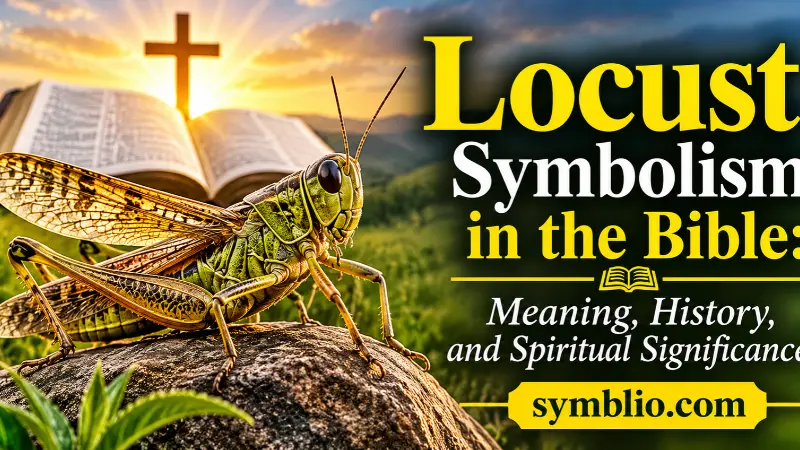
Locust symbolism in the Bible is closely connected with divine judgment, destruction, warning, and the consequences of turning away from God. Throughout the Old and New Testaments, locusts appear as destructive insects that consume crops, threaten food supplies, and represent overwhelming hardship. Their presence often communicates the seriousness of a spiritual warning or the consequences of human disobedience.
One of the best-known biblical examples is the plague of locusts in the book of Exodus. As the eighth plague brought upon Egypt, the insects destroyed vegetation and demonstrated the power of God during the confrontation between Moses and Pharaoh. Locusts also appear in the books of Joel, Amos, Nahum, and Revelation, where their meanings depend on the surrounding message.
For modern American readers, locusts are often understood as symbols of judgment, hardship, and spiritual consequences. However, their biblical meaning is not entirely negative. The book of Joel also presents a message of restoration, showing that periods of loss can be followed by renewal when people turn back to God.
Understanding the biblical locust requires looking beyond the insect’s destructive behavior. Its appearances in Scripture connect agricultural life, spiritual responsibility, repentance, and the possibility of restoration.
Quick Answer: What Do Locusts Symbolize in the Bible?
Locusts in the Bible commonly symbolize divine judgment, destruction, hardship, and the consequences of disobedience. Historically, they also represent spiritual warnings, calls to repentance, and, particularly in the book of Joel, the possibility of restoration after devastating loss.
TL;DR: Key Biblical Meanings
- Divine judgment: Represents consequences for persistent disobedience.
- Destruction: Illustrates the devastation of crops and livelihoods.
- Warning: Calls attention to spiritual responsibility.
- Repentance: Encourages people to return sincerely to God.
- Restoration: Represents renewed hope after periods of loss.
- Spiritual conflict: Appears in Revelation’s vision of judgment.
What Locusts Represent in Different Biblical Passages
Locusts appear in several biblical books, and their meaning changes according to the message being communicated. Some passages describe actual agricultural disasters, while others use locust imagery to explain spiritual or national events.
The following examples show how Scripture uses the insect in different ways.
| Biblical Passage | Context | Symbolic Meaning |
|---|---|---|
| Exodus 10:1–20 | Eighth plague in Egypt | Divine judgment and deliverance |
| Deuteronomy 28:38–42 | Consequences of disobedience | Loss and agricultural hardship |
| Joel 1:4–12 | Devastation of crops | Destruction and a call to repentance |
| Amos 7:1–3 | Vision of a locust swarm | Judgment and divine mercy |
| Revelation 9:1–11 | Apocalyptic vision | Spiritual suffering and judgment |
| Proverbs 30:27 | Description of locust behavior | Order, cooperation, and preparation |
These passages demonstrate why readers should consider the surrounding verses rather than assign one meaning to every biblical reference to locusts.
The Eighth Plague in Egypt: A Sign of Divine Judgment
One of the most important biblical appearances of locusts occurs in Exodus 10.
The Israelites were living under Egyptian oppression, and Moses repeatedly asked Pharaoh to release them. Pharaoh refused, despite several warnings and earlier plagues. As a result, God announced that a massive swarm of locusts would cover Egypt.
According to the biblical account, the insects consumed the vegetation that remained after the earlier hailstorm. They covered the land so thoroughly that the ground became difficult to see.
The devastation affected Egypt’s agricultural resources and demonstrated the seriousness of Pharaoh’s refusal to release the Israelites.
In this passage, locusts represent several connected ideas.
Judgment for disobedience: Pharaoh’s continued refusal to follow God’s command brought another consequence upon Egypt.
The limits of human authority: Pharaoh possessed considerable political power, but he could not control the natural disaster described in the story.
Deliverance for the oppressed: The plague formed part of the larger account of Israel’s liberation from slavery.
The Exodus narrative therefore presents locusts as more than destructive insects. They become part of a larger story about justice, freedom, and God’s response to oppression.
Locusts as a Warning Against Disobedience
The book of Deuteronomy also connects locusts with the consequences of disobedience.
In Deuteronomy 28, Moses describes blessings associated with obedience to God’s covenant and hardships associated with rejecting it. Among the warnings is the possibility that people will plant crops but fail to enjoy their harvest because locusts consume it.
This image would have been particularly serious for ancient Israel.
Agriculture supported families, supplied food, and contributed to the economic stability of communities. A destroyed harvest could affect an entire household rather than simply reduce its income.
Locusts therefore represented the loss of security that could follow a breakdown in the relationship between the people and their covenant responsibilities.
The passage also reflects the agricultural realities of the ancient Near East. Farmers depended heavily on seasonal rainfall and successful harvests. A major infestation could create food shortages and long-term financial difficulties.
For modern Christian readers, Deuteronomy presents a reminder that biblical faith involves responsibility, obedience, and concern for the consequences of human decisions.
However, these covenant warnings should be understood within their original historical and religious setting. They should not be used to claim that every modern crop failure or financial difficulty is evidence of an individual’s disobedience.
The Book of Joel: Destruction Followed by Restoration
The book of Joel offers one of the most detailed biblical treatments of locust symbolism.
Its opening chapter describes a devastating invasion that damages vineyards, fig trees, fields, and agricultural produce. The disaster affects not only farmers but also priests, families, and the wider community.
The destruction creates a national crisis. Food supplies become uncertain, celebrations are interrupted, and people are called to recognize the seriousness of their circumstances.
Joel uses the devastation to call the people toward repentance.
The prophet urges the community to return to God sincerely rather than relying on outward religious appearances. The situation becomes an opportunity for spiritual reflection and renewed commitment.
In the second chapter, the imagery becomes even more dramatic. A vast advancing force is described in terms that resemble an approaching army.
This language connects the locust invasion with the biblical theme of the Day of the Lord, a time associated with divine judgment and accountability.
Yet Joel’s message does not end with destruction.
The prophet also describes God’s compassion and the possibility of restoration. The community is promised renewed agricultural abundance and relief from the devastation.
This development gives locusts a more complex meaning than simple destruction. They represent a crisis that exposes spiritual responsibility while setting the stage for repentance and renewed hope.
“I Will Restore the Years”: The Promise in Joel 2:25
Joel 2:25 is one of the most recognized biblical passages involving locusts. It contains a promise that God will restore what the destructive swarms have taken away.
The verse refers to different kinds of locusts that consumed the people’s crops. The precise identification of the Hebrew terms is uncertain, but the overall picture is clear: repeated waves of destruction have left the land struggling to recover.
For many Christians, this passage offers encouragement during periods of disappointment, hardship, and loss.
Its message is often understood in three ways.
God’s compassion: The passage emphasizes that judgment is not the final word in Joel’s message. God responds to the people’s return with compassion.
The possibility of renewal: The promise points toward restored harvests and a renewed community after a devastating period.
Hope beyond past losses: The language encourages believers to look beyond painful experiences and trust that life can hold new opportunities.
An important distinction is necessary here. Joel’s promise originally addresses a particular community facing a specific agricultural and spiritual crisis. Christians may apply its message of restoration to personal circumstances, but the verse should not be treated as a guarantee that every lost possession, opportunity, or year will be returned in exactly the same form.
Its central encouragement is that hardship does not have to define the future.
Amos and the Locust Vision: Judgment and Mercy
The prophet Amos also uses locusts to communicate a message about judgment.
In Amos 7:1–3, the prophet describes a vision in which God prepares a swarm of locusts after the king’s portion of the harvest has been collected. The insects threaten the remaining vegetation and create the possibility of widespread destruction.
Amos responds by asking God to forgive and spare the people, explaining that the nation is vulnerable.
The vision then describes God relenting from the announced disaster.
This passage introduces an important aspect of biblical locust symbolism: divine mercy.
The locusts initially represent an approaching judgment, but the prophet’s appeal demonstrates that the story is not simply about punishment. It also concerns compassion, intercession, and the possibility of mercy.
Amos 4:9 presents a different picture. It recalls agricultural destruction caused by locusts as part of a series of hardships that failed to bring the people back to God.
Together, these passages show two related ideas. People are responsible for their actions, but the biblical message also leaves room for repentance and mercy.
Locusts in Revelation: A Picture of Spiritual Judgment
The book of Revelation introduces one of the Bible’s most unusual descriptions of locusts.
In Revelation 9:1–11, the apostle John describes a vision in which locust-like creatures emerge from smoke after the opening of the fifth trumpet. Their appearance is unlike that of ordinary insects, and their behavior is described using several frightening comparisons.
Unlike the agricultural locusts in Exodus and Joel, these creatures are part of an apocalyptic vision.
They are given authority to torment people who do not have God’s seal on their foreheads. Their activity is limited, and the passage specifies that they are not permitted to destroy vegetation as ordinary locust swarms would.
The imagery communicates several themes.
- Judgment: The creatures participate in a larger sequence of divine judgments.
- Spiritual conflict: Their unusual appearance contributes to the book’s depiction of conflict between good and evil.
- Limited authority: Their power operates within boundaries rather than without restriction.
- Human suffering: Their activity illustrates the seriousness of the events described in Revelation.
Christians interpret this passage in different ways. Some understand the locusts primarily as symbolic representations of spiritual or historical forces. Others emphasize the vision’s supernatural character and its place within future events.
It is therefore inaccurate to insist that every detail has one universally accepted interpretation.
The main point is that Revelation uses locust imagery to communicate judgment and suffering within its larger message about accountability, faithfulness, and God’s ultimate victory.
Proverbs 30:27: Locusts as an Example of Organization
Not every biblical reference to locusts presents them negatively.
Proverbs 30:27 offers a different perspective by observing that locusts have no king, yet they move forward together in organized groups.
The verse appears in a passage that describes small or seemingly insignificant creatures that display remarkable characteristics.
The locust becomes an example of coordinated behavior. Although the insects do not have a visible ruler directing them, they move together in a way that allows them to accomplish something much larger than an individual insect could achieve.
This observation creates a useful contrast with the destructive images found elsewhere in Scripture.
Here, the emphasis is not on judgment or agricultural loss. Instead, the locust illustrates organization, cooperation, and collective action.
For Christian readers, the passage can encourage reflection on teamwork and the importance of contributing to a shared purpose.
It also demonstrates why biblical symbolism should not be reduced to a single negative interpretation.
Locusts as Food in Biblical Times
Another detail that often surprises modern readers is that the Bible does not treat locusts exclusively as destructive creatures.
Leviticus 11:20–23 discusses insects that the Israelites were permitted to eat under the dietary laws. Certain kinds of locusts and related jumping insects were included among the permitted foods.
John the Baptist is also described as eating locusts and wild honey in Matthew 3:4 and Mark 1:6.
This detail reflects the practical realities of life in the ancient Near East. Locusts were available in some regions and could serve as a source of food.
Their nutritional and agricultural significance was therefore more complicated than their destructive reputation might suggest.
This biblical detail is useful because it prevents an overly narrow interpretation. The same creature that could destroy a harvest could also become food for people living in an agricultural society.
Its meaning depended on the situation being described.
The Historical and Agricultural Background of Biblical Locusts
To understand why locusts appear so frequently in Scripture, it helps to consider the agricultural environment of the ancient Near East.
Many biblical communities depended on farming and livestock for their survival. Crops such as barley, wheat, grapes, and figs provided food and supported local economies.
Locust swarms could threaten these resources on a large scale.
Unlike many insects that remain relatively localized, certain locust species can change their behavior under particular environmental conditions and form enormous migrating swarms.
These swarms can consume vegetation across extensive areas, sometimes leaving farmers with little opportunity to protect their fields.
For ancient communities without modern agricultural protection systems, such events could create severe food shortages.
The biblical writers used familiar natural disasters to communicate ideas that their audiences understood immediately.
A locust invasion was not an abstract image of destruction. It represented a real threat to food, family stability, trade, and community life.
This agricultural background explains why locusts became such an effective image of hardship and divine judgment in biblical literature.
It also helps modern readers appreciate the seriousness of the warnings found in Exodus, Deuteronomy, and Joel.
The Emotional and Spiritual Meaning of Locusts
Locust imagery can communicate several emotional and spiritual ideas, depending on the biblical passage.
Fear of loss: A destructive swarm represents the anxiety that comes when essential resources disappear. In agricultural communities, the loss of a harvest could threaten an entire family’s future.
Recognition of human limitations: The insects illustrate how quickly circumstances can change, even when people believe they have control over their surroundings.
A call to reflection: In prophetic passages, locusts encourage people to consider their responsibilities and examine their relationship with God.
Hope after hardship: Joel’s restoration message provides an alternative to despair by emphasizing compassion and the possibility of renewal.
Cooperation and discipline: Proverbs uses the insects’ collective movement to illustrate the value of organization and shared effort.
These meanings can help modern readers understand why locusts remain memorable images in biblical teaching.
Their symbolism is connected with recognizable human experiences: uncertainty, responsibility, loss, perseverance, and hope.
What Locust Symbolism Means in Modern American Christianity
In the United States, locusts are commonly understood through the Bible’s stories of judgment, repentance, and restoration.
Church sermons, Bible studies, devotional books, and Christian discussions often use locust imagery to explain the consequences of wrongdoing or the importance of returning to God.
Joel 2:25 is particularly familiar among American Christians because its promise of restoration offers encouragement during difficult seasons.
People may encounter this passage when studying topics such as:
- Recovering from personal or financial difficulties.
- Finding hope after disappointment.
- Understanding repentance and forgiveness.
- Rebuilding relationships and spiritual commitments.
- Trusting God during uncertain circumstances.
Locust imagery also appears in Christian artwork and educational materials. Illustrations of the Egyptian plagues, for example, often depict enormous swarms covering the landscape.
In contemporary American culture, the insect can also appear in discussions about environmental disasters and agricultural losses. These real-world events sometimes remind readers of the biblical descriptions of devastated crops.
However, a modern locust infestation should not automatically be interpreted as a divine punishment. Biblical passages have specific historical and theological contexts, and applying them responsibly requires understanding those differences.
Common Misunderstandings About Biblical Locusts
Several misunderstandings can lead to inaccurate interpretations of locust symbolism.
Locusts do not always represent evil.
Although many biblical passages associate them with destruction, Proverbs 30:27 uses their behavior as an example of organization and cooperation.
Every disaster is not a punishment from God.
The Bible describes particular events as judgments within specific religious narratives. This does not establish that every modern natural disaster happens because someone has committed a particular sin.
Joel’s promise is not a guarantee of material repayment.
The restoration described in Joel 2:25 belongs to a specific prophetic message. Its spiritual encouragement can apply to modern life, but it does not promise that every financial or personal loss will be returned exactly as it was.
The locusts in Revelation are not ordinary agricultural insects.
John describes supernatural creatures within an apocalyptic vision. Their unusual characteristics distinguish them from the locust swarms described in the Old Testament.
Locusts are not exclusively symbols of destruction.
The dietary laws in Leviticus and the account of John the Baptist show that these insects also had practical uses in biblical society.
Recognizing these distinctions allows readers to understand the passages without forcing one interpretation onto every reference.
How the Meaning of Locusts Has Evolved Over Time
The meaning of locusts has developed through centuries of biblical interpretation and Christian teaching.
In the Old Testament, their primary associations often involve agricultural destruction, covenant warnings, and divine judgment. These meanings reflected the everyday experiences of communities that depended on successful harvests.
The prophetic books added another dimension by using locust imagery to communicate spiritual accountability and the possibility of repentance.
The New Testament introduced different contexts. John the Baptist’s diet illustrates the practical role of locusts as food, while Revelation uses them in an apocalyptic vision of judgment.
Over time, Christian teachers and writers have continued to explore these passages in sermons, devotional literature, and religious artwork.
In modern American Christianity, locusts can represent both the seriousness of spiritual consequences and the hope of restoration after hardship.
The message of Joel remains especially influential because it connects an image of devastating loss with a promise of renewed life.
This development shows that biblical symbolism is not always fixed. Its interpretation depends on the passage, historical circumstances, and theological message.
FAQs
Locusts commonly symbolize divine judgment, destruction, hardship, and the consequences of disobedience. Some passages also connect them with repentance, mercy, restoration, and cooperation.
In passages such as Exodus 10, locusts are presented as an instrument of divine judgment. Their arrival demonstrates the consequences of Pharaoh’s refusal to release the Israelites and contributes to the larger story of their deliverance.
In Joel 2:25, locusts represent the devastation that consumed the community’s agricultural resources. God’s promise to restore what was lost provides a message of hope, compassion, and renewal.
No. Although they frequently represent destruction, Proverbs 30:27 uses locusts as an example of organization and cooperation. Leviticus also identifies certain locusts as permitted food.
In Revelation 9, locust-like creatures appear in an apocalyptic vision associated with suffering and divine judgment. Their unusual characteristics distinguish them from ordinary agricultural locusts.
The Bible uses several ancient Hebrew terms for different kinds or stages of locusts, and their precise identification is sometimes uncertain. Modern English translations may use descriptions such as swarming, hopping, consuming, or young locusts to communicate these distinctions.
Biblical locust passages encourage readers to consider spiritual responsibility, recognize human limitations, and understand the importance of repentance. The book of Joel also reminds Christians that hardship does not have to be the end of a story.
Conclusion
Locust symbolism in the Bible brings together several important themes, including divine judgment, destruction, repentance, mercy, and restoration. From the eighth plague in Egypt to the prophetic warnings of Joel and Amos, locusts illustrate the consequences of disobedience and the vulnerability of human communities.
However, Scripture does not give the insect one universal meaning. Proverbs presents locusts as examples of cooperation, Leviticus discusses them as food, and Revelation uses them in an extraordinary vision of spiritual judgment.
For modern American Christians, the most meaningful lesson is the connection between accountability and hope. The biblical stories encourage reflection on personal choices while reminding readers that loss and hardship do not have to define the future.