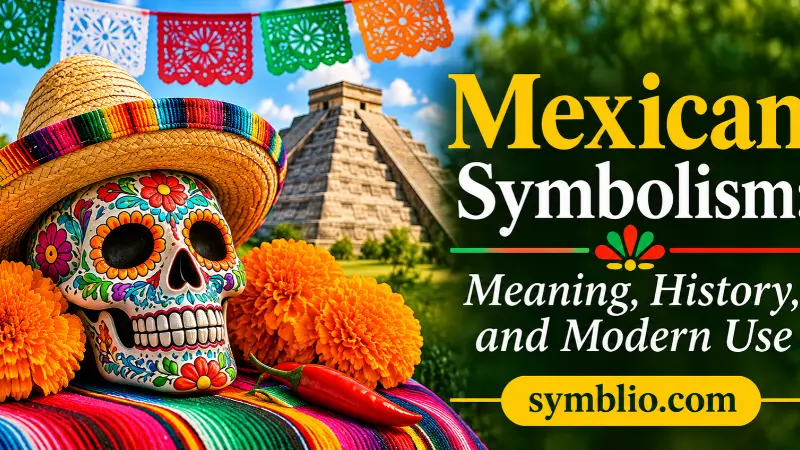
Mexican symbolism reflects the country’s Indigenous civilizations, colonial history, religious traditions, natural environment, and evolving national identity. From the eagle and serpent on the Mexican flag to colorful marigolds used during Día de los Muertos, Mexican symbolism communicates ideas about heritage, family, faith, resilience, and remembrance.
Mexico has a particularly varied symbolic tradition because its culture developed through the interaction of many Indigenous communities, including the Mexica (Aztec), Maya, Zapotec, and Mixtec peoples, alongside Spanish and other cultural influences. These traditions contributed different images, stories, rituals, and artistic practices that continue to appear in Mexican life.
For Americans, Mexican symbols are familiar in national celebrations, traditional artwork, food, religious imagery, tattoos, and Día de los Muertos festivities. However, their meanings are not always obvious. Understanding where these images originated helps distinguish authentic cultural traditions from simplified commercial interpretations.
Quick Answer
Mexican symbolism commonly represents cultural identity, family, faith, resilience, remembrance, and pride in heritage in modern American culture. Its historical meanings draw from Indigenous Mesoamerican civilizations, Spanish colonial influences, Catholic traditions, and Mexico’s struggle for independence.
TL;DR
- The eagle, serpent, and cactus represent Mexico’s foundational national story.
- Indigenous civilizations contributed many of Mexico’s oldest symbolic traditions.
- Marigolds and sugar skulls are associated with Día de los Muertos.
- The Virgin of Guadalupe represents faith and cultural identity.
- Mexican colors and folk art communicate heritage, celebration, and community.
- Modern Mexican symbolism connects ancestral traditions with contemporary identity.
What Mexican Symbolism Represents
Mexican symbolism is a collection of visual images, objects, colors, stories, and traditions that communicate cultural ideas. It does not belong to a single historical period or religious system. Instead, it reflects centuries of cultural development.
Some symbols represent national belonging, while others express religious devotion, family connections, agricultural traditions, or relationships with the natural world.
For example, the Mexican national emblem features an eagle standing on a cactus while holding a serpent. This image connects modern Mexico with the traditional account of the founding of Tenochtitlan, the Mexica capital.
Other symbols have more personal meanings. A marigold might remind someone of a deceased relative, while an image of the Virgin of Guadalupe may represent faith, protection, or family tradition.
Three broad themes appear frequently:
- Identity: Symbols connect people with Mexican history, communities, and ancestry.
- Continuity: Traditional images preserve stories and practices across generations.
- Connection: Religious, artistic, and family symbols express relationships between people, nature, and the past.
These meanings can overlap, but they are not universal. The significance of a particular image depends on its historical background and the person or community using it.
Indigenous Roots of Mexican Symbolism
Many important Mexican symbols existed long before the Spanish arrived in the Americas.
Ancient Mesoamerican civilizations developed complex systems of visual communication through architecture, sculpture, ceramics, textiles, manuscripts, and ceremonial objects.
The Mexica, commonly called the Aztecs, created important religious and political imagery. Their traditions included symbols associated with the sun, agricultural cycles, warfare, deities, and the natural environment.
The Maya developed their own sophisticated systems of writing and imagery. Their artistic traditions included representations of rulers, celestial bodies, sacred animals, and creation stories.
The Zapotec and Mixtec civilizations also contributed distinctive visual traditions, including elaborate designs in stonework, pottery, jewelry, and illustrated manuscripts.
Maize was particularly important across many Mesoamerican societies. It represented more than an agricultural product because communities depended on it for nourishment, survival, and cultural continuity.
These early traditions remain important because modern Mexican identity includes connections to Indigenous heritage, even though individual communities preserve different languages, customs, and interpretations.
It is therefore inaccurate to assume that every Mexican symbol comes from Aztec mythology. Mexico’s Indigenous history is much broader than any single civilization.
The Eagle, Serpent, and Cactus: Mexico’s National Emblem
The eagle, serpent, and cactus form one of the most recognizable combinations in Mexican symbolism.
According to the traditional account, the Mexica people searched for a place to establish their capital. They were guided by a sign involving an eagle perched on a cactus and holding a serpent. They eventually identified this image in the Valley of Mexico, where they established Tenochtitlan in 1325.
The scene became closely connected with the origin story of the city and later developed into a national emblem.
Each element contributes to the image:
- Eagle: Represents strength, authority, and an important connection with Mexica traditions.
- Serpent: Belongs to the traditional founding image and carries associations with the natural and spiritual world.
- Nopal cactus: Represents the landscape and the historical importance of native plants.
- Water and rock: Help establish the setting associated with the foundation of Tenochtitlan.
The emblem is not simply a collection of attractive natural images. It connects Mexico’s present national identity with an important account of its precolonial past.
Today, the design appears at the center of the Mexican flag, on official documents, government buildings, currency, and other national representations.
The Mexican Flag and Its Three Colors
The Mexican flag is another major expression of national identity. Its three vertical stripes—green, white, and red—are instantly recognizable.
The colors became associated with Mexican independence in 1821, when the Army of the Three Guarantees adopted a tricolor flag.
Historically, the three colors were connected with the guarantees of religion, independence, and union. Their interpretations have changed over time, and modern popular explanations often associate them with hope, unity, and the sacrifices made for the nation.
The national emblem in the center gives the flag an additional historical dimension.
For many Mexicans and Mexican Americans, the flag communicates:
- National pride and belonging.
- Respect for Mexican history.
- Connections with family and ancestry.
- Cultural continuity across generations.
- Recognition of Mexico’s independence.
In the United States, the Mexican flag is commonly displayed during Mexican Independence Day celebrations, cultural festivals, and community gatherings.
It can also carry personal significance for people whose families immigrated from Mexico. Displaying it may express a connection with a birthplace, ancestral homeland, or family history.
Día de los Muertos and the Symbolism of Remembrance
Día de los Muertos, or Day of the Dead, is among the most internationally recognized Mexican cultural traditions.
Observed primarily on November 1 and 2, the celebration honors deceased family members and loved ones. Its development reflects Indigenous commemorative practices combined with Catholic observances introduced during Spanish colonization.
Rather than treating death only as an occasion for sadness, the tradition creates opportunities for families to remember the personalities, experiences, and stories of those who have passed away.
Its most recognizable symbols include:
Ofrendas: Family altars that display photographs, candles, food, drinks, and personal belongings. They provide a place for remembrance and honoring deceased relatives.
Marigolds: Bright orange and yellow flowers, commonly called cempasúchil in Mexico, are used to decorate altars and graves. Their fragrance and petals are traditionally associated with guiding the departed.
Sugar skulls: Decorative skulls, often made from sugar, represent remembrance and the relationship between life and death.
Papel picado: Intricately cut paper decorations symbolize the presence of wind and add movement and color to celebrations.
Pan de muerto: Traditional sweet bread associated with the occasion and the sharing of food in remembrance of loved ones.
These objects work together to create a visual language of family connection, memory, and cultural continuity.
In the United States, Día de los Muertos is celebrated by Mexican American communities and others interested in learning about the tradition. Its popularity has also influenced museums, schools, public exhibitions, and cultural festivals.
However, the occasion is more than a colorful Halloween alternative. Its central purpose is honoring the dead through family traditions and remembrance.
The Virgin of Guadalupe and Religious Identity
The Virgin of Guadalupe is one of the most important religious and cultural images associated with Mexico. Known as Nuestra Señora de Guadalupe, she represents the Virgin Mary in a form that has become closely connected with Mexican identity.
According to Catholic tradition, Mary appeared to an Indigenous man named Juan Diego in 1531 near present-day Mexico City. Her image became associated with the Basilica of Our Lady of Guadalupe, which developed into an important pilgrimage destination.
Her symbolism extends beyond religious devotion.
For many Mexican Catholics, she represents:
- Faith and devotion to the Virgin Mary.
- Protection and comfort during difficult circumstances.
- Maternal care and compassion.
- Hope during periods of hardship.
- Connections between Indigenous heritage and Catholic traditions.
Her importance also developed through Mexican political history. During the independence movement, Miguel Hidalgo used an image of the Virgin of Guadalupe as a banner in 1810. Later, Mexican American and Chicano communities also adopted her image to express cultural identity, dignity, and social solidarity.
In the United States, her image appears in homes, churches, murals, jewelry, clothing, and community celebrations.
However, not everyone interprets her image in exactly the same way. For some, she is primarily a sacred religious figure. For others, she also represents family heritage, Mexican history, or cultural belonging.
These overlapping interpretations help explain why her image remains so recognizable on both sides of the border. Smithsonian Institution+2
La Catrina: Death, Fashion, and Social Equality
La Catrina is an elegant skeleton wearing fashionable clothing and an elaborate hat. Today, she is closely associated with Mexican art and Día de los Muertos celebrations.
Her original history, however, involves political and social criticism.
Mexican printmaker José Guadalupe Posada created the image of a fashionable female skeleton in the early twentieth century. Originally known as La Calavera Garbancera, the figure mocked people who rejected their Mexican and Indigenous backgrounds while attempting to imitate European upper-class fashion.
The image became especially recognizable after Diego Rivera included a dressed-up skeleton in his famous mural, Dream of a Sunday Afternoon in Alameda Central.
La Catrina eventually developed into a broader cultural figure.
Her modern associations include:
- The unavoidable nature of death.
- The temporary character of wealth and fashion.
- Social criticism and class awareness.
- Mexican artistic identity.
- The relationship between humor and mortality.
Her appearance during Día de los Muertos celebrations often includes elaborate dresses, floral decorations, and decorative face painting.
In American communities, La Catrina appears in festival artwork, costumes, paintings, posters, and tattoos.
An important distinction is that La Catrina is not an ancient Aztec goddess. She is a modern artistic creation with roots in Mexican political satire. Her current cultural meaning developed over time. Gobierno de México+2
Mexican Marigolds and Their Connection to Memory
Marigolds, particularly the Mexican marigold known as cempasúchil, are among the most recognizable flowers in Mexican cultural traditions.
Their bright orange and yellow petals make them especially prominent during Día de los Muertos.
In traditional celebrations, families arrange marigolds around photographs, candles, graves, and household altars. Some scatter petals to create pathways associated with welcoming the departed.
Their fragrance and vivid appearance contribute to their traditional role in remembering loved ones.
Marigolds commonly communicate:
- Remembrance of deceased family members.
- Respect for ancestors.
- Family connection across generations.
- Celebration of life.
- The relationship between nature and seasonal traditions.
The flowers also have a connection with precolonial Mexican practices. Their historical use in commemorative rituals demonstrates how certain Indigenous traditions continued through cultural changes.
Today, Mexican marigolds are used in floral arrangements, public decorations, artwork, and seasonal displays throughout the United States.
Their appearance outside Día de los Muertos can simply communicate warmth, autumn, or appreciation for flowers. Their specific commemorative meaning depends on the context in which they appear. Smithsonian Institution+1
Mexican Folk Art and the Symbolism of Alebrijes
Alebrijes are brightly painted Mexican folk-art figures depicting imaginative creatures. They often combine features from several animals, producing unusual forms with wings, horns, unusual faces, and elaborate patterns.
Unlike many Mexican symbols associated with ancient civilizations, alebrijes are a relatively recent artistic tradition.
Mexico City artist Pedro Linares developed the original papier-mâché alebrijes during the twentieth century. According to his family’s account, he began creating these fantastic creatures after experiencing vivid dreams while seriously ill.
The craft later influenced artisans in Oaxaca, where woodcarvers developed their own recognizable versions using copal wood.
Alebrijes do not have one universally accepted symbolic meaning. Their significance often comes from the animals, colors, and individual artistic choices involved.
They can suggest:
- Creativity and imagination.
- Individual expression.
- Artistic independence.
- Connections with animals and nature.
- The preservation of traditional craftsmanship.
In the United States, alebrijes are displayed in museums, cultural exhibitions, galleries, and private collections.
They are also popular in contemporary Mexican-inspired interior design.
It is worth distinguishing the original papier-mâché tradition from Oaxacan wooden carving. Both are important expressions of Mexican folk art, but they developed through different artistic practices. Gobierno de México+2
Maize, Nopal, and the Symbolism of Mexican Nature
Mexico’s natural environment contributes significantly to its symbolic traditions. Plants and agricultural products are not merely decorative elements; many have historical relationships with food, survival, community, and cultural identity.
Two particularly important examples are maize and the nopal cactus.
Maize
Maize has been central to Mesoamerican agriculture for thousands of years. It remains an essential ingredient in Mexican cooking, appearing in tortillas, tamales, pozole, and numerous regional dishes.
In Indigenous traditions, maize also carries associations with creation, nourishment, fertility, and the relationship between human communities and the land.
Its importance is cultural as well as practical. Traditional food preparation and agricultural knowledge help preserve family and community identities.
Nopal cactus
The nopal cactus is an important part of Mexican landscapes and cuisine. Its image also appears in the national coat of arms, connecting it with the founding story of Tenochtitlan.
Its ability to grow in challenging environments makes it a natural image of endurance and adaptation in contemporary interpretations.
Other natural elements
- Agave represents an important connection with Mexican agriculture and traditional craftsmanship.
- Cornfields suggest cultivation, nourishment, and community.
- Native flowers communicate regional identity and seasonal celebration.
- Mountains and landscapes often appear in artwork celebrating Mexican regional heritage.
These natural symbols remind viewers that Mexican cultural identity is closely connected with the country’s geography, biodiversity, and agricultural history.
Mexican Symbolism in American Culture
Mexican symbolism has a visible place in the United States, particularly in communities with Mexican heritage.
Migration, family relationships, cultural celebrations, music, food, and artistic exchange have helped carry Mexican imagery across the border.
For Mexican Americans, certain symbols may provide a connection with relatives, childhood experiences, ancestral communities, and family traditions.
Their meanings can also change depending on where and how they appear.
For example, the Mexican flag displayed during a community festival expresses national pride. The same flag displayed inside a family home may represent personal heritage and memories of relatives in Mexico.
The Virgin of Guadalupe can communicate religious devotion, while a mural featuring La Catrina may celebrate Mexican artistic history.
Mexican symbolism is also visible during several American celebrations:
- Cinco de Mayo: Mexican and Mexican American cultural events frequently feature traditional decorations, music, and regional artwork.
- Mexican Independence Day: Celebrations around September 16 often include the national flag and patriotic colors.
- Día de los Muertos: Altars, marigolds, sugar skulls, and papel picado appear in community celebrations.
- December 12: Many Mexican Catholic communities honor the Virgin of Guadalupe through religious gatherings and processions.
These traditions are not interchangeable. Cinco de Mayo and Mexican Independence Day, for example, commemorate different historical events.
Understanding those distinctions helps Americans appreciate the cultural background behind the imagery.
Emotional and Psychological Meanings of Mexican Symbols
Symbols communicate feelings because people associate images with experiences, relationships, and shared stories.
Mexican symbolism often carries emotional associations because many of its most recognizable images appear in family traditions, religious practices, national celebrations, and community gatherings.
A photograph placed on a Día de los Muertos altar may represent an individual relationship with someone who has died. A Mexican flag may remind someone of their parents’ homeland. An image of the Virgin of Guadalupe may provide religious comfort.
Different symbols can communicate different emotions:
| Symbol | Common Emotional Association | Cultural Context |
|---|---|---|
| Mexican flag | Pride and belonging | National identity |
| Virgin of Guadalupe | Faith and comfort | Catholic devotion |
| Marigold | Love and remembrance | Día de los Muertos |
| La Catrina | Reflection and social awareness | Mexican art |
| Alebrije | Creativity and imagination | Folk art |
| Maize | Nourishment and continuity | Indigenous heritage |
These associations are not fixed psychological rules.
A person may have a deeply personal reason for choosing a particular symbol that differs from its more widely recognized cultural meaning.
For example, someone might associate marigolds with a grandparent who grew them in a garden rather than with a traditional Day of the Dead celebration.
The personal history attached to an image can be just as important as its established cultural associations.
Mexican Symbolism in Tattoos, Fashion, and Modern Design
Mexican cultural imagery has become increasingly visible in contemporary tattoos, fashion, jewelry, graphic design, and home decoration.
People choose these images for different reasons. Some want to express Mexican heritage, while others appreciate the artwork, historical associations, or personal memories connected with a particular symbol.
Popular examples include:
Eagle tattoos: Often represent national pride, strength, and connections with Mexican identity.
La Catrina tattoos: Commonly express an interest in Mexican artistic traditions, mortality, and the visual culture of Día de los Muertos.
Marigold tattoos: May represent remembrance, family affection, or connections with deceased loved ones.
Virgin of Guadalupe tattoos: Often communicate Catholic devotion, gratitude, protection, or family heritage.
Alebrije-inspired designs: Offer opportunities for imaginative combinations of animals, colors, and patterns.
In fashion and interior decoration, Mexican-inspired designs may incorporate embroidered flowers, geometric patterns, traditional textiles, and bright color combinations.
However, an image does not automatically communicate the same meaning to everyone.
Someone choosing a tattoo should understand whether the design has religious, historical, or community-specific significance. This is particularly important when using sacred imagery or symbols connected with Indigenous traditions.
Respectful appreciation involves recognizing the cultural background rather than treating every Mexican image as interchangeable decoration.
Misunderstandings and Misuse of Mexican Symbols
Mexican symbols are sometimes misunderstood when people encounter them without knowing their historical or cultural background.
One common example is treating Día de los Muertos as simply another version of Halloween. Although both occasions may include skeleton imagery and costumes, their purposes and traditions are different. Día de los Muertos centers on remembering deceased loved ones and maintaining family connections.
Other misunderstandings include:
Assuming all Mexican symbols are Aztec: Mexico includes numerous Indigenous cultures, each with distinct traditions and artistic histories.
Treating La Catrina as an ancient goddess: Her recognizable image originated in the work of a twentieth-century Mexican printmaker.
Reducing the Virgin of Guadalupe to decoration: For many Catholics, her image represents a sacred religious relationship.
Assuming every colorful skull represents death in the same way: In Día de los Muertos traditions, decorative skulls can communicate remembrance, affection, and celebration.
Confusing Mexican celebrations: Cinco de Mayo commemorates the Mexican victory at the Battle of Puebla in 1862, whereas September 16 marks the beginning of Mexico’s independence movement in 1810.
Commercial products sometimes remove symbols from their original settings and present them as generic Mexican decorations. This can overlook their religious, historical, or community significance.
Understanding the background of an image makes cultural appreciation more meaningful and reduces the risk of misrepresenting traditions.
How Mexican Symbolism Has Evolved Over Time
Mexican symbolism has never remained completely unchanged. Its development reflects political transformations, religious encounters, artistic innovation, migration, and changing ideas about national identity.
Before Spanish colonization, Indigenous civilizations developed symbolic traditions connected with agriculture, mythology, religious ceremonies, and political authority.
Spanish colonization introduced Catholic imagery and new artistic practices. Over time, Indigenous and European traditions interacted, producing cultural expressions that were neither entirely precolonial nor exclusively European.
Mexico’s independence movement created another important transformation. National symbols became tools for expressing political unity and separating the new nation from Spanish colonial authority.
During the nineteenth and twentieth centuries, Mexican artists increasingly explored questions of national identity, social inequality, and cultural heritage.
The work of José Guadalupe Posada and later muralists helped establish visual images that became internationally recognized representations of Mexican culture.
In the United States, Mexican American communities added further dimensions to these traditions. Symbols increasingly expressed experiences of migration, belonging, cultural preservation, and identity across national borders.
Digital media has introduced another stage in this evolution. Traditional imagery now appears in contemporary illustration, online celebrations, photography, fashion, and graphic design.
The essential point is that Mexican symbolism is a living cultural tradition. Its images preserve historical stories while continuing to acquire new meanings through everyday experiences.
FAQs
The eagle standing on a cactus while holding a serpent is arguably Mexico’s most recognizable national symbol. It appears on the Mexican flag and represents the traditional founding story of Tenochtitlan.
Mexican spiritual symbolism can represent faith, remembrance, protection, gratitude, and relationships with ancestors. Its interpretation depends on the particular tradition, including Indigenous beliefs and Catholic practices.
In Día de los Muertos traditions, decorative skulls commonly represent remembrance and the continuing connection between families and deceased loved ones. Their colorful appearance often emphasizes celebration rather than fear.
The Virgin of Guadalupe represents Catholic devotion, maternal protection, hope, and Mexican cultural identity. Her image also has historical importance in Mexican independence and Mexican American community movements.
Green, white, and red are the colors of the Mexican national flag. Historically, they represented independence, religion, and union, while modern popular interpretations often associate them with hope, unity, and national sacrifice.
Mexican flowers have different meanings depending on the variety and cultural setting. Marigolds are especially associated with Día de los Muertos, where they represent remembrance and help create traditional pathways for welcoming the departed.
Mexican symbols are popular in tattoos because they can express family heritage, religious devotion, national pride, artistic appreciation, and personal memories. Images such as La Catrina, marigolds, eagles, and the Virgin of Guadalupe each carry different cultural associations.
Conclusion
Mexican symbolism brings together Indigenous heritage, religious traditions, national history, nature, and artistic expression. Images such as the eagle and serpent, the Virgin of Guadalupe, La Catrina, marigolds, and alebrijes communicate different aspects of Mexican identity and cultural memory.
In modern American culture, these symbols connect Mexican Americans with family traditions and ancestral heritage while introducing broader audiences to Mexico’s history and artistic achievements. Their meanings continue to evolve through celebrations, tattoos, fashion, and contemporary art.
Ultimately, understanding Mexican symbolism means looking beyond colorful images and recognizing the historical experiences, family connections, and cultural traditions that give them meaning.