
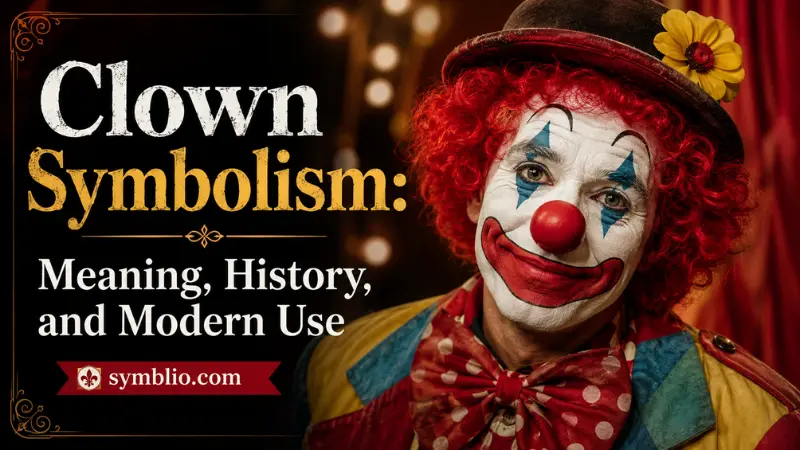
Clowns are among the most recognizable figures in American popular culture. A painted face, oversized shoes, colorful clothing, exaggerated expressions, and deliberately awkward behavior can immediately suggest comedy, playfulness, or entertainment. Yet the same visual language can also feel unsettling, particularly in horror films and modern internet culture.
The meaning of clown symbolism depends heavily on context. A clown at a child’s birthday party communicates something very different from a clown appearing in a horror movie, a political cartoon, a circus poster, or a tattoo. That flexibility is one reason the figure has remained culturally useful for so long.
In the United States, the clown has moved through several distinct roles: circus entertainer, comic outsider, children’s performer, television personality, advertising mascot, theatrical archetype, and eventually a figure associated with fear. Understanding those changes makes the symbol easier to interpret without reducing it to either “funny” or “scary.”
Quick Answer
Clown symbolism commonly represents humor, playfulness, entertainment, and the freedom to behave outside ordinary social rules in modern American culture. Historically, clowns and related comic figures also represented foolishness, social criticism, theatrical disguise, and the outsider who could mock authority.
TL;DR
- Clowns commonly symbolize humor, play, entertainment, and comic rebellion.
- Their theatrical roots include European fools and commedia dell’arte characters.
- American circus transformed the clown into a major popular-culture figure.
- Sad clowns can symbolize loneliness hidden behind public performance.
- Horror culture later associated clowns with fear, deception, and uncertainty.
- Today, meaning depends strongly on setting, costume, expression, and story.
What a Clown Symbolically Represents
At its simplest, the clown represents the comic outsider.
A clown does not behave like an ordinary person. The clothing may be oversized, the makeup exaggerated, and the movements intentionally awkward. Instead of following everyday expectations about appearance and behavior, the performer exaggerates them.
That difference gives the clown several related symbolic meanings:
- Humor — making people laugh through physical comedy, surprise, or absurdity.
- Playfulness — encouraging people to loosen ordinary rules.
- Nonconformity — behaving differently from what society expects.
- Foolishness — deliberately appearing incompetent or ridiculous.
- Social criticism — using comedy to expose the behavior of powerful people.
- Performance — showing how a public identity can differ from private emotion.
- Uncertainty — creating a character whose intentions may be difficult to read.
These meanings can coexist. A clown can be ridiculous and insightful at the same time. Historically, comic performers often gained freedom to say things that a more respectable character could not.
This is especially important in understanding the American tradition. Smithsonian research on American clowns describes early circus clowning as more than simple children’s entertainment: performers could mock social conventions and authority while creating a communal comic experience.
Ancient and European Roots of the Clown Figure
There is no single ancient culture that invented the modern clown. Instead, the figure developed from several traditions involving fools, comic servants, tricksters, masked performers, and theatrical outsiders.
One important influence was commedia dell’arte, the Italian theatrical tradition that developed in the sixteenth century. Its professional actors worked with recurring character types, masks, physical comedy, improvisation, and recognizable personalities. The tradition helped establish theatrical conventions that later influenced European and American clowning.
Characters such as the clever servant, foolish rustic, boastful captain, and mischievous performer offered audiences familiar comic personalities. Their exaggerated behavior made social relationships easier to parody.
This matters because the clown’s symbolism has never been limited to “someone who tells jokes.” The theatrical fool often occupies an unusual position: apparently inferior, but sometimes capable of seeing what more respectable characters cannot.
That tension remains part of the modern clown.
Why Clowns Became Important in American Culture
The clown became especially prominent in the United States through the development of the circus.
Modern American circus culture developed rapidly during the nineteenth century. The Library of Congress identifies 1793 as an important early point in American circus history and notes that traveling circus culture expanded significantly during the nineteenth century.
Early American clowns were not necessarily the cheerful children’s entertainers that many people picture today. Smithsonian cultural history describes nineteenth-century circus clowns as performers who could mock authority, challenge social expectations, and appeal to adults as well as children.
That history gives the American clown a surprisingly rebellious side.
The clown could make fun of politicians, social manners, class expectations, or ordinary human foolishness. Because the performance was framed as comedy, uncomfortable observations could become entertaining rather than confrontational.
In this sense, the clown symbolized permission to break the rules temporarily.
The Shift From Adult Humor to Children’s Entertainment
The American meaning of the clown changed substantially during the late nineteenth and twentieth centuries.
As American culture increasingly emphasized childhood as a distinct stage of life, circus marketing began presenting clowns more directly to children. Over time, the clown became strongly associated with birthday parties, children’s television, toys, fairs, and family entertainment.
This produced the familiar cheerful clown:
- bright colors
- oversized costumes
- friendly expressions
- balloons
- juggling
- slapstick
- silly voices
- exaggerated gestures
The symbolic center shifted from social satire toward innocence and amusement.
Television strengthened that association. American children’s programs featured recognizable clown characters, while commercial culture also used clown imagery to attract young audiences. Smithsonian research notes figures such as Clarabell Clown, Bozo, and Ronald McDonald as examples of the clown’s growing presence in American children’s and commercial culture.
The result is the image many Americans still recognize today: the clown as an entertainer whose primary job is to make people smile.
The Meaning of the Happy Clown
The cheerful clown usually symbolizes joy expressed through performance.
This distinction is important. A clown is not simply a symbol of happiness; the clown is someone who creates laughter.
That can suggest generosity, social connection, and emotional openness. At a party, a clown’s exaggerated behavior encourages children to participate in imagination rather than ordinary adult routines.
The clown also gives people permission to be silly.
Adults normally regulate their behavior carefully in public. A clown does the opposite. The performer trips intentionally, makes exaggerated faces, uses absurd costumes, and turns mistakes into entertainment.
Symbolically, this can represent the idea that embarrassment does not always have to be avoided. Sometimes a mistake can become part of the fun.
The Sad Clown and Hidden Emotion
The cheerful clown has an important counterpart: the sad clown.
This figure represents the contrast between public performance and private emotion. The performer may entertain everyone else while appearing personally lonely, tired, disappointed, or emotionally distant.
The idea became especially recognizable through theatrical and popular culture. The late nineteenth-century opera Pagliacci helped establish the tragic clown as a memorable dramatic image, while American performers such as Emmett Kelly developed melancholy clown characters for the circus.
The sad clown therefore symbolizes more than sadness. It can represent:
- emotional concealment
- loneliness
- professional performance
- the contrast between appearance and reality
- resilience under pressure
- the difficulty of knowing what another person feels
However, it is worth avoiding the assumption that every clown is secretly unhappy. That interpretation is a later cultural association, not an essential rule of clown symbolism.
Clown Symbolism in the United States Today
American interpretations now depend heavily on context.
| Context | Meaning in the USA | Common Associations | Notes |
|---|---|---|---|
| Circus | Entertainment and comic performance | Big tops, acrobatics, family shows | Closest to traditional clowning |
| Children’s party | Playfulness and fun | Balloons, games, laughter | Usually positive |
| Comedy or theater | Absurdity and social commentary | Physical comedy, satire | Can challenge social conventions |
| Tattoo or artwork | Individual interpretation | Humor, rebellion, nostalgia | Meaning depends on design |
| Horror media | Fear and unpredictability | Suspense, masks, danger | A relatively modern cultural development |
| Political satire | Mockery of authority | Foolishness, absurdity | Connects with older comic traditions |
This range explains why there is no single universal interpretation.
A colorful circus clown may feel nostalgic to one person. A minimalist clown face in black ink may communicate something more serious. A horror clown may symbolize danger or deception. The surrounding imagery determines which meaning becomes dominant.
Why Some People Find Clowns Unsettling
The association between clowns and fear is real in modern American culture, but it should not be treated as the original meaning of the clown.
The Library of Congress notes that research into fear of clowns has identified several possible contributing factors, including facial appearance, behavior, and the way clowns have been portrayed in media.
The painted face creates an unusual visual situation. People can see a human face, but its normal emotional signals have been exaggerated or altered. A smile may appear unusually large, while makeup can make the eyes or mouth difficult to interpret.
That ambiguity can produce uncertainty.
Modern horror intensified this effect. Films, novels, comics, and other media repeatedly used clown imagery to transform something normally associated with childhood amusement into something threatening. The Library of Congress describes the “scary clown” as a comparatively recent cultural development rather than an ancient essential feature of clowning.
So the scary clown is best understood as a modern reinterpretation of an older comic figure.
The Clown as a Symbol of Rebellion
One of the most interesting aspects of clown symbolism is its connection to rebellion.
The traditional clown can break social rules without completely rejecting society. Instead, the performer exaggerates the rules until they become funny.
A clown who pretends to misunderstand an important official can expose that person’s arrogance. A foolish character can reveal the foolishness of supposedly intelligent people. An outsider can point out contradictions that insiders ignore.
This is closely related to the older European fool and jester traditions, although the modern circus clown should not be treated as identical to every historical jester.
In American culture, this rebellious side can appear in comedy, political satire, theater, cartoons, and performance art. The clown becomes a symbol of laughing at authority rather than simply obeying it.
What Clown Makeup Symbolizes
Clown makeup is one of the figure’s strongest visual features.
Whiteface, exaggerated lips, enlarged eyebrows, painted eyes, and other facial designs make the performer’s expressions visible to a large audience. Different clown traditions developed recognizable face types, including whiteface, Auguste, and tramp styles.
Symbolically, makeup creates a boundary between the ordinary person and the performed character.
It can therefore suggest:
- transformation
- theatrical identity
- exaggeration
- disguise
- visibility
- emotional performance
But the idea that clown makeup always represents a literal “mask hiding the true self” is more interpretive than historical. In traditional circus settings, makeup also served practical theatrical purposes, helping audiences recognize facial expressions from a distance.
Clown Symbolism in Tattoos and Personal Style
Clown imagery appears in tattoos, clothing, artwork, posters, collectibles, and alternative fashion.
The meaning is highly personal.
Someone might choose a clown tattoo because they love circus history or comedy. Another person may use the image to represent rebellion, irony, absurdity, childhood memories, or the contrast between happiness and sadness.
A sad clown can communicate emotional complexity, while a grotesque or horror-inspired clown can represent fear, distrust, or an interest in dark fiction.
Color also changes the impression. Bright red, yellow, blue, and pink may reinforce traditional circus associations, while black-and-gray artwork can produce a more somber or dramatic effect.
There is no universal “clown tattoo meaning.” The surrounding symbols and the person’s reason for choosing the design matter more than any fixed dictionary definition.
Clowns in Holidays, Decor, and Popular Culture
In the United States, clowns appear most naturally in settings connected with entertainment and childhood.
Circus-themed rooms may use clown figures as nostalgic decoration. Children’s parties may include clown imagery alongside balloons and games. Halloween introduces another interpretation, because the holiday provides a natural setting for costumes that deliberately exaggerate the unsettling side of familiar characters.
Digital culture has expanded the possibilities further. Clown emojis, reaction images, memes, costumes, and edited photographs can use the figure to communicate embarrassment, foolishness, irony, or self-mockery.
The clown’s visual clarity makes it particularly adaptable to digital communication. A single painted face can imply “I’m being ridiculous,” “that was embarrassing,” or “someone is acting foolishly,” depending on context.
Cross-Cultural Meanings of the Comic Fool
Clown-like figures exist in many cultures, but they should not all be treated as versions of the American circus clown.
European theatrical traditions contributed important elements to modern Western clowning. Commedia dell’arte, for example, relied on recurring masked characters and established comic types.
Other cultures have their own sacred, ritual, comic, or disruptive figures that can resemble the clown in certain respects without sharing the same history.
This distinction matters when discussing symbolism responsibly. Similar behavior does not necessarily mean identical cultural meaning.
A figure who uses humor to challenge social expectations might resemble a clown conceptually, while serving a very different religious or ceremonial purpose.
Common Misunderstandings About Clown Symbolism
Several popular assumptions oversimplify the symbol.
“Clowns have always represented fear.”
Not historically. The modern scary-clown association developed much later than circus and theatrical clowning.
“Every clown represents hidden sadness.”
The sad clown is a recognizable artistic convention, but it is not the universal meaning of the clown.
“Clown makeup is always a disguise.”
Makeup can symbolize disguise or transformation, but historically it also served the practical needs of theatrical performance.
“Clowns are only children’s entertainers.”
American clowning spent significant periods aimed at adults, and professional clowns continue to work in theater, circus, comedy, and other performance settings.
“A clown always means something negative.”
Context matters. A circus clown, party clown, political cartoon clown, and horror clown can communicate entirely different ideas.
How Clown Meaning Has Changed From the Past to 2026
The clown’s symbolic evolution can be understood as a series of overlapping layers.
First came the broader theatrical tradition of fools, comic servants, tricksters, and stock characters. European theater, including commedia dell’arte, supplied important conventions involving masks, recurring characters, and physical comedy.
American circus then developed its own clown traditions. In the nineteenth century, clowns could appeal strongly to adults through satire and irreverence. Later, the expanding focus on children turned the clown into a familiar figure of family entertainment.
Television and advertising strengthened the cheerful image.
Then twentieth-century literature, film, and popular entertainment increasingly explored the disturbing possibilities of the same visual character. By the late twentieth and early twenty-first centuries, the scary clown had become an established part of American popular culture.
By 2026, the symbol therefore carries several meanings simultaneously:
the entertainer, the fool, the rebel, the performer, the outsider, the sad character, and the frightening stranger.
The setting determines which one audiences notice first.
FAQs
Clowns do not have one universal spiritual meaning. In symbolic or spiritual interpretations, the clown may represent humility, foolishness, transformation, the disruption of ordinary expectations, or the need to recognize humor in human imperfection.
A clown tattoo can represent humor, rebellion, nostalgia, individuality, performance, sadness, or an interest in horror. The specific facial expression, colors, accompanying imagery, and personal story usually determine the intended meaning.
Modern media played a major role in connecting clowns with fear. Their exaggerated faces and ambiguous expressions can also make emotions difficult to read, while horror stories deliberately reverse the traditional expectation that a clown should entertain people.
Sometimes, particularly through the artistic tradition of the sad or melancholy clown. This interpretation became prominent through theater and performers such as Emmett Kelly, but sadness is only one possible clown meaning.
A happy clown generally represents amusement, playfulness, celebration, and the freedom to behave less seriously. In American culture, this interpretation is especially common in circus, children’s entertainment, parties, and family-oriented settings.
They can be. Historically, American circus clowns sometimes mocked authority and social conventions, giving the figure a connection with irreverence and comic rebellion.
It can be either. Traditional circus and children’s entertainment usually give the clown positive associations with fun and laughter, while horror culture can make the same figure represent fear, deception, or uncertainty.
Conclusion
The meaning of clown symbolism cannot be reduced to either happiness or fear. In American culture, the clown developed from theatrical and comic traditions into a major circus figure, then became associated with children’s entertainment, television, advertising, satire, personal expression, and eventually horror.
Its most enduring quality is flexibility. The clown can make people laugh, challenge authority, represent emotional contradiction, or unsettle an audience precisely because the character exists outside ordinary social behavior.
In 2026, a clown still asks a simple but useful symbolic question: Are we laughing at the performance, joining it, or wondering what lies behind it?


