
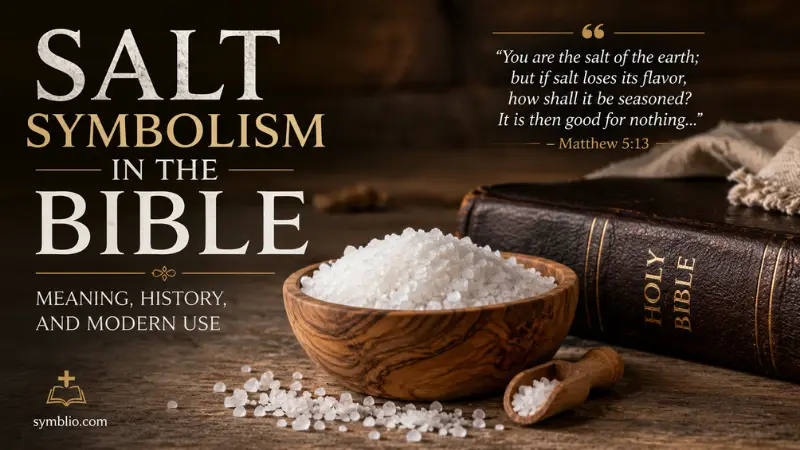
Salt is an ordinary household ingredient, but salt symbolism in the Bible carries several distinct meanings, including covenant, faithfulness, purification, preservation, sacrifice, and useful influence. Biblical writers drew on salt’s everyday value in the ancient world, where it was used in food, preservation, ritual settings, and other practical contexts.
For modern American readers, salt can be easy to overlook because it sits on nearly every kitchen table. In biblical passages, however, its usefulness provides the foundation for metaphor. Salt could preserve something from decay, improve food, mark a ritual offering, or represent the enduring character of an agreement.
That makes biblical salt symbolism more specific than the simple idea that “salt is sacred.” Its meaning depends heavily on the passage and the function salt is performing.
Quick Answer
Salt symbolism in the Bible commonly represents faithfulness, preservation, covenant, purity, and beneficial influence, especially when salt is connected with offerings or Jesus’ description of his followers as “salt of the earth.” In biblical contexts, it can also suggest permanence and loyalty because salt was associated with enduring covenants and important ritual practices.
TL;DR
- Salt can symbolize covenant faithfulness and permanence.
- Biblical offerings sometimes included salt as part of ritual practice.
- Salt represents useful influence in Jesus’ teaching.
- Preservation helped make salt a natural metaphor for endurance.
- Purification is another biblical association of salt.
- Modern Christians often read salt as a call to faithful living.
What Salt Meant in the Biblical World
To understand the symbolism, it helps to begin with salt itself.
Salt was not simply a seasoning. It had practical value in ancient societies because it could help preserve food and was useful in everyday life. Its ability to alter and protect what it touched made it a natural source of metaphor.
Biblical references therefore tend to use familiar properties of salt rather than treating it as an abstract mystical object.
A useful distinction is this: the Bible does not give salt one universal symbolic meaning. The image changes according to context.
That contextual approach prevents a common mistake: assigning every biblical reference to salt the same interpretation.
Salt as a Symbol of Covenant and Faithfulness
One of the most important biblical associations is the covenant of salt.
Numbers 18:19 describes a “covenant of salt” in connection with God’s promises concerning offerings. Second Chronicles 13:5 also uses the expression when discussing God’s covenant with David. Because salt was associated with preservation, later interpreters have understood the phrase as emphasizing durability and permanence.
The image makes intuitive sense. Something associated with preservation can become a fitting metaphor for an agreement expected to endure.
This does not mean that every biblical covenant literally involved someone exchanging salt. Rather, the phrase uses salt’s known properties to communicate something about the lasting character of the relationship.
For readers today, the symbolism is often summarized as faithfulness, reliability, and an enduring commitment.
Salt and Sacrifice in the Old Testament
Salt also appears directly in Israelite sacrificial practice.
Leviticus 2:13 instructs that grain offerings should be seasoned with salt and specifically connects salt with the covenant of God. The instruction appears within detailed regulations governing offerings.
This gives salt a religious meaning that is more concrete than a general symbol of “goodness.” Salt belongs to the ritual language of offering.
The connection between salt and sacrifice also helps explain why salt became associated with covenant faithfulness. Ritual practice and covenant identity were closely connected in biblical Israel.
For modern readers, the important point is that salt was not an ornamental religious detail. Its inclusion formed part of a larger system of worship and covenant practice.
Why Salt Can Represent Preservation
Salt’s practical role in preservation provides another important layer of biblical imagery.
In a world without modern refrigeration, preserving food was a serious everyday concern. Salt could help slow deterioration, making it an obvious metaphor for something that protects against decay.
That background helps illuminate Jesus’ statement in Matthew 5:13: “You are the salt of the earth.”
The image is not merely about making life more pleasant, as though Jesus were saying that his followers should make the world more interesting. Salt changes what it touches. It serves a purpose outside itself.
Contemporary biblical interpreters therefore often understand the metaphor as a call for Jesus’ followers to have a constructive presence in the world rather than withdrawing from it.
“Salt of the Earth” and Christian Character
The phrase “salt of the earth” has become one of the Bible’s best-known expressions in American English.
In Matthew 5:13, Jesus tells his followers that they are the salt of the earth. Mark 9:50 and Luke 14:34 also use salt imagery, though in different contexts.
The metaphor emphasizes usefulness and character. Salt does something. It affects the food or substance around it.
That makes the passage particularly relevant to Christian ideas about service, integrity, mercy, and responsible participation in society.
Importantly, the passage is not simply saying that Christians should be “nice.” The surrounding Sermon on the Mount connects the image with a demanding pattern of life involving righteousness, mercy, reconciliation, and faithfulness.
Some modern interpreters therefore describe salt as an image of constructive moral influence: a person whose conduct benefits the community rather than serving only personal interests.
Salt and Purification in Biblical Imagery
Purification is another association found in biblical salt imagery, although it should not be treated as the meaning of every salt reference.
Second Kings 2:19–22 describes the prophet Elisha using salt in connection with the healing of a spring at Jericho. Ezekiel also associates salt with ritual activity and purification in passages concerning offerings and the temple.
These passages show how salt could participate in a symbolic world concerned with removing impurity, restoring what was damaged, or preparing something for sacred use.
Modern readers sometimes turn this into the claim that biblical salt always means “spiritual cleansing.” That goes too far. Purification is one strand of the symbolism, not a universal definition.
Salt and Purity: A More Careful Interpretation
Salt’s association with purity deserves particular care.
In everyday language, people often connect salt with cleansing because salt can have practical cleaning uses today. But biblical symbolism developed within ancient cultural and religious contexts, not modern household practice.
The important biblical pattern is that salt can appear alongside actions involving offerings, restoration, or ritual preparation.
This makes purity and suitability for sacred purposes reasonable themes in certain passages.
At the same time, biblical salt imagery can carry opposite associations in other contexts. Salt could also be used figuratively in connection with destruction or desolation. The famous image of Lot’s wife becoming a pillar of salt is therefore not a positive symbol of purification.
Context matters.
Salt and Desolation: The Negative Side of the Symbol
Salt symbolism in the Bible is not exclusively positive.
Several biblical passages associate salt with barren or devastated land. Salt-covered ground could represent an environment where crops could not flourish.
This creates an important symbolic contrast. The same substance that preserves food and participates in covenant ritual could also represent sterility or destruction when associated with ruined land.
Lot’s wife in Genesis 19:26 is the most recognizable example for many American readers. She looks back toward the destroyed cities of the plain and becomes a pillar of salt.
The passage is not presenting salt as a symbol of blessing. Instead, the image belongs to a story about judgment and disobedience.
That contrast demonstrates why it is misleading to create a single “biblical salt meaning.” Salt can symbolize preservation in one context and desolation in another.
What Salt Symbolism Means in the United States
In modern American culture, biblical salt symbolism is most familiar through Christian language.
People encounter phrases such as “salt of the earth” in sermons, Bible studies, Christian books, devotional writing, and ordinary conversation. The expression has also moved beyond explicitly religious settings and can describe someone regarded as honest, dependable, humble, or genuinely good.
American Christian culture commonly connects salt with:
| Biblical context | Meaning often emphasized in the USA | Common association | Important distinction |
|---|---|---|---|
| Salt of the earth | Positive influence | Service and character | Focuses on how people affect others |
| Salt covenant | Faithfulness | Commitment and permanence | Rooted in covenant language |
| Salt in offerings | Devotion | Worship and sacrifice | Connected to ritual practice |
| Salt and healing imagery | Purification or restoration | Renewal | Depends on the specific passage |
| Salt-covered land | Desolation | Judgment and barrenness | Negative rather than protective |
The American interpretation often simplifies these different strands into a broader message: live in a way that preserves what is good and benefits the people around you.
That interpretation is especially common in Christian teaching, although the exact theological emphasis varies among denominations.
How Salt Became a Metaphor for Influence
The metaphor of influence may be the most culturally recognizable part of biblical salt symbolism today.
When someone is called “the salt of the earth,” Americans generally understand the expression as praise. It suggests a person who is dependable, grounded, sincere, and beneficial to others.
This meaning developed from the biblical image but has become flexible in everyday English.
It is worth noticing what makes the metaphor effective. Salt is relatively small in quantity, yet it changes the larger mixture around it. That provides a useful image for the idea that a person does not need to dominate a community to make a meaningful difference.
In this sense, salt symbolism can communicate quiet influence rather than public power.
Salt in Christian Worship and Everyday Religious Life
Salt does not occupy the same ritual role across all Christian denominations.
Some Christians encounter salt mainly through Scripture, preaching, and devotional interpretation. Other Christian traditions have incorporated salt into particular blessings or ceremonial practices.
These practices should not be treated as universal Christian customs.
For many Americans, the most common exposure to biblical salt symbolism comes through Bible passages rather than through a physical religious object. A churchgoer may hear about being “salt and light,” study the covenant of salt, or encounter salt during a sermon about sacrifice.
The symbolism therefore remains active even when salt itself is absent from worship.
Emotional and Psychological Meaning
From a psychological perspective, salt imagery can communicate several different ideas.
When used positively, it can represent dependability, usefulness, loyalty, restraint, and constructive influence. Someone described as “salt of the earth” is usually being recognized for character rather than status.
The covenant association adds another emotional layer: commitment that is expected to last.
The preservation metaphor can also evoke the desire to protect something valuable—relationships, moral principles, community traditions, or faith.
But the negative biblical imagery introduces a different emotional register. Salt can also evoke loss, barrenness, warning, and irreversible consequences when the context concerns destruction.
That range is one reason the symbol remains interesting. It is not emotionally one-dimensional.
Salt Symbolism in Modern Christian Tattoos and Design
Salt appears less frequently in mainstream American religious tattoos than crosses, doves, fish, or Scripture references, but it can still carry a clear personal meaning.
Someone might use a small salt-shaker image, salt crystals, or the phrase “salt and light” to represent Christian identity or a commitment to serving others.
In design, the meaning often depends on accompanying elements.
The image itself does not automatically establish a biblical meaning. Context supplies much of the interpretation.
Common Misunderstandings About Biblical Salt
One common misunderstanding is that salt always represents purity.
It does not. Biblical passages use salt in several ways, including covenant, offerings, influence, preservation, purification, and desolation.
Another mistake is assuming that “salt of the earth” means Christians should simply make society more pleasant. The Gospel context is more demanding. Jesus connects the image with a community whose conduct should visibly reflect the values described in the Sermon on the Mount.
A third misunderstanding is treating the “covenant of salt” as a modern formula for making promises. The phrase belongs to the biblical and ancient Near Eastern world and should be understood within that cultural setting.
Finally, salt should not be treated as a universal protective charm simply because some biblical passages associate it with purification or restoration.
How the Symbol Has Changed Over Time
The meaning of salt developed as its cultural setting changed.
In ancient Israel, salt had practical, agricultural, culinary, and ritual associations. Biblical authors could therefore use it without explaining why salt mattered.
Later Jewish and Christian interpretation preserved many of these associations while expanding their theological applications.
In modern America, the practical importance of salt has declined in some respects because refrigeration and industrial food systems have changed how people preserve food. Yet the metaphor has survived remarkably well.
The phrase “salt of the earth” is now understood even by many people who are not thinking directly about ancient food preservation.
That is an important feature of symbolism: the object can become culturally ordinary while its metaphor remains meaningful.
Why Biblical Salt Symbolism Still Matters Today
Salt remains relevant because its biblical meanings connect ordinary life with questions of character.
A person may not think about ancient preservation techniques when hearing “salt of the earth,” but the underlying metaphor still works. It suggests that a person’s value can be measured partly by what they contribute to the lives of others.
The covenant imagery also remains recognizable in a culture where people continue to value loyalty and lasting commitments.
For Christians, salt can therefore function as a reminder that faith is not intended to remain private in every sense. Jesus’ metaphor places discipleship in relationship with the wider world.
For readers outside Christianity, the biblical salt image can still be understood as an example of how everyday objects become moral and cultural symbols.
FAQs
Salt can symbolize covenant, faithfulness, preservation, sacrifice, purification, and beneficial influence. Its meaning changes according to the passage, so no single definition applies everywhere.
The image emphasizes their effect on the world around them. Salt changes and serves what it touches, making it a fitting metaphor for followers whose actions should benefit their communities.
Sometimes, particularly in contexts involving ritual or restoration. However, purity is only one biblical association; salt also represents covenant, sacrifice, preservation, and even desolation in other passages.
A “covenant of salt” is biblical language for an enduring covenant. Because salt was associated with preservation, the expression came to communicate ideas of permanence and reliability.
No. Salt can have negative associations when connected with barren land, destruction, or judgment. The story of Lot’s wife is a well-known example.
In modern American English, it usually describes someone who is sincere, dependable, humble, and good-hearted. The expression comes from Jesus’ teaching in Matthew 5:13.
Yes, although the meaning depends on the surrounding imagery. Salt can represent Christian service, covenant faithfulness, biblical teaching, or the idea of being “salt and light.”
Conclusion
Salt symbolism in the Bible is best understood as a collection of related meanings rather than one fixed definition. Salt can point toward covenant faithfulness, preservation, sacrifice, purification, useful influence, or, in darker contexts, desolation and judgment.
For Americans today, the most familiar expression is probably “salt of the earth,” which turns an everyday substance into a picture of dependable character and constructive influence. The enduring appeal of the metaphor comes from its simplicity: something ordinary can still matter because of what it does to everything around it.