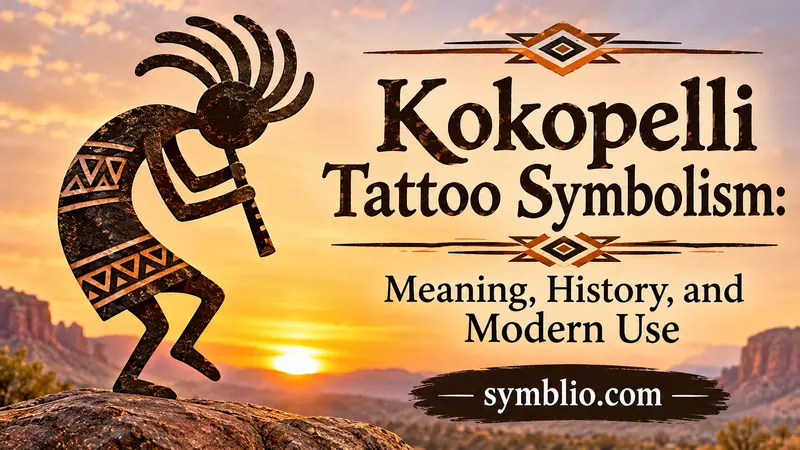
Kokopelli tattoo symbolism commonly connects music, fertility, creativity, freedom, and the cultural heritage of the American Southwest. Recognized by its distinctive figure playing a flute, the design has become a familiar image in American tattoo culture, particularly among people drawn to Southwestern art, Native American-inspired imagery, and traditional folklore.
The figure usually appears as a bent or humpbacked character holding a flute, sometimes with decorative details such as feathers, a curved back, or dancing limbs. Its recognizable outline makes it suitable for both small, minimalist tattoos and larger artistic compositions.
However, the history behind Kokopelli is more complicated than its modern popularity suggests. The familiar flute player combines imagery from ancient Southwestern rock art with traditions associated with the Hopi figure Kookopölö. These traditions should not automatically be treated as identical.
Quick Answer
Kokopelli tattoo symbolism commonly represents creativity, music, fertility, freedom, and an appreciation for Southwestern culture in modern American tattoo culture. Its historical associations include Pueblo traditions, flute-playing figures, seasonal renewal, and stories connected with fertility, although ancient images do not all have one confirmed meaning.
TL;DR
- Music represents creativity, expression, and communication.
- Fertility connects the figure with growth and renewal.
- The flute player draws inspiration from ancient Southwestern imagery.
- Modern tattoos often express freedom and individuality.
- Hopi traditions require more cultural context than popular designs suggest.
- Respectful use recognizes Indigenous history and living communities.
What Does a Kokopelli Tattoo Look Like?
A traditional Kokopelli tattoo depicts a humanlike figure with a curved or humpbacked posture, playing a flute. The body often appears in profile, with the head slightly raised and the legs positioned as if walking, dancing, or moving to music.
The most recognizable features include:
- A curved back or hump.
- A flute held near the mouth.
- A long, simplified body.
- Bent legs suggesting movement.
- Occasional feathers or decorative elements.
Artists frequently use black outlines, solid silhouettes, earthy colors, and geometric patterns inspired by Southwestern visual traditions.
Some tattoos are deliberately simple, showing only the outline of the flute player. Others incorporate desert landscapes, mountains, suns, cacti, or additional decorative elements.
The design’s simplicity is part of its appeal. Even a small silhouette can communicate a recognizable connection to Southwestern imagery.
However, not every ancient flute-player carving represents the same character. Archaeologists have identified numerous variations, and the original purposes of individual images are not always known.
The Main Symbolic Meanings of a Kokopelli Tattoo
Kokopelli tattoos have several commonly recognized interpretations. Their meaning often depends on the wearer’s personal interests, the particular design, and the cultural context.
Music and Creative Expression
The flute is the most recognizable feature of the figure. For modern tattoo owners, it frequently represents music, artistic expression, imagination, and communication.
Someone who plays an instrument, writes songs, dances, or appreciates music might choose this design to express how creativity influences their life.
The flute also gives the figure an association with storytelling. Music can communicate feelings and experiences that ordinary conversation sometimes cannot express.
Fertility and New Beginnings
Kokopelli is frequently associated in popular Southwestern interpretations with fertility and reproduction.
This association also extends to agriculture, where fertility means productive soil, healthy crops, and successful growing seasons.
In modern tattoo culture, the idea can be interpreted more broadly. A person might choose the design to represent a new chapter, personal development, family aspirations, or the beginning of a creative project.
It is important to distinguish these modern interpretations from specific Indigenous religious traditions rather than assuming every tattoo carries an identical historical meaning.
Freedom and Independence
The moving flute player often appears carefree and expressive. This visual quality has encouraged modern associations with independence, adventure, and an unconventional approach to life.
A person might select the design to represent a preference for following personal interests rather than conforming to expectations.
Happiness and Celebration
Music, dancing, and movement give the image an upbeat appearance.
For some tattoo owners, it represents enjoying everyday experiences, celebrating achievements, and appreciating the lighter side of life.
Ancient Southwestern Origins of the Flute Player
The imagery associated with Kokopelli has roots in the archaeological record of the American Southwest.
Flute-player figures appear in prehistoric rock art across parts of the Four Corners region, which includes present-day Arizona, Colorado, New Mexico, and Utah.
These images appear on rock surfaces and other objects created by ancestral Indigenous communities. Some depict figures with curved backs, musical instruments, or unusual body proportions.
Archaeological evidence also establishes that flutes were used in Ancestral Puebloan communities. Early wooden and reed instruments have been identified at archaeological sites dating to the Basketmaker period, approximately A.D. 400–700.
This evidence confirms that music was part of ancient Southwestern life. It does not, however, establish that every flute-player image represented one named deity or had the same religious purpose.
The meaning of rock art depends on its location, surrounding images, cultural setting, and historical context. Some interpretations may remain unknown because the original communities did not leave written explanations that can be directly connected to every carving.
Consequently, describing all ancient flute players as Kokopelli can oversimplify a diverse archaeological record.
Kokopelli and the Hopi Kookopölö Tradition
One of the most important distinctions in understanding Kokopelli concerns the Hopi figure Kookopölö.
Kookopölö is associated with Hopi religious and ceremonial traditions. The figure is commonly described as a humpbacked character connected with flute-related ceremonial activities, fertility, healing, and seasonal renewal.
The Hopi katsina and the various prehistoric flute-player images should not automatically be treated as the same figure.
Researchers have discussed how the familiar modern Kokopelli image developed through the blending of different visual and cultural traditions. This distinction matters because a sacred or ceremonial figure cannot simply be reduced to a decorative character without losing important cultural context.
For tattoo enthusiasts, learning about this distinction provides a more responsible starting point than relying on simplified descriptions found in popular tattoo catalogs.
What Kokopelli Tattoo Symbolism Means in the United States
In the United States, Kokopelli has become closely associated with the visual identity of the Southwest.
The figure appears in travel-related artwork, decorative products, jewelry, public-facing designs, and popular representations of Southwestern landscapes.
Its modern popularity comes partly from its distinctive silhouette and partly from its association with music, movement, and regional culture.
Americans may interpret a Kokopelli tattoo in several ways:
Regional appreciation: People who have lived in or traveled through Arizona, New Mexico, Colorado, and neighboring states may associate the image with the landscapes and artistic traditions of the region.
Personal creativity: Musicians, artists, and people who enjoy creative activities may connect the flute player with artistic expression.
Interest in history: Some people choose the design because they appreciate prehistoric Southwestern art and want to learn more about its cultural background.
Individual identity: The image may communicate an interest in independent thinking, music, travel, and personal expression.
Nevertheless, Kokopelli should not be treated as a universal representation of all Native American cultures. Indigenous communities have distinct histories, traditions, and religious practices.
Fertility, Agriculture, and Seasonal Renewal
Fertility is one of the most frequently repeated associations with Kokopelli in popular descriptions.
In agricultural societies, fertility has a practical meaning. It concerns the ability of land to support crops, provide food, and sustain communities.
The American Southwest has long included communities whose survival depended on understanding seasonal conditions, rainfall, planting cycles, and available resources.
Within popular interpretations of Kokopelli, the flute player became associated with the arrival of spring, the return of warmth, and the renewal of agricultural life.
In contemporary tattoo culture, agricultural fertility has developed into broader ideas of growth and possibility.
A Kokopelli tattoo may therefore represent:
- The beginning of a new stage in life.
- Appreciation for nature and agriculture.
- Family growth and new opportunities.
- Personal development.
- Hope for a productive future.
The Flute as a Symbol of Communication and Storytelling
The flute is more than a decorative object in Kokopelli imagery.
Across many societies, musical instruments have played roles in ceremonies, storytelling, entertainment, and community gatherings.
In the context of the modern Kokopelli image, the flute has become a recognizable representation of music and communication.
A tattoo featuring this instrument may express the importance of sharing ideas, maintaining creative interests, or communicating through artistic activities.
For someone who has experienced meaningful moments through music, the image can also represent memories associated with particular songs, performances, or relationships.
Some people choose a flute-player design because they prefer symbols that suggest an activity rather than displaying words or written statements.
Emotional and Psychological Meaning of Kokopelli Tattoos
Tattoos frequently serve as personal reminders. Their meanings are not determined entirely by historical interpretations or popular descriptions.
A Kokopelli tattoo can carry several emotional associations depending on the wearer’s experiences.
Creative confidence: The musician-like figure can remind someone to continue developing artistic abilities and expressing individual ideas.
Personal freedom: Its energetic posture may represent independence and a desire to explore different interests.
Connection with nature: Southwestern imagery can reflect an appreciation for open landscapes, changing seasons, and outdoor experiences.
Positive memories: Someone might associate the figure with a memorable journey, a family experience, or time spent in the American Southwest.
Personal transformation: The association with seasonal renewal can provide a way to commemorate a new direction in life.
The same tattoo can therefore communicate different things to two people. A musician might focus on creativity, while someone interested in Southwestern history might value its artistic background.
Popular Kokopelli Tattoo Designs and Their Interpretations
Different tattoo styles emphasize different aspects of the figure.
| Tattoo Design | Common Modern Interpretation | Visual Characteristics |
|---|---|---|
| Minimalist Kokopelli | Simplicity and personal expression | Fine lines and small silhouette |
| Traditional flute player | Music and Southwestern imagery | Recognizable curved figure |
| Kokopelli with sun | Nature and seasonal renewal | Sun and landscape elements |
| Geometric Kokopelli | Artistic individuality | Repeated shapes and patterns |
| Colorful Kokopelli | Creativity and celebration | Earthy or contrasting colors |
Minimalist Kokopelli
Minimalist designs use a simplified outline or solid silhouette. They are popular among people who prefer recognizable imagery without additional decoration.
Their meaning often focuses on music, creativity, and personal interests.
Traditional Silhouette
The traditional silhouette emphasizes the curved back, flute, and walking posture.
It is one of the most recognizable versions of the image and is often associated with Southwestern decorative art.
Kokopelli with a Sun or Desert Landscape
Adding a sun, mountains, or desert scenery creates a stronger connection with the American Southwest.
These additions can communicate an appreciation for nature, travel, and regional landscapes.
Geometric Kokopelli
Geometric versions incorporate lines, triangles, circles, and other repeated shapes.
They appeal to people who appreciate contemporary design and prefer a more stylized interpretation.
However, geometric decoration should not automatically be described as traditional Indigenous symbolism. Modern artistic additions and historical cultural elements are different things.
Colors and Their Modern Interpretations
Color choices can change the overall appearance of a Kokopelli tattoo.
Although no single color system establishes the historical meaning of every Kokopelli representation, modern tattoo artists often use colors associated with Southwestern landscapes and contemporary design.
| Color | Common Modern Association | Design Effect |
|---|---|---|
| Black | Simplicity and contrast | Traditional silhouette |
| Red | Energy and warmth | Strong visual emphasis |
| Turquoise | Southwestern-inspired design | Regional decorative character |
| Yellow | Sunshine and optimism | Bright, lively appearance |
| Brown | Earth and desert landscapes | Natural appearance |
Black remains a practical choice for recognizable flute-player silhouettes because it emphasizes the figure’s distinctive outline.
Turquoise, red, and earthy shades are frequently used in Southwestern-inspired artwork. However, their inclusion does not automatically make a modern tattoo culturally authentic.
Kokopelli Tattoos and Modern American Tattoo Culture
Kokopelli has become a familiar figure in American decorative culture, especially in areas associated with Southwestern tourism.
The image appears on clothing, household decorations, jewelry, souvenirs, and artistic products. Its recognizable shape has also made it popular in tattoo design.
In modern tattoo culture, people may encounter Kokopelli through several influences.
Southwestern travel: Visitors may first notice the figure in regional artwork, museums, shops, and public decorations.
Music and artistic interests: The flute-player image attracts people who identify with musical expression.
Traditional-inspired tattoo styles: Some artists incorporate the figure into larger compositions inspired by desert scenery and regional visual traditions.
Personal storytelling: A tattoo may commemorate a particular journey, interest, or meaningful experience.
Its popularity also reflects the way American commercial culture has transformed particular Indigenous-inspired images into widely marketed regional icons.
Cultural Respect and Controversies Surrounding Kokopelli Tattoos
Kokopelli tattoos raise legitimate questions about cultural representation and appropriation.
The issue is not simply whether a person outside an Indigenous community can appreciate Southwestern artwork. The more important question is whether the design represents a specific living tradition, how it is being used, and whether its cultural background is being treated accurately.
Several misunderstandings deserve attention.
Treating Every Flute Player as Kokopelli
Not every prehistoric flute-player image represents Kokopelli.
Archaeological images come from different places and periods, and their original meanings may vary. Assigning one popular name to every similar figure can erase important distinctions.
Describing Kokopelli as a Universal Native American God
There is no single Native American religious tradition shared by every Indigenous nation.
Kokopelli is associated particularly with Southwestern cultural discussions and Hopi traditions, but that does not make the figure a universal representative of Indigenous spirituality.
Reducing the Figure to Sexual Fertility
Some popular interpretations focus heavily on fertility and sexuality.
Although fertility appears in discussions of Kokopelli and related traditions, presenting the character only as a sexual figure ignores its broader cultural and historical context.
Commercializing Indigenous Imagery
The widespread use of Kokopelli in souvenirs, advertising, and decorative products has attracted criticism.
Some scholars argue that the modern commercial image combines distinct traditions and reflects outside expectations about what Southwestern Indigenous culture should look like.
For anyone considering a Kokopelli tattoo, a thoughtful approach includes learning about the figure’s origins, distinguishing historical evidence from popular storytelling, and respecting the communities connected with the traditions.
How Kokopelli Symbolism Has Changed Over Time
The modern understanding of Kokopelli did not develop in a single historical moment.
Prehistoric Southwestern communities created flute-player images in different artistic and cultural settings. Their original meanings were connected with the communities that produced them, although many individual interpretations remain uncertain.
Hopi traditions also preserved the figure Kookopölö within a specific cultural and ceremonial context.
Over time, outside observers, researchers, artists, and commercial businesses helped popularize the name Kokopelli and the familiar flute-playing silhouette.
During the twentieth century, the image increasingly became a recognizable representation of the American Southwest. It appeared in tourism, regional decoration, and popular merchandise.
This wider exposure helped establish modern associations with music, fertility, creativity, and adventure.
Today, tattoos add another layer to that development. Individuals may use the image to express personal interests while others approach it as an opportunity to explore Southwestern Indigenous history.
The result is a symbol with several overlapping interpretations, not one universally accepted definition.
Where Kokopelli Tattoos Are Commonly Placed
Tattoo placement can influence the overall presentation of the design.
Because the flute player has a distinctive horizontal or diagonal posture, artists can adapt it to different areas of the body.
Some common placements include:
- Forearm: Provides room for a recognizable silhouette.
- Upper arm: Works well for medium-sized designs.
- Shoulder: Accommodates decorative additions and larger compositions.
- Calf: Offers a suitable area for a vertical or moving figure.
- Ankle: Often used for smaller, simplified designs.
- Back: Provides more space for a complete Southwestern-inspired composition.
The best placement depends on the intended design, its size, and the wearer’s personal preferences.
How to Understand the Personal Meaning of a Kokopelli Tattoo
There is no requirement that everyone who chooses a Kokopelli tattoo interpret it in exactly the same way.
A useful starting point is to consider what attracts someone to the image.
Is it the flute and its connection with music? Is it an interest in Southwestern history? Does the design remind someone of a particular journey or artistic experience?
These questions help separate personal meaning from assumptions about ancient traditions.
It is also worth examining the specific design. A simple flute-player silhouette communicates something different visually from an elaborate composition that includes additional cultural motifs.
Most importantly, personal interpretation should not replace historical accuracy. Someone can appreciate the figure as an artistic image while acknowledging that its name and associated traditions have specific Indigenous connections.
FAQs
A Kokopelli tattoo commonly represents music, creativity, fertility, freedom, and renewal. Its interpretation depends on the wearer’s personal interests and understanding of the figure’s Southwestern cultural background.
Kokopelli is associated with Southwestern Indigenous traditions, particularly discussions of Hopi culture and the flute-player imagery of the region. However, not every ancient flute-player carving represents the same figure, and Kokopelli should not be described as a universal Native American symbol.
The flute is commonly associated with music, creativity, communication, and storytelling. In modern tattoo designs, it often emphasizes artistic expression and an appreciation for music.
Fertility is one of the figure’s widely recognized traditional associations in popular Southwestern interpretations. Modern tattoo owners may extend this idea to include growth, new beginnings, and agricultural abundance.
Not everyone views the use of Kokopelli imagery in the same way. Because the figure has connections with living Indigenous traditions, learning about its history, avoiding inaccurate representations, and respecting cultural boundaries are important considerations.
In modern American culture, the image is frequently associated with Southwestern identity, music, adventure, and artistic expression. Its popularity in regional decoration and tourism has also influenced how people understand it.
Kookopölö has a place in Hopi ceremonial and religious traditions. However, the many prehistoric flute-player images found throughout the Southwest cannot all be assigned to one religious identity or interpreted through a single tradition.
Conclusion
Kokopelli tattoo symbolism brings together modern ideas of music, creativity, freedom, fertility, and personal renewal with a complicated history rooted in the American Southwest. Its recognizable flute-playing figure has become a familiar part of American decorative and tattoo culture, but its origins deserve more attention than popular descriptions sometimes provide.
The distinction between prehistoric flute-player imagery and the Hopi Kookopölö tradition is especially important. Understanding these connections helps people appreciate the artwork without overlooking the Indigenous communities whose histories and traditions are associated with it.
Ultimately, a Kokopelli tattoo can express an appreciation for music, artistic individuality, or Southwestern culture. Its meaning becomes more thoughtful when personal interpretation is balanced with historical knowledge and respect for the traditions behind the image.