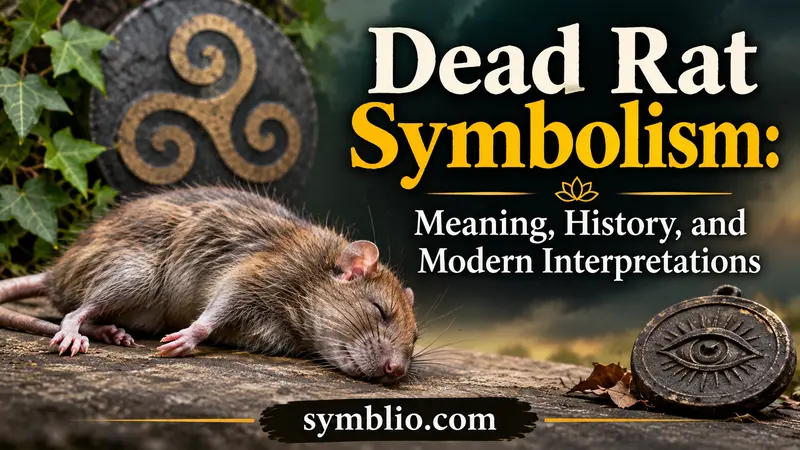
A dead rat is an unsettling sight that often attracts attention because rats are associated with survival, adaptability, disease, and human environments. When people encounter one in a dream, a story, a work of art, or an actual setting, they may wonder whether it represents something beyond its physical presence. Dead rat symbolism commonly centers on endings, neglect, hidden problems, betrayal, and the consequences of unhealthy situations.
Unlike symbols with widely established religious or ceremonial meanings, a dead rat does not have one universal interpretation. Its meaning depends on cultural associations with rats, the circumstances surrounding death, and the context in which the image appears.
In modern American culture, the image often suggests an unpleasant problem that can no longer be ignored. It can also represent the end of a difficult period, the exposure of something hidden, or the need to leave an unhealthy situation behind.
Quick Answer
Dead rat symbolism commonly represents endings, neglected problems, betrayal, decay, and the exposure of something unhealthy in modern American culture. In broader historical and folkloric contexts, it draws on older associations between rats, disease, survival, poverty, and the difficulties of living alongside human settlements.
TL;DR
- A dead rat often represents an ending or an unresolved problem.
- Historical associations connect rats with disease, poverty, and urban hardship.
- American interpretations frequently emphasize neglect, contamination, and unwanted situations.
- In dreams, the image may reflect anxiety or a desire for closure.
- In art, it can communicate decay, social criticism, or transformation.
- Its meaning depends on cultural background and personal context.
What a Dead Rat Looks Like and Where People Encounter It
A dead rat is usually represented as a small or medium-sized rodent lying motionless, sometimes in a street, building, basement, garden, or abandoned space. In symbolic images, it may appear alone, surrounded by rubbish, placed near a doorway, or shown in a neglected environment.
The setting often influences the interpretation more than the animal itself.
For example:
- A dead rat in a house may suggest domestic neglect or an uncomfortable situation.
- A dead rat in a street may represent urban decay or ignored social problems.
- A dead rat in an abandoned building may suggest something that has been forgotten.
- A dead rat in artwork may communicate criticism of unhealthy social conditions.
- A dead rat in a dream may reflect discomfort about a situation that feels unresolved.
These interpretations are cultural and personal associations rather than established rules. The image does not automatically predict an event or reveal something about the future.
The Core Symbolic Meanings of a Dead Rat
Several recurring ideas shape how people interpret this image.
Endings and closure: Death represents the end of life, so a dead rat can become a metaphor for something that has reached its conclusion. In a personal narrative, it might represent the end of a difficult relationship, an outdated habit, or a situation someone no longer wishes to tolerate.
Neglect and deterioration: Rats are frequently associated with places where sanitation and maintenance have been neglected. A dead rat can therefore represent the visible consequences of ignoring a problem.
Betrayal and broken trust: In stories and popular expressions, rats sometimes represent disloyalty or people who act deceptively. A dead rat may extend this association into an image of exposed dishonesty or a relationship that has lost its foundation.
Exposure of hidden problems: Rats are often imagined as creatures that move through concealed spaces. Their appearance in public can symbolize something previously unnoticed becoming visible.
Vulnerability and loss: A dead rat can also challenge the idea that survival and adaptability guarantee safety. Even an animal associated with resilience remains vulnerable to its surroundings.
These meanings are not interchangeable. The surrounding story, emotional atmosphere, and cultural background determine which interpretation makes the most sense.
Historical Origins of Rat Symbolism
Rats have lived alongside human communities for thousands of years. Their ability to find food, reproduce, and survive in different environments made them familiar animals in settlements, farms, markets, and cities.
This close relationship created conflicting attitudes.
On one hand, rats represented resourcefulness and intelligence. They could survive in places where other animals struggled. On the other hand, they damaged stored food, spoiled supplies, and sometimes caused serious agricultural and household problems.
In European societies, rats gradually became associated with poverty, crowded living conditions, and urban disorder. Their presence in buildings could indicate inadequate food storage or poor sanitation.
The association between rats and disease became especially influential during the nineteenth century, when developments in bacteriology changed scientific understanding of infectious illness. Popular accounts increasingly portrayed rats as dangerous carriers of disease.
However, the familiar story that rats were primarily responsible for spreading the Black Death across medieval Europe is more complicated than traditional accounts suggest. Recent historical research has questioned how central rats were to some major plague outbreaks and has examined how later narratives strengthened their reputation as epidemic villains. NCBI Bookshelf+2
A dead rat consequently acquired several overlapping associations: mortality, contamination, urban hardship, and the failure of human environments to remain healthy.
Why Death Changes the Meaning of the Rat
A living rat and a dead rat communicate different ideas.
A living rat may represent adaptability, quick thinking, survival, and the ability to find opportunities in difficult circumstances. Its behavior can make it a symbol of persistence.
Death changes that interpretation.
Instead of emphasizing survival, the image emphasizes its limits. The animal that once moved through hidden spaces becomes still and exposed. Its presence may suggest that a situation has reached an irreversible point.
This contrast creates several possible interpretations:
- Lost adaptability: A situation that once seemed manageable has become unsustainable.
- The end of survival: A person or organization can no longer continue under existing conditions.
- Visible consequences: A hidden problem has produced an outcome that cannot be ignored.
- The end of an unwanted presence: Something disruptive is no longer active, although its consequences may remain.
The distinction matters because a dead rat does not always represent something entirely negative. In a fictional story, for example, it might mark the end of a period of disorder. The surrounding circumstances determine whether that ending feels like relief, sadness, or warning.
Dead Rat Symbolism in American Culture
In the United States, rats have a complicated cultural reputation. They appear in city stories, public-health discussions, cartoons, films, literature, and everyday expressions.
American attitudes often connect rats with crowded urban environments, neglected buildings, damaged property, and sanitation problems. Their appearance in a residential or commercial space can become a sign that something requires attention.
A dead rat intensifies these associations because it introduces visible evidence of deterioration or an environmental problem.
In American storytelling, the image can serve several purposes.
Urban neglect: Writers and filmmakers may use a dead rat to establish an environment that feels abandoned, poorly maintained, or socially forgotten.
Broken trust: The familiar insult of calling someone a rat connects the animal with betrayal and disloyalty. A dead rat can become a visual metaphor for a dishonest character whose influence has ended.
The consequences of neglect: In social commentary, the image can suggest what happens when communities, buildings, or institutions ignore underlying problems.
The end of an unwanted situation: In a fictional setting, the death of a troublesome animal can represent the conclusion of a particular conflict.
These interpretations are especially relevant in American urban fiction and visual storytelling. They are cultural associations, not a universal belief that every dead rat carries a particular message.
Dead Rats in Different Cultural Traditions
The rat does not have the same reputation in every culture. Understanding this difference prevents a negative Western interpretation from being treated as universal.
Chinese cultural traditions
The rat occupies an important place in the Chinese zodiac, where it is the first animal in the twelve-year cycle. Traditional descriptions associate it with intelligence, agility, resourcefulness, and quick thinking.
The Metropolitan Museum of Art explains that the rat’s position in the zodiac developed from an established East Asian calendar tradition and became a familiar subject in art and folklore. The Metropolitan Museum of Art+1
In this cultural setting, a dead rat does not automatically inherit the positive meanings of the zodiac animal. Its death may instead introduce themes of loss, interruption, or the ending of a period of opportunity.
Japanese cultural traditions
Japanese folklore includes varied representations of rats. Their associations can involve cleverness, prosperity, and supernatural activity, depending on the particular story or tradition.
The rat’s connection with the god Daikokuten is also part of Japanese religious imagery, where rodents can appear as associated animals rather than simply unwanted pests.
Hindu traditions
In Hindu iconography, a mouse or rat is traditionally associated with Ganesha, the deity connected with wisdom, learning, and the removal of obstacles. The animal serves as his vehicle, known as a vahana.
This association gives the small rodent a religious and philosophical role that differs considerably from common American pest-related imagery.
European folklore
European folklore and literature have often represented rats negatively, particularly through associations with disease, household damage, poverty, and urban disorder. Later Gothic storytelling strengthened these darker impressions.
These differences show why the symbolism of a dead rat cannot be separated from the cultural meaning of the living animal.
Psychological and Emotional Interpretations
A dead rat can produce strong emotional reactions because it combines an animal that many people find unpleasant with the finality of death.
In symbolic interpretation, these reactions may connect with several emotional experiences.
Discomfort: The image may represent something a person finds difficult to accept or confront. It can stand for an uncomfortable truth, an unpleasant memory, or an unresolved disagreement.
Disappointment: When a rat represents survival or resourcefulness, its death can become an image of lost confidence or an opportunity that did not develop as expected.
Relief: In a story where rats represent persistent trouble, their disappearance may suggest that an unwanted situation has finally ended.
Disgust and rejection: The image can communicate a desire to distance oneself from an environment, behavior, or relationship perceived as unhealthy.
Grief and vulnerability: A dead animal can also remind viewers that living creatures are vulnerable. This interpretation is particularly relevant when the image is presented sympathetically rather than as a symbol of contamination.
Psychological interpretations should not be treated as diagnoses. A person’s reaction to an image depends on memories, experiences, cultural background, and individual feelings.
What a Dead Rat May Represent in Dreams
Dreams involving dead rats can feel unpleasant or confusing. People sometimes interpret them as signs of betrayal, difficult relationships, personal endings, or problems that have become impossible to ignore.
However, dreams do not have scientifically established universal symbolic meanings. A dead rat in a dream does not predict misfortune, reveal another person’s intentions, or guarantee that a particular event will occur.
The dream’s emotional atmosphere can offer a more useful starting point for personal reflection.
Seeing a dead rat: This image might bring attention to something uncomfortable that has been overlooked. It could also reflect ordinary memories or recent experiences involving rodents.
Finding a dead rat inside a house: The setting may connect with concerns about privacy, household responsibilities, or feeling uncomfortable in a familiar environment.
Seeing several dead rats: A group of dead animals may create an impression of widespread disorder or accumulated concerns. The number itself does not establish a special meaning.
Seeing a dead rat without feeling afraid: A calm reaction may suggest that the image is less threatening to the dreamer than its appearance initially implies.
Feeling disturbed by the image: The emotional response may reflect personal discomfort, recent stress, or an unpleasant memory.
Rather than searching for a fixed prediction, consider what the image reminds you of and whether anything in your everyday surroundings has influenced the dream.
Spiritual Interpretations and Religious Associations
Some spiritual interpretations treat dead animals as reminders of change, mortality, and the temporary nature of life. A dead rat may therefore be used as a metaphor for leaving an unhealthy situation, recognizing personal limitations, or reconsidering priorities.
However, there is no single established religious teaching that assigns a universal spiritual message to a dead rat.
In Christianity, death can carry broader associations with mortality, judgment, loss, and the possibility of renewal. Rats themselves do not have one universally accepted Christian meaning. Their interpretation often depends on the surrounding biblical passage, artwork, or later cultural tradition.
In Hindu traditions, the rat’s association with Ganesha offers a different perspective. The animal can represent the ability to navigate difficult circumstances and the relationship between a small creature and a deity associated with wisdom. Its death does not have a standardized religious interpretation.
In Chinese traditions, the rat’s zodiac position connects it with intelligence and resourcefulness, although the death of a rat may introduce a contrasting theme of loss.
It is important to distinguish established religious imagery from modern spiritual interpretations. Personal beliefs may give an image meaning, but an individual’s interpretation should not be presented as an official teaching shared by an entire religion.
Dead Rat Symbolism in Literature, Film, and Art
Artists and writers frequently use animals to communicate ideas that would otherwise require lengthy explanations. Rats are particularly useful because audiences already recognize their associations with cities, survival, fear, and human neglect.
A dead rat can communicate an atmosphere before a character even speaks.
In Gothic fiction, dead animals may establish an environment of deterioration or approaching danger. A dead rat can make a building seem neglected and suggest that its surroundings are no longer healthy or welcoming.
In social criticism, the image may represent the consequences of poor living conditions. It can draw attention to overcrowding, inadequate sanitation, or the unequal distribution of resources.
In political cartoons, rats sometimes represent corrupt individuals or institutions. A dead rat can suggest that a dishonest influence has been exposed or removed.
Modern street art sometimes reverses the traditional negative reputation of rats. Artists have used the animal to challenge conventional ideas about ugliness, exclusion, and social status. This artistic approach makes the rat a more complicated figure than a simple representation of disease. NCBI Bookshelf+1
The dead rat can therefore work as a visual contrast: an animal associated with persistence becomes an image of vulnerability and finality.
Positive and Negative Meanings Compared
Although the dead rat is generally associated with unpleasant ideas, its interpretation can change depending on the context.
| Context | Possible symbolic meaning | Emotional association |
|---|---|---|
| Personal storytelling | End of an unhealthy situation | Relief or closure |
| Urban imagery | Neglect and deterioration | Concern or discomfort |
| Literature | Exposure of hidden problems | Suspense or unease |
| Religious or cultural imagery | Mortality or loss | Reflection |
| Political artwork | End of corruption or harmful influence | Criticism or change |
| Dream interpretation | Personal concerns or unresolved feelings | Anxiety or uncertainty |
The table illustrates why the same image can communicate different ideas. Its meaning depends on the message being presented rather than the animal’s appearance alone.
Dead Rat Symbolism in Modern Fashion and Tattoos
Rats occasionally appear in tattoos, illustrations, alternative fashion, and unconventional artwork. Their appeal often comes from their associations with survival, intelligence, independence, and life outside conventional social expectations.
A living rat tattoo may communicate resourcefulness, resilience, or an interest in animals that are frequently misunderstood.
A dead rat design would usually communicate something different. It might represent:
- The conclusion of a difficult chapter.
- Rejection of dishonest behavior.
- A reminder of mortality and vulnerability.
- Criticism of neglect or unhealthy surroundings.
- An interest in Gothic or unconventional artistic imagery.
There is no widely standardized dead rat tattoo meaning. Someone choosing such a design may have a personal reason that has little connection with traditional interpretations.
In fashion and graphic design, the image can also create a deliberately uncomfortable contrast with polished or attractive surroundings. This approach appears in some alternative artistic styles, where challenging conventional ideas about beauty is part of the creative message.
Common Misunderstandings About Dead Rat Symbolism
Because dead rats have strong negative associations, people sometimes assume their appearance always represents something bad. Several misunderstandings are worth correcting.
It does not always represent betrayal. Although rats can symbolize disloyalty in popular language, a dead rat can also represent neglect, vulnerability, mortality, or the end of a difficult situation.
It is not automatically a bad omen. There is no reliable evidence that encountering a dead rat predicts an unfortunate event.
It does not have one universal religious meaning. Different traditions understand rats in different ways, and the animal’s death does not create a single shared spiritual interpretation.
It does not always represent personal transformation. Some modern interpretations connect death with change, but that reading depends on the story or personal context.
It is not always an artistic symbol. Sometimes a dead rat is simply an animal that has died. A real-world occurrence does not need a symbolic explanation.
Distinguishing ordinary events from symbolic interpretations helps prevent unnecessary fear and exaggerated conclusions.
How the Meaning Has Changed Over Time
The symbolic reputation of rats has changed considerably across different periods.
In earlier societies, rats were often understood through their practical relationship with people. They consumed stored food, damaged property, and lived close to human settlements. Their presence could represent household difficulties and economic hardship.
During the nineteenth century, scientific discoveries and changing public-health practices strengthened the association between rats and infectious disease. Newspapers, illustrations, and popular literature helped spread an increasingly negative image.
By the twentieth century, rats had become familiar figures in horror stories, urban fiction, political cartoons, and social commentary. Their reputation extended beyond physical problems to include dishonesty, corruption, and unwanted social behavior.
Contemporary art has sometimes challenged this reputation by presenting rats as intelligent survivors or symbols of people excluded from mainstream society.
The dead rat consequently carries several layers of meaning. Older associations with household damage and disease remain influential, while modern interpretations also explore vulnerability, endings, and social criticism.
What to Consider When Interpreting a Real Dead Rat
Not every dead rat needs a symbolic interpretation. In everyday life, its presence is more likely to have a practical explanation involving its surroundings, health, or environmental conditions.
If someone encounters a dead rat near a home, workplace, or public building, the sensible response is to treat it as an ordinary sanitation concern rather than an omen.
Avoid touching the animal. Keep children and pets away, and tell a responsible adult, property manager, or appropriate local sanitation service so the situation can be handled safely.
This distinction is important because symbolic interpretations belong to culture, literature, and personal reflection. A real dead animal should first be understood as an environmental matter.
FAQs
Some modern spiritual interpretations associate a dead rat with endings, personal reflection, and leaving unhealthy circumstances behind. However, these are personal interpretations rather than universal religious teachings.
No established evidence shows that seeing a dead rat predicts bad luck or future events. Its negative reputation comes mainly from cultural associations with disease, neglect, and urban hardship.
A dead rat in a dream may be interpreted as an image of unresolved concerns, discomfort, or the end of an unpleasant situation. Dreams do not have fixed meanings, so personal experiences and emotions matter more than a universal interpretation.
Christian interpretations may connect the image with broader themes of mortality, loss, or spiritual reflection. However, Christianity does not establish one universal symbolic meaning for a dead rat.
It can serve as a metaphor for ending an unhealthy relationship in modern personal storytelling. This is a contemporary symbolic interpretation, not a traditional rule or prediction.
Rats became strongly associated with disease through historical experiences, public-health developments, and popular representations of plague. Their connection with damaged food supplies and crowded living conditions also contributed to their negative reputation.
Yes. In literature and personal symbolism, it can represent the end of an unwanted situation, the exposure of a hidden problem, or the conclusion of a difficult chapter. Its interpretation depends on the surrounding circumstances.
Conclusion
Dead rat symbolism brings together several ideas, including endings, neglect, vulnerability, betrayal, and the exposure of hidden problems. Its negative reputation developed through historical relationships between rats, human settlements, damaged food supplies, and disease, but different cultures have also associated living rats with intelligence, resourcefulness, and prosperity.
In modern American culture, the image most commonly suggests an unpleasant situation or an environmental problem that can no longer be overlooked. In literature and art, however, it can communicate social criticism, personal closure, or the vulnerability of living creatures.
Ultimately, dead rat symbolism does not carry one permanent meaning. Its interpretation becomes clearer when people consider the cultural background, setting, and message surrounding the image.