The Joshua tree is one of the most recognizable plants of the American Southwest. With its unusual branching shape, spiky leaves, and ability to survive in harsh desert conditions, it has become closely associated with resilience, endurance, independence, and hope. Joshua tree symbolism reflects the relationship between survival and strength, particularly in places where water, shelter, and other resources are limited.
Native to the Mojave Desert, the Joshua tree is not an ordinary tree. It belongs to the yucca family and grows slowly in an environment where extreme temperatures, limited rainfall, and poor soil challenge many forms of plant life. Its distinctive appearance has inspired artists, photographers, travelers, and people who feel connected to the American desert.
In modern American culture, the Joshua tree represents more than desert scenery. People associate it with personal independence, environmental protection, spiritual reflection, and the ability to keep growing through difficult circumstances. Its meaning also connects to regional history, Indigenous relationships with desert plants, and the changing landscape of the American West.
Quick Answer
Joshua tree symbolism commonly represents resilience, survival, independence, and hope in modern American culture, especially through its ability to grow in the demanding Mojave Desert. It also carries associations with faith, guidance, spiritual reflection, and the relationship between people and the natural environment.
TL;DR
- Represents resilience and survival in difficult conditions.
- Reflects independence, adaptability, and personal endurance.
- Connects strongly with the Mojave Desert and American Southwest.
- Carries historical associations with faith and westward migration.
- Appears in modern art, tattoos, photography, and environmental awareness.
- Reminds people of the importance of protecting fragile desert ecosystems.
What Does the Joshua Tree Look Like?
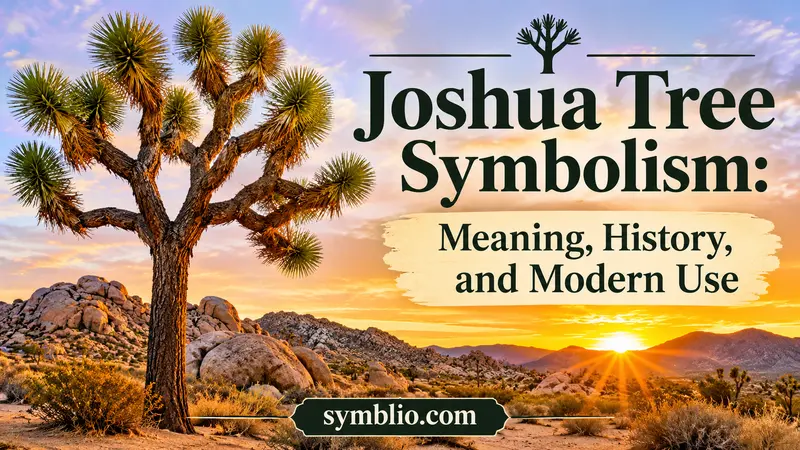
The Joshua tree (Yucca brevifolia) is an evergreen plant with a distinctive silhouette. Instead of developing a conventional rounded canopy, it produces thick branches that divide into unusual shapes. Clusters of stiff, pointed leaves grow near the ends of its branches, creating a form that can resemble an outstretched arm or a figure reaching toward the sky.
Joshua trees generally grow in the Mojave Desert, particularly in California, Nevada, Utah, and Arizona. Their appearance varies with age, growing conditions, and environmental history. Some develop multiple branches, while younger specimens may have a single upright trunk.
The plant’s unusual structure explains much of its visual symbolism. Its upward-reaching branches suggest aspiration and determination, while its ability to remain rooted in dry ground represents stability.
Unlike a conventional tree, the Joshua tree has an appearance that seems almost sculptural. This makes it especially recognizable in landscape photography, paintings, travel imagery, and Southwestern decorative design.
The Core Symbolism of the Joshua Tree
The Joshua tree carries several related meanings, but resilience is its most recognizable modern association. Its survival in an environment with limited rainfall provides a natural example of endurance without suggesting that difficult circumstances are easy.
Its symbolism commonly includes:
- Resilience: Continuing to grow despite environmental challenges.
- Survival: Making use of limited resources in demanding conditions.
- Independence: Standing distinctly within an open desert landscape.
- Hope: Representing the possibility of growth after difficult periods.
- Faith: Reaching upward in a way that invites spiritual interpretation.
- Adaptability: Responding to changing environmental conditions.
These meanings are interpretations rather than scientifically established qualities of the plant. Its biological adaptations provide the foundation for the symbolism, while individual experiences and cultural traditions influence how people understand it.
Why the Joshua Tree Symbolizes Resilience
Resilience is closely connected to the Joshua tree because of the environment in which it grows. The Mojave Desert experiences long dry periods, intense sunlight, temperature fluctuations, and limited water availability.
The Joshua tree has developed characteristics that help it live under these conditions. Its growth is relatively slow, and its survival depends on relationships with the surrounding desert ecosystem.
Its growth pattern also makes resilience a useful metaphor. A Joshua tree does not necessarily develop in a straight or predictable direction. Its branches divide and extend according to environmental conditions, creating individual shapes over time.
People often connect this appearance with personal experiences. Someone recovering from a difficult period may see the tree as a reminder that progress does not always follow a smooth path. Growth can be gradual, irregular, and still meaningful.
For this reason, the Joshua tree has become a natural image of persistence in American art and personal expression.
Historical Origins of Its Name and Symbolism
The name Joshua tree is commonly connected with Mormon settlers who traveled through the southwestern United States during the nineteenth century. According to a widely repeated historical account, these travelers associated the plant’s unusual branches with the biblical figure Joshua raising his arms toward the heavens.
This explanation connects the plant with prayer, guidance, and faith. The upward-reaching branches appeared to resemble a person directing travelers toward a higher power.
The exact circumstances surrounding the naming are not fully documented, so the story is best understood as a traditional explanation rather than a proven account of one specific naming event.
The plant’s name also reflects the religious and cultural perspectives of particular American settlers. It does not establish that the Joshua tree originally belonged to a Christian symbolic tradition. Indigenous communities had relationships with the plant and the surrounding desert long before the name became familiar to settlers.
Over time, the name helped establish the Joshua tree as an identifiable feature of the American West.
Indigenous Relationships With the Joshua Tree
The Joshua tree has a cultural history that extends far beyond its association with nineteenth-century settlers. Indigenous communities have lived in and traveled through the Mojave Desert for thousands of years, developing practical knowledge of its plants, animals, water sources, and seasonal conditions.
The Serrano, Cahuilla, Chemehuevi, and Mojave peoples have traditional connections to the region now included within Joshua Tree National Park. For these communities, desert plants were part of everyday life, food systems, craftsmanship, and relationships with the land.
The Cahuilla used Joshua tree leaves to make sandals, baskets, and other useful objects. The flower buds and seeds also provided food. These uses demonstrate an important dimension of the plant’s cultural importance: it was a practical resource rather than simply a visual feature of the landscape.
This history offers a different way to understand the Joshua tree. Its significance includes knowledge, resourcefulness, continuity, and the ability of communities to live in relationship with a challenging environment.
It is important not to assign one universal spiritual meaning to all Indigenous communities. Each nation has its own history, language, and cultural knowledge. Respectful interpretation recognizes these differences instead of treating Indigenous traditions as a single belief system.
Joshua Tree Symbolism in American Culture
In the United States, the Joshua tree has become an identifiable symbol of the Southwest. Its distinctive outline appears in landscape photography, travel advertising, artwork, outdoor clothing, and decorative designs inspired by desert life.
For many Americans, it represents the open spaces and independent spirit associated with the American West. The tree’s unusual shape distinguishes it from familiar eastern woodland trees and makes it an instantly recognizable feature of the Mojave landscape.
Its association with Joshua Tree National Park has also strengthened its cultural identity. Established as a national monument in 1936, the protected area became a destination for people interested in desert scenery, geology, wildlife, hiking, and outdoor recreation.
The plant now communicates several ideas in American visual culture:
- Western identity: A recognizable feature of the American Southwest.
- Freedom: An association with open landscapes and independent travel.
- Environmental awareness: A reminder that desert ecosystems deserve protection.
- Individuality: An unusual natural form that stands apart from familiar trees.
- Adventure: A visual connection with road trips, camping, and exploration.
These meanings are not necessarily shared by everyone. A person who grew up near the Mojave Desert may associate the tree with home, while someone encountering it for the first time may connect it with travel and discovery.
The Spiritual Meaning of the Joshua Tree
The Joshua tree can carry spiritual associations, particularly because of its name and upward-reaching branches.
The traditional explanation connecting its name with the biblical Joshua has encouraged interpretations involving prayer, divine guidance, faith, and direction. In this reading, the branches appear to reach toward heaven, suggesting a relationship between earthly life and spiritual belief.
For some Christians, the tree can serve as a reminder of perseverance, trust, and continuing forward during uncertain periods. Its presence in an unforgiving landscape may also encourage reflection on the relationship between faith and endurance.
However, the Joshua tree is not a universally recognized religious symbol. Its spiritual meaning depends on the beliefs and experiences of the person interpreting it.
People without a particular religious affiliation may also find spiritual meaning in its appearance. The quiet desert setting, open horizon, and unusual branches can encourage contemplation and appreciation of nature.
Hope, Guidance, and New Beginnings
The Joshua tree is sometimes interpreted as a symbol of hope because it grows in a landscape that can initially appear empty or inhospitable.
Its presence offers a visual reminder that life can continue under demanding circumstances. This association makes it meaningful to people experiencing major life changes, including moving to a new place, beginning a different career, or recovering confidence after a challenging period.
Its branches also contribute to the symbolism of guidance. The traditional naming story presents the tree as resembling a figure directing travelers toward a destination. Modern interpretations often extend this idea to finding direction during uncertain moments.
New beginnings are another possible association. A young Joshua tree may represent the early stages of development, while a mature specimen can suggest the results of patience and long-term growth.
These interpretations are personal rather than fixed. The plant does not promise that every difficult situation will have an easy outcome. Instead, it provides a natural image through which people can express hope and determination.
Emotional and Psychological Meaning
The Joshua tree can communicate emotions that are difficult to express through ordinary decorative imagery. Its unusual form combines vulnerability and strength: its branches look exposed against the desert sky, yet the plant remains part of an established ecosystem.
This contrast can create several emotional associations.
Independence and self-reliance: A Joshua tree standing in an open desert landscape can suggest confidence and individuality. People who value independence may identify with its distinctive appearance.
Patience and acceptance: Its relatively slow growth encourages an interpretation of progress that does not depend on immediate results.
Solitude and reflection: The wide desert landscape surrounding the tree can represent quietness, personal space, and time away from everyday distractions.
Belonging and connection: For people with family memories or personal experiences in the Southwest, the tree may represent a particular place and a sense of home.
Adaptability: Its survival in an environment with changing conditions can serve as a reminder that flexibility matters when circumstances change.
Psychologically, the tree’s meaning often comes from the relationship between its appearance and the viewer’s experiences. Someone who associates the desert with freedom may interpret it differently from someone who connects it with loneliness or isolation.
What the Joshua Tree Represents in Nature and Environmental Awareness
The Joshua tree is more than an attractive desert landmark. It plays an important role in the Mojave ecosystem, providing habitat and ecological connections for other living organisms.
Its relationship with the yucca moth is especially important. Joshua trees depend on specialized moths for pollination, while the moths rely on the flowers to complete their reproductive cycle. This relationship demonstrates how closely connected different species can be.
The tree’s environmental meaning has become increasingly relevant as researchers study climate change, habitat conditions, and the future distribution of desert plants.
Rising temperatures, changing rainfall patterns, and wildfires can affect the conditions Joshua trees need to survive and reproduce. Young plants may face particular challenges when suitable growing conditions become less available.
Consequently, the Joshua tree has become an important image in conversations about conservation and environmental responsibility.
For Americans, protecting this plant can represent a broader commitment to preserving natural landmarks, biodiversity, and the landscapes that give different regions their identity.
The Joshua Tree in Tattoos and Personal Style
The Joshua tree is a popular visual choice for people who want nature-inspired artwork with a connection to the American Southwest.
In tattoo culture, the tree’s unusual silhouette makes it recognizable even when represented with simple lines. Artists can portray it as a single tree, a desert landscape, or a larger composition featuring mountains, a setting sun, and distant horizons.
Common personal interpretations include:
- Resilience tattoo: A reminder of continuing through challenging circumstances.
- Independence tattoo: An expression of individuality and personal identity.
- Faith tattoo: A visual connection with spiritual guidance and perseverance.
- Nature tattoo: An appreciation for desert landscapes and environmental protection.
- Travel tattoo: A permanent reminder of a meaningful experience in the American Southwest.
Some people choose the design because they visited Joshua Tree National Park, while others simply appreciate its unusual natural shape.
The tattoo does not have one established meaning. Its significance usually comes from the story, memory, or personal value the wearer associates with it.
Joshua Tree Imagery in Art, Photography, and Home Decor
The Joshua tree’s recognizable shape makes it particularly suitable for visual art. Its irregular branches create strong outlines against open skies, while its surroundings offer natural contrasts between desert soil, distant mountains, and changing light.
In American photography, Joshua trees frequently appear in images of sunrise, sunset, star-filled skies, and expansive desert scenery. These compositions often communicate solitude, exploration, and appreciation of nature.
In home decor, Joshua tree designs are often associated with Southwestern interiors. They may appear in:
- Botanical prints and framed landscape photographs.
- Ceramic decorations and handmade pottery.
- Desert-inspired textiles and cushions.
- Minimalist wall illustrations.
- Travel posters and vintage-style artwork.
The tree’s distinctive silhouette works particularly well in minimalist designs because it remains recognizable without extensive detail.
In this setting, it can communicate an appreciation for natural landscapes, simplicity, and regional identity rather than a specific spiritual belief.
Cross-Cultural and Religious Interpretations
Joshua tree symbolism should be understood within its geographical and historical context. Unlike internationally established symbols such as the lotus or olive branch, the Joshua tree does not have one widely recognized meaning across different world religions.
Its best-known religious association comes from the biblical Joshua and the traditional story behind its English name. This connection is primarily part of American regional history rather than an ancient religious tradition surrounding the plant itself.
Indigenous relationships with the tree provide another important cultural perspective. The Cahuilla, Serrano, Chemehuevi, and Mojave communities have distinct histories connected to the desert environment.
Their relationships with Joshua trees include traditional knowledge and practical uses that cannot be reduced to a single symbolic interpretation.
In other parts of the world, people may interpret the Joshua tree through general associations with desert survival, unusual plant forms, or American landscapes. These interpretations should not be confused with established religious traditions.
Negative Symbolism and Common Misunderstandings
The Joshua tree is generally associated with positive meanings, but its appearance can also communicate more complicated emotions.
Its isolated position in a wide desert landscape may suggest loneliness, distance, or emotional separation. Its spiky leaves and irregular branches can create an impression of harshness or defensiveness.
These interpretations do not make the tree a negative symbol. They simply demonstrate how visual context influences meaning.
Several misunderstandings are also worth correcting.
The tree is not a universal religious symbol. Its biblical name has encouraged Christian interpretations, but people do not need to follow a particular religion to appreciate it.
Its historical name is not completely verified. The Mormon pioneer explanation is widely repeated, but historical records do not establish the story conclusively.
Indigenous cultural relationships are not interchangeable. Different communities have their own names, practices, and histories connected to the region.
The tree does not represent every desert ecosystem. It is especially associated with the Mojave Desert and has particular ecological requirements.
A balanced interpretation recognizes the tree’s historical associations without treating popular stories as established facts.
How Joshua Tree Symbolism Has Changed Over Time
The meaning of the Joshua tree has developed through several stages of American history.
Before European settlement, Indigenous communities understood the plant through its practical and cultural relationships with the desert. Its leaves, flowers, and seeds contributed to everyday life.
During the nineteenth century, the name Joshua introduced a biblical association that connected the plant with faith, direction, and westward travel. This interpretation became part of its popular American identity, although the naming story remains uncertain. National Park Service+1
During the twentieth century, conservation efforts and the establishment of Joshua Tree National Monument in 1936 helped strengthen its identity as a symbol of the American desert.
Today, the tree carries several overlapping meanings. It represents personal resilience, regional identity, environmental responsibility, artistic inspiration, and the importance of protecting natural landscapes.
Its symbolism continues to evolve as people encounter it through travel, photography, environmental education, and personal experiences.
Joshua Tree Symbolism Across Different Contexts
The meaning of a Joshua tree can change depending on where it appears and why someone chooses to use its image.
| Context | Meaning in the USA | Common Associations |
|---|---|---|
| Spirituality | Faith and guidance | Prayer, direction, reflection |
| Personal growth | Resilience and patience | Endurance, adaptability |
| Tattoos | Individual identity | Independence, meaningful memories |
| Nature and conservation | Environmental protection | Biodiversity, preservation |
| Art and decor | Southwestern identity | Freedom, simplicity, natural beauty |
This comparison shows why the Joshua tree appeals to different audiences. Its meaning can be personal, cultural, environmental, or artistic without requiring one interpretation to replace the others.
FAQs
The Joshua tree can symbolize faith, guidance, prayer, and spiritual perseverance. These associations are commonly connected to the traditional story linking its name with the biblical Joshua.
Yes. Its ability to grow in the challenging Mojave Desert makes it a natural representation of resilience, endurance, and adaptability. People often use its image to express the importance of continuing through difficult circumstances.
A Joshua tree tattoo often represents independence, survival, personal growth, or a connection with the American Southwest. For some people, it also commemorates a meaningful visit to Joshua Tree National Park.
A popular explanation says nineteenth-century Mormon settlers thought its raised branches resembled the biblical Joshua directing travelers toward the promised land. However, historical evidence does not conclusively establish this naming story.
Yes. Indigenous communities, including the Cahuilla, Serrano, Chemehuevi, and Mojave peoples, have longstanding relationships with the region and its plant life. The Cahuilla traditionally used Joshua tree leaves for weaving and used its flowers and seeds as food.
It can represent hope because it continues growing in a demanding desert environment. People may associate its survival with patience, optimism, and the possibility of making progress during difficult periods.
Its most common interpretations are positive, including resilience, independence, faith, and environmental awareness. However, its isolated appearance can also suggest loneliness or solitude, depending on the viewer’s perspective.
Conclusion
The Joshua tree represents resilience, survival, independence, and hope in modern American culture. Its unusual shape and ability to live in the demanding Mojave Desert have made it an enduring image of strength and adaptability. Its historical associations with faith and guidance add another dimension to its meaning.
Understanding Joshua tree symbolism also requires recognizing its Indigenous history, ecological importance, and place in the American Southwest. It is more than a decorative desert plant; it represents relationships between people, landscapes, history, and the natural world.
Ultimately, the Joshua tree reminds us that growth does not always follow a straight path. Sometimes, the most recognizable signs of endurance are found in the places where survival requires the greatest patience.